Iain Finlayson - Browning
Здесь есть возможность читать онлайн «Iain Finlayson - Browning» — ознакомительный отрывок электронной книги совершенно бесплатно, а после прочтения отрывка купить полную версию. В некоторых случаях можно слушать аудио, скачать через торрент в формате fb2 и присутствует краткое содержание. Жанр: unrecognised, на английском языке. Описание произведения, (предисловие) а так же отзывы посетителей доступны на портале библиотеки ЛибКат.
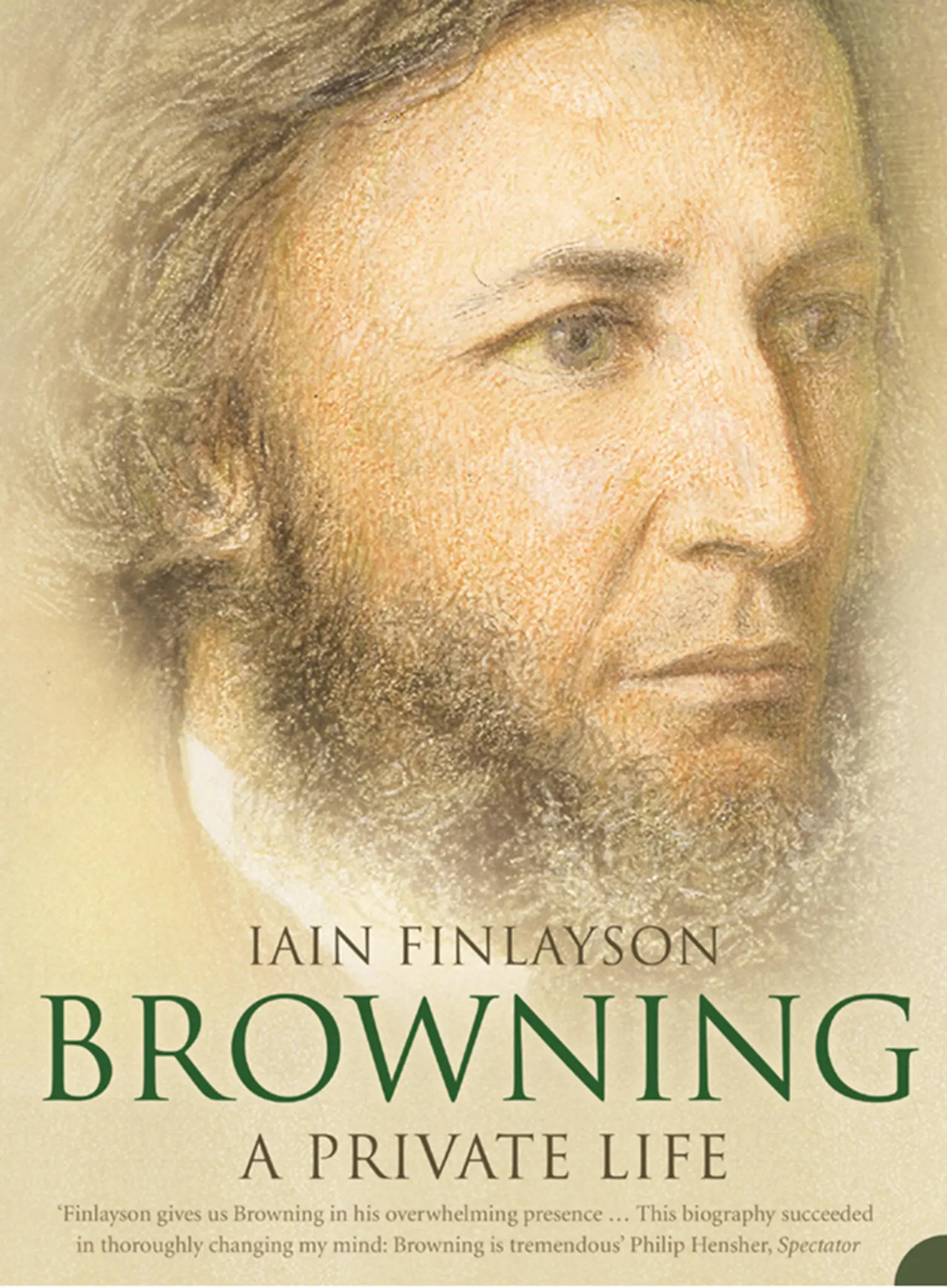
- Название:Browning
- Автор:
- Жанр:
- Год:неизвестен
- ISBN:нет данных
- Рейтинг книги:5 / 5. Голосов: 1
-
Избранное:Добавить в избранное
- Отзывы:
-
Ваша оценка:
Browning: краткое содержание, описание и аннотация
Предлагаем к чтению аннотацию, описание, краткое содержание или предисловие (зависит от того, что написал сам автор книги «Browning»). Если вы не нашли необходимую информацию о книге — напишите в комментариях, мы постараемся отыскать её.
Browning — читать онлайн ознакомительный отрывок
Ниже представлен текст книги, разбитый по страницам. Система сохранения места последней прочитанной страницы, позволяет с удобством читать онлайн бесплатно книгу «Browning», без необходимости каждый раз заново искать на чём Вы остановились. Поставьте закладку, и сможете в любой момент перейти на страницу, на которой закончили чтение.
Интервал:
Закладка:
Which begs a question about the condition of his own heart: love, remarks Mrs Orr very astutely at this point, had played a noticeably small part in Robert’s life. His adolescent feelings of affection for Eliza Flower were never very serious, nor likely to be taken very seriously, considering her long-standing devotion to William Fox. No woman—so far as we know from the scant evidence remaining of Robert’s early years—detained his romantic attention or redirected it from the affection he maintained for his mother. Nobody else, for the time being, could count on being kissed goodnight every night by Robert Browning. Mrs Orr suggests that, in the absence of any personal experience of ‘wild and passionate love’, Robert turned to Fanny Haworth to supply the deficit, though what he supposed she might know of it is beyond conjecture. There was a lively sympathy, but no romantic feeling, between Robert and Fanny, and it would certainly have been indelicate, if not improper, for him to inquire too closely into the passions of an older, unmarried woman living cloistered at home with her mother. In a letter of April 1839, he tells Fanny direct, ‘Do you know I was, and am, an Improvisatore of the head —not of the hort [ sic ] …—not you!’
In March 1840, Edward Moxon, at the expense of Robert’s father, published Sordello —‘that colossal derelict upon the ocean of poetry’, as even the partisan William Sharp is obliged to describe the poem. Alfred Tennyson read the first line:
Who will, may hear Sordello’s story told,
and finally he read the last line:
Who would, has read Sordello’s story told,
whereupon he famously said that the first line and the last line were the only two lines of the poem that he understood and they were lies since nothing in between made any sense to him. Douglas Jerrold, at the time a well-known playwright and later an original staff member and contributor to Punch , is said to have started reading Sordello while recuperating from illness. No sooner had he picked up the book than he put it down, saying, ‘My God! I’m an idiot. My health is restored, but my mind’s gone. I can’t understand two consecutive lines of an English poem.’ He called his family to his bedside and gave them the poem to read. When they sadly shook their heads and could make no more of it than he could himself, he heaved a sigh of relief and, confirmed in his sanity, went to sleep. Thomas Carlyle wrote to say that he had read Sordello with great interest but that Jane, his wife, wished to know whether Sordello was a man, a city or a book. 82
It is as well to get these three memorably funny stories dusted off at the start. They live forever in Browning’s life and legend, not just because they are sharply humorous or because they comfort our own confusion on reading the poem with the satisfaction of knowing that it confounded even the greatest intellects of its time, but also because they express a genuine, general bewilderment that explanations by critics of the poem’s form and expositions by researchers of the poem’s references have not wholly redeemed. Sordello has been incorporated into the fabric of English literature, but—still and all—its reputation persists, unfairly say some modern revisionary critics, as a notoriously difficult work, a monument to obscurity and a testament to tedium.
Robert Browning himself, says Sharp, came to be resigned to the shortcomings of Sordello as an accessible work of art: years later, ‘on his introduction to the Chinese Ambassador, as a “brother-poet”, he asked that dignitary what kind of poetic expression he particularly affected. The great man deliberated, and then replied that his poetry might be defined as “enigmatic.” Browning at once admitted his fraternal kinship.’ Sharp adds, rather nicely, that Browning’s holograph dedication of a copy of Sordello to a later friend, the French critic Joseph Milsand, read: ‘My own faults of expression were many; but with care for a man or book such would be surmounted, and without it what avails the faultlessness of either? I blame nobody, least of all myself, who did my best then or since.’
That was—and remains—simply true. George Santayana, in an essay, ‘The Poetry of Barbarism’, declares that if we are to do justice to Browning’s poetry, we must keep two things in mind: ‘One is the genuineness of the achievement, the sterling quality of the vision and inspiration; these are their own justification when we approach them from below and regard them as manifesting a more direct or impassioned glimpse of experience than is given to mildly blatant, convention-ridden minds. The other thing to remember is the short distance to which this comprehension is carried, its failure to approach any kind of finality, or to achieve a recognition even of the traditional ideals of poetry and religion.’ This latter qualification is now more disputed than the preceding encomium.
However, the estimation of Browning’s contemporaries was naturally foreshortened by the immediate, looming presence of Sordello , which had not then achieved the longer perspective of later critical perception nor the farther horizon of literary history. It was right under their noses. Sharp 83 characterizes the poem as ‘a gigantic effort, of a kind; so is the sustained throe of a wrestling Titan’. He compares its monotony to ‘one of the enormous American inland seas to a lover of the ocean, to whom the salt brine is as the breath of delight’—which is a pretty way of dressing up the word ‘stagnant’. He regrets the ‘fatal facility of the heroic couplet to lapse into diffuseness’ and this, ‘coupled with a warped anxiety for irreducible concision, has been Browning’s ruin here’. Nevertheless, on the charge of Sordello ’s obscurity, Sharp admits that ‘its motive thought is not obscure. It is a moonlit plain compared to the “ silva oscura ” of the “Divina Commedia”’—a tract of open country compared to Dante’s ‘dark wood’.
It is irresistible, though irreverent, to think of comparing Sordello to the smuggler’s ship that Robert came across on his voyage to Italy: the poem first setting sail on publication, heavily armed with emotion and erudition, fully ballasted with all the approved poetic paraphernalia, confident of successfully accosting and overwhelming readers and critics that cross its path, foundering on the unexpected obstacle of public bewilderment and upturned by a sudden storm of critical abuse, all hands dead, wounded, lost in attitudes of frightful prayer, finally righting itself and—with an ineffably battered dignity—turning to look mutely, uncomprehendingly at those critic-surgeons who butchered it and cast it adrift, reeling off into the sunset like a ‘mutilated creature’. It is a painful metaphor for the unsuspected end of a brave adventure.
As Chesterton remarks, 84 Sordello is almost unique in literary history, in the sense that praise or blame hardly figured in its reception: both were overwhelmed by an almighty, universal incomprehension that stopped informed criticism in its tracks. ‘There had been authors whom it was fashionable to boast of admiring and authors whom it was fashionable to boast of despising; but with Sordello enters into literary history the Browning of popular badinage, the author whom it is fashionable to boast of not understanding.’ So far in his career, Robert’s reputation as a poet and playwright had seemed to be advancing much in step with those of his contemporaries. Pauline had fallen stillborn and anonymously from the press, but since nobody had noticed, nobody had heard the dull thud, its failure made no difficulties, and it had had the useful result of attracting the interested attention and positive regard of William Johnson Fox. Paracelsus had obtained a reasonable critical reception, though the poem itself had not sold out its first edition; and Strafford had been received with general enthusiasm, though how it would have fared in a longer theatrical run could never be known. So far, so good, all things considered: one undoubted failure, two moderate successes, nothing to be ashamed of (though Pauline remained decently veiled and in a permanent purdah). But Sordello suddenly blighted this promise in the bud.
Читать дальшеИнтервал:
Закладка:
Похожие книги на «Browning»
Представляем Вашему вниманию похожие книги на «Browning» списком для выбора. Мы отобрали схожую по названию и смыслу литературу в надежде предоставить читателям больше вариантов отыскать новые, интересные, ещё непрочитанные произведения.



Обсуждение, отзывы о книге «Browning» и просто собственные мнения читателей. Оставьте ваши комментарии, напишите, что Вы думаете о произведении, его смысле или главных героях. Укажите что конкретно понравилось, а что нет, и почему Вы так считаете.