Iain Finlayson - Browning
Здесь есть возможность читать онлайн «Iain Finlayson - Browning» — ознакомительный отрывок электронной книги совершенно бесплатно, а после прочтения отрывка купить полную версию. В некоторых случаях можно слушать аудио, скачать через торрент в формате fb2 и присутствует краткое содержание. Жанр: unrecognised, на английском языке. Описание произведения, (предисловие) а так же отзывы посетителей доступны на портале библиотеки ЛибКат.
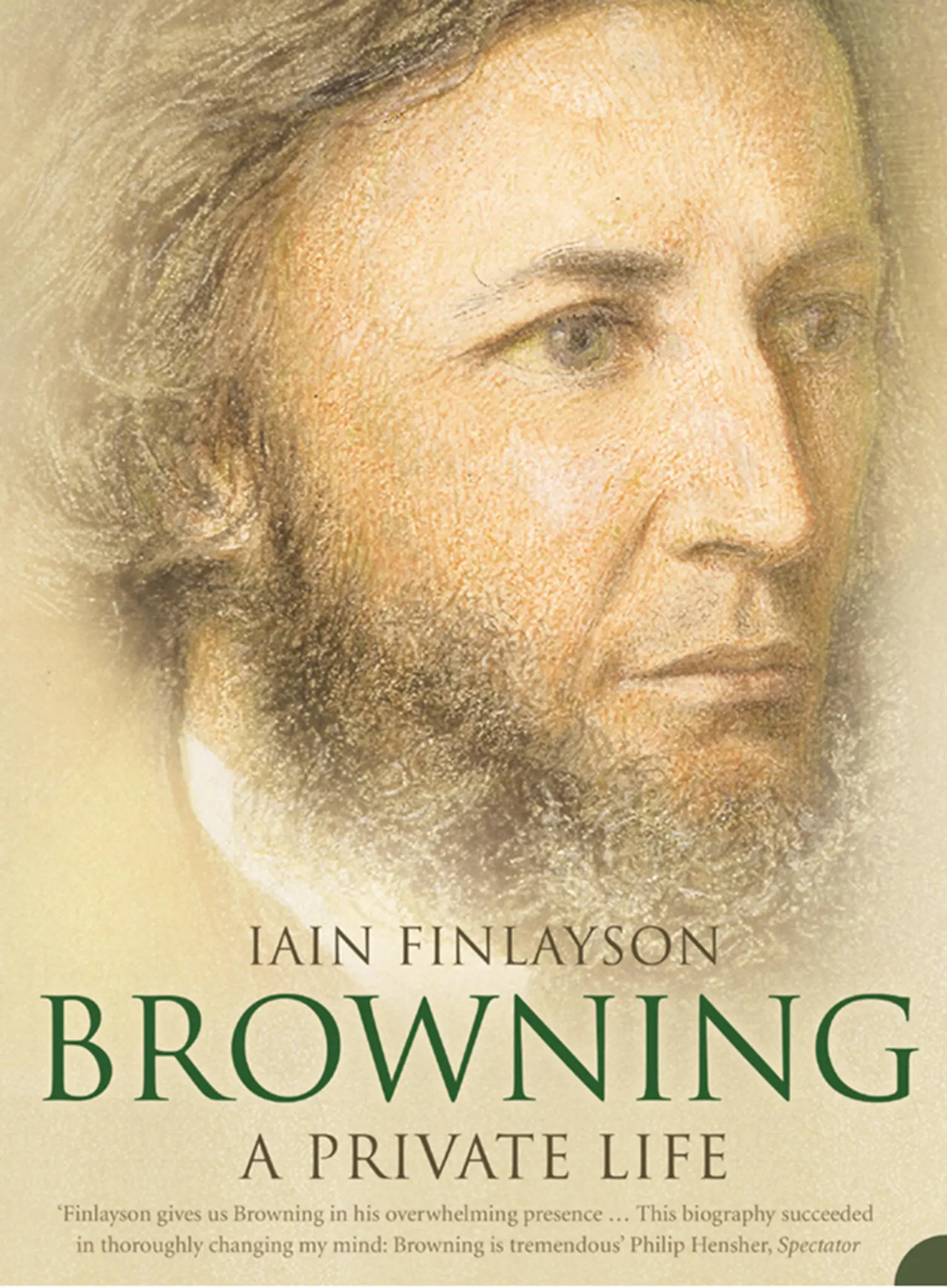
- Название:Browning
- Автор:
- Жанр:
- Год:неизвестен
- ISBN:нет данных
- Рейтинг книги:5 / 5. Голосов: 1
-
Избранное:Добавить в избранное
- Отзывы:
-
Ваша оценка:
Browning: краткое содержание, описание и аннотация
Предлагаем к чтению аннотацию, описание, краткое содержание или предисловие (зависит от того, что написал сам автор книги «Browning»). Если вы не нашли необходимую информацию о книге — напишите в комментариях, мы постараемся отыскать её.
Browning — читать онлайн ознакомительный отрывок
Ниже представлен текст книги, разбитый по страницам. Система сохранения места последней прочитанной страницы, позволяет с удобством читать онлайн бесплатно книгу «Browning», без необходимости каждый раз заново искать на чём Вы остановились. Поставьте закладку, и сможете в любой момент перейти на страницу, на которой закончили чтение.
Интервал:
Закладка:
The exceptions were very likely Miss Faucit as Lady Carlisle and Macready as Strafford. Both had acquitted themselves well; she tender and affectingly pathetic, he majestic in bearing and bearded to resemble a Vandyke courtier of the period. Mr Vandenhoff as Pym had taken a purely perfunctory interest in his part, which he reportedly played with a nauseating, whining drawl; Mr Dale as Charles I was deaf as a post; and ‘The Younger Vane’, says Sharp, ‘ranted so that a hiss, like an embodied scorn, vibrated on vagrant wings throughout the house’. 72 The part of the Queen, Henrietta Maria, was taken by Miss Vincent, fresh from her triumph at Drury Lane where she had played with Burmese bulls to the greatest satisfaction of her audiences. It was thus all the more to the credit of the play itself that it transcended these ignoble obstacles. The second night, when Robert sat ‘muffled up in the pit to feel the pulse of the audience’, 73 the house received the play with warm-enough applause.
And so on through to the fourth night’s ‘fervid applause’ from an ‘admirably filled house’ and playbills announcing two further performances, one of which took place as advertised, the second fatally handicapped by the absence of Vandenhoff, who, having secured a better offer in America, jumped stage and took ship. He failed to turn up to play the important part of Pym, Strafford’s principal antagonist. The performance was cancelled. The play’s run was terminated. The precarious financial condition of the Covent Garden theatre collapsed entirely, and the promising young author, for his pains, got not a penny of his promised reward of £12 for even four, five, far less the projected first twenty-five nights, and he might whistle forever for the £10 for each of the ten nights further envisioned.
It was something, however, never mind if Robert had made little or no money from the play’s performances, that Longman had at least published the text of his play on the occasion of the first night of Strafford , 1 May. The Brownings had not been required to dip into their own purse to pay for the honour, though neither the book nor the play brought any profit to either party. Five months later, Macready took over the management of the Covent Garden theatre from Osbaldistone with a troupe of good actors, and for two years thereafter indulged his mission and pursued his ambition to improve the English stage. Robert himself stuck for a decent while to the vow of renunciation he had made in the hearing of Eliza Flower: it was to be six years before he next ventured near a stage or a theatre except as a regular spectator.
The blank verse tragedy that was Strafford took as its principal character the English statesman Sir Thomas Wentworth, first Earl of Strafford (1593–1641), who from 1639 was chief adviser to Charles I. In 1640, Strafford was impeached by the House of Commons. On a Bill of Attainder, and with the assent of the king, he was executed on Tower Hill. The action, such as it is, of Browning’s play—rather, the course of events from which the drama derives—is centred around the character of Strafford himself; his monarch, Charles I; his antagonist, John Pym, formerly Strafford’s closest friend; and his would-be lover, Lady Carlisle. It is a drama of crossed loves and conflicted loyalties, passions and prejudices, public and personal: Strafford loves Pym, who considers himself betrayed by his friend’s defection to the royalist cause; Strafford loves Charles I whose unworthiness and weakness betray his adviser’s loyalty and send him to the block; Strafford is loved by the unhistorical character Lady Carlisle, whose devotion he does not perceive, blinded as he is by his fatal commitment to the king.
Strafford had not been a critical failure—that the production had abruptly stalled due to external circumstances was no fault of Robert Browning’s, but the fiasco of the fifth night and the abrupt, untimely termination of the play’s intended run has tended to colour posterity’s judgement of its success. Of course posterity has also had an extended opportunity to judge the published text of the play and to review it in the light of developments in drama since 1837. It does not stand out conspicuously in the modern, revised history of the English theatre. It has enjoyed occasional amateur college productions, but it has never been professionally revived—nor is it likely to be. But for all that, Strafford in its time was well-enough received by contemporary critics and those playgoers who happened to see it before it fell off the stage into the pit of English literary and theatrical history.
Robert retired hurt—by the stage, by Forster, by the low conduct of venal and inadequate actors, by a general disgust—though his disappointment did not stop him associating with the many new friends he had made, frequenting the backstage green room when he attended the theatre, dining with Macready and Forster and Talfourd and the rest, all of whom welcomed his good company. He retired for extended periods to Camberwell where, in his room, succoured by his immediate family and surrounded by his familiar and fetish objects, pictures, and books, an idea for another historical play occurred to him. But mostly he set himself back to work on his interrupted poem, Sordello , which he intended to finish during a visit to Italy.
Prompted perhaps by his theatrical disappointments (it is good form to remove oneself abroad temporarily after an embarrassing dramatic disaster), and probably also to add colour not only to his own life but to his poetic work in progress, he embarked on his adventure in the afternoon of Good Friday, 13 April 1838. He sailed from London’s St Katharine’s Docks as the only passenger on the Norham Castle , a merchant vessel bound for Trieste on Rothschild business. It may be supposed that passage had been arranged for Robert by Reuben Browning.
The journey to Trieste, where he was dropped off by the ship’s Captain, Matthew Davidson, took seven weeks. It was as terrible in its episodes of almost Byronic high drama as in constantly wretched periods of dispiritingly low seasickness. It took a full week of gales and snow before they even reached Start Point, Devon. On 26 April, they were off Lisbon; the next day they were sixteen miles north-west of Cape St Vincent. They passed the Straits of Gibraltar on Sunday 29 April, and on 6 May they came upon an upturned boat off the coast of Algiers. On 13 May, they were seven miles from Valetta; the next day they sailed close to Syracuse and were briefly becalmed on 16 May within sight of Mount Etna. It took another fortnight before they reached Trieste. The next evening, 31 May, Robert left by steamer for Venice, where he arrived early on the morning of 1 June. 74
A letter to Fanny Haworth in Elstree is normally quoted in full in any account of Browning’s life. It is worth repeating as a rare early example of Robert’s narrative prose. It is dated 24 July 1838, by which time he was back in Camberwell. The introductory passage has been partly quoted already—‘I have, you are to know, such a love for flowers and leaves … bite them to bits … snowdrops and Tilsit …’; it is a charming, literally flowery, preface to saying:
You will see Sordello in a trice, if the fagging-fit holds. I did not write six lines while absent (except a scene in a play, jotted down as we sailed thro’ the Straits of Gibraltar)—but I did hammer out some four, two of which are addressed to you, two to the Queen … the whole to go in Book 3—perhaps. I called you ‘Eyebright’—meaning a simple and sad sort of translation of ‘Euphrasia’ into my own language: folks would know who Euphrasia, or Fanny, was,—and I should not know Ianthe or Clemanthe. Not that there is anything in them to care for, good or bad. Shall I say ‘Eyebright’? I was disappointed in one thing, Canova. What companions should I have? The story of the ship must have reached you ‘with a difference’ as Ophelia says,—my sister told it to a Mr Dow who delivered it, I suppose to Forster, who furnished Macready with it, who made it over etc. etc. etc.—As short as I can tell, this way it happened: the Captain woke me one bright Sunday morning to say there was a ship floating keel uppermost half a mile off; they lowered a boat, made ropes fast to some floating canvas, and towed her towards our vessel. Both met half-way, and the little air that had risen an hour or two before, sank at once. Our men made the wreck fast, and went to breakfast in high glee at the notion of having ‘new trousers out of the sails,’ and quite sure that she was a French boat, broken from her moorings at Algiers, close by. Ropes were next hove (hang this sea-talk) round her stanchions, and after a quarter of an hour’s pushing at the capstan, the vessel righted suddenly, one dead body floating out; five more were in the forecastle, and had probably been there a month—under a blazing African sun … don’t imagine the wretched state of things. They were, these six, the ‘watch below’—(I give you the results of the day’s observation)—the rest, some eight or ten, had been washed overboard at first. One or two were Algerines, the rest Spaniards. The vessel was a smuggler bound for Gibraltar; there were two stupidly-disproportionate guns, taking up the whole deck, which was convex and [here Browning inserts three small drawings of the ship, noting (‘All the “bulwarks,” or sides at the top, carried away by the waves’)]—nay, look you, these are the gun rings, and the black square the place where the bodies lay. Well, the sailors covered up the hatchway, broke up the aft deck, hauled up tobacco and cigars, good lord such heaps of them, and then bale after bale of prints and chintz, don’t you call it, till the Captain was half frightened—he would get at the ship’s papers, he said; so these poor fellows were pulled up, piecemeal, and pitched into the sea, the very sailors calling to each other ‘to cover the faces’: no papers of importance were found, however, but fifteen swords, powder and ball enough for a dozen such boats, and bundles of cotton &c that would have taken a day to get out, but the Captain vowed that after five-o’clock she should be cut adrift; accordingly she was cast loose, not a third of her cargo having been touched; and you can hardly conceive the strange sight when the battered hulk turned around, actually, and looked at us, and then reeled off, like a mutilated creature from some scoundrel French surgeon’s lecture-table, into the most gorgeous and lavish sunset in the world: there—only thank me for not taking you at your word and giving you the whole ‘story.’
Читать дальшеИнтервал:
Закладка:
Похожие книги на «Browning»
Представляем Вашему вниманию похожие книги на «Browning» списком для выбора. Мы отобрали схожую по названию и смыслу литературу в надежде предоставить читателям больше вариантов отыскать новые, интересные, ещё непрочитанные произведения.









Обсуждение, отзывы о книге «Browning» и просто собственные мнения читателей. Оставьте ваши комментарии, напишите, что Вы думаете о произведении, его смысле или главных героях. Укажите что конкретно понравилось, а что нет, и почему Вы так считаете.