Iain Finlayson - Browning
Здесь есть возможность читать онлайн «Iain Finlayson - Browning» — ознакомительный отрывок электронной книги совершенно бесплатно, а после прочтения отрывка купить полную версию. В некоторых случаях можно слушать аудио, скачать через торрент в формате fb2 и присутствует краткое содержание. Жанр: unrecognised, на английском языке. Описание произведения, (предисловие) а так же отзывы посетителей доступны на портале библиотеки ЛибКат.
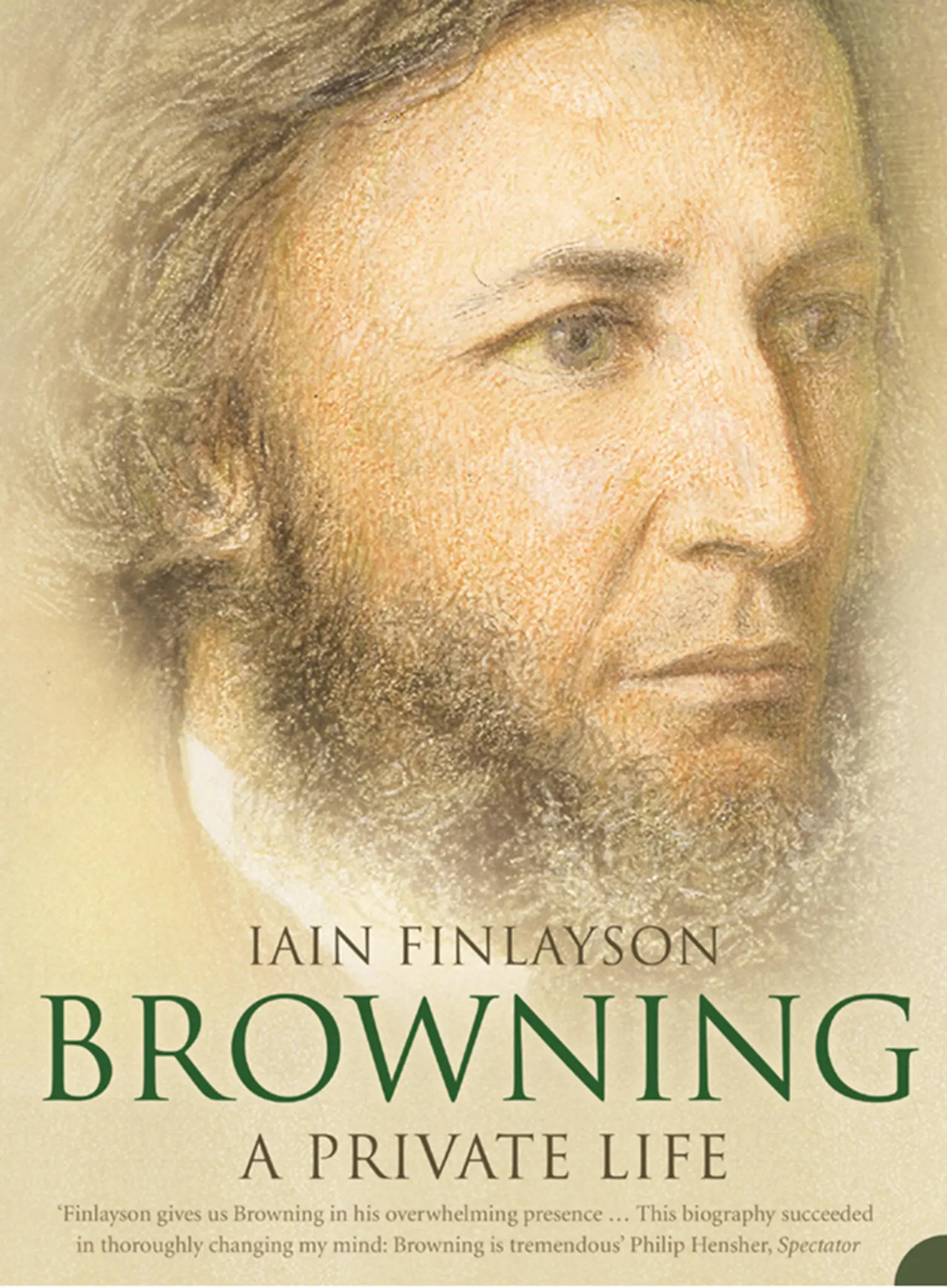
- Название:Browning
- Автор:
- Жанр:
- Год:неизвестен
- ISBN:нет данных
- Рейтинг книги:5 / 5. Голосов: 1
-
Избранное:Добавить в избранное
- Отзывы:
-
Ваша оценка:
Browning: краткое содержание, описание и аннотация
Предлагаем к чтению аннотацию, описание, краткое содержание или предисловие (зависит от того, что написал сам автор книги «Browning»). Если вы не нашли необходимую информацию о книге — напишите в комментариях, мы постараемся отыскать её.
Browning — читать онлайн ознакомительный отрывок
Ниже представлен текст книги, разбитый по страницам. Система сохранения места последней прочитанной страницы, позволяет с удобством читать онлайн бесплатно книгу «Browning», без необходимости каждый раз заново искать на чём Вы остановились. Поставьте закладку, и сможете в любой момент перейти на страницу, на которой закончили чтение.
Интервал:
Закладка:
It is not to be assumed, from Karlin’s demonstration, that Robert set out deliberately to seduce Elizabeth, though it is plain that he was powerfully attracted by the idea of the woman he identified with her poetry. But they had never met, knowing each other only by literary repute and conversational hearsay. It did not seem improbable to Robert that they would meet. From the very outset he hoped, and very likely intended, that they would. He had been rebuffed (like many others) once: through John Kenyon, Robert had once come so close, ‘so close, to some world’s wonder in chapel or crypt, only a screen to push and I might have entered’. 124 Now, tantalizingly, Elizabeth offered some renewed basis for hope: ‘Winters shut me up as they do dormouse’s eyes; in the spring, we shall see : and I am so much better that I seem turning round to the outward world again.’ 125 Their first letters were ‘all in the uttermost innocence’ because, by and large, Robert and Elizabeth were innocents—at least in love.
Neither of them, though they had not been short-changed in their experience of the complete love and whole trust of family and friends, had been properly in love. Robert had fancied himself in love with one or other, or possibly both, of the Flower sisters, though had perhaps only played with the fancy of being in love with them; and he had flirted a little—though not seriously, not with intent—in his lively, youthful, teasing letters to Fanny Haworth, whose mature heart may (but we don’t know) have fluttered at the sight of his handwriting. Elizabeth’s experience of love had been not dissimilar: as Robert was adored and indulged by his mother and father, so Elizabeth was adored with a profoundly protective love by her father, and she in turn deeply loved the large litter of her younger brothers and sisters. As Robert had felt comfortable in the company of older women and was drawn to the values of a good mind complemented by feminine virtues, so Elizabeth had found pleasure in the learned company and erudite correspondence of older men whose intellects interested her and held her attention perhaps more than their persons, though she was not unaware of—greatly valued, indeed—the attractive power of a confident masculinity.
Both Robert and Elizabeth possessed a generous nature and a vitality of expression which informed their everyday lives and coloured their personal letters. For all that Daniel Karlin emphasizes the underlying Pauline rigour of Robert’s letters to Elizabeth, they possess a surface sheen of Robert’s delight in the exercise of writing, certainly, but also of having found a receptive and responsive correspondent—importantly and excitingly, an intelligent woman. Robert wrote spontaneously and instinctively within that Pauline style, being amusing, intelligent, sympathetic, and responsive to the nuances of Elizabeth’s less confident, more impressionistic replies. He was graceful, poetic, provocative, pressing, and often powerfully eloquent in images and assertive attitudes that displayed a degree of sophistication seemingly derived from a worldliness beyond Elizabeth’s personal experience. In short, irresistible even without declarations of love. If she had her doubts and anxieties about the constantly reiterated word ‘love’, Elizabeth was at least allured by Robert’s manner—‘you draw me on with your kindness’. 126
At first, Robert and Elizabeth contented themselves more or less with thoughtful, tentative criticism of each other’s work. She frankly admitted her faults (as they seemed to her): ‘Headlong I was at first, and headlong I continue … guessing at the meaning of unknown words instead of looking into the dictionary—tearing open letters, and never untying a string,—and expecting everything to be done in a minute, and the thunder to be as quick as the lightning. And so, at your half word I flew at the whole one, with all its possible consequences, and wrote what you read.’ 127 But, she further admitted, ‘In art, however, I understand that it does not do to be headlong, but patient and laborious—and there is a love strong enough, even in me, to overcome nature.’
In Robert she recognized ‘What no mere critic sees, but what you, an artist know, is the difference between the thing desired and the thing attained … You have in your vision two worlds … you are both subjective and objective in the habits of your mind. You can deal both with abstract thought and with human passion in the most passionate sense. Thus you have an immense grasp in Art … Then you are “masculine” to the height—and I, as a woman, have studied some of your gestures of language and intonation wistfully, as a thing beyond me far! and the more admirable for being beyond.’
This appeal for informed criticism, signifying that Robert, as a masculine poet, had much to teach Elizabeth as a feminine poet, was also about the differences between them, between men and women indeed, and Elizabeth rather tended to assume that she had at last found her great instructor, a kindred poetic spirit whose abilities, deserving of admiration, would communicate themselves advantageously to her own art and abilities. Simultaneously, her use of words—‘passionate’, ‘masculine’—was unconsciously provocative to Robert. He, just as Elizabeth had feared that he conflated her with her poetry and perceived a unity that she did not herself understand to be true, similarly felt that Elizabeth estimated him by his poetry and, in a letter post-marked 28 January, told her, ‘you know nothing, next to nothing of me’.
He elaborated this in his next letter, post-marked 11 February, concluding: ‘when I remember how I have done what was published, and half done what may never be, I say with some right, you can know but little of me’. Elizabeth accepted some of this letter, and protested the rest of it in her reply of 17 February: ‘I do not, you say, know yourself—you. I only know abilities and faculties. Well, then, teach me yourself—you.’
And so it properly begins.
She had found out some small details already—Robert had offered to open his desk for her, that repository of things half begun, half finished. She was interested in the desk. She wrote: ‘if I could but see your desk—as I do your death heads and the spider webs appertaining’, 128 but he had not written of skulls and spider webs. In his reply, post-marked 26 February, Robert inquired, ‘Who told you of my sculls and spider webs—Horne? Last year I petted extraordinarily a fine fellow (a garden spider—there was the singularity,—the thin, clever-even-for a spider-sort, and they are so “spirited and sly,” all of them—this kind makes a long cone of web, with a square chamber of vantage at the end, and there he sits loosely and looks about), a great fellow that housed himself, with real gusto, in the jaws of a great scull, whence he watched me as I wrote, and I remember speaking to Horne about his good points.’
That might have been quite enough about spiders and intimations of mortality; but Robert continued, laying the skull to quiet contemplation of the view from the window in Hatcham and giving some intimate particulars of the room in which the skull reposed and Robert worked. ‘Phrenologists look gravely at that great scull, by the way, and hope, in their grim manner, that its owner made a good end. He looks quietly, now, out at the green little hill behind. I have no little insight to the feelings of furniture, and treat books and prints with a reasonable consideration. How some people use their pictures, for instance, is a mystery to me; very revolting all the same—portraits obliged to face each other for ever,—prints put together in portfolios. My Polidori’s perfect Andromeda along with “Boors Carousing,” by Ostade,—where I found her,—my own father’s doing, or I would say more.’
Читать дальшеИнтервал:
Закладка:
Похожие книги на «Browning»
Представляем Вашему вниманию похожие книги на «Browning» списком для выбора. Мы отобрали схожую по названию и смыслу литературу в надежде предоставить читателям больше вариантов отыскать новые, интересные, ещё непрочитанные произведения.







Обсуждение, отзывы о книге «Browning» и просто собственные мнения читателей. Оставьте ваши комментарии, напишите, что Вы думаете о произведении, его смысле или главных героях. Укажите что конкретно понравилось, а что нет, и почему Вы так считаете.