Iain Finlayson - Browning
Здесь есть возможность читать онлайн «Iain Finlayson - Browning» — ознакомительный отрывок электронной книги совершенно бесплатно, а после прочтения отрывка купить полную версию. В некоторых случаях можно слушать аудио, скачать через торрент в формате fb2 и присутствует краткое содержание. Жанр: unrecognised, на английском языке. Описание произведения, (предисловие) а так же отзывы посетителей доступны на портале библиотеки ЛибКат.
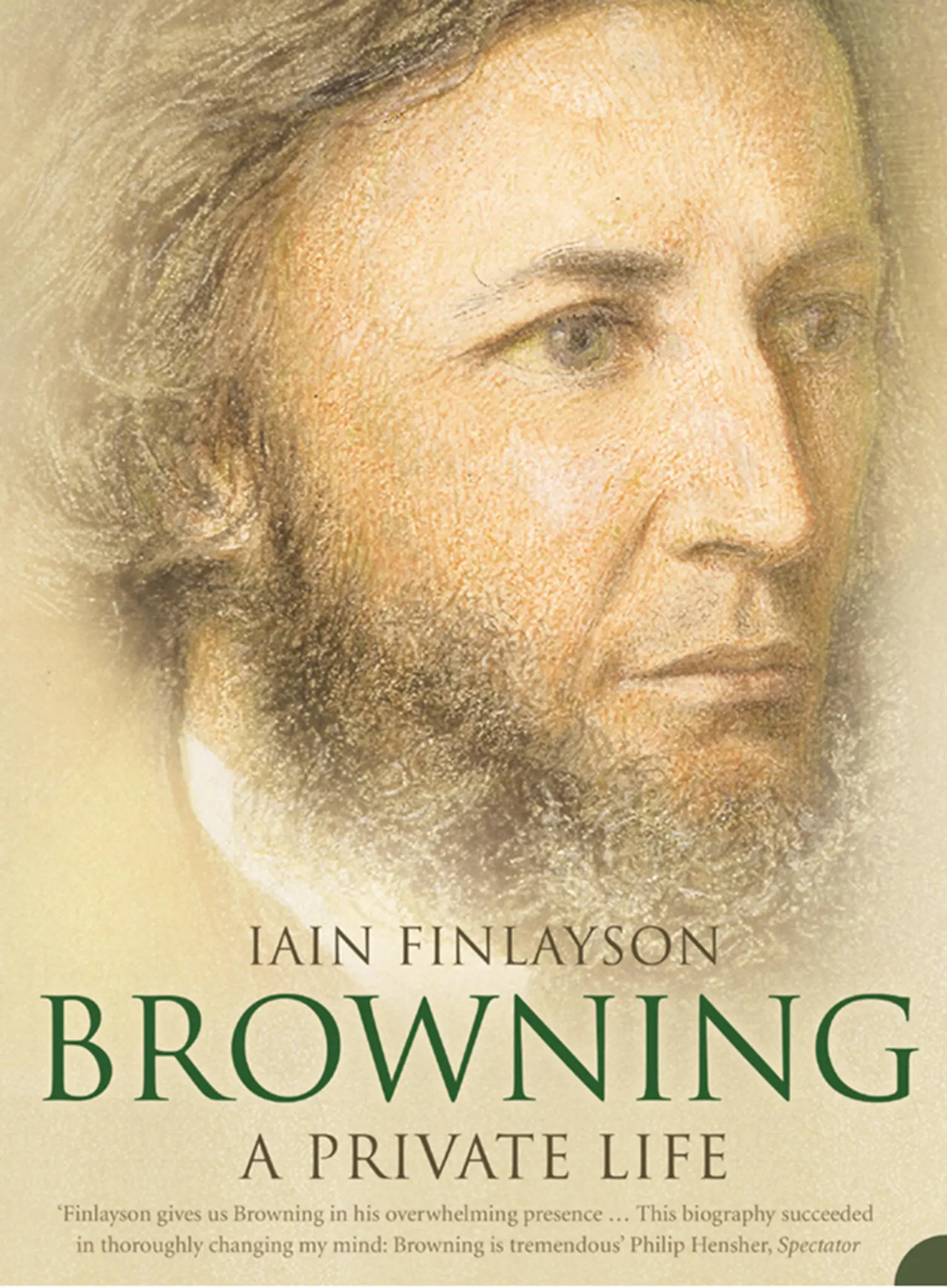
- Название:Browning
- Автор:
- Жанр:
- Год:неизвестен
- ISBN:нет данных
- Рейтинг книги:5 / 5. Голосов: 1
-
Избранное:Добавить в избранное
- Отзывы:
-
Ваша оценка:
Browning: краткое содержание, описание и аннотация
Предлагаем к чтению аннотацию, описание, краткое содержание или предисловие (зависит от того, что написал сам автор книги «Browning»). Если вы не нашли необходимую информацию о книге — напишите в комментариях, мы постараемся отыскать её.
Browning — читать онлайн ознакомительный отрывок
Ниже представлен текст книги, разбитый по страницам. Система сохранения места последней прочитанной страницы, позволяет с удобством читать онлайн бесплатно книгу «Browning», без необходимости каждый раз заново искать на чём Вы остановились. Поставьте закладку, и сможете в любой момент перейти на страницу, на которой закончили чтение.
Интервал:
Закладка:
William Sharp makes the point that the young Robert Browning is sometimes credited with ‘the singular courage to decline to be rich’, but that Browning himself ‘was the last man to speak of an inevitable artistic decision as “singular courage”’. He had, says Sharp, ‘nothing of this bourgeois spirit’. Money, for money’s sake, was not a consideration—as his letter of 13 September 1845 to Elizabeth Barrett later testified. He would prefer ‘a blouse and a blue shirt (such as I now write in) to all manner of dress and gentlemanly appointment’. He could, ‘if necessary, groom a horse not so badly, or at all events would rather do it all day long than succeed Mr Fitzroy Kelly in the Solicitor-Generalship’, though by 1845 that youthful insouciance was changing in the light of love and its prospective attendant domestic expenses and obligations. Nevertheless, for the time being, in 1830, he ‘need not very much concern himself beyond considering the lilies how they grow’. Or how the roses might blow in his mother’s garden.
In Robert Browning: A Portrait , Betty Miller reviews the Brownings’ financial situation, pointing remorselessly to the comparatively humble origins of Robert’s mother as the daughter of a ‘mariner in Dundee’ rather than aggrandizing her as the daughter of a more substantial ship owner, and playing down the status and salary of the Bank of England clerkship enjoyed by Robert’s father. She also instances some contemporary critics who perceived Robert’s lack of apparent professional middle-class occupation as disgraceful. The prevailing attitude of respect for what is now identified as the ‘Protestant work ethic’ was as incorrigible then as now: poverty was generally considered to be morally reprehensible and fecklessness was regarded as a moral failing. The ‘deserving poor’ (a fairly select minority of the hapless and the disadvantaged) received pretty rough charity, grudging at best and rarely without an attached weight of sanctimony.
An accredited gentleman with an adequate fortune might blamelessly lead a life of leisure and pleasure, but the Brownings pretended to no giddy gentility. They were of the middle class, and the men of the middle class contributed their work to the perceived profit (moral and pecuniary) of society and to their own interests (much the same). Faults in character evidenced by apparent idleness were probably vicious and not easily glossed over by any high-tone, high-flown talk of devotion to poetry or art as a substitute for masculine resolve or absolution from a moral and material responsibility to earn a decent living. There is in this a suggestion that a poet must be, if not effeminate, at least effete—in contrast to the virtuous character of the common man committed to his daily labour who takes his ‘true honourable place in society, etc. etc.’, as Robert himself remarked. He was not wholly indifferent to conventional social values and expectations.
His position as a family dependent, nevertheless, did not unduly worry Robert: he acknowledged his father’s generosity and airily supposed that, with a little effort, he might make ‘a few hundred pounds which would soon cover my simple expenses’; and furthermore he felt, too, ‘whenever I make up my mind to that, I can be rich enough and to spare—because,’ he wrote later to Elizabeth Barrett, ‘along with what you have thought genius in me, is certainly talent, what the world recognises as such; and I have tried it in various ways, just to be sure that I was a little magnanimous in never intending to use it.’ Robert could do it if he had to, but for the time being he didn’t see, or perhaps acknowledge, the necessity—he continued never to know ‘what it was to have to do a certain thing to-day and not to-morrow’, though that did not imply any inclination to do nothing. As Edmund Gosse reported from a conversation with Robert in his later life, ‘freedom led to a super-abundance of production since on looking back he could see that he had often, in his unfettered leisure, been afraid to do nothing’. For the time being, however, Robert settled back into the familiar routines of family life and his proper application to poetry. He gave up vegetarianism as damaging to his health and atheism as damaging to his soul. The prodigal had returned, though in this case he could barely be said ever to have been away.
In January 1833, Robert completed a poetic work entitled Pauline: A Fragment of a Confession . It had been written as the first item in a projected grander master plan conceived at Richmond on the afternoon shading to evening of 22 October 1832 when he had seen Edmund Kean, once a great actor, by then in decline and disrepair but still powerfully impressive even when debilitated by drink and tuberculosis, play Shakespeare’s Richard III. The poem, consisting of 1,031 lines, took Robert three months to write. He was twenty years old. Chesterton’s dry comment is that ‘It exhibits the characteristic mark of a juvenile poem, the general suggestion that the author is a thousand years old.’ Robert himself, in a note inserted in 1838 at the beginning of his own copy, remarks that, ‘The following Poem was written in pursuance of a foolish plan which occupied me mightily for a time, and which had for its object the enabling me to assume and realize I know not how many different characters;—meanwhile the world was never to guess that “Brown, Smith, Jones & Robinson” (as the spelling books have it) the respective authors of this poem, the other novel, such an opera, such a speech, etc., etc., were no other than one and the same individual. The present abortion was the first work of the Poet of the batch, who would have been more legitimately myself than most of the others; but I surrounded himself with all manner of (to my then notion) poetical accessories, and had planned quite a delightful life for him. Only this crab remains of the shapely Tree of Life in this fool’s paradise of mine,—R.B.’
If Christiana, Aunt Silverthorne, had not kindly and unpromptedly paid £30 for its publication (£26 and 5 shillings for setting, printing and binding, £3 and 15 shillings for advertising), Pauline might have experienced the fate of Incondita —burned by its author to ashes. As it was, Sarianna had secretly copied, in pencil, particularly choice passages during Robert’s composition of the poem. 34 She knew already the irresistible attraction for her brother of a fire in an open grate. She, indeed, was the only other person in the household who knew that Robert had begun writing the work at all. But then, five months later, there it was, published by Saunders and Otley, born and bound and in the hands of booksellers in March 1833. The author remained anonymous. Readers might suppose it to be the work of Brown, Smith, Jones, even Robinson, if they pleased: Robert Browning perhaps wisely elected for privacy over fame, though possibly only, batedly, preferring to anticipate the moment of astonishing revelation.
The book fell, not by chance, into the hands of reviewers. The Revd William Johnson Fox had read Incondita , and had reacted with a response that, if it stopped somewhat short of fulsome praise, had not been discouraging. Fox had acquired, in the interim, the Monthly Repository which, under his ownership and editorship, had achieved a reputation as an influential Unitarian publication. Its original emphasis had been theological, but Fox was eager not only to politicize its content but equally to give it a reputation for literary and dramatic criticism. Space could be found to notice improving literature: ten pages had recently been devoted in January 1830 to a review of the Poems of Tennyson by the 24-year-old John Stuart Mill (editor of Jeremy Bentham’s Treatise upon Evidence and founder of the Utilitarian Society, activities that had unsettled him to the point of madness until the poetry of Wordsworth restored to him the will to live). On receipt of a positive reply to the letter reintroducing himself—though he seems only to have been aware, to judge by his letter, that Fox contributed reviews to the Westminster Review —Robert had twelve copies of Pauline sent to Mr Fox, together with a copy of Shelley’s Rosalind and Helen which, afterwards wishing to retrieve, he later used as an excuse to call personally on Fox.
Читать дальшеИнтервал:
Закладка:
Похожие книги на «Browning»
Представляем Вашему вниманию похожие книги на «Browning» списком для выбора. Мы отобрали схожую по названию и смыслу литературу в надежде предоставить читателям больше вариантов отыскать новые, интересные, ещё непрочитанные произведения.








Обсуждение, отзывы о книге «Browning» и просто собственные мнения читателей. Оставьте ваши комментарии, напишите, что Вы думаете о произведении, его смысле или главных героях. Укажите что конкретно понравилось, а что нет, и почему Вы так считаете.