Iain Finlayson - Browning
Здесь есть возможность читать онлайн «Iain Finlayson - Browning» — ознакомительный отрывок электронной книги совершенно бесплатно, а после прочтения отрывка купить полную версию. В некоторых случаях можно слушать аудио, скачать через торрент в формате fb2 и присутствует краткое содержание. Жанр: unrecognised, на английском языке. Описание произведения, (предисловие) а так же отзывы посетителей доступны на портале библиотеки ЛибКат.
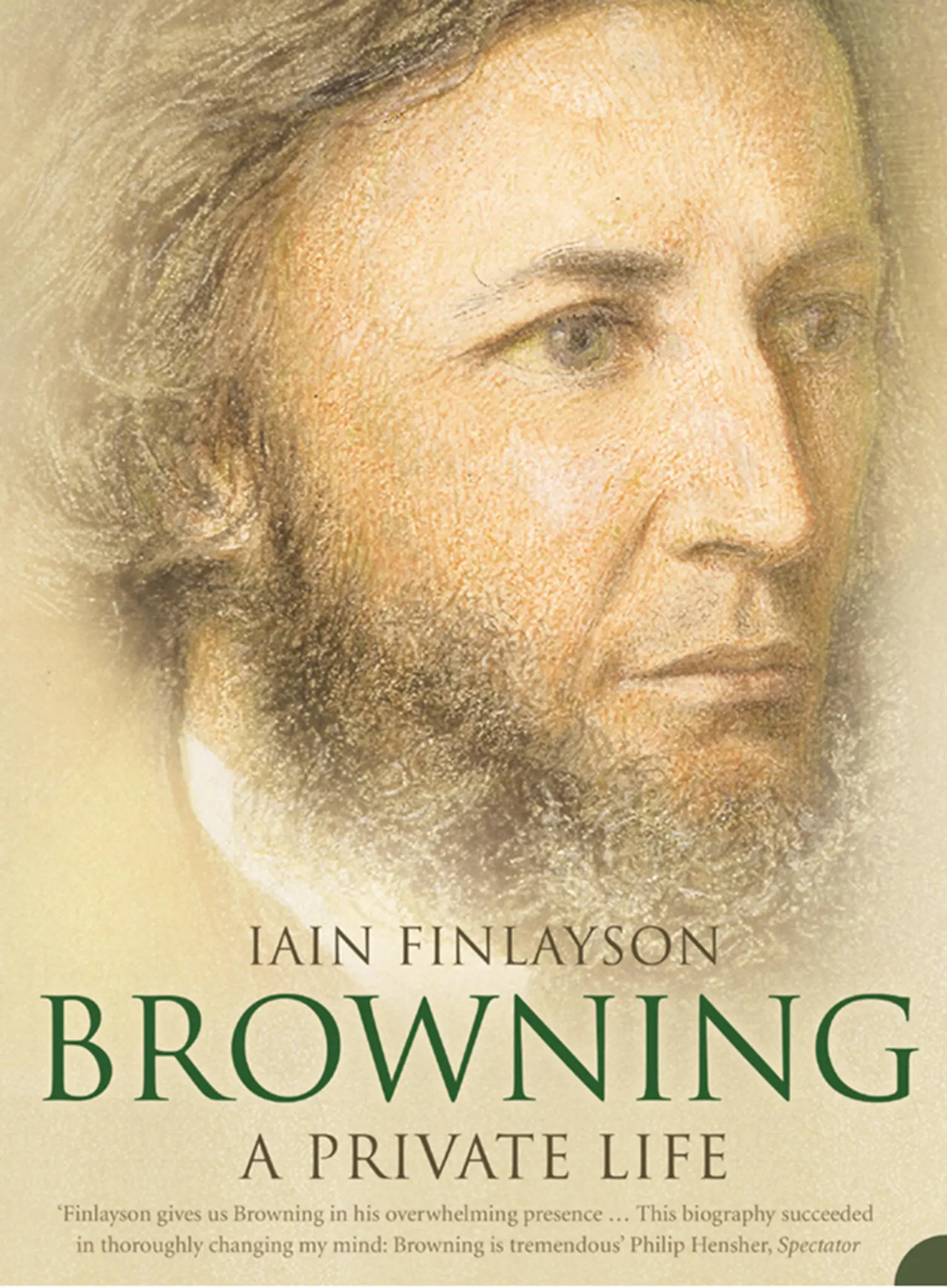
- Название:Browning
- Автор:
- Жанр:
- Год:неизвестен
- ISBN:нет данных
- Рейтинг книги:5 / 5. Голосов: 1
-
Избранное:Добавить в избранное
- Отзывы:
-
Ваша оценка:
Browning: краткое содержание, описание и аннотация
Предлагаем к чтению аннотацию, описание, краткое содержание или предисловие (зависит от того, что написал сам автор книги «Browning»). Если вы не нашли необходимую информацию о книге — напишите в комментариях, мы постараемся отыскать её.
Browning — читать онлайн ознакомительный отрывок
Ниже представлен текст книги, разбитый по страницам. Система сохранения места последней прочитанной страницы, позволяет с удобством читать онлайн бесплатно книгу «Browning», без необходимости каждый раз заново искать на чём Вы остановились. Поставьте закладку, и сможете в любой момент перейти на страницу, на которой закончили чтение.
Интервал:
Закладка:
There is talk, too, of Robert’s taste for country fairs. This is elaborated by Griffin and Minchin, who charmingly describe how, ‘For three days each summer the Walworth Road from Camberwell Gate to the village green—a goodly mile—was aglow after sunset with candles beneath coloured shades on the roadside stalls: on the Green itself, besides the inevitable boats and swings and merry-go-rounds, there was the canvas-covered avenue with its gingerbread booths, there was music and dancing, and best of all, there was the ever-popular Richardson’s Theatre—appreciated, it is said, by the poet in his younger days. Peckham also had its fair, which was held just opposite Mr Ready’s school; and Greenwich, noisiest and most boisterous of fairs, was close at hand.’ 26 Again, with an implied note of reproof, Mrs Orr dampens any speculative fervour about Robert’s bohemian instincts by insisting that ‘a few hours spent at a fair would at all times have exhausted his capacity for enduring it. In the most undisciplined acts of his early youth, were always present curious delicacies and reserves.’
She is keen to return Robert to his books and his work, away from any suggestion of irreverent or—spare the mark—inappropriate interests and activities: ‘There was always latent in him the real goodness of heart which would not allow him to trifle consciously with other lives.’ Fifine might go to the fair, but Robert should stay home and satisfy himself with the habit of work as his safeguard and keep tight control of an imagination that, rather than mastering him, would serve him. This seems a little censorious, not to say apprehensive that Robert might have had yearnings that, if not severely restrained, would have led him into even more ‘undisciplined acts’. We must close our eyes in holy dread at the very thought and be thankful that nothing unworthy soiled the blameless page he worked upon, far less sufficiently overcame his ‘curious delicacies and reserves’ to distract him from it.
Better to think of Robert no longer incited by his early adherence to Byron—that libertine and sceptic who roamed at large as much in the world as in his meditations—but at sundown, on the brow of the Camberwell hill (now known as Camberwell Grove), among the spreading elms, suffused with the spiritual light of Shelley and looking down, deliriously, on the darkling mass of London sprawled at his feet, lit by the new gas lamps. For the time being, Robert remained safely distant from the snares and entanglements of the beautiful but seductive city: so many lives to refrain from toying with, so much noisy, messy—maybe vicious—life to assault curious delicacies and reserves should he dare to descend to put them to the test. Byronism, as Chesterton remarks, ‘was not so much a pessimism about civilized things as an optimism about savage things’. But now Robert was Byronic only in the dandyism of his dress. It was Shelley who suited his soul. And so, turning, Robert would go home to bed, sleeping in a bedroom that adjoined his mother’s, the door always open between them, and to give her a kiss—every night, even in the worst of their disputes—before retiring. He never willingly spent a night away from home. 27
Robert’s fascination with and attachment to the natural as contrasted with the artificial world was innate. It took inspiration from his mother’s intense sympathy with flora and fauna, if we are to credit W. J. Stillman, in his Autobiography of a Journalist (quoted by Griffin and Minchin), who states that Mrs Browning had that ‘extraordinary power over animals of which we hear sometimes, but of which I have never known a case so perfect as hers. She would lure the butterflies in the garden to her, and domestic animals obeyed her as if they reasoned.’ The Browning household at times approximated to a menagerie: Griffin and Minchin speak respectfully of Browning’s learning early to ride his pony, playing with dogs, keeping pets and birds including a monkey, a magpie, and—improbably—an eagle. The collection of toads, frogs, efts, and other ‘portable creatures’ that is said to have filled his pockets gives some additional substance to the story already quoted that Mrs Browning induced Robert to take medicine by finding a toad for him in the garden. He could whistle up a lizard in Italy, chuck a toad under its chin in Hatcham, and later kept a pet owl in London as well as geese that would follow him around and submit to being embraced by the middle-aged poet. 28
William Sharp describes Browning’s occasional long walks into the country: ‘One particular pleasure was to lie beside a hedge, or deep in meadow-grasses, or under a tree … and there give himself up so absolutely to the life of the moment that even the shy birds would alight close by, and sometimes venturesomely poise themselves on suspicious wings for a brief space on his recumbent body.’ Sharp, in this pastoral mode, quotes Browning himself as having said that ‘his faculty of observation at that time would not have appeared despicable to a Seminole or an Iroquois’. 29 His faculty of absorption and repose, in this imagery, would have done credit to a St Francis. His love for his mother’s flowers—particularly the roses and lilies that later he would gather to send to Elizabeth Barrett—was perhaps one contributory factor in his brief vegetarianism.
In a letter of 24 July 1838 to Miss Euphrasia Fanny Haworth, he makes a significant confession: ‘I have, you are to know, such a love for flowers and leaves—some leaves—that I every now and then,—in an impatience at being able to possess myself of them thoroughly, to see them quite, satiate myself with their scent—bite them to bits.’ This devouring quality of Browning’s desire for sensation, to the extent of attempting to consume it literally in the form of vegetable matter, is remarkable. It is as though Browning’s passion to possess the world could only be achieved by eating it, by incorporating it within himself. In Pauline , he recognized some of this when he identified
a principle of restlessness
Which would be all, have, see, know, taste, feel, all.
and he declared that,
I have lived all life
When it is most alive.
How apposite, then, to come upon the charmingly-named Flower sisters, Eliza and Sarah. It was to Eliza that Mrs Browning had confided the text of Incondita and it was Eliza, so taken with it, who had copied it for Mr William Johnson Fox, a friend of her father, Benjamin Flower, ‘known’, says Mrs Orr, ‘as editor of the Cambridge Intelligencer ’. Robert, encouraged by her enthusiasm for his poems, began writing to Eliza Flower at the age of twelve or thirteen. 30 She was nine years his senior. These letters, which she kept for her lifetime, were eventually and effortfully retrieved and destroyed—all but a few scraps—by Robert. It seems likely, even without the confirmation of the correspondence, that Eliza was his first, immature love, though the boyish, romantic attachment died out ‘for want of root’. Sentimental love, if that was what it amounted to, subsided into a lasting respect and affection for ‘a very remarkable person’ who, with her sister, was responsible for a number of popular hymns such as ‘Nearer, my God, to thee’, written by Sarah Flower Adams and set to music by Eliza. These were composed for Mr Fox’s chapel where Eliza ‘assumed the entire management of the choral part of the service’. 31 Eliza, though Robert denied it, seems to have been the major identifiable inspiration for his second excursion into verse: the long confessional poem entitled Pauline .
Mrs Orr conventionally regrets that the headstrong Robert Browning was not sent to a public school where his energies might have been efficiently directed; but Griffin and Minchin take the more sensible view that a pre-Arnoldian public school education, if only and unrepresentatively to judge by the boy’s experience of the Ready school, would have been been ‘hardly encouraging … Nor were public schools in good odour.’ The reforms inspired by Dr Arnold of Rugby were a thing of the future.
Читать дальшеИнтервал:
Закладка:
Похожие книги на «Browning»
Представляем Вашему вниманию похожие книги на «Browning» списком для выбора. Мы отобрали схожую по названию и смыслу литературу в надежде предоставить читателям больше вариантов отыскать новые, интересные, ещё непрочитанные произведения.







Обсуждение, отзывы о книге «Browning» и просто собственные мнения читателей. Оставьте ваши комментарии, напишите, что Вы думаете о произведении, его смысле или главных героях. Укажите что конкретно понравилось, а что нет, и почему Вы так считаете.