Iain Finlayson - Browning
Здесь есть возможность читать онлайн «Iain Finlayson - Browning» — ознакомительный отрывок электронной книги совершенно бесплатно, а после прочтения отрывка купить полную версию. В некоторых случаях можно слушать аудио, скачать через торрент в формате fb2 и присутствует краткое содержание. Жанр: unrecognised, на английском языке. Описание произведения, (предисловие) а так же отзывы посетителей доступны на портале библиотеки ЛибКат.
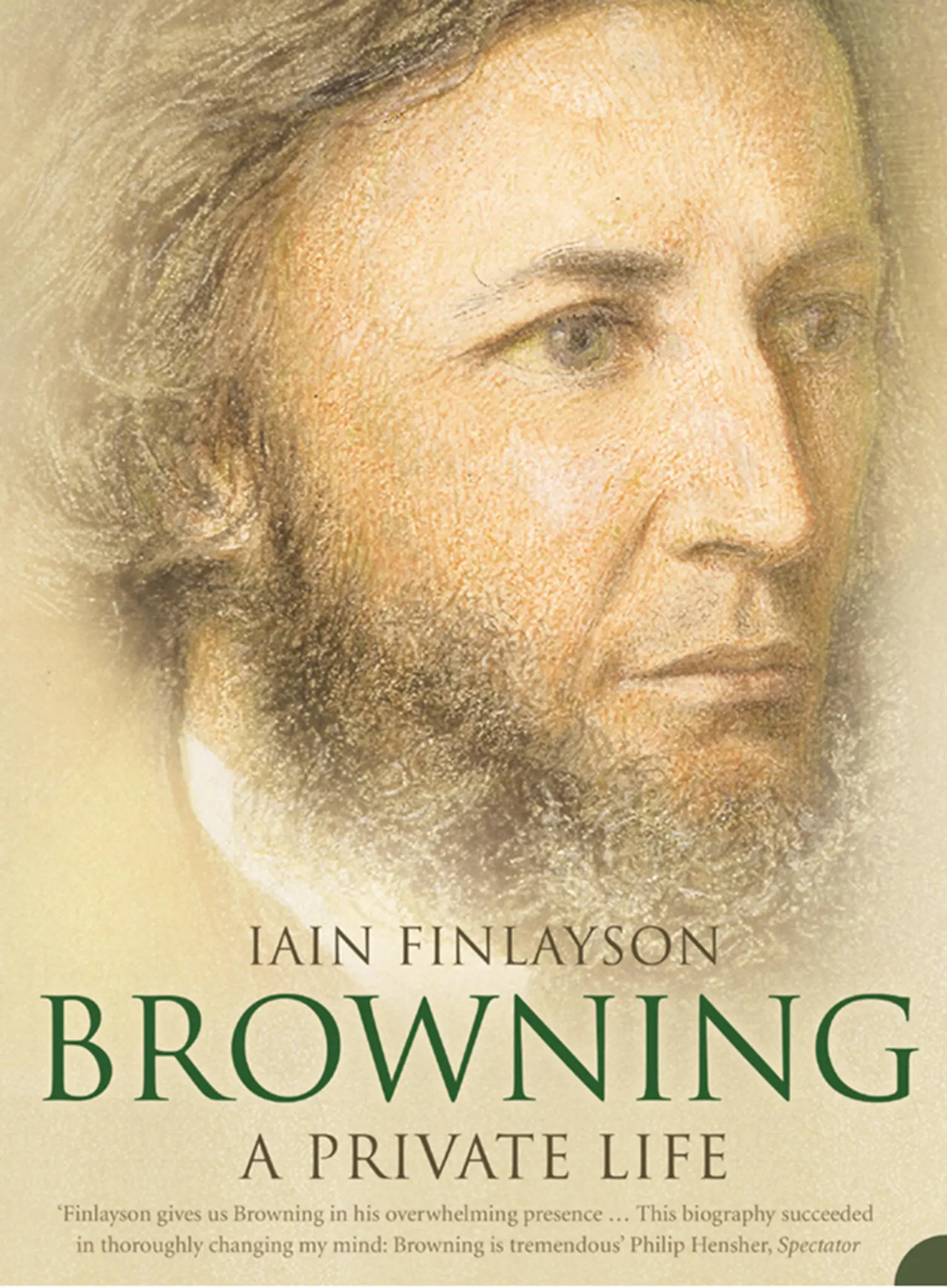
- Название:Browning
- Автор:
- Жанр:
- Год:неизвестен
- ISBN:нет данных
- Рейтинг книги:5 / 5. Голосов: 1
-
Избранное:Добавить в избранное
- Отзывы:
-
Ваша оценка:
Browning: краткое содержание, описание и аннотация
Предлагаем к чтению аннотацию, описание, краткое содержание или предисловие (зависит от того, что написал сам автор книги «Browning»). Если вы не нашли необходимую информацию о книге — напишите в комментариях, мы постараемся отыскать её.
Browning — читать онлайн ознакомительный отрывок
Ниже представлен текст книги, разбитый по страницам. Система сохранения места последней прочитанной страницы, позволяет с удобством читать онлайн бесплатно книгу «Browning», без необходимости каждый раз заново искать на чём Вы остановились. Поставьте закладку, и сможете в любой момент перейти на страницу, на которой закончили чтение.
Интервал:
Закладка:
I have tried—my trial is made too!
But this is in the future. The boy Robert had only just begun, on first acquaintance with the Dulwich pictures, to try his hand at poetry, good, bad, or indifferent, excepting some early extemporized lines of occasional verse for domestic or school consumption. The critic—tutored by the work of de Lairesse—was being formed, but the artist was still mostly whistling, ruddy by the hawthorn hedges, on the way to Dulwich. It was difficult to know which way to turn, which vocation to pursue: painting and drawing, for which young Robert had a facility, inspired by his father and the works of de Lairesse; music, which he dearly loved, inspired by his mother, Charles Avison’s Essay on Musical Expression , and two distinguished tutors—Relfe, who taught theory, and Abel, who was proficient in technique; poetry, for which he not only had an aptitude but also a taste fuelled in several languages (Greek, Latin, French, some Spanish, some Italian, German later, even a smattering of Hebrew in addition to English) by the great exemplars—Horace, Homer, Pope, Byron—of the art of happy expression.
In the event, at the age of twelve, in the very year, 1824, of Byron’s death at Missolonghi, Robert the Third produced a collection of short poems entitled Incondita . The title, comments Mrs Orr, ‘conveyed a certain idea of deprecation’; Griffin and Minchin suggest an ‘allusion to the fact that “in the beginning” even the earth itself was “without form”’. The title may have been modest, but the principal stylistic influence—Byronic—was not, and at least one of the poems, ‘The Dance of Death’, was, on the authority of Mrs Orr, who was told of it, ‘a direct imitation of Coleridge’s “Fire, Famine, and Slaughter”’ (1798). A letter of 11 March 1843 from Robert the Second to a Mr Thomas Powell, quoted by Mrs Orr, testified that his son had been composing verses since ‘quite a child’ and referred to a great quantity of ‘juvenile performances’, some of which ‘extemporaneous productions’ Robert the Second enclosed.
The sample sheet of verses, taken at the time and for some while after at face value, was subsequently identified to Mrs Orr by Sarianna Browning as ‘her father’s own impromptu epigrams’. The attempt to pass off the father’s effusions as the work of the son is baffling, and Mrs Orr kindly directs us to suppose that ‘The substitution may from the first have been accidental.’ The letter is, however, valuable for its affirmation that Robert the Third was remarkably precocious in poetry and the credible information—borne out by his habitual practice in later life—that he deliberately destroyed all instances of his first efforts ‘that ever came in his way’.
Sarianna being too young at the time—no more than ten years old—never saw the poetry of Incondita , but it impressed Mr and Mrs Browning to the extent that they tried, unsuccessfully, to get the manuscript published. Disappointment in this enterprise may have been one reason that led Robert to destroy the manuscript, but it had already got beyond him into the world: Mrs Browning had shown the poems to an acquaintance, Miss Eliza Flower, who had copied them for the attention of a friend, the Revd William Johnson Fox, ‘the well-known Unitarian minister’. Robert, with an adult eye for reputation, retrieved this copy after the death of Mr Fox and, additionally, a fragment of verse contained in a letter from Miss Sarah Flower. He destroyed both.
Mrs Orr, though regretting the loss of ‘these first fruits of Mr Browning’s genius’, supposes that ‘there can have been little in them to prefigure its later forms. Their faults seem to have lain in the direction of too great splendour of language and too little wealth of thought’, an echo of Mr Fox’s opinion. Fox admitted later to Robert that ‘he had feared these tendencies as his future snare’. Two poems, said to have survived from Incondita ’s brief and limited exposure, are ‘The First-Born of Egypt’, in blank verse, and ‘The Dance of Death’, in tetrameters. They are certainly gorgeous, richly allusive, spare no wrenching emotion or sensational effect, and ascend to dramatic climax. A distinct gust from the graveyard scents the relentless progress of grisly calamities that would give suffering Job more than usual pause for thought.
Nevertheless, the Byronic, perhaps less so the Coleridgean, influences were not merely juvenile infatuations. In a letter of 22 August 1846 to Miss Barrett, Robert commented that ‘I always maintained my first feeling for Byron in many respects … the interest in places he had visited, in relics of him. I would at any time have gone to Finchley to see a curl of his hair or one of his gloves, I am sure—while Heaven knows that I could not get up enthusiasm enough to cross the room if at the end of it all Wordsworth, Coleridge and Southey were condensed into the little China bottle yonder, after the Rosicrucian fashion … they seem to “have their reward” and want nobody’s love or faith.’ (The reference to Finchley as a place of ultimate pilgrimage is attributable to the fact that two days previously Miss Barrett had driven out as far as that fascinating faubourg.)
The death of Byron was as climactic in its effect as either of the surviving poems of Incondita , which take the fold of death as their theme. It may have been the stimulus that prompted the twelve-year-old Browning’s manuscript. The fallout was great on other poets, other idealists, who subsided into plain prose and practical politics—it was the death, too, at least in England, of any idea of romantic revolution. Alfred Tennyson, we are told, memorialized the event by carving the words ‘Byron is dead’ on a rock near Somersby. He was fifteen. Thomas Carlyle, approaching thirty, felt as though he had lost a brother. It is not too much to say that the death of Byron had as profound an effect in England and Europe in 1824 as the death of President John F. Kennedy had for America and the world in 1963. It was like an eclipse of the sun that stills even bird song, or the silence after a thunderclap. There were few who were unaffected. ‘The news of his death came upon my heart like a mass of lead,’ wrote Carlyle to his wife Jane.
Equally tremendous was the year 1832: Goethe died, and so did Sir Walter Scott. Robert maintained a high regard for Scott the polymathic author, often quoting from him and occasionally reflecting Scott’s work in his own poetry. The death of Keats in 1821 had been quickly followed by that of Shelley in 1822. Wordsworth was to die in 1850, and Heinrich Heine in 1856. These losses amounted, in the case of poetry, to the death of European Romanticism. ‘Though it is by no means clear what Romanticism stood for,’ the historian Eric Hobsbawm points out in a chapter on ‘The Arts’ in The Age of Revolution , ‘it is quite evident what it was against: the middle.’ Isaiah Berlin, in The Roots of Romanticism , supposes that, had one ‘spoken in England to someone who had been influenced by, say, Coleridge, or above all by Byron’, one would have found that ‘the values to which they attached the highest importance were such values as integrity, sincerity, readiness to sacrifice one’s life to some inner light, dedication to some ideal for which it is worth sacrificing all that one is, for which it is worth both living and dying’. This attitude, says Berlin, was relatively new. ‘What people admired was wholeheartedness, sincerity, purity of soul, the ability to dedicate yourself to your ideal, no matter what it was.’
The middle, then, famously distrustful of extremes, did not apparently stand much chance, squeezed between the reactionary, traditional elements of the old order and the revolutionary, idealistic instincts of the avant-garde. Yet society has an irresistible tendency to compromise, to assimilate and settle into social stability—albeit radically altered, both right and left—when shaken by destructive events and stirred by disturbing philosophies. Nowhere is this more marked than in the mobile middle class, the eternally buoyant bourgeoisie, which confidently came into its own following the French and Industrial Revolutions.
Читать дальшеИнтервал:
Закладка:
Похожие книги на «Browning»
Представляем Вашему вниманию похожие книги на «Browning» списком для выбора. Мы отобрали схожую по названию и смыслу литературу в надежде предоставить читателям больше вариантов отыскать новые, интересные, ещё непрочитанные произведения.



Обсуждение, отзывы о книге «Browning» и просто собственные мнения читателей. Оставьте ваши комментарии, напишите, что Вы думаете о произведении, его смысле или главных героях. Укажите что конкретно понравилось, а что нет, и почему Вы так считаете.