Iain Finlayson - Browning
Здесь есть возможность читать онлайн «Iain Finlayson - Browning» — ознакомительный отрывок электронной книги совершенно бесплатно, а после прочтения отрывка купить полную версию. В некоторых случаях можно слушать аудио, скачать через торрент в формате fb2 и присутствует краткое содержание. Жанр: unrecognised, на английском языке. Описание произведения, (предисловие) а так же отзывы посетителей доступны на портале библиотеки ЛибКат.
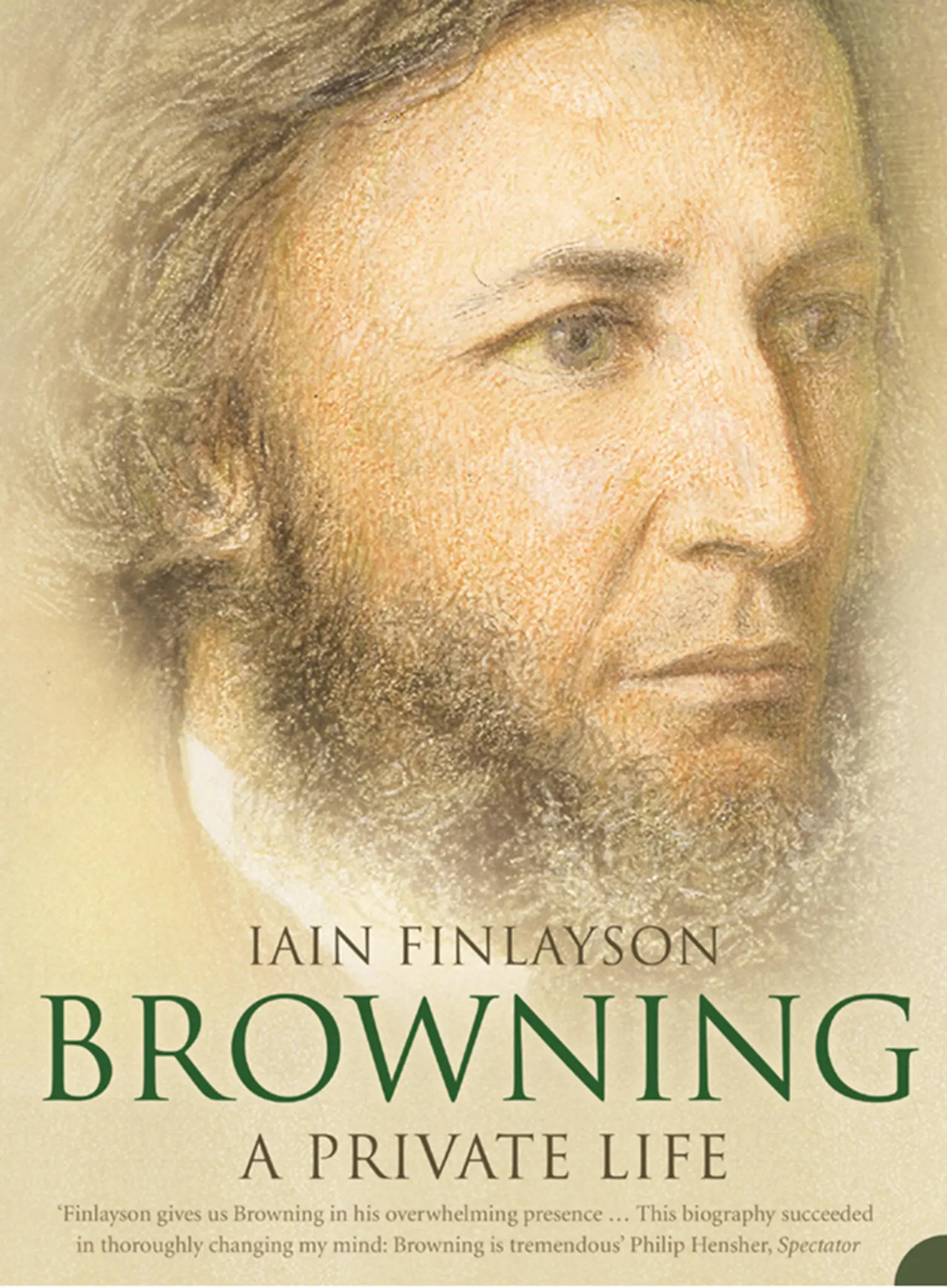
- Название:Browning
- Автор:
- Жанр:
- Год:неизвестен
- ISBN:нет данных
- Рейтинг книги:5 / 5. Голосов: 1
-
Избранное:Добавить в избранное
- Отзывы:
-
Ваша оценка:
Browning: краткое содержание, описание и аннотация
Предлагаем к чтению аннотацию, описание, краткое содержание или предисловие (зависит от того, что написал сам автор книги «Browning»). Если вы не нашли необходимую информацию о книге — напишите в комментариях, мы постараемся отыскать её.
Browning — читать онлайн ознакомительный отрывок
Ниже представлен текст книги, разбитый по страницам. Система сохранения места последней прочитанной страницы, позволяет с удобством читать онлайн бесплатно книгу «Browning», без необходимости каждый раз заново искать на чём Вы остановились. Поставьте закладку, и сможете в любой момент перейти на страницу, на которой закончили чтение.
Интервал:
Закладка:
Meantime, Robert’s father in 1825 had subscribed £100 to the foundation of the new London University, an investment that brought no dividends but procured one particular advantage: since Mr Browning was one of the original ‘proprietors’, he was entitled to a free education for a nominee. Robert, his son, could be admitted to London University as a student. In contrast to Oxford, Cambridge, and the other ancient universities, which required subscription to the Thirty-nine Articles as a necessary prerequisite to admission, London University was nonsectarian, the education was less costly than at other academic institutions, and it was possible to combine the university education with private home study.
Robert was earnestly recommended by his father, describing himself as ‘a parent anxious for the welfare of an only Son’ who deemed admission to the University ‘essential to his future happiness’. Furthermore, Mr Browning testified to Robert’s impeccable moral character (‘I never knew him from his earliest infancy, guilty of the slightest deviation from Truth’) and to his ‘unwearied application for the last 6 years, to the Greek, Latin & French languages’. Mrs Orr draws a discreet veil over the upshot, confining herself to the information that ‘In his eighteenth year he attended, for a term or two, a Greek class at the London University’—he registered for the opening session, 1829–30—and that ‘It was at about the time of his short attendance at University College that the choice of poetry as his future profession was formally made.’ The phrase ‘short attendance’ implies some length of time more than a week, which was the period Robert survived lodging away from home and his mother with a Mr Hughes in Bedford Square, and perhaps a little longer than the few months he endured the pedestrian German, Greek, and Latin classes for which he registered before quitting the college entirely. He was seventeen years old, an age at which, as Mrs Orr frankly acknowledges, he was naturally ‘not only more restless, but less amiable than at any other’.
‘The always impatient temper assumed a quality of aggressiveness,’ she reports. ‘He behaved as a youth will who knows himself to be clever, and believes that he is not appreciated, because the crude or paradoxical forms which his cleverness assumes do not recommend it to his elders’ minds.’ This is judiciously put. A little less indulgent is the bald admission that Robert ‘set the judgements of those about him at defiance, and gratuitously proclaimed himself everything that he was, and some things that he was not.’ School and college simply wearied him: the pedantic routine was stifling. It was not that he lacked aptitude for study, more that he lacked inclination to confine it to the well-worn track. Which is not to say Robert was unpopular: William Sharp quotes a letter from The Times of 14 December 1889, in which a friend loyally testified that ‘I attended with him the Greek class of Professor Long, and I well remember the esteem and regard in which he was held by his fellow-students.’
Poetry was the thing—a foregone conclusion, at least according to Robert. Some attempts seem to have been made to promote the professions of barrister (chosen by his friends Domett and Arnould), clergyman (though Robert had given up regular church attendance), banker (employment in the Bank of England and Rothschild’s bank being the family business), even desperately—it is said—painter or actor. For a short while, when he was sixteen years old, Robert attended medical lectures given by the celebrated physician Dr Blundell at Guy’s Hospital. These are said to have aroused in him ‘considerable interest in the sciences connected with medicine’, 32 but perhaps more from a fascination with the morbid, since ‘no knowledge of either disease or its treatment ever seems to have penetrated into his life’. At any rate, there seems to have been no positive belief that Robert might be suited to the medical profession. The tentative suggestions of anxious parents—the adamantine refusal of a strong-willed son—sulks and silences: it is a familiar-enough scenario, distressing to Mrs Browning, worrying to Mr Browning, a matter of some well-concealed anxiety, no doubt, to Robert Browning himself, who made a conspicuous effort to prepare himself for the profession of poet by reading Johnson’s Dictionary from cover to cover.
Robert had become accustomed to the standards of early nineteenth-century suburban middle-class comfort, but he had been educated as a mid-to-late eighteenth-century gentleman, not only in the breadth of his acquired learning but equally in the departments of upper-class sporting activities such as riding, boxing, and fencing, the social graces of singing, dancing, music, and art, and the civilized values of a man of fine feeling in dress and deportment. The acquisition of these benefits was one thing—they required no financial outlay on his own part; to maintain them would be quite another. Refined tastes are generally expensive to indulge as a permanent style of life.
In his late teens and early twenties, Robert cut a noticeable figure: his appearance was dapper and dandified, verging in some respects on the Byronic, particularly in the manner of his hair, which he wore romantically long, falling over his shoulders and carefully curled. He was of middle height, neither tall nor short, slim, dark-haired, sallow-complexioned, brightly grey-eyed, charming in his urbane, self-confident manner. Robert presented himself to society as ‘full of ambition, eager for success, eager for fame, and, what’s more, determined to conquer fame and to achieve success.’ He was a model of punctilious politeness, good-looking, light-footed and—remarked Mrs ‘Tottie’ Bridell-Fox, daughter of William Johnson Fox, of his appearance in 1835 to 1836—‘just a trifle of a dandy, addicted to lemon-coloured kid-gloves and such things: quite “the glass of fashion and the mould of form”.’ 33 He grew, when able to do so, crisp whiskers from cheekbone to chin.
In the absence of an assured annual unearned income, Robert made up his mind to a calculated economy in his private needs: writing to Elizabeth Barrett on 13 September 1845, he would later comment, ‘My whole scheme of life (with its wants, material wants at least, closely cut down) was long ago calculated … So for my own future way in the world I have always refused to care’—though that was then, without any responsibility other than to his own material maintenance. The Brownings were not poor, but neither were they rich—they were generous not only in keeping Robert at home but equally in the confidence they displayed in allowing him to devote himself to writing poetry. They might, of course, have been merely marking time, hoping that something would turn up, catch Robert’s attention, fire his imagination and provide him with a good living. But on the best interpretation, his parents were large-minded and great-hearted in their confidence that this was the right thing to do for their son in particular and for the larger matter of literature in general. There was not much prospect of any financial return on their expenditure: it could hardly have been regarded as an investment except in the most optimistic view, poetry then, as now, being a paying proposition only in the most exceptional cases—Lord Byron being one in his own times; Sir Walter Scott, who also benefited from his activity as a novelist, being another.
But no doubt Mr Browning would have looked back on his own career and felt again the sigh of responsibility, of inevitability, with which he had given up his own artistic ambitions for routine employment as a banker. Robert ‘appealed to his father’, says Edmund Gosse, ‘whether it would not be better for him to see life in the best sense, and cultivate the powers of his mind, than to shackle himself in the very outset of his career by a laborious training foreign to that aim’. And, says Gosse, ‘so great was the confidence of the father in the genius of the son’ that Mr Browning acquiesced—though perhaps by no means as promptly as Robert Browning later convinced himself and Gosse to have been the case. But acquiesce he did. Whatever Mr Browning might have felt he owed his son, perhaps he felt he owed himself another chance, albeit at second-hand. It was an indulgence, no doubt, but Mr Browning was not a man to invite difficulties or disputes. It was also a matter of simple fact: Robert remained rooted at home.
Читать дальшеИнтервал:
Закладка:
Похожие книги на «Browning»
Представляем Вашему вниманию похожие книги на «Browning» списком для выбора. Мы отобрали схожую по названию и смыслу литературу в надежде предоставить читателям больше вариантов отыскать новые, интересные, ещё непрочитанные произведения.


Обсуждение, отзывы о книге «Browning» и просто собственные мнения читателей. Оставьте ваши комментарии, напишите, что Вы думаете о произведении, его смысле или главных героях. Укажите что конкретно понравилось, а что нет, и почему Вы так считаете.