Iain Finlayson - Browning
Здесь есть возможность читать онлайн «Iain Finlayson - Browning» — ознакомительный отрывок электронной книги совершенно бесплатно, а после прочтения отрывка купить полную версию. В некоторых случаях можно слушать аудио, скачать через торрент в формате fb2 и присутствует краткое содержание. Жанр: unrecognised, на английском языке. Описание произведения, (предисловие) а так же отзывы посетителей доступны на портале библиотеки ЛибКат.
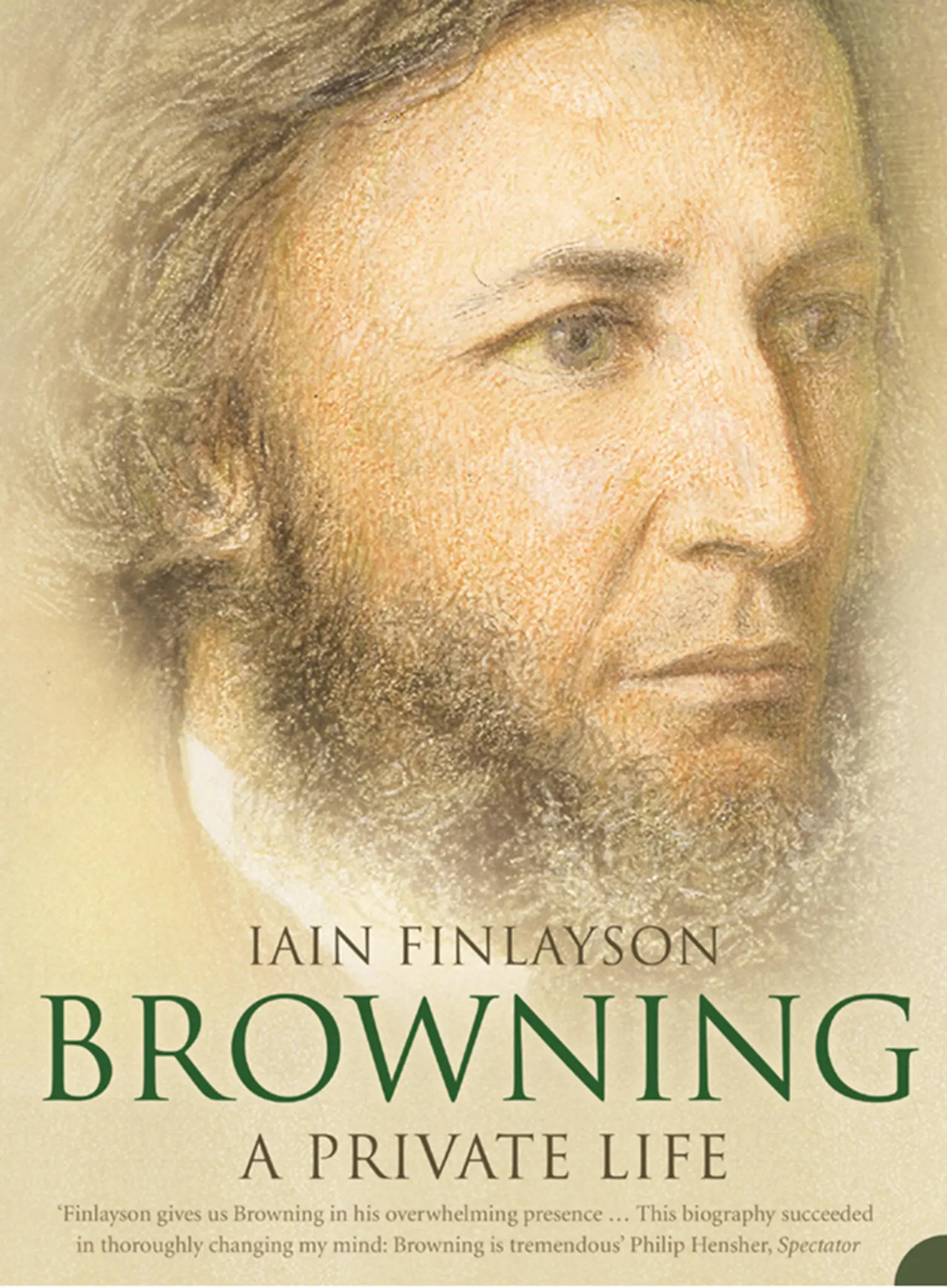
- Название:Browning
- Автор:
- Жанр:
- Год:неизвестен
- ISBN:нет данных
- Рейтинг книги:5 / 5. Голосов: 1
-
Избранное:Добавить в избранное
- Отзывы:
-
Ваша оценка:
Browning: краткое содержание, описание и аннотация
Предлагаем к чтению аннотацию, описание, краткое содержание или предисловие (зависит от того, что написал сам автор книги «Browning»). Если вы не нашли необходимую информацию о книге — напишите в комментариях, мы постараемся отыскать её.
Browning — читать онлайн ознакомительный отрывок
Ниже представлен текст книги, разбитый по страницам. Система сохранения места последней прочитанной страницы, позволяет с удобством читать онлайн бесплатно книгу «Browning», без необходимости каждый раз заново искать на чём Вы остановились. Поставьте закладку, и сможете в любой момент перейти на страницу, на которой закончили чтение.
Интервал:
Закладка:
Robert claimed Pauline to be ‘dramatic in principle’. It is gorgeous in imagery, but it is dramatic in the sense that a philosophical inquiry by Plato is dramatic: a scene is set; time, place, and characters are perfunctorily established before it proceeds to discussion of a moral crisis or conundrum and its resolution. The poem is of course—in view of Robert’s preoccupation with him—heavily influenced by Shelley (invoked in Pauline as ‘Sun-treader’ and ‘Apollo’). Scholarly consensus has it that the dramatic principle of Pauline is a lyrical narrative inspired by the form of Shelley’s Alastor , and deriving elements from that poet’s Epipsychidion . Robert Browning confesses his guilty history to Pauline, who is made privy to disappointing experiences in life and disappointed experiments with living—the poet’s loss of honour in disloyalty to all he held dear, to Pauline herself (who represents women he has loved, including his mother, representing familiar, comfortable domesticity), to a lapse from his inherited religious faith and the substituted creed of Shelley (who taught him to believe in men perfected as gods and the earth perfected as heaven), the sinking of the good estimation of his family (disappointed by his spurning of conventional education and a conventional career). It is a sorry catalogue, all in all.
The examination of the poet’s soul reveals the accumulation of guilt and regret, initially a cause of despair and self-doubt that gradually evolves into a more positive source of self-confidence and optimism. Robert, in the course of Pauline , heals himself, though his renewal necessarily involves an alteration in personal consciousness. To become what he is, it has been necessary to be what he was. On a note of self-definition, he relinquishes his Shelleyan delusions; he returns to his love of God (with some qualifications and reservations), to his love for Pauline (and her domestic virtues and comforts), to art (Shelley, the ‘Sun-treader’, is installed in the firmament—a star in eternity—his ideals renounced but his supremacy as a poet maintained), and to himself in the space he has cleared for future manoeuvre. Read autobiographically, rather than as art, Pauline probably did an effective therapeutic job for the poet; as art, the poem is generally agreed to be a precociously subjective failure.
Robert’s return to religion was not corseted by the narrow confines of Congregationalism. He sought out colourful, dramatic, evangelizing preachers whose theatricality appealed to his taste not merely for their rhetorical flourishes of eloquence, but for imaginative reasoning splendidly dressed with a generous garnish of allusions, references, myth, metaphor, and metaphysics. One of the most celebrated was William Johnson Fox himself, who spoke with a liberal tongue and conscience. Following on Fox’s review of Pauline , Robert paid an evening call at Stamford Grove West, near Dalston in Hackney, where he renewed acquaintance not only with Fox but with Eliza and Sarah Flower, both nearing thirty years of age, who were living with him as his wards after the death of their father in 1829.
They hardly recognized Robert after four years: now almost twenty-one years old, he was a sight to behold—becomingly whiskered, elegantly gloved and caped, drily witty. The sisters had read Pauline and were interested to see the author. Sarah, in a letter of June 1833, remarked to a cousin that the ‘poet boy’ had turned up, ‘very interesting from his great power of conversation and thorough originality, to say nothing of his personal appearance, which would be exceptionally poetic if nature had not served him an unkind trick in giving him an ugly nose’. 37 Quite what was wrong with Robert’s nose is not specified, though perhaps it was merely less ‘unmatured’ than the poet who, Sarah considered, ‘will do much better things’. Her estimation of Pauline was evidently more critical than that of her guardian, Mr Fox, though William Sharp suggests that the enthusiasm of the Flower sisters influenced Fox’s own partiality for the poem. Sarah herself wrote poetry, so probably knew what she was talking about, and she had doubtless discussed Pauline with her sister Eliza, who was acknowledged to be an excellent critic.
Eliza Flower makes only brief appearances in Mrs Orr’s Life and Letters of Robert Browning , but she acknowledges that, ‘If, in spite of his [Browning’s] denials, any woman inspired Pauline , it can have been no other than she.’ Vivienne Browning offers the alternative suggestion, in an essay, ‘The Real Identity of Pauline’, published in the Browning Society notes in 1983, that Robert might have had in mind his Aunt Jemima, only a year older than himself, described by Mrs Orr as ‘very amiable and, to use her nephew’s words, “as beautiful as the day”’. But whoever may have been the model for Pauline is hardly relevant: she was, as Mill understood, ‘a mere phantom’. Pauline was a womanly compound: if not Woman herself, she was at least a combination of friend, lover, Sophia, sister, mother, and even—since it is possible to identify some subtle adolescent homophile lines in the poem—the inspiration may sometimes, just as likely, have been Shelley as well as any woman. The point being, rather, that Robert probably felt some tender adolescent attraction to Eliza, who was nine years his elder—the first of the older women after his mother to engage his attentions and affections throughout his life. The poetic figure of Pauline, a mature figure of a woman with abundant dark hair and a rather sultry eroticism, very likely represented—personified—the sexual image, ideals, and desires that Robert was beginning to form for himself.
Eliza, who was in love with William Johnson Fox, was pleased to see Robert again, though her initial admiration was exceeded by his own self-admiration. She began to think, ‘he has twisted the old-young shoot off by the neck’ and that, ‘if he had not got into the habit of talking of head and heart as two separate existences, one would say that he was born without a heart’. At any rate, any prospect of romance between them was fairly improbable, though they continued to be friends. Ever afterwards, Robert maintained for Eliza a sentimental friendship that was rooted in loyalty to his admiration for her music, respect for her mind, and tender affection for her goodness. She died of consumption in 1846, the year of Robert’s marriage to Elizabeth Barrett.
For all Robert’s later repugnance for Pauline , for all his thwarted attempts to recover the copy of the book that Mill had written in, for all his reluctance to authorize any further publication even of extracts from it in his lifetime, for all his resistance to inclusion of an amended version of the poem in a collected edition of his work in 1868, and for all revisionist tinkerings with the poem to render it fit for an edition of 1888, his dissociation from it could never be complete. The secret of his authorship soon leaked out and, in fact, initially did him some good. It brought him at least some limited literary recognition (albeit of a mixed nature) and established something of a style that twenty years later was recognized by the young painter and poet Dante Gabriel Rossetti, who had read Browning’s Paracelsus and, coming across Pauline in the British Museum library, was astute enough to understand that it was by the hand of the same author—though he was careful enough to copy it out and ask for Browning’s confirmation of authorship, which Robert duly supplied. 38
Biographers of Browning now fall down a hole of unknowing for two years, pulling themselves back into the light of biographical day with some difficulty, finding occasional toeholds in scattered references throughout Browning’s later work that give clues to his activities from publication of Pauline in 1833 to publication of his next production, Paracelsus , in 1835. William Sharp suggests that during this period Robert began to go out and about in ‘congenial society’, specifically citing new acquaintance with ‘many well-known workers in the several arts’, 39 including Charles Dickens and Serjeant Thomas Noon Talfourd, a notable lawyer—the title ‘Serjeant’ derived from his position in the Inns of Court as a barrister—who was to publish Ion in 1836 and several more blank verse tragedies that do not much detain the attention of posterity but gave pleasure in their own time. Talfourd was then famous, nevertheless, for his wide acquaintance with literary men, later on account of his elevation to the judiciary and his work as a Member of Parliament in securing real protection for authors’ copyright, and always for his loquacity and conviviality.
Читать дальшеИнтервал:
Закладка:
Похожие книги на «Browning»
Представляем Вашему вниманию похожие книги на «Browning» списком для выбора. Мы отобрали схожую по названию и смыслу литературу в надежде предоставить читателям больше вариантов отыскать новые, интересные, ещё непрочитанные произведения.







Обсуждение, отзывы о книге «Browning» и просто собственные мнения читателей. Оставьте ваши комментарии, напишите, что Вы думаете о произведении, его смысле или главных героях. Укажите что конкретно понравилось, а что нет, и почему Вы так считаете.