Iain Finlayson - Browning
Здесь есть возможность читать онлайн «Iain Finlayson - Browning» — ознакомительный отрывок электронной книги совершенно бесплатно, а после прочтения отрывка купить полную версию. В некоторых случаях можно слушать аудио, скачать через торрент в формате fb2 и присутствует краткое содержание. Жанр: unrecognised, на английском языке. Описание произведения, (предисловие) а так же отзывы посетителей доступны на портале библиотеки ЛибКат.
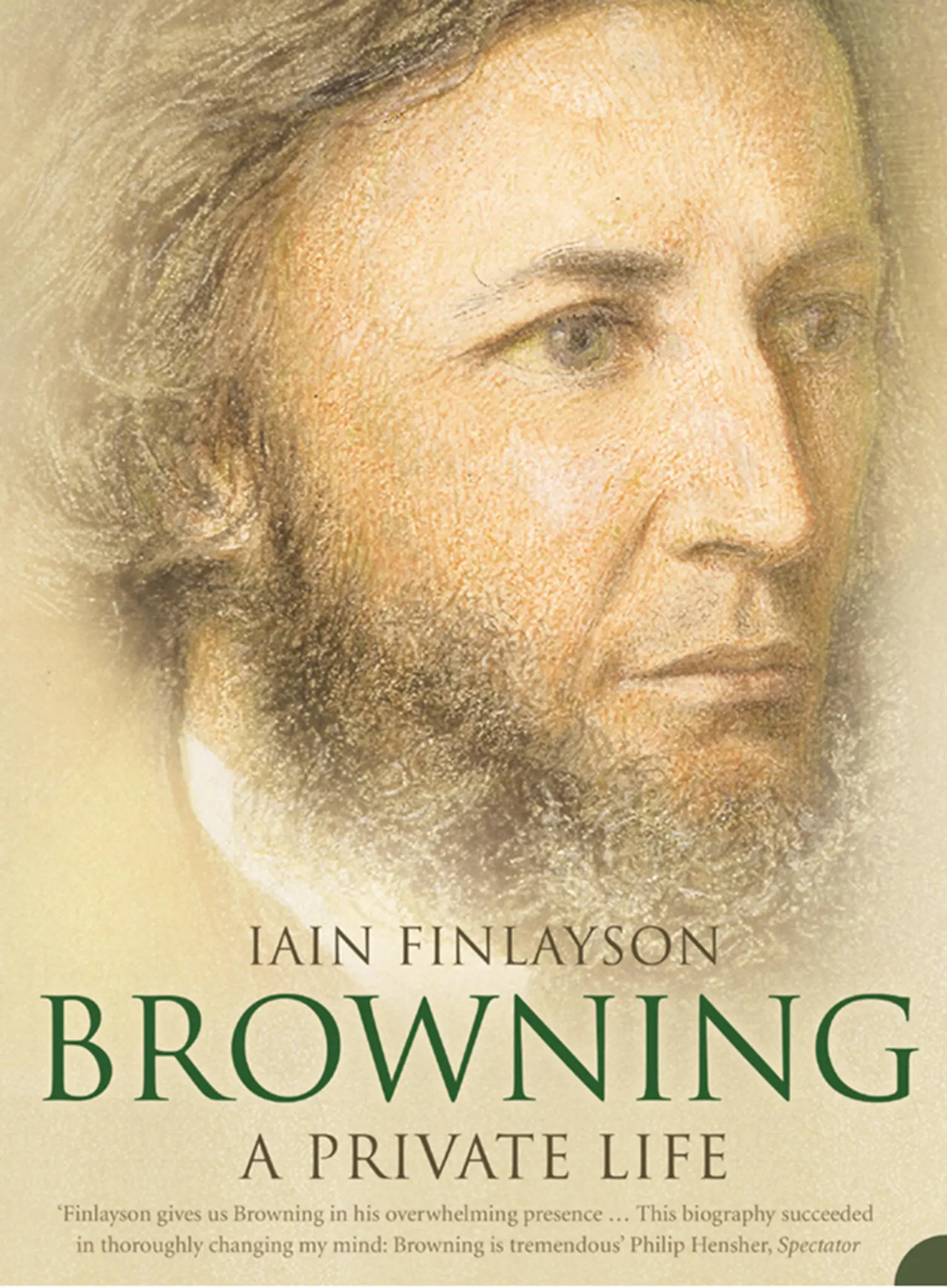
- Название:Browning
- Автор:
- Жанр:
- Год:неизвестен
- ISBN:нет данных
- Рейтинг книги:5 / 5. Голосов: 1
-
Избранное:Добавить в избранное
- Отзывы:
-
Ваша оценка:
Browning: краткое содержание, описание и аннотация
Предлагаем к чтению аннотацию, описание, краткое содержание или предисловие (зависит от того, что написал сам автор книги «Browning»). Если вы не нашли необходимую информацию о книге — напишите в комментариях, мы постараемся отыскать её.
Browning — читать онлайн ознакомительный отрывок
Ниже представлен текст книги, разбитый по страницам. Система сохранения места последней прочитанной страницы, позволяет с удобством читать онлайн бесплатно книгу «Browning», без необходимости каждый раз заново искать на чём Вы остановились. Поставьте закладку, и сможете в любой момент перейти на страницу, на которой закончили чтение.
Интервал:
Закладка:
If Robert did indeed meet Talfourd at this time, he would have been a good man for a young author to know—though Sharp says that Browning’s first reputation among such company was as an artist and musician rather than as a poet, and residence south of the river in remote, rural Camberwell made night engagements impracticable. During the day, says Sharp, Robert consulted works on philosophy and medical history in the British Museum Library and very often visited the National Gallery (unlikely, since that institution did not open until 1838). Certainly Robert was fortifying his friendships with men like Alfred Domett, Jim Silverthorne, his cheerful young uncle Reuben Browning (who was an elegant scholar of Latin and an accomplished horseman), and he may at this time have joined a circle of young men who clustered around a Captain Pritchard of Battersea, who had met Robert when he was sixteen and had introduced him to the medical lectures given at Guy’s Hospital by a cousin, Dr Blundell.
In the winter of 1833–4, at the age of twenty-one going on twenty-two, Robert found himself on an expedition to Russia, specifically to St Petersburg, nominally as secretary to the Chevalier de Benkhausen, the Russian consul-general in London. How on earth he wangled this trip, how on earth indeed he made the acquaintance in the first place of the Russian consul-general—who ‘had taken a great liking to him’ 40 —is not clear, though Mrs Orr says that ‘the one active career which would have recommended itself to him in his earlier youth was diplomacy … He would indeed not have been averse to any post of activity and responsibility not unsuited to the training of a gentleman.’
These remarks suggest that Robert was by then perhaps chafing and fretting at home even more than before and may have been thinking better of his decision to commit himself exclusively to poetry and financial dependence on his family. Mrs Orr does not spell out the reasons for this aspiration to diplomacy as a career, and there are no surviving letters from this period to add substance to speculation. William Shergold Browning worked as a Rothschild banker in Paris at this time, while his brother Reuben Browning, Robert’s favourite uncle, worked for Nathan Rothschild in the Rothschild London banking house. It is tempting to assume a connection between international banking and diplomacy that could have brought Robert to the attention of the consul-general. At any rate, there must have been some personal recommendation and introduction, more likely to have derived from a family connection than any other.
Of the Russian expedition, of its official purpose and its immediate personal importance for Robert, we know next to nothing: Robert wrote regularly and lengthily to Sarianna, but he burned the letters in later life. He set off with Benkhausen, say Griffin and Minchin, contradicting by a few months Mrs Orr’s version of an earlier, winter journey, on Saturday 1 March 1834. Early spring seems more likely; they would still be travelling through snow, but would reach Russia just as a thaw was setting in. They travelled, it is estimated, 1500 miles on horseback and by post carriage. In 1830, Stephenson’s Rocket, a marvel of modern technology, had made the first journey on the Liverpool to Manchester railway, and The General Steam Navigation Company operated a basic, bucketing, piston-thumping packet service from London to Ostend and Rotterdam; but there the transport system ran, literally, out of steam. ‘We know,’ says Mrs Orr, ‘how strangely he was impressed by some of the circumstances of the journey: above all by the endless monotony of snow-covered pine forest through which he and his companion rushed for days and nights at the speed of six post-horses, without seeming to move from one spot.’
‘How I remember the flowers—even grapes—of places I have seen!’ wrote Robert to a friend, Fanny Haworth, on 24 July 1838, ‘—some one flower or weed, I should say, that gets some strangehow connected with them. Snowdrops and Tilsit in Prussia go together’; and throughout Browning’s work there are associations of this sort that testify to the power of his memory for detail: ‘Wall and wall of pine’ and, from the poem ‘A Forest Thought’:
In far Esthonian solitudes
The parent firs of future woods
Gracefully, airily spire at first
Up to the sky, by the soft sand nurst …
and so on until he reached St Petersburg where he looked at pictures in the Hermitage, no doubt as thoroughly and with as critical an eye as at the Dulwich Gallery.
In a letter to Elizabeth Barrett, on 11 August 1845, Robert described a play he had written, in about 1843, entitled ‘Only a Player Girl’: ‘it was Russian, and about a fair on the Neva, and booths and droshkies and fish pies and so forth, with the Palaces in the background’. The play is not known to have survived either the destroying hand of time or that of the author. He says, furthermore, that at St Petersburg he met a Sir James Wylie who ‘chose to mistake me for an Italian—“M. l’Italien” he said another time, looking up from his cards.’ Others regularly made the same assumption, whether sincerely or satirically, taking their cue from Robert’s sallow-complexioned, dandified appearance. Another acquaintance in St Petersburg, say Griffin and Minchin, 41 was a King’s Messenger called Waring whose name Robert borrowed eight years later in Dramatic Lyrics to cover for the identity of Alfred Domett as the eponymous subject of the poem ‘Waring’ and imagined as,
Waring in Moscow, to those rough
Cold northern climes borne, perhaps.
Before leaving Russia, after an absence from England of some three months, Robert watched the solid ice crack on the frozen Neva and heard the boom of guns that accompanied the governor’s journey on the now navigable river to present a ceremonial goblet of Neva water to the tsar. ‘St Petersburg, no longer three isolated portions,’ say Griffin and Minchin, ‘was once more united, as the floating wooden bridges swung into place across the mighty stream, and the city was en fête ’. Robert, presumably delighting in Russian fairs, which may have occupied his interest rather more than Mrs Orr would have approved, kept an attentive and recording ear open to the music of Russia, folk songs in particular. Fifty years later in Venice, by the account of a friend, Katherine Bronson, he was able to recollect perfectly and accurately sing some of these songs to the elderly Prince Gagarin, a retired Russian diplomat, who exclaimed delightedly and wonderingly at Browning’s musical memory that, he declared, surpassed his own. 42
In Russia, and shortly after his return to London, Robert had not overlooked his poetic vocation: besides storing up materials for future work, he wrote a number of poems—notably the grimly dramatic monologue ‘Porphyria’s Lover’, with its quietly sensational last line; a sonnet, ‘A Forest Thought’, which most early Browning biographers and critics have passed by tight-lipped and with a sorrowful shake of the head; a song (beginning, ‘A King lived long ago …’) that he incorporated a few years later into Pippa Passes ; a lyric (beginning, ‘Still ailing, wind? Wilt be appeased or no?’) that was later introduced into the sixth section of ‘James Lee’ (in Dramatis Personæ ); and the poem ‘Johannes Agricola in Meditation’ (later published in Dramatic Lyrics ), which might be thought of, in its theme of Calvinistic predestination, as Browning’s equivalent of ‘Holy Willie’s Prayer’ by Robert Burns. All these were submitted to Fox’s Monthly Repository and accepted for publication. They appeared there, anonymously over the initial ‘Z’, from 1834 to 1836.
Whether to support his life as a poet or seriously to begin a diplomatic career, or simply to reinforce the independence that the visit to St Petersburg had probably aroused, Robert felt confident enough after his three months as aide or secretary, or whatever role he played in attendance to the Russian consul-general, to apply ‘for appointment on a mission which was to be despatched to Persia’. 43 He was disappointed to be passed over, the more so since the response to his application had, on a misreading, appeared to offer him the position which in fact—he learned only in the course of an interview with ‘the chief’—was offered to another man, whom Robert damned in a letter to Sarah Flower, suggesting that ‘the Right Hon. Henry Ellis etc., etc., may go to a hotter climate for a perfect fool—(that at Baghdad in October, 127 Fahrenheit in the shade)’. 44
Читать дальшеИнтервал:
Закладка:
Похожие книги на «Browning»
Представляем Вашему вниманию похожие книги на «Browning» списком для выбора. Мы отобрали схожую по названию и смыслу литературу в надежде предоставить читателям больше вариантов отыскать новые, интересные, ещё непрочитанные произведения.






Обсуждение, отзывы о книге «Browning» и просто собственные мнения читателей. Оставьте ваши комментарии, напишите, что Вы думаете о произведении, его смысле или главных героях. Укажите что конкретно понравилось, а что нет, и почему Вы так считаете.