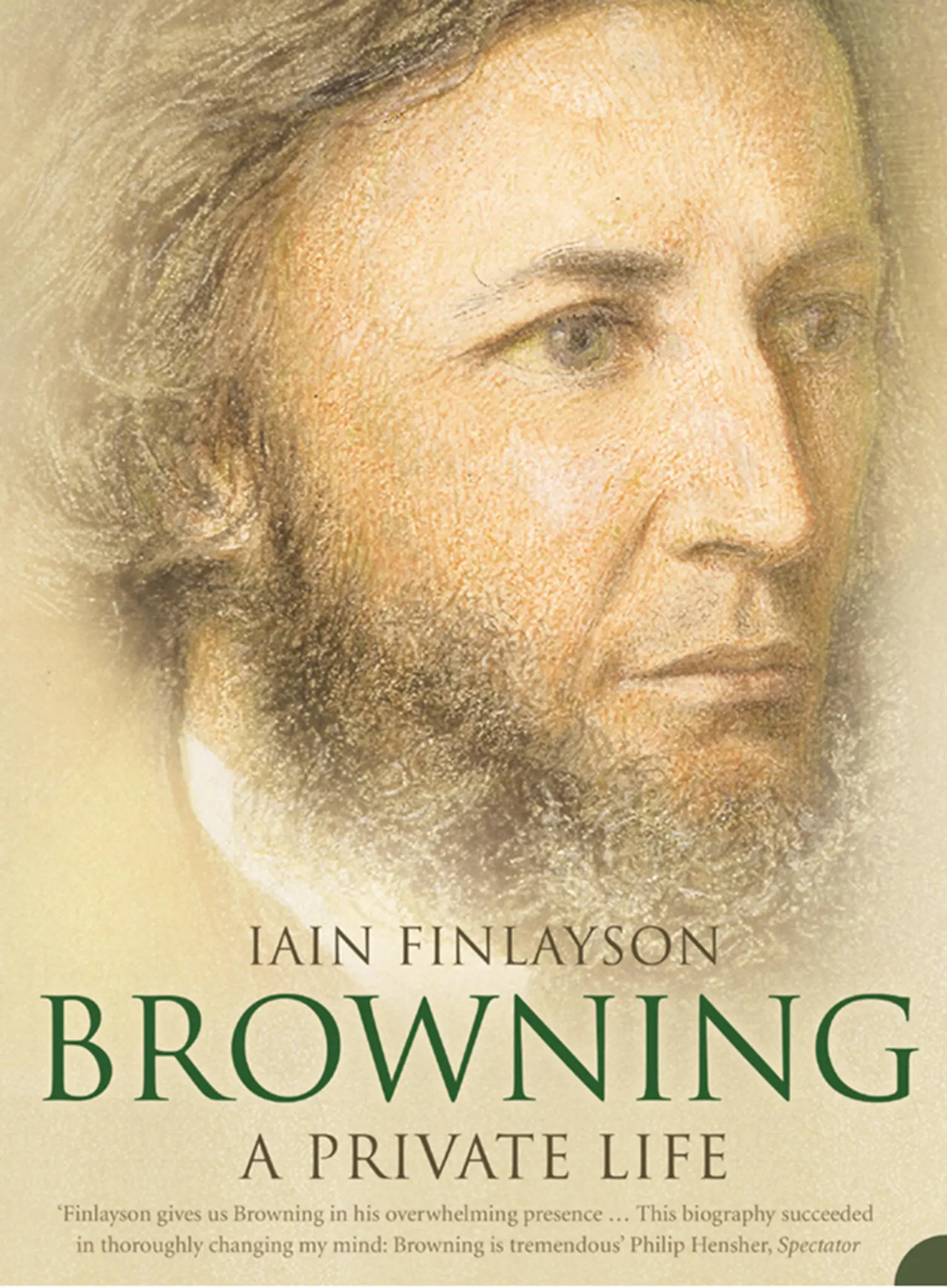
Iain Finlayson - Browning
Здесь есть возможность читать онлайн «Iain Finlayson - Browning» — ознакомительный отрывок электронной книги совершенно бесплатно, а после прочтения отрывка купить полную версию. В некоторых случаях можно слушать аудио, скачать через торрент в формате fb2 и присутствует краткое содержание. Жанр: unrecognised, на английском языке. Описание произведения, (предисловие) а так же отзывы посетителей доступны на портале библиотеки ЛибКат.
- Название:Browning
- Автор:
- Жанр:
- Год:неизвестен
- ISBN:нет данных
- Рейтинг книги:5 / 5. Голосов: 1
-
Избранное:Добавить в избранное
- Отзывы:
-
Ваша оценка:
Browning: краткое содержание, описание и аннотация
Предлагаем к чтению аннотацию, описание, краткое содержание или предисловие (зависит от того, что написал сам автор книги «Browning»). Если вы не нашли необходимую информацию о книге — напишите в комментариях, мы постараемся отыскать её.
Browning — читать онлайн ознакомительный отрывок
Ниже представлен текст книги, разбитый по страницам. Система сохранения места последней прочитанной страницы, позволяет с удобством читать онлайн бесплатно книгу «Browning», без необходимости каждый раз заново искать на чём Вы остановились. Поставьте закладку, и сможете в любой момент перейти на страницу, на которой закончили чтение.
Интервал:
Закладка:
His bold, informed defence of the poem had its effect: John Forster, in an article in the New Monthly Magazine and Literary Journal early in 1836, promoted Robert to Parnassus: ‘Without the slightest hesitation we name Mr Browning at once with Shelley, Coleridge, Wordsworth.’ A vacancy had recently occurred, since Samuel Taylor Coleridge had died in 1834. But Forster had needed little or no prompting from a sympathetic review by Fox. As chief dramatic and literary reviewer of the Examiner , he had already dealt generously with Paracelsus in that publication: ‘Since the publication of Philip von Artevelde ,’ he wrote, ‘we have met with no such evidences of poetic genius, and of general intellectual power, as are contained in this volume.’ Forster closed his review of Paracelsus with these words: ‘It is some time since we read a work of more unequivocal power than this. We conclude that its author is a young man, as we do not recollect his having published before.’ He was evidently, perhaps mercifully, unacquainted with Pauline , now immured in the British Museum Library. ‘If so, we may safely predict for him a brilliant career, if he continues true to the present promise of his genius. He possesses all the elements of a fine poet.’ Forster, unlike Fox, had not enjoyed the benefit of Robert Browning’s acquaintance, and his review is all the more valuable for that reason. He assumed Browning to be a young man, though it was difficult to tell from the poem itself: to repeat Chesterton’s line, Robert could have been anything between twenty and a thousand years old if the evidence of Paracelsus were the only criterion by which to judge his age.
Forster, says Mrs Orr, ‘knew that a writer in the Athenaeum had called it rubbish, and he had taken it up as a probable subject for a piece of slashing criticism’. A young critic (Forster was twenty-three years old in 1835, only five months younger than Browning) will sometimes adopt this tactic—an acknowledged means of getting on in literary society by bringing one’s own talent more prominently to the attention of fellow-critics, editors, and publishers than the work being reviewed. However, intending to bury Browning, Forster paused to praise, though ‘what he did write’, says Mrs Orr, ‘can scarcely be defined as praise. It was the simple, ungrudging admission of the unequivocal power, as well as brilliant promise, which he recognized in the work.’ 53 This in turn is perhaps a little grudging of Forster’s real recognition that here was a poet, perhaps not yet fully formed but promising great things. Robert himself, weighing the laurel crown awarded by Forster in the balance against the ashes heaped on his head by others, did not feel as pleased as he might otherwise have done if Forster’s had been but one voice amongst a full chorus singing in praiseful tune. Though he privately enjoyed the wholehearted applause of family and friends for his ‘private theatricals’, his public reception, now that he had put himself stage front, was more problematical.
Paracelsus was important to Robert. If Pauline had been a preview, in theatrical terms, the aspiring player would have performed to an empty house before being hooked off the stage by dissatisfied critics. But now—as he himself had written to Fox—this latest poem was his ‘first appearance on any stage’. It had been better, maybe, to start again and afresh. However, Robert specifically disclaimed in the preface any intention to promote Paracelsus as a drama or a dramatic poem. It was, he insisted, a poem and of a genre very different from that undertaken by any other poet. He warned critics off judging it ‘by principles on which it was never moulded’ and subjecting it ‘to a standard to which it was never meant to conform’.
What he meant by this was his intention ‘to reverse the method usually adopted by writers whose aim it is to set forth any phenomenon of mind or the passions by the operation of persons and events; and that, instead of having recourse to an external machinery of incidents to create and evolve the crisis I desire to produce, I have ventured to display somewhat minutely the mood itself in its rise and progress, and have suffered the agency by which it is influenced and determined, to be generally discernible in its effects along and subordinate throughout, if not altogether excluded.’
No doubt this sentence made his meaning entirely clear to his contemporaries. What in effect Browning did in Paracelsus was to divide the poem into five sections or scenes, each a monologue by Aureolus Paracelsus, ‘a student’, with occasional interruptions by three other characters—Festus and Michal, husband and wife, described as ‘his friends’, and Aprile, thought to be inspired by Shelley, described as ‘an Italian poet’. These three took the roles, mostly, of auditors and sometimes prompts, iterating his moods at a critical point in his life. In each section, Paracelsus examines the state of his own inner life. By means of the insights he successively gains, he is enabled to act.
Rather more clearly, in his preface to the poem, Browning defined its intended form: ‘I have endeavoured to write a poem, not a drama: the canons of the drama are well known, and I cannot but think that, inasmuch as they have immediate regard to stage representation, the peculiar advantages they hold out are really such only so long as the purpose for which they were first instituted is kept in view. I do not very well understand what is called a Dramatic Poem, wherein all those restrictions, only submitted to on account of compensating good in the original scheme are scrupulously retained, as though for some special fitness in themselves and all new facilities placed at an author’s disposal by the vehicle he selects, as pertinaciously rejected. It is certain, however, that a work like mine depends more immediately on the intelligence and sympathy of the reader for its success: indeed, were my scenes stars, it must be his co-operating fancy which, supplying all chasms, should connect the scattered lights into one constellation—a Lyre or a Crown.’
The poem is not notably dramatic, nor is it a linear narrative, nor is it lyric. It is light years away in its obscure allusions, recondite references, novel form, and difficult philosophy from the comparatively undemanding verse narratives of, say, Sir Walter Scott (who was nevertheless considered difficult even by some contemporary critics) or, for that matter, the familiar brio and theatricality of Byron’s verses. If it required strenuous mental effort from a perceptive critic, it stretched to incomprehension the limits of the common reader whom Browning, however flatteringly, expected to co-operate with him, engage with him, in the very creation of the poem. Paracelsus was, in the modern term, ‘interactive’—it depended, as Browning said in his preface, ‘more immediately on the intelligence and sympathy of the reader for its success’.
For the meantime, however, the common reader confirmed the most dolorous expectations of Moxon. The light-minded reader in 1835 preferred the sentimental verse of Laetitia Elizabeth Landon (who died in 1838 at the age of 36, styled herself in life for the purposes of authorship as ‘L.E.L.’, wrote several novels and copious poetry, attracted to herself a reputation for indecorous romantic attachments that caused her to break off her engagement to John Forster) and Felicia Dorothea Hemans (who was responsible in 1829 for the poem ‘Casabianca’ and its famous first line, ‘The boy stood on the burning deck …’); preferred, too, gift books of mawkish poetry, and other such comforting, easily digestible products, after-dinner bon-bons or bon-mots that demanded no effort or response more than an easy smile, a wistful sigh, a romantic tear or any momentary rush of unreflecting, commonplace feeling. Nothing but the most banal expression of sentimental emotion was likely to succeed in the market for new poetry. Robert accepted that a work such as Paracelsus , even if lucky enough to find a publisher ready to print it, would be not only a short-term casualty of the early nineteenth-century crisis in poetry publishing but even, in the long term, might stand more as a succès d’estime than as a source of short-term financial profit or a lasting resource of popular taste. It would have to be enough in the mid-1830s that a few discriminating readers should read Robert Browning and—so far as they were able—appreciate what he was trying to do and say.
Читать дальшеИнтервал:
Закладка:
Похожие книги на «Browning»
Представляем Вашему вниманию похожие книги на «Browning» списком для выбора. Мы отобрали схожую по названию и смыслу литературу в надежде предоставить читателям больше вариантов отыскать новые, интересные, ещё непрочитанные произведения.




Обсуждение, отзывы о книге «Browning» и просто собственные мнения читателей. Оставьте ваши комментарии, напишите, что Вы думаете о произведении, его смысле или главных героях. Укажите что конкретно понравилось, а что нет, и почему Вы так считаете.