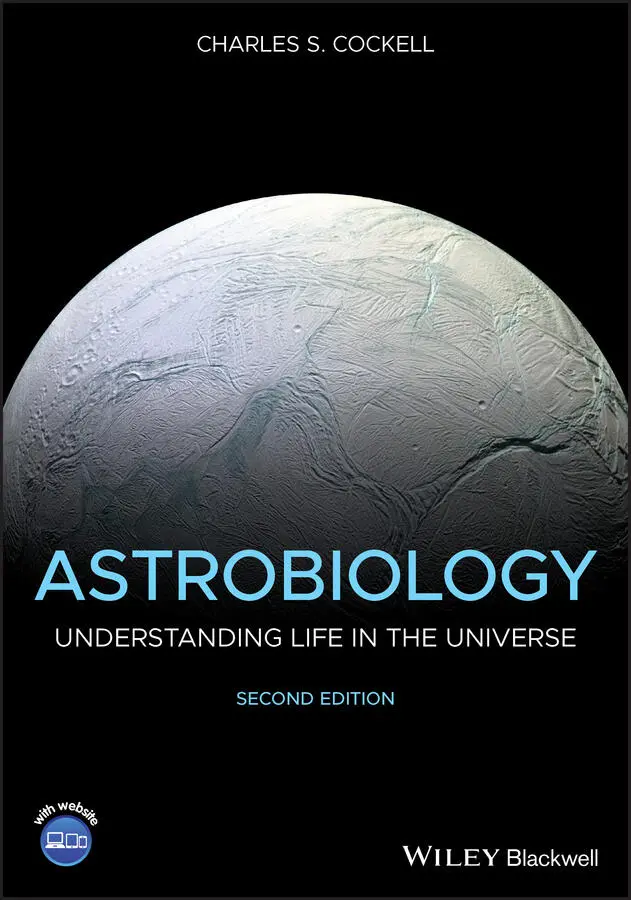
Charles S. Cockell - Astrobiology
Здесь есть возможность читать онлайн «Charles S. Cockell - Astrobiology» — ознакомительный отрывок электронной книги совершенно бесплатно, а после прочтения отрывка купить полную версию. В некоторых случаях можно слушать аудио, скачать через торрент в формате fb2 и присутствует краткое содержание. Жанр: unrecognised, на английском языке. Описание произведения, (предисловие) а так же отзывы посетителей доступны на портале библиотеки ЛибКат.
- Название:Astrobiology
- Автор:
- Жанр:
- Год:неизвестен
- ISBN:нет данных
- Рейтинг книги:3 / 5. Голосов: 1
-
Избранное:Добавить в избранное
- Отзывы:
-
Ваша оценка:
Astrobiology: краткое содержание, описание и аннотация
Предлагаем к чтению аннотацию, описание, краткое содержание или предисловие (зависит от того, что написал сам автор книги «Astrobiology»). Если вы не нашли необходимую информацию о книге — напишите в комментариях, мы постараемся отыскать её.
offers an introductory text that explores the structure of living things, the formation of the elements required for life in the Universe, the biological and geological history of the Earth, and the habitability of other planets. Written by a noted expert on the topic, the book examines many of the major conceptual foundations in astrobiology, which cover a diversity of traditional fields including chemistry, biology, geosciences, physics, and astronomy.
The book explores many profound questions such as: How did life originate on Earth? How has life persisted on Earth for over three billion years? Is there life elsewhere in the Universe? What is the future of life on Earth?
is centered on investigating the past and future of life on Earth by looking beyond Earth to get the answers. Astrobiology links the diverse scientific fields needed to understand life on our own planet and, potentially, life beyond. This new second edition:
Expands on information about the nature of astrobiology and why it is useful Contains a new chapter “What is Life?” that explores the history of attempts to understand life Contains 20% more material on the astrobiology of Mars, icy moons, the structure of life, and the habitability of planets New ‘Discussion Boxes’ to stimulate debate and thought about key questions in astrobiology New review and reflection questions for each chapter to aid learning New boxes describing the careers of astrobiologists and how they got into the subject Offers revised and updated information throughout to reflect the latest advances in the field Written for students of life sciences, physics, astronomy and related disciplines, the updated edition of
is an essential introductory text that includes recent advances to this dynamic field.
Astrobiology — читать онлайн ознакомительный отрывок
Ниже представлен текст книги, разбитый по страницам. Система сохранения места последней прочитанной страницы, позволяет с удобством читать онлайн бесплатно книгу «Astrobiology», без необходимости каждый раз заново искать на чём Вы остановились. Поставьте закладку, и сможете в любой момент перейти на страницу, на которой закончили чтение.
Интервал:
Закладка:
1 Bedau, M.A. and Cleland, C.E. (2018). The Nature of Life. Cambridge: Cambridge University Press.
2 Crick, F. (1981). Life Itself: Its Origin and Nature. New York: Simon & Shuster.
3 Maynard-Smith, J. (1986). The Problems of Biology. Oxford: Oxford University Press.
4 Schrödinger, E. (2012). What is Life? Cambridge: Cambridge University Press (originally published in 1944).
Papers
1 Bains, W. (2014). What do we think life is? A simple illustration and its consequences. International Journal of Astrobiology 13: 101–111.
2 Bedau, M.A. (1998). Four puzzles about life. Artificial Intelligence 4: 125–140.
3 Benner, S.A. (2010). Defining life. Astrobiology 10: 1021–1030.
4 Chao, L. (2000). The meaning of life. BioScience 50: 245–250.
5 Cleland, C.E. and Chyba, C.F. (2002). Defining “life.”. Origins of Life and Evolution of the Biosphere 32: 387–393.
6 Conrad, P.G. and Nealson, K.H. (2001). A non-earthcentric approach to life detection. Astrobiology 1: 15–24.
7 Fleischaker, G.R. (1990). Origins of life: an operational definition. Origins of Life and Evolution of the Biosphere 20: 127–137.
8 Koonin, E.V. (2012). Defining life: an exercise in semantics or a route to biological insights? Journal of Biomolecular Structure and Dynamics 29: 603–605.
9 Lange, M. (1996). Life, “artificial life,” and scientific explanation. Philosophy of Science 63: 225–244.
10 Machery, E. (2012). Why I stopped worrying about the definition of life … and why you should as well. Synthese 185: 145–164.
11 Mariscal, C. and Doolittle, W.F. (2018). Life and life only: a radical alternative to life definitionism. Synthese. https://doi.org/10.1007/s11229-018-1852-2.
12 Mix, L.J. (2015). Defending definitions of life. Astrobiology 15: 15–19.
13 Moreira, D. and López-García, P. (2009). Ten reasons to exclude viruses from the tree of life. Nature Reviews Microbiology 7: 306–311.
14 Nealson, K.H., Tsapin, A., and Storrie-Lombardi, M. (2002). Search for life in the universe: unconventional methods for an unconventional problem. International Microbiology 5: 223–230.
15 Ruiz-Mirazo, K., Peretó, J., and Moreno, A. (2004). A universal definition of life: autonomy and open-ended evolution. Origins of Life and Evolution of the Biosphere 34: 323–346.
16 Tsokolov, S.A. (2009). Why is the definition of life so elusive? Epistemological considerations. Astrobiology 9: 401–412.
17 Varela, F., Maturana, H., and Uribe, R. (1974). Autopoiesis: the organization of living systems. Biosystems 5: 187–196.
3 Matter and Life
Learning Outcomes
Understand the concept of atoms, ions, and molecules and their basic structure.
Be able to describe and explain different bonding types: ionic, covalent, metallic, van der Waals interactions, and hydrogen bonding.
Understand and give examples of the role of these bonding types in biological systems.
Understand phase diagrams and the unusual characteristics of the water phase diagram.
Understand how phase diagrams can be used to understand planetary environments and their suitability for liquid water.
Describe extreme states of matter, including plasma and degenerate matter.
Understand some of the interactions between matter and light that are important to astrobiology.
Be able to calculate the energy, frequency, and wavelength of light absorbed or emitted for given energy level changes of electrons in atoms and thus the implications for absorption and emission spectroscopy of stars and exoplanets.
3.1 Matter and Life
At the heart of our understanding of physical processes in the Universe, including the principles that govern the assembly of life, is our knowledge about the structure of matter. The structure of matter, including the interactions of atoms and molecules, may not seem to be directly linked to astrobiology. However, to understand how the molecules of life are assembled, we need to understand how atoms associate and the types of associations that occur. Ultimately, it is the binding between individual atoms, ions, and molecules that results in the complex array of structures we call life.
Knowledge of the structure of matter can also provide us with a basis to question how universal the characteristics of life might be. Are all living things, if they exist elsewhere, made in the same way?
A grasp of the structure of matter is also enormously helpful for understanding why biological systems are constructed in particular ways. Why don't organisms make widespread use of solid metals in their assembly? How does a gecko attach to a window? How are the two strands of the genetic material DNA put together? These questions, which might seem detached and even obscure, will be answered by the end of this chapter. You will discover that what unites these questions is an understanding of the bonding between atoms, ions, and molecules, and how those bonds are used to perform certain tasks in living things.
The application of this information to astrobiology is that it allows you to go beyond what seem to be parochial Earth-based questions into the underlying principles that govern living things.
3.2 Life Is Made of “Ordinary” Matter
The matter from which stars, planets, and life are made is probably less than 5% of all the matter in the Universe. That may come as a surprise. Most of the rest of the matter of the Universe is thought to be in more elusive forms such as Dark Matter. The properties of so-called Dark Matter are not known, but this matter was hypothesized to exist to explain certain properties of galaxies, such as their rotation, that cannot be explained without assuming there is a lot more matter in the Universe than the 5% we are familiar with. It is called Dark Matter because of its apparent lack of interaction with electromagnetic radiation (which is one factor that makes it difficult to detect).
In addition, Dark Energyis an elusive form of energy thought to permeate the Universe and has been hypothesized to exist to complete theories about the expansion rate of the Universe. These other types of matter and energy that are thought to exist in the Universe are cosmological areas of science that are hugely interesting. However, as far as we know, they have no direct relevance to life, although of course they are thought to influence the characteristics of the Universe in which life exists.
We will not consider these other forms of matter further in this textbook. Instead, this whole book focuses on the part of the Universe that we call ordinary matter or baryonic matter. It is usually just called “matter.”
The basic building blocks of matter are atoms, themselves constructed from subatomic particles. An atom has a nucleus, which is surrounded by electrons. Apart from hydrogen, which has a single proton, the nucleus of atoms is made of two subatomic particles: protons, which are positively charged, and neutrons, which have no charge. They have very small masses: the proton is 1.672 × 10 −27kg; the neutron is 1.675 × 10 −27kg. Protons and neutrons are themselves made of elementary particles, called quarks. An elementary particle is a particle that cannot be broken down any further, so they represent the basic building blocks, if you like, of matter. Quarks fall into the domain of the scientific field of particle physics. Although, like the cosmological questions raised earlier, this is an enormously interesting area of science, we will not spend any more time on it here. The electrons that surround the nucleus are negatively charged and they are elementary particles (Figure 3.1).
Читать дальшеИнтервал:
Закладка:
Похожие книги на «Astrobiology»
Представляем Вашему вниманию похожие книги на «Astrobiology» списком для выбора. Мы отобрали схожую по названию и смыслу литературу в надежде предоставить читателям больше вариантов отыскать новые, интересные, ещё непрочитанные произведения.









Обсуждение, отзывы о книге «Astrobiology» и просто собственные мнения читателей. Оставьте ваши комментарии, напишите, что Вы думаете о произведении, его смысле или главных героях. Укажите что конкретно понравилось, а что нет, и почему Вы так считаете.