Charles S. Cockell - Astrobiology
Здесь есть возможность читать онлайн «Charles S. Cockell - Astrobiology» — ознакомительный отрывок электронной книги совершенно бесплатно, а после прочтения отрывка купить полную версию. В некоторых случаях можно слушать аудио, скачать через торрент в формате fb2 и присутствует краткое содержание. Жанр: unrecognised, на английском языке. Описание произведения, (предисловие) а так же отзывы посетителей доступны на портале библиотеки ЛибКат.
- Название:Astrobiology
- Автор:
- Жанр:
- Год:неизвестен
- ISBN:нет данных
- Рейтинг книги:3 / 5. Голосов: 1
-
Избранное:Добавить в избранное
- Отзывы:
-
Ваша оценка:
Astrobiology: краткое содержание, описание и аннотация
Предлагаем к чтению аннотацию, описание, краткое содержание или предисловие (зависит от того, что написал сам автор книги «Astrobiology»). Если вы не нашли необходимую информацию о книге — напишите в комментариях, мы постараемся отыскать её.
offers an introductory text that explores the structure of living things, the formation of the elements required for life in the Universe, the biological and geological history of the Earth, and the habitability of other planets. Written by a noted expert on the topic, the book examines many of the major conceptual foundations in astrobiology, which cover a diversity of traditional fields including chemistry, biology, geosciences, physics, and astronomy.
The book explores many profound questions such as: How did life originate on Earth? How has life persisted on Earth for over three billion years? Is there life elsewhere in the Universe? What is the future of life on Earth?
is centered on investigating the past and future of life on Earth by looking beyond Earth to get the answers. Astrobiology links the diverse scientific fields needed to understand life on our own planet and, potentially, life beyond. This new second edition:
Expands on information about the nature of astrobiology and why it is useful Contains a new chapter “What is Life?” that explores the history of attempts to understand life Contains 20% more material on the astrobiology of Mars, icy moons, the structure of life, and the habitability of planets New ‘Discussion Boxes’ to stimulate debate and thought about key questions in astrobiology New review and reflection questions for each chapter to aid learning New boxes describing the careers of astrobiologists and how they got into the subject Offers revised and updated information throughout to reflect the latest advances in the field Written for students of life sciences, physics, astronomy and related disciplines, the updated edition of
is an essential introductory text that includes recent advances to this dynamic field.
Astrobiology — читать онлайн ознакомительный отрывок
Ниже представлен текст книги, разбитый по страницам. Система сохранения места последней прочитанной страницы, позволяет с удобством читать онлайн бесплатно книгу «Astrobiology», без необходимости каждый раз заново искать на чём Вы остановились. Поставьте закладку, и сможете в любой момент перейти на страницу, на которой закончили чтение.
Интервал:
Закладка:
One characteristic of life is its capacity for evolution (intriguingly it does not feature in the MRS GREN mnemonic taught to school pupils, but it is common in many other discussions on the requirements for something to be classified as alive). Evolution is meant here in the Darwinian sense, namely the process by which variation in a population of organisms, placed under environmental conditions, results in the selection of surviving organisms that pass their traits onto subsequent generations (“natural selection”). Attempts to capture the concept of evolution are a common theme in definitions of life. The combination of evolution, growth, and reproduction is bound up in one definition devised by NASA scientist Gerald Joyce that life is “a self-sustained chemical system capable of undergoing Darwinian evolution.”
However, we might question whether a shopping list of characteristics really is sufficient to circumscribe what life is and thus whether a definition based on these characteristics can provide a clear-cut separation between life and non-life. Consider some of the proposed characteristics of life exemplified by the MRS GREN mnemonic. Movement is exhibited by life, but many non-biological processes also exhibit movement, such as a tornado (Figure 2.6).
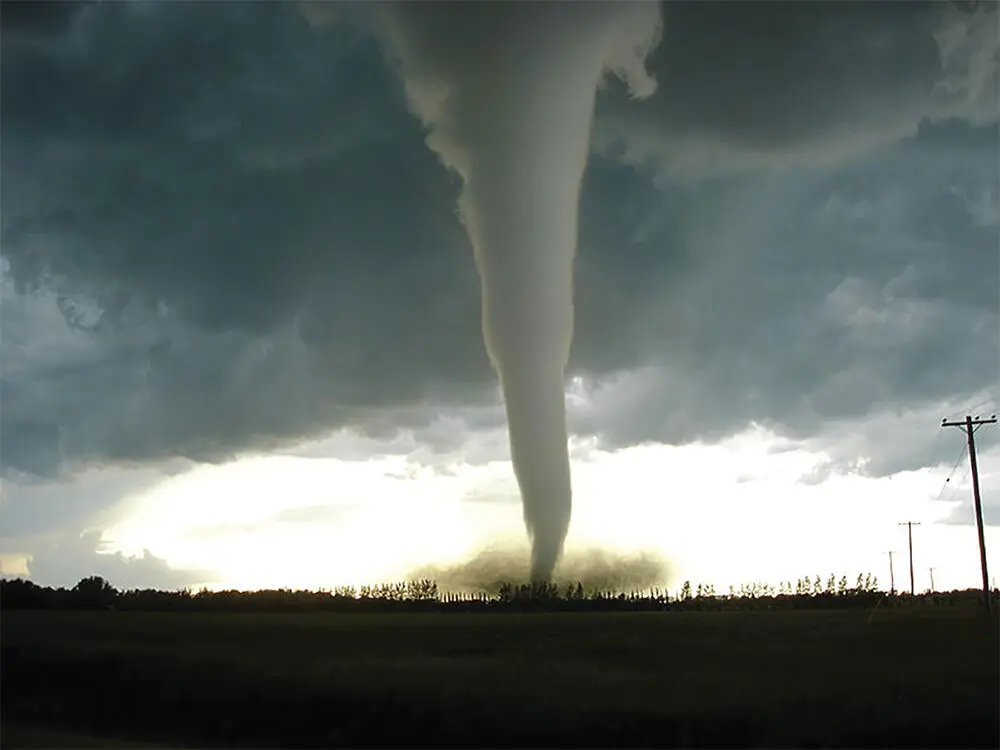
Figure 2.6 Complexity in matter. A tornado, such as this one in Manitoba, Canada, exhibits certain characteristics often associated with life, such as movement and rudimentary “sensitivity” to changes in its environment.
Source: Reproduced with permission of Justin Hobson, https://commons.wikimedia.org/wiki/File:F5_tornado_Elie_Manitoba_2007.jpg.
Respiration might seem intuitively biological, but fires, in a rudimentary way, “respire” organic material. They burn organic carbon in oxygen to produce waste products: carbon dioxide and water. The chemical reaction involved in this process is identical to aerobic respiration used to produce energy in some types of life; the only difference is that the reaction is biochemically controlled in life and uncontrolled in fires (Figure 2.7).
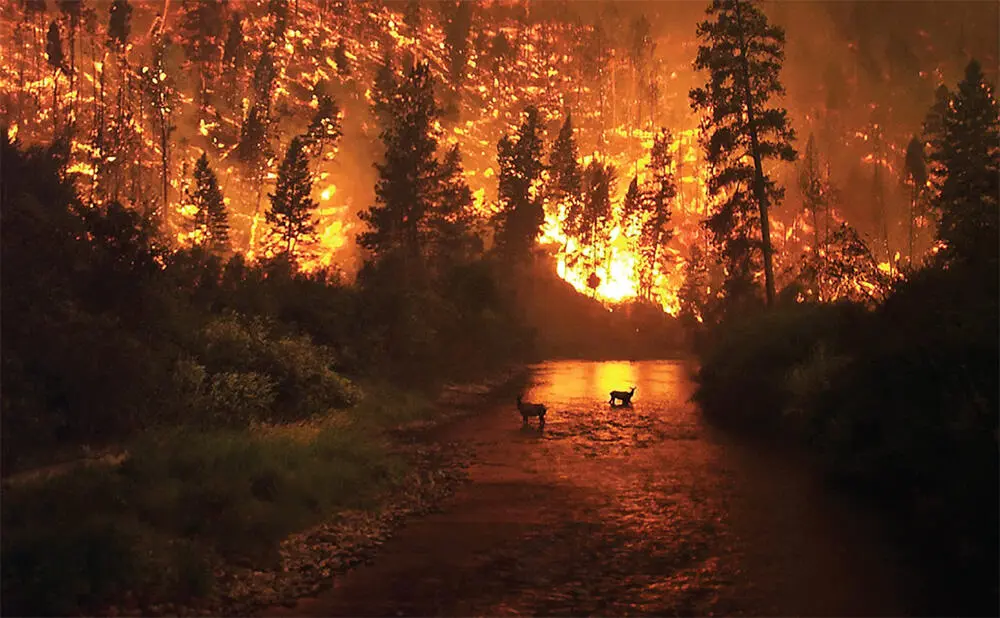
Figure 2.7 A wildfire burns organic carbon in oxygen to produce carbon dioxide and water in an identical chemical reaction performed by respiring animals.
Sensitivity is a highly equivocal term. What do we mean by this? If we mean response to external stimuli, then many abiotic systems are sensitive to changes in the natural environment around them, tornados providing yet another example of a complex system that is sensitive to changing weather and climatic perturbations.
Growth is not unique to life. Salt crystals, when exposed to the appropriate conditions, such as a saturated salt solution, can grow (Figure 2.8).
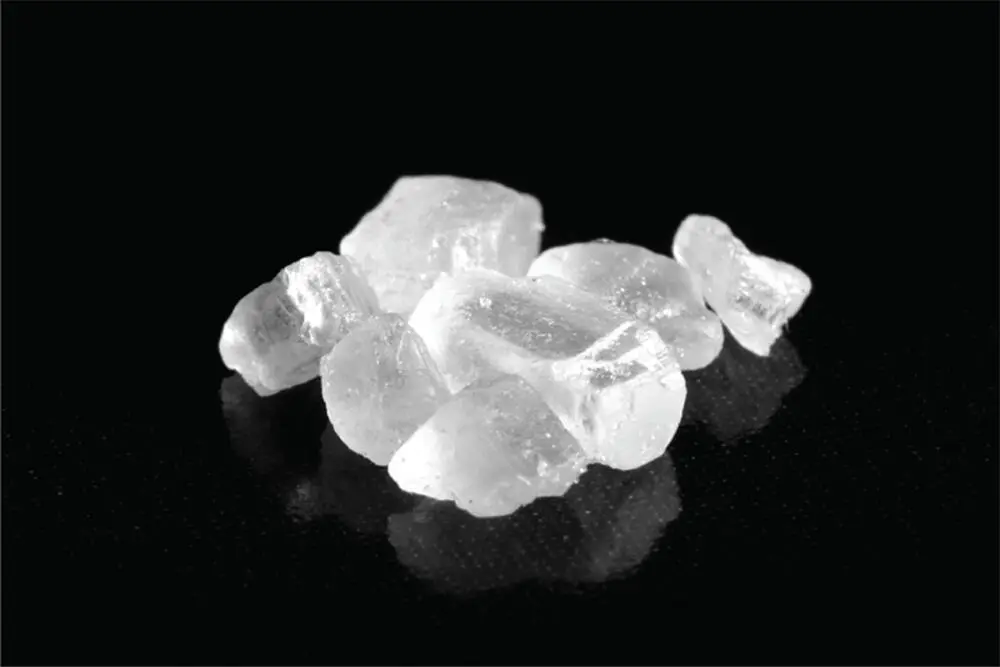
Figure 2.8 Life grows, but crystals do as well. These salt (NaCl) crystals can grow if they are placed in a saturated salt solution.
Source: Reproduced with permission of Mark Schellhase, https://commons.wikimedia.org/wiki/User:Mschel#/media/File:Salt_Crystals.JPG.
Reproduction is a more obviously biological trait. However, molecules made in the laboratory, such as ribonucleic acid (RNA)molecules, can reproduce, but most people would not describe them as alive. Excretion too is an equivocal term since chemical reactions produce products, wastes if you like, that are “excreted” from chemical systems. Nutrition is the uptake of reactants that can be viewed in purely chemical terms.
Evolution, considered broadly, need not necessarily be uniquely biological. Even computer programs can be made to evolve in a rudimentary sense – their outputs are selected by a defined numerical environment and used to generate the next set of outputs, changing in response to their digital environment. Although in this case, the “evolution” is overseen by advanced creatures who themselves are a product of evolution. Some people might say that such computers and their programs are biosignatures. Even if we were to create androids that exhibit all the characteristics of life, they would still be made by human beings, who are the products of Darwinian evolution, making even the most advanced self-aware android a biosignature and not a living thing in its own right.
Human beings themselves, through their capacity to genetically remove diseases from the human genome and their increasing attempts to control the onslaught of the microbial world, are putting themselves outside many of the factors that once selected them in a Darwinian sense. Does that mean as we weaken the grip of Darwinian evolution, we are putting ourselves outside the definition of life? I suspect we would think that these technologies have little bearing on whether we are alive.
Many of these characteristics are incorporated into attempts to define life. The first part of Joyce's definition that life is a “self-sustained chemical system” recognizes the characteristic of respiration, excretion, and nutrition, and the second part – “capable of undergoing Darwinian evolution” – recognizes its evolutionary capacity.
In addition to finding non-biological examples of each of life's characteristics, we can find entities made of the molecules that we associate with living things, but which fail to exhibit characteristics that we associate with most life. For example, virusescontain nucleic acidsand proteins, the molecules of life, so why would they be excluded from the category of living things? One reason is that viruses, such as influenza viruses, are particles that require a host to replicate, taking over cell machinery to reproduce themselves (Figure 2.9). As they cannot reproduce on their own, they lack the characteristic of reproduction, often considered to be a defining characteristic of life. Many people prefer to call them “biological particles” or some such word or phrase that captures the idea that they are made up of molecules associated with life, but are not life.
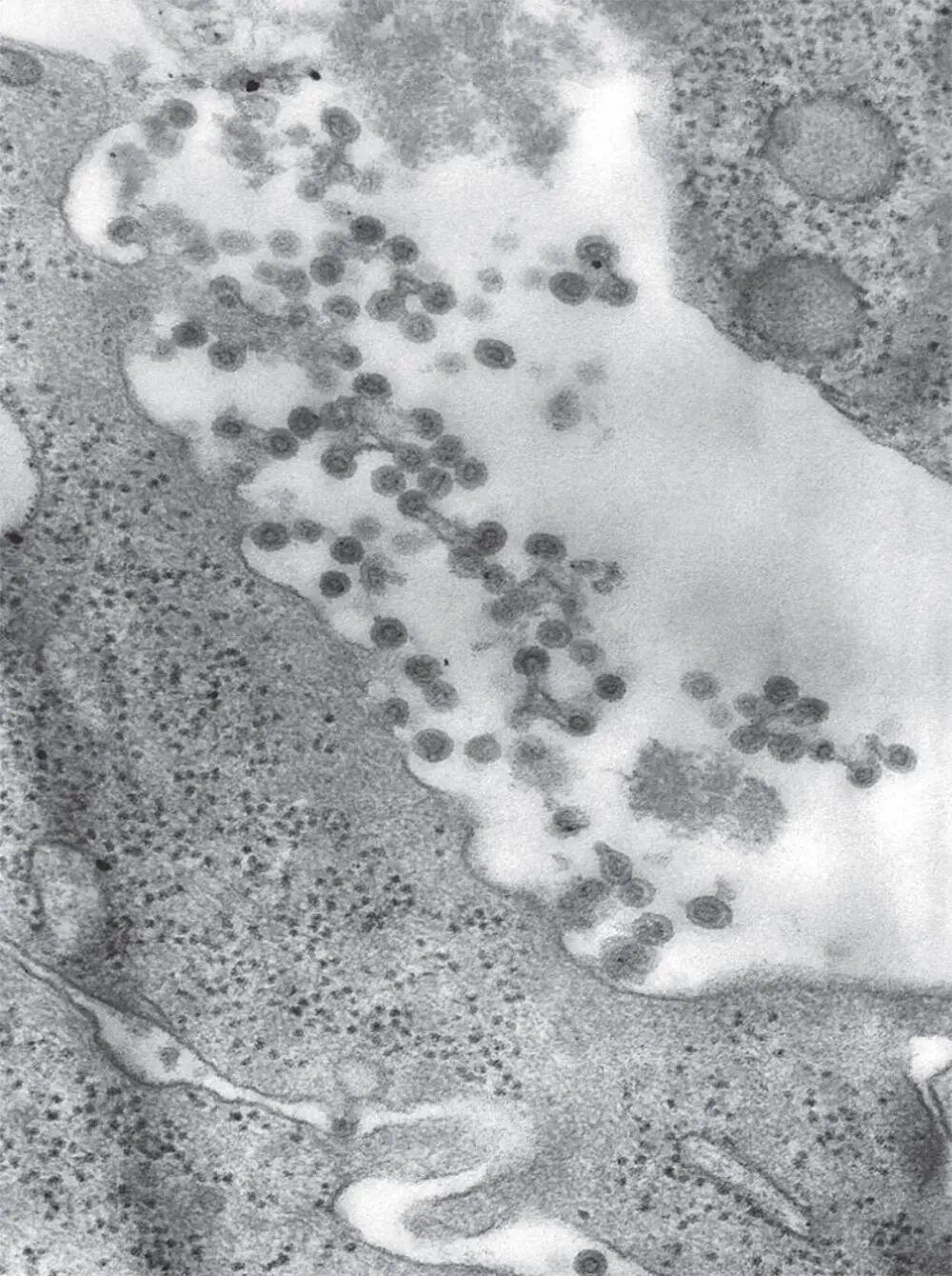
Figure 2.9 Viruses as biological entities. A virus cannot reproduce on its own. It requires a cell within which to replicate. This is exemplified by these Rubella virus particles (center) budding from host cell tissue (lower left and upper right) and visualized as stained material using a transmission electron microscope. Some people consider that this places viruses outside a definition of life.
Source: Reproduced with permission of Dr. Fred Murphy and Sylvia Whitfield, https://commons.wikimedia.org/wiki/File:Rubella_virus_10221_lores.jpg.
The problem with excluding viruses is that the same argument can easily be applied to other organisms that we do think are alive. What about a rabbit? Like a virus, it cannot replicate on its own. It requires another rabbit. Is a rabbit on its own dead, but only a living thing when it has found a mate? What about you? You cannot reproduce on your own. If you are single, does that make you dead? I think you'd disagree. Another example would be sterile animals, such as a mule (Figure 2.10), which cannot reproduce even if they do find a mate. Very quickly we arrive at a reductio ad absurdum and the discussion goes nowhere.
Читать дальшеИнтервал:
Закладка:
Похожие книги на «Astrobiology»
Представляем Вашему вниманию похожие книги на «Astrobiology» списком для выбора. Мы отобрали схожую по названию и смыслу литературу в надежде предоставить читателям больше вариантов отыскать новые, интересные, ещё непрочитанные произведения.




Обсуждение, отзывы о книге «Astrobiology» и просто собственные мнения читателей. Оставьте ваши комментарии, напишите, что Вы думаете о произведении, его смысле или главных героях. Укажите что конкретно понравилось, а что нет, и почему Вы так считаете.