Siegfried Siegesmund - Monument Future
Здесь есть возможность читать онлайн «Siegfried Siegesmund - Monument Future» — ознакомительный отрывок электронной книги совершенно бесплатно, а после прочтения отрывка купить полную версию. В некоторых случаях можно слушать аудио, скачать через торрент в формате fb2 и присутствует краткое содержание. Жанр: unrecognised, на немецком языке. Описание произведения, (предисловие) а так же отзывы посетителей доступны на портале библиотеки ЛибКат.
- Название:Monument Future
- Автор:
- Жанр:
- Год:неизвестен
- ISBN:нет данных
- Рейтинг книги:4 / 5. Голосов: 1
-
Избранное:Добавить в избранное
- Отзывы:
-
Ваша оценка:
Monument Future: краткое содержание, описание и аннотация
Предлагаем к чтению аннотацию, описание, краткое содержание или предисловие (зависит от того, что написал сам автор книги «Monument Future»). Если вы не нашли необходимую информацию о книге — напишите в комментариях, мы постараемся отыскать её.
Alle vier Jahre treffen sich auf einer internationalen Tagung Experten, die sich mit den entsprechenden Sachfragen beschäftigen. Der „14th International Congress on the Deterioration and Conservation of Stone“ findet im September 2020 in Göttingen statt. Er ist die wichtigste Veranstaltung zur Verbreitung des Wissens von Praktikern und Forschern, die im Bereich der Steinkonservierung zur Erhaltung des baulichen Kulturerbes arbeiten: Geowissenschaftler, Architekten, Bauspezialisten, Ingenieure, Restauratoren, Denkmalpfleger und Bauherren.
Der Tagungsband mit über 150 wissenschaftlichen Beiträgen repräsentiert und erfasst den neuesten Stand der Technik auf diesem Gebiet.
Themen sind:
– Charakterisierung von Schadensphänomenen von Steinen und verwandten Baumaterialien (Stuck, Putz, Mörtel usw.)
– Methoden zur Untersuchung des Steinverfalls in situ und zerstörungsfreie Prüfung
– Langzeitüberwachung von Steindenkmälern und Gebäuden
– Simulation und Modellierung des Zerfalls
– Technologien und Entwicklung verbesserter Bearbeitung und Verwendung von Stein in Neubauten
– Bewertung der Langzeitwirkung von Bearbeitungstechniken
– Auswirkungen des Klimawandels auf die Steinverwitterung des Kulturerbes
– Berichte zur Steinkonservierung: Fallstudien und Projekte
– Digitalisierung und Dokumentation von Steinkonservierung
–
The 14th International Congress on the Deterioration and Conservation of Stone, entitled MONUMENT FUTURE: DECAY AND CONSERVATION OF STONE is a quadrennial event that brings together a world-wide community of geoscientists, architects, building specialists, engineers, conservators, restorators, monument curators and building owners who are concerned about the conservation of cultural stone structures and objects. Since antiquity, the weathering and deterioration of historical buildings, masonry, monuments, sculptures etc. using natural stones has been a very well-known problem.
This conference is the main gathering for the dissemination of knowledge in the field of stone deterioration issues. It represents and captures the state-of-the-art in the field of stone conservation and cultural heritage conservation with regards to the following topics:
– Characterisation of damage phenomena of stone and related building materials (plaster, rendering, mortar etc.)
– Methods for the investigation of stone decay; in-situ and non-destructive testing
– Long-term monitoring of stone monuments and buildings
– Simulation and modelling of decay
– Technology and development of improved treatments and use of stone in new buildings
– Assessment of long-term effects of treatments
– Impact of climate change on stone decay of Cultural Heritage
– Reports about stone conservation: case studies and projects
– Digitalization and documentation in stone conservation
Monument Future — читать онлайн ознакомительный отрывок
Ниже представлен текст книги, разбитый по страницам. Система сохранения места последней прочитанной страницы, позволяет с удобством читать онлайн бесплатно книгу «Monument Future», без необходимости каждый раз заново искать на чём Вы остановились. Поставьте закладку, и сможете в любой момент перейти на страницу, на которой закончили чтение.
Интервал:
Закладка:
The most recent restoration works were performed in 2016. Biological crust and cracked mortars were removed, and unstable elements were secured. Water-repelling treatment was applied in the last phase of the restoration.
248 
Figure 4: Fuente de Cibeles after the Spanish Civil War; a: Photograph, c. 1941. Ornamental jets. Vertical jet without flint rock covering the water-spouts; b: Photograph, c. 1941. Landscaped area around the fountain; c: Photograph, c. 1960. Night lighting.
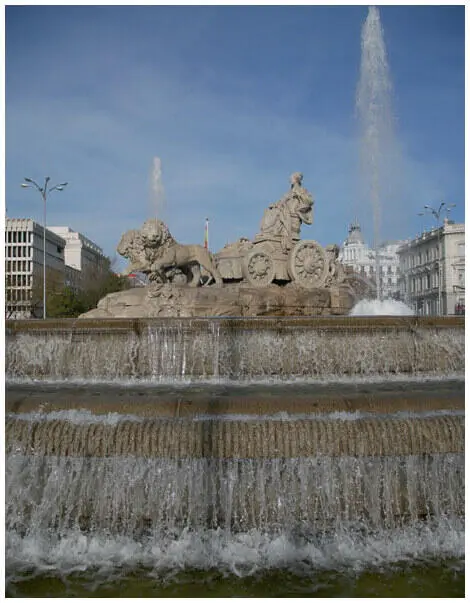
Figure 5: Current appearance of Fuente de Cibeles .
Materials and Methods
Montesclaros is located approximately 140 km from Fuente de Cibeles and approximately 15 km north of Talavera de la Reina (Toledo). The marbles are very coarse to coarse-grained (crystal size up to 5 mm) and predominantly white, white-bluish in colour. In addition, there are gray, blue-gray, cream, pink and cream marbles.
Alterated marble stones have been extracted from a historic Montesclaros quarry. Samples have been extracted at 5, 10 and 15 mm from their surface (M1, M2, and M3 respectively). These samples have been cut to measure Hg intrusion porosimetry, colorimetry and for thin sections.
Petrographic Microscopy (PM)
Two thin sections of M1, M2 and M3 were observed under a polarisation microscope Leica DM 4500 P, equipped with a digital FireWire Camera Leica DFC 290 HD that worked with the Leica application suite software LAS 4.
Linear microcrack density (LMD) was calculated as the number of microcracks per millimetre. It was found for the first 5 mm from the surface to the inside of another thin section (M4) by counting the number of microcracks intersecting a line of 5 mm.
Mercury Intrusion Porosimetry (MIP)
The micropore size distribution was measured by mercury intrusion porosimetry (MIP; Pascal 140 and Pascal 440 from Thermo Scientific) using irregular samples (ca. 1.0 g).
The analysis was run on M1, M2 and M3 samples oven-dried to a constant weight at 70 °C.
249 Colour
After oven-drying at 70 °C to a constant weight, 15 colour measurements were taken in each sample, and the mean for each sample were calculated. Afterwards each sample was submerged in water for an hour and 20 colour measurements were taken again in the wet samples. The colour was assessed with an X-Rite colorimeter (model 964), with 45°/0° geometry and specular component included, D65 illuminant and 8 mm aperture. Colour was expressed using the three chromatic coordinates of CIE-L*a*b* system. The colour difference (ΔE*) between the dry and wet state was calculated for each sample.
Results and Discussion
Petrographically, Montescaros marble is dolomitic with crystals visible to the naked eye with coarse equigranular blasts and granoblastic texture. The blasts’ boundaries are very sinuous, and microcrystals fill cracks and blast boundaries (Fig. 6).
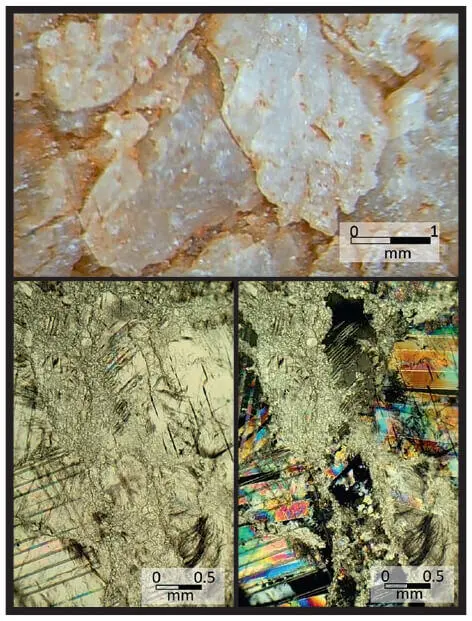
Figure 6: Montesclaros marble. a: Altered surface. b: Parallel Nicol microscopic image. c: Crossed Nicol microscopic image.
The porosity is very low. Fig. 7 shows the pore size distribution for the three samples M1 = 0.09 %, M2 = 0.29 %, M3 = 1.46 %.
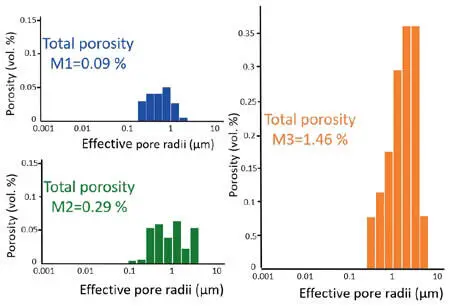
Figure 7: Montesclaros marble. Pore size distribution determined by MIP for three tested Montesclaros marble samples (M1, M2 and M3).
LMD decresses with the depth. LMD = 17 in the first millimeter and LMD = 9 in the fourth millimeter. The rhombohedral crystals that M4 presents on the surface are due to the alteration, which accentuates the rhombohedral exfoliation, decreasing the equidistance between the microcracks (Fig. 8, red ellipse).
The alteration produces a reduction in the luminosity of the marble. Marble becomes more yellow and red ( table 1). The colour difference (ΔE) between dry and wet state has been 18.0, 14.1 and 12.3 for M1, M2 and M3 respectively.
Table 1: Colour parameters of M1, M2 and M3 L*: lightness; a*: red-green value; b*: blue-yellow value.
| Dry color | |||
| L* | a* | b* | |
| M1 | 82.3 ± 1.8 | 0.7 ± 0.2 | 4.8 ± 0.6 |
| M2 | 76.6 ± 1.6 | 1.9 ± 0.8 | 8.2 ± 1.5 |
| M3 | 72.9 ± 1.5 | 1.9 ± 0.6 | 8.5 ± 1.4 |
| Wet color | |||
| L* | a* | b* | |
| M1 | 64.4 ± 15.3 | 0.8 ± 0.2 | 6.7 ± 0.6 |
| M2 | 63.6 ± 2.8 | 2.9 ± 0.9 | 13.5 ± 1.6 |
| M3 | 61.2 ± 2.5 | 2.2 ± 0.9 | 12.3 ± 1.9 |
Conclusions
Knowledge of stones, historic quarries, modifications suffered in the monuments and causes of 250stone decay are necessary for conservation interventions, especially for reintegration and replacing the original stone with compatible materials.
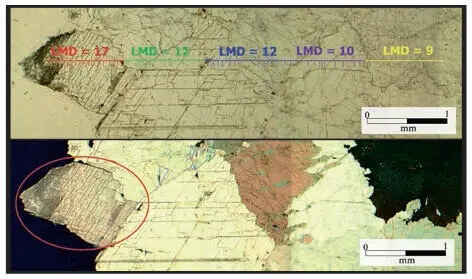
Figure 8: PM micrograph mosaics of Montesclaros marble (M4 sample) above: parallel Nicols. A 5 mm line indicates the LMD. below: crossedNicols. A red ellipse indicates the tightly rhombohedral exfoliation in the most superficial part of the sample.
Fuente de Cibeles was originally at ground level, protected by 20 granite bollards.
All water-spouts and bollards were removed in 1862, and a perimeter cast-iron fence was installed.
The monument was moved, rotated and raised in 1895 and the rocky platform was expanded to add two putti.
A hand, the keys, the sceptre and the nose of the goddess Cybele were damaged and restored in 1931. The left lion lost its snout and suffered damage to the left front leg and tail in 1936.
The perimeter fence was removed after the Spanish Civil War and the perimeter of the fountain was landscaped. Two granite basins with cascading water from the upper basin to the new external basins were added and the flint rock covering the base of the rocky promontory was removed in 1968. The last restoration was in 2016.
The dissolution of the smaller calcite crystals that border the dolomite crystals causes increased porosity, colour change and superficial disintegration of the blasts.
Tightly rhombohedral exfoliation is in the most superficial part of the alterated sample.
Acknowledgements
Stimulus of Scientific Employment Individual Support 2017. CEECIND/03568/2017. Fundação para a Ciência e a Tecnologia of Portugal (FCT).
References
Bednarik M., Moshammer B., Heinrich M., et al. 2014. Engineering geological properties of Leitha Limestone from historical quarries in Burgenland and Styria, Austria. Eng Geol doi: 10.1016/j.enggeo.2014.04.005.
Читать дальшеИнтервал:
Закладка:
Похожие книги на «Monument Future»
Представляем Вашему вниманию похожие книги на «Monument Future» списком для выбора. Мы отобрали схожую по названию и смыслу литературу в надежде предоставить читателям больше вариантов отыскать новые, интересные, ещё непрочитанные произведения.











Обсуждение, отзывы о книге «Monument Future» и просто собственные мнения читателей. Оставьте ваши комментарии, напишите, что Вы думаете о произведении, его смысле или главных героях. Укажите что конкретно понравилось, а что нет, и почему Вы так считаете.