Siegfried Siegesmund - Monument Future
Здесь есть возможность читать онлайн «Siegfried Siegesmund - Monument Future» — ознакомительный отрывок электронной книги совершенно бесплатно, а после прочтения отрывка купить полную версию. В некоторых случаях можно слушать аудио, скачать через торрент в формате fb2 и присутствует краткое содержание. Жанр: unrecognised, на немецком языке. Описание произведения, (предисловие) а так же отзывы посетителей доступны на портале библиотеки ЛибКат.
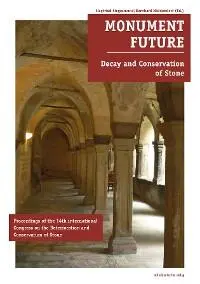
- Название:Monument Future
- Автор:
- Жанр:
- Год:неизвестен
- ISBN:нет данных
- Рейтинг книги:4 / 5. Голосов: 1
-
Избранное:Добавить в избранное
- Отзывы:
-
Ваша оценка:
Monument Future: краткое содержание, описание и аннотация
Предлагаем к чтению аннотацию, описание, краткое содержание или предисловие (зависит от того, что написал сам автор книги «Monument Future»). Если вы не нашли необходимую информацию о книге — напишите в комментариях, мы постараемся отыскать её.
Alle vier Jahre treffen sich auf einer internationalen Tagung Experten, die sich mit den entsprechenden Sachfragen beschäftigen. Der „14th International Congress on the Deterioration and Conservation of Stone“ findet im September 2020 in Göttingen statt. Er ist die wichtigste Veranstaltung zur Verbreitung des Wissens von Praktikern und Forschern, die im Bereich der Steinkonservierung zur Erhaltung des baulichen Kulturerbes arbeiten: Geowissenschaftler, Architekten, Bauspezialisten, Ingenieure, Restauratoren, Denkmalpfleger und Bauherren.
Der Tagungsband mit über 150 wissenschaftlichen Beiträgen repräsentiert und erfasst den neuesten Stand der Technik auf diesem Gebiet.
Themen sind:
– Charakterisierung von Schadensphänomenen von Steinen und verwandten Baumaterialien (Stuck, Putz, Mörtel usw.)
– Methoden zur Untersuchung des Steinverfalls in situ und zerstörungsfreie Prüfung
– Langzeitüberwachung von Steindenkmälern und Gebäuden
– Simulation und Modellierung des Zerfalls
– Technologien und Entwicklung verbesserter Bearbeitung und Verwendung von Stein in Neubauten
– Bewertung der Langzeitwirkung von Bearbeitungstechniken
– Auswirkungen des Klimawandels auf die Steinverwitterung des Kulturerbes
– Berichte zur Steinkonservierung: Fallstudien und Projekte
– Digitalisierung und Dokumentation von Steinkonservierung
–
The 14th International Congress on the Deterioration and Conservation of Stone, entitled MONUMENT FUTURE: DECAY AND CONSERVATION OF STONE is a quadrennial event that brings together a world-wide community of geoscientists, architects, building specialists, engineers, conservators, restorators, monument curators and building owners who are concerned about the conservation of cultural stone structures and objects. Since antiquity, the weathering and deterioration of historical buildings, masonry, monuments, sculptures etc. using natural stones has been a very well-known problem.
This conference is the main gathering for the dissemination of knowledge in the field of stone deterioration issues. It represents and captures the state-of-the-art in the field of stone conservation and cultural heritage conservation with regards to the following topics:
– Characterisation of damage phenomena of stone and related building materials (plaster, rendering, mortar etc.)
– Methods for the investigation of stone decay; in-situ and non-destructive testing
– Long-term monitoring of stone monuments and buildings
– Simulation and modelling of decay
– Technology and development of improved treatments and use of stone in new buildings
– Assessment of long-term effects of treatments
– Impact of climate change on stone decay of Cultural Heritage
– Reports about stone conservation: case studies and projects
– Digitalization and documentation in stone conservation
Monument Future — читать онлайн ознакомительный отрывок
Ниже представлен текст книги, разбитый по страницам. Система сохранения места последней прочитанной страницы, позволяет с удобством читать онлайн бесплатно книгу «Monument Future», без необходимости каждый раз заново искать на чём Вы остановились. Поставьте закладку, и сможете в любой момент перейти на страницу, на которой закончили чтение.
Интервал:
Закладка:
De Wever P., Baudin F., Pereira D., Cornée A., Egoroff G., Page K. 2016. The importance of Geosites and Heritage Stones in Cities. Geoheritage doi: 10.1007/s12371-016-0210-3.
López de Azcona M. C., Fort González R., Mingarro Martín F. 2002. Conservation of the stone in Cibeles Fountain, Madrid (Spain). Materiales de construcción doi: 10.3989/mc.2002.v52.i265.345.
Luque A., Cultrone G., Mosch S., Siegesmund, S., Sebastian, E., Leiss B. 2010. Anisotropic behaviour of White Macael marble used in the Alhambra of Granada (Spain): The role of thermohydric expansion in stone durability. Eng Geol doi: 10.1016/j.enggeo.2009.06.015.
Ondrasina J., Kirchner D., Siegesmund S. 2002. Freeze–thaw cycles and their influence on marble deterioration: a long-term experiment, Geological Society, vol 205. Special Publications, London, pp 9–18.
Siegesmund S., Török A. 2011. Building stones. In: Siegesmund S, Snethlage R (eds) Stone in architecture-properties, durability. Springer, Berlin, Heidelberg. Pp. 11–96. Doi: 10.1007/978-3-642-14475-2_2.
251
WATER CONTENT ESTIMATION USING NON-DESTRUCTIVE TOOLS APPLIED TO ARCHAEOLOGICAL MATERIALS
Oriol Sánchez Rovira 1, 2, 3, 4, David Giovannacci 1, 2, Jean-Didier Mertz 1, 2, Jérôme Wassermann 3, Béatrice Ledésert 4, Ronan Hébert 4, Yannick Mélinge 3
IN: SIEGESMUND, S. & MIDDENDORF, B. (EDS.): MONUMENT FUTURE: DECAY AND CONSERVATION OF STONE.
– PROCEEDINGS OF THE 14TH INTERNATIONAL CONGRESS ON THE DETERIORATION AND CONSERVATION OF STONE –
VOLUME I AND VOLUME II. MITTELDEUTSCHER VERLAG 2020.
1LRMH, Laboratoire de Recherche des Monuments Historiques, Ministère de la Culture et de la Communication, 29 rue de Paris, 77420 Champs-sur-Marne, France
2Centre de Recherche sur la Conservation (CRC), Muséum national d’Histoire naturelle, CNRS, Ministère de la Culture, 36 rue Geoffroy Saint Hilaire, 75005 Paris, France
3L2MGC ; Laboratoire de Mécanique et Matériaux du Génie Civil-EA4114, CY Cergy Paris Université, 5 mail Gay Lussac, Neuville sur Oise 95031 Cergy-Pontoise, France
4GEC, Laboratoire Géosciences et Environnement Cergy, EA 4506, CY Cergy Paris Université, 1 rue Descartes, Neuville sur Oise 95031 Cergy-Pontoise, France
Abstract
Water content in stone is of primary relevance for the preservation of cultural heritage. High water content promotes the development of microorganisms and causes mechanical or physico-chemical alterations by swelling/shrinkage or dissolution/recrystallization of salt. The identification and then the control of the water transfer remain important to assess the risk of damage. A good prediction of the water content helps to develop some preventive action dedicated to the conservation of Heritage.
The most accurate methods to measure water content require sampling and can only exceptionally be used. Few methods are non-destructive, but their accuracies are often limited.
The aim of this study concerns the application of Non-Destructive Technics (NDT) to determine the water distribution within the building masonry, in particular the infrared imaging and electrical method.
The electrical method enables to image the spatial and/or temporal variation of the electrical properties related to the water content distribution in the materials while infrared thermography provides the boundary limit conditions by the means of surface thermograms. Those methods are performed for several samples used as building materials in the archeological site of Vaux de la Celle (Genainville, France). The site concentrates various structures built between the 2nd and 4th century AD. The temple structure is constructed at the lowest part of the valley with its foundations in direct contact with the vadose zone where the water table fluctuates. Reproducibility and reliability are also provided through several experimental configurations.
Introduction
The damage of the stone building materials is closely related to change in the equilibrium between the stone and the atmosphere. Thus, instabilities introduced by the environmental variations are the driving force of stone damage. In such cases, the biggest threats to the stone are related to those 252cyclic factors (Benavente et al., 2008), which are related to water and heat transfer.
The patterns of stone deterioration (ICOMOS ISCS, 2008) depend on the nature of the material and the weathering processes and are mainly linked with water content in its different aspects as its spatial and temporal distribution.
The most common methods used to characterize water content and distribution within the porous materials need sampling in order to determine it by gravimetry (EN 16682, 2017). However, for heritage building, due to the invasive nature of the direct measurements approach it is better to use indirect non-destructive methods to characterize the water content.
Indirect methods analyze the variation of a physical property and/or quantity of the materials which can be exploited to characterize moisture content. Nuclear magnetic resonance (NMR), evanescent-field dielectrometry (EFD) (V. Di Tullio et al., 2010), infrared thermography and electrical resistivity surveys are the most common indirect non-destructive methods of sensing the water content of porous media.
Infrared thermography allows to image the temperature map of the surface of the materials. Depending on endogenic or exogenic conditions, the temperature of the damped areas may vary from the dried parts. These thermal behaviors make the infrared thermography a powerful imaging method to make qualitative measurements of water content distribution. However, because the relationship between temperature and water content is highly affected by the material properties and the environmental conditions, quantitative measurements need calibration curves generated through controlled laboratory conditions (Grinzato et al., 2011).
Resistivity methods are mostly used in geophysical survey for geological and archaeological applications. However, since they monitor the resistance of the material to the passage of an electric current, it can be applied to characterize water content in porous building materials. Indeed, this resistance is directly influenced by water content, its salinity, its temperature, as well as by its distribution within the pore network (Hassine et al., 2018). As for the infrared imaging method, due to the complex relationship between the different parameters affecting the resistivity measurements, quantitative analysis needs prior calibration data.
Thanks to resistivity imaging methods providing volumetric information, and infrared thermography providing information from surface, the combination of the two methods can provide complementary information to characterize water content and its distribution.
The work presented in this paper is dedicated to highlight the complementarity of the infrared and electric imaging methods. Such methods are used to characterize water content variations in limestone from an archeological site. The final goal is to establish the basis of a non-destructive method-based water content characterization protocol in situ .
Materials
The stone samples used in this research come from a Gallo-Roman temple which is part of the greater archaeological complex of Vaux-de-la-Celle located in the bottom of a valley at 60 km at the north west of Paris.
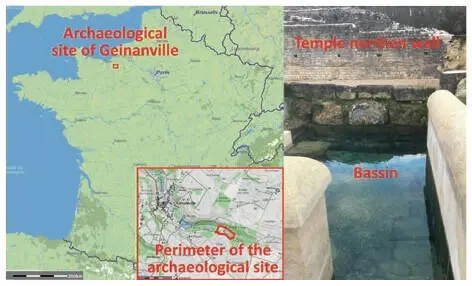
Figure 1: Archaeological site location.
The main structures of this archaeological site (theatre, sanctuary, basins…) were erected during the 2nd century A. D. (Vermeersch, 2009). The particular hydrogeological context characterizing this archaeological site is the presence of a water table that appears to be at or near the ground surface level in the lower topographical area of the valley where the sanctuary complex is erected (BRGM, 2531974). Since the foundations of the Temple might be in direct contact with the ground water, the erected parts of the structure are affected by capillary rise phenomena. Thus, from all major structures it has been chosen to analyze the limestone material from the Temple, which is the most representative building material of the walls from the architectural complex constituting the sacred area.
Читать дальшеИнтервал:
Закладка:
Похожие книги на «Monument Future»
Представляем Вашему вниманию похожие книги на «Monument Future» списком для выбора. Мы отобрали схожую по названию и смыслу литературу в надежде предоставить читателям больше вариантов отыскать новые, интересные, ещё непрочитанные произведения.







Обсуждение, отзывы о книге «Monument Future» и просто собственные мнения читателей. Оставьте ваши комментарии, напишите, что Вы думаете о произведении, его смысле или главных героях. Укажите что конкретно понравилось, а что нет, и почему Вы так считаете.