Siegfried Siegesmund - Monument Future
Здесь есть возможность читать онлайн «Siegfried Siegesmund - Monument Future» — ознакомительный отрывок электронной книги совершенно бесплатно, а после прочтения отрывка купить полную версию. В некоторых случаях можно слушать аудио, скачать через торрент в формате fb2 и присутствует краткое содержание. Жанр: unrecognised, на немецком языке. Описание произведения, (предисловие) а так же отзывы посетителей доступны на портале библиотеки ЛибКат.
- Название:Monument Future
- Автор:
- Жанр:
- Год:неизвестен
- ISBN:нет данных
- Рейтинг книги:4 / 5. Голосов: 1
-
Избранное:Добавить в избранное
- Отзывы:
-
Ваша оценка:
Monument Future: краткое содержание, описание и аннотация
Предлагаем к чтению аннотацию, описание, краткое содержание или предисловие (зависит от того, что написал сам автор книги «Monument Future»). Если вы не нашли необходимую информацию о книге — напишите в комментариях, мы постараемся отыскать её.
Alle vier Jahre treffen sich auf einer internationalen Tagung Experten, die sich mit den entsprechenden Sachfragen beschäftigen. Der „14th International Congress on the Deterioration and Conservation of Stone“ findet im September 2020 in Göttingen statt. Er ist die wichtigste Veranstaltung zur Verbreitung des Wissens von Praktikern und Forschern, die im Bereich der Steinkonservierung zur Erhaltung des baulichen Kulturerbes arbeiten: Geowissenschaftler, Architekten, Bauspezialisten, Ingenieure, Restauratoren, Denkmalpfleger und Bauherren.
Der Tagungsband mit über 150 wissenschaftlichen Beiträgen repräsentiert und erfasst den neuesten Stand der Technik auf diesem Gebiet.
Themen sind:
– Charakterisierung von Schadensphänomenen von Steinen und verwandten Baumaterialien (Stuck, Putz, Mörtel usw.)
– Methoden zur Untersuchung des Steinverfalls in situ und zerstörungsfreie Prüfung
– Langzeitüberwachung von Steindenkmälern und Gebäuden
– Simulation und Modellierung des Zerfalls
– Technologien und Entwicklung verbesserter Bearbeitung und Verwendung von Stein in Neubauten
– Bewertung der Langzeitwirkung von Bearbeitungstechniken
– Auswirkungen des Klimawandels auf die Steinverwitterung des Kulturerbes
– Berichte zur Steinkonservierung: Fallstudien und Projekte
– Digitalisierung und Dokumentation von Steinkonservierung
–
The 14th International Congress on the Deterioration and Conservation of Stone, entitled MONUMENT FUTURE: DECAY AND CONSERVATION OF STONE is a quadrennial event that brings together a world-wide community of geoscientists, architects, building specialists, engineers, conservators, restorators, monument curators and building owners who are concerned about the conservation of cultural stone structures and objects. Since antiquity, the weathering and deterioration of historical buildings, masonry, monuments, sculptures etc. using natural stones has been a very well-known problem.
This conference is the main gathering for the dissemination of knowledge in the field of stone deterioration issues. It represents and captures the state-of-the-art in the field of stone conservation and cultural heritage conservation with regards to the following topics:
– Characterisation of damage phenomena of stone and related building materials (plaster, rendering, mortar etc.)
– Methods for the investigation of stone decay; in-situ and non-destructive testing
– Long-term monitoring of stone monuments and buildings
– Simulation and modelling of decay
– Technology and development of improved treatments and use of stone in new buildings
– Assessment of long-term effects of treatments
– Impact of climate change on stone decay of Cultural Heritage
– Reports about stone conservation: case studies and projects
– Digitalization and documentation in stone conservation
Monument Future — читать онлайн ознакомительный отрывок
Ниже представлен текст книги, разбитый по страницам. Система сохранения места последней прочитанной страницы, позволяет с удобством читать онлайн бесплатно книгу «Monument Future», без необходимости каждый раз заново искать на чём Вы остановились. Поставьте закладку, и сможете в любой момент перейти на страницу, на которой закончили чтение.
Интервал:
Закладка:
In order to understand the flow properties of the water through the porous media the petrophysical properties have been characterized (porosity, permeability and pore size distribution). Obtained results are presented in the table 1and in the figure 2.
Table 1: Limestone petrophysical properties results.
| Limestone petrophysical properties | |
| Total porosity | 41.9 ± 2.4 % |
| 48 h porosity | 33.3 ± 2.8 % |
| Hg porosity | 40.1 ± 2.8 % |
| Air permeability | 2.5 ± 0.6 × 10 –12m 2 |
| Water permeability | 5 ± 3.8 × 10 –13m 2 |
| Water absorption | 1.83 kg/m 2min 0.5 |
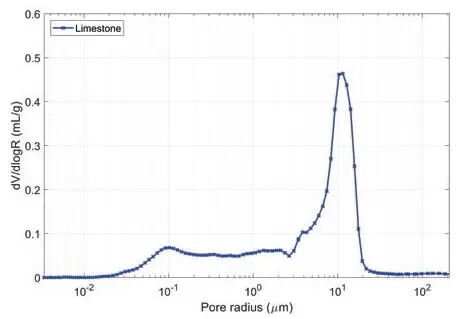
Figure 2: Pore size distribution of the limestone sample.
The limestone samples from the temple are characterized by a high porosity and permeability and a bimodal pore size distribution showing a major peak corresponding to a macropore radius of 10 µm.
Methodology
Considered the specificity of the studied heritage, non-invasive techniques have been investigated in the project with the use of infrared thermography and electric resistivity measurements. Those technics help us to investigate the water content in a porous media at real scale and to prevent against damages of the structures.
To illustrate the methodology, the focus is done with the use of IR thermography.
The technic is firstly calibrated and then is used reversely to characterize a specific situation.
IR Thermography calibration
With the aim to highlight a functional link between water content and surface temperature, a FLIR microbolometer (sc655, spectral range of 7.5–13 µm and ±2 °C (or ±2 % of reading) accuracy is used and vertically positioned in an apparatus to ensure the calibration of the focal length and the orientation of the camera. A parallelepiped sample is positioned near a perfect reflector on a table. The apparatus is at room temperature with a restriction of the light noise. The selected geometry of the sample is done to prevent against optic default.
Dimensions of the limestone samples are given as follow (38.9 ±0.4 mm width, 62.9 ±0.4 mm height and 10.5 ±0.6 mm thick).
The samples have been dried in a stove at 65 °C until mass became stable. Then partial saturation and homogenization of the sample have been done from ≈0 % to ≈100 %. The lowest saturation corresponds to the amount of absorbed water at environmental conditions while the maximum water content is represented by the samples completely saturated using the 48 h porosity protocol.
The partially saturated samples are then placed in a chamber with a relative humidity of 100 % for a duration of 15 days to allow the diffusion of the water within the volume of the sample to obtain a homogeneous distribution.
Illustration of the IR Thermography measurement is given in the figure 3. For each sample, several thermograms are registered in order to statistically determine its relevance. In the thermal scene, the perfect reflector (crumpled aluminum-foil) has a predictable emissivity that allows to estimate and filter the environmental noise affecting the measurements. Moreover, such a reference is used to 254calibrate the apparent temperature delivered by the infrared camera.
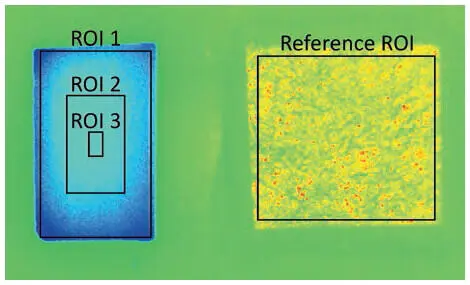
Figure 3: Thermogram of the sample and the crumpled aluminum-foil (reference) showing the different ROI tested.
The statistical relevance of the data is determined by the temperature analyses of each region of interest (ROI) of all the samples. Such analyses are done over ten images of the thermal scene. The statistical moments (mean, standard deviation, Skewness and Kurtosis) are calculated. The analysis of those parameters allows to determine the best ROI that will be used to define the calibration function representing the thermal response over the water content variation.
Relevance of the calibration law
Before using the method at real scale, the relevance of the calibration law has been tested for several scenarios. One of them consisted in the desaturation survey of the limestone sample. IR thermography technic is carried out simultaneously with an electric technic and sample mass measurements.
Tests are carried out on cylindrical samples of 2 cm diameter and 2 to 4 cm height previously saturated using the 48 h porosity protocol. The electrical and infrared measurements are done inside a black chamber specially designed to attenuate the environmental infrared noise sources. During the electric and infrared measurements, it has been simultaneously measured the mass loss with a 1 mg accuracy. Multiple sensors are placed inside the black chamber allowing to record the chamber temperature, atmospheric pressure and relative humidity variations.
The monitoring of the desaturation process by the electrical method is done by analyzing the electrical resistivity variation using the two-point probes method. The electrical resistivity is calculated using the Ohms law. The voltage is measured between the two extremities of the sample for a fixed current.
The signal injected at the top of the sample is a square waveform of 12 V of amplitude and 137 Hz frequency. This signal is compared to the signal received at the bottom of the sample in order to calculate de variation of the voltage during the desaturation process. An Average Waveform Generator incorporated to a digital oscilloscope (TiePie Handyscope HS5) is used. The same oscilloscope is used to record the evolution of the signal with a resolution of 12 bits and a sampling frequency of 10 kHz.
The thermal scene has been recorded with the same camera previously presented. IR images of the thermal scene are recorded at a frequency of 0.01 Hz. From each IR Image a surface area has been selected to highlight the temperature evolution of the limestone sample and the reference (crumpled aluminum-foil).
Finally, a mass balance allows to measure the mass loss during the experience.
Results and Discussion
In order to determine the most convenient ROI used to calculate the thermal response versus the saturation degree, those histograms are used to determine the relevance of the ROI’s by analyzing their statistical moments. Evolution of the mean temperature values versus the water content is presented in the figure 4.
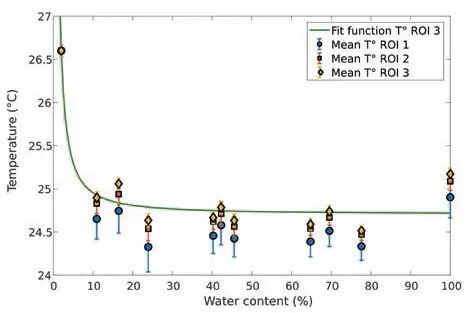
Figure 4: Mean temperature values and its standard deviations for each ROI with fit curve model.
255Functional mathematical relation is highlighted. In addition, with ROI 3 the skewness value is closed to zero. The third and fourth order moments values are consistent with a Laplace-Gauss distribution. As a consequence, the reduction of the surface analysis gives a better standard deviation to mean value ratio.
Finally, for a better accuracy of the calibration protocol, the reduction of the analysis surface helps to prevent against the edge effect and the risk of the non-homogenization of the water in the porous media.
In order to avoid edge effects, the calibration between the sample saturation and the IR response are defined by a fit function representing the evolution of the average temperature values of the ROI 3.
Читать дальшеИнтервал:
Закладка:
Похожие книги на «Monument Future»
Представляем Вашему вниманию похожие книги на «Monument Future» списком для выбора. Мы отобрали схожую по названию и смыслу литературу в надежде предоставить читателям больше вариантов отыскать новые, интересные, ещё непрочитанные произведения.










Обсуждение, отзывы о книге «Monument Future» и просто собственные мнения читателей. Оставьте ваши комментарии, напишите, что Вы думаете о произведении, его смысле или главных героях. Укажите что конкретно понравилось, а что нет, и почему Вы так считаете.