Siegfried Siegesmund - Monument Future
Здесь есть возможность читать онлайн «Siegfried Siegesmund - Monument Future» — ознакомительный отрывок электронной книги совершенно бесплатно, а после прочтения отрывка купить полную версию. В некоторых случаях можно слушать аудио, скачать через торрент в формате fb2 и присутствует краткое содержание. Жанр: unrecognised, на немецком языке. Описание произведения, (предисловие) а так же отзывы посетителей доступны на портале библиотеки ЛибКат.
- Название:Monument Future
- Автор:
- Жанр:
- Год:неизвестен
- ISBN:нет данных
- Рейтинг книги:4 / 5. Голосов: 1
-
Избранное:Добавить в избранное
- Отзывы:
-
Ваша оценка:
Monument Future: краткое содержание, описание и аннотация
Предлагаем к чтению аннотацию, описание, краткое содержание или предисловие (зависит от того, что написал сам автор книги «Monument Future»). Если вы не нашли необходимую информацию о книге — напишите в комментариях, мы постараемся отыскать её.
Alle vier Jahre treffen sich auf einer internationalen Tagung Experten, die sich mit den entsprechenden Sachfragen beschäftigen. Der „14th International Congress on the Deterioration and Conservation of Stone“ findet im September 2020 in Göttingen statt. Er ist die wichtigste Veranstaltung zur Verbreitung des Wissens von Praktikern und Forschern, die im Bereich der Steinkonservierung zur Erhaltung des baulichen Kulturerbes arbeiten: Geowissenschaftler, Architekten, Bauspezialisten, Ingenieure, Restauratoren, Denkmalpfleger und Bauherren.
Der Tagungsband mit über 150 wissenschaftlichen Beiträgen repräsentiert und erfasst den neuesten Stand der Technik auf diesem Gebiet.
Themen sind:
– Charakterisierung von Schadensphänomenen von Steinen und verwandten Baumaterialien (Stuck, Putz, Mörtel usw.)
– Methoden zur Untersuchung des Steinverfalls in situ und zerstörungsfreie Prüfung
– Langzeitüberwachung von Steindenkmälern und Gebäuden
– Simulation und Modellierung des Zerfalls
– Technologien und Entwicklung verbesserter Bearbeitung und Verwendung von Stein in Neubauten
– Bewertung der Langzeitwirkung von Bearbeitungstechniken
– Auswirkungen des Klimawandels auf die Steinverwitterung des Kulturerbes
– Berichte zur Steinkonservierung: Fallstudien und Projekte
– Digitalisierung und Dokumentation von Steinkonservierung
–
The 14th International Congress on the Deterioration and Conservation of Stone, entitled MONUMENT FUTURE: DECAY AND CONSERVATION OF STONE is a quadrennial event that brings together a world-wide community of geoscientists, architects, building specialists, engineers, conservators, restorators, monument curators and building owners who are concerned about the conservation of cultural stone structures and objects. Since antiquity, the weathering and deterioration of historical buildings, masonry, monuments, sculptures etc. using natural stones has been a very well-known problem.
This conference is the main gathering for the dissemination of knowledge in the field of stone deterioration issues. It represents and captures the state-of-the-art in the field of stone conservation and cultural heritage conservation with regards to the following topics:
– Characterisation of damage phenomena of stone and related building materials (plaster, rendering, mortar etc.)
– Methods for the investigation of stone decay; in-situ and non-destructive testing
– Long-term monitoring of stone monuments and buildings
– Simulation and modelling of decay
– Technology and development of improved treatments and use of stone in new buildings
– Assessment of long-term effects of treatments
– Impact of climate change on stone decay of Cultural Heritage
– Reports about stone conservation: case studies and projects
– Digitalization and documentation in stone conservation
Monument Future — читать онлайн ознакомительный отрывок
Ниже представлен текст книги, разбитый по страницам. Система сохранения места последней прочитанной страницы, позволяет с удобством читать онлайн бесплатно книгу «Monument Future», без необходимости каждый раз заново искать на чём Вы остановились. Поставьте закладку, и сможете в любой момент перейти на страницу, на которой закончили чтение.
Интервал:
Закладка:
Fuente de Cibeles of Madrid (Spain) was carved in Montesclaros marble between 1777 and 1782. In order to know its modifications and anthropogenic decay throughout its history, a documentary search was carried out. Montesclaros marble and its deterioration have been evaluated with optical microscopy, mercury intrusion porosimetry and colourimetry. In addition, the linear microcrack density from the surface to the interior of an altered sample was calculated. This dolomitic marble has coarse equigranular blasts and granoblastic texture. Dolomite crystals are surrounded by smaller calite crystals that dissolve more easily. This dissolution produces pores, a slight colour change and finally granular disintegration. Rhombohedral exfoliation microcracks are more numerous in the first superficial millimeters of altered stones.
Keywords: Fuente de Cibeles, marble decay, weathering processes, maintenance
Introduction
Traditional building stones are an important cultural and social focus; they are identifying and differentiating traits particular to each city. Their conservation is a challenge for the scientific community dedicated to the built heritage (Siegesmund and Török, 2011). The care and conservation of stones are essential to protect and to guarantee the successful future of monuments (De Wever et al., 2016). The historical quarries of traditional building stones should be recognized as valuable assets to provide restoration stones (Bednarik et al. 2014). Anisotropy, thermal changes and dissolution condition the deterioration of marbles (Ondrasina et al., 2002; Luque et al., 2010).
Construction of Fuente de Cibeles
It is written on the Fuente de Cibeles plan (1777) that the goddess, the carriage, the lions and the plant motifs of the rocky promontory where the fontain set is installed would be sculpted in Montesclaros marble, and that the rocky promontory and the base of the basin would be sculpted in Redueña dolostone (the latter one was crossed out).
Originallly, the fountain was at ground level, protected by 20 cylindrical bollards of granite with two smooth borders at their ends and topped with a rosette of twelve petals and a central button at the top (Figs. 1a, b, and c). A cobblestone flint pavement, measuring ten feet wide, was placed around it in the year the fountain was inaugurated, 1782.
246Two zoomorphic water-spouts, a dragon to the right and a bear to the left of the goddess Cybele began to operate in 1798. They supplied water for human consumption through bronze pipes inserted into their mouths. In addition, there were manual water pumps on the basin, and draft animals drank from the basin (Figs. 1b and c). The zoomorphic water-spouts and the bollards were removed in 1862, when the fountain was no longer used to supply drinking water. After this, a Figure 1 cast-iron fence was installed around the fountain (Fig. 1d).
In 1895, Fuente de Cibeles was transferred from its initial location to the centre of a circular island or sidewalk in the current Plaza de Cibeles (with the goddess facing west towards calle de Alcalá), and the fountain set was raised and repositioned (Fig. 2). The sculpture of goddess Cybele rose two meters and sixty centimetres from the pavement. The granite basin was placed on top of a circular platform of four granite steps on a circular sidewalk (Figs 2a and b).

Figure 1: Fuente de Cibeles in its original location. a: Engraving by Isidro Velázquez, 1788. Goddess Cybele is looking towards Salón del Prado and horses are drinking; b: Drawing by David Roberts and engraving by J. T. Willmore, 1835. Bear-shaped water-spout; c: Photograph, 1853. Bear- and dragon-shaped waterspouts, three manual water pumps and the peripheral bollards; d: Photograph, 1864. The original water-spout came out through a pipe in the mouth of the mask and was divided into four jets.
Eight equidistant rectangular cuboid blocks of limestone were inserted in the first three steps of the platform, on top of the sidewalk (Fig. 2a). The rocky surface promontory on which the carriage rests was also raised with a granite base covered with flint rocks (Figs. 2a and b), and the original base of the basin disappeared.
The rocky promontory was enlarged towards the back of the carriage to install two putti (Figs. 2a and b). The putto on the left pours water from an amphora; the one on the right stands and holds a conch shell. These putti were sculpted in Carrara marble (López de Azcona et al., 2002).
A snake and a felled tree trunk of the rocky promontory were moved backwards at that time to their current position under the putto that holds the amphora. Two groups of ornamental jets, with the highest vertical central jet surrounded by smaller parabolic ones were installed on the sides of the goddess (Fig. 2a). The water-spouts of these jets were also coated with flint rocks. A few years after the repositioning of the fountain, a new cast-iron perimeter fence was installed around the entire fountain. The new fence had more ornamentation than the previous one, was fixed to the lowest step 247and attached to eight bollards of granite installed on the eight rectangular cuboids of limestone, whose upper vertices were carved for such purpose (Figs. 2a and b).

Figure 2: Fuente de Cibeles elevated and enlarged after it was transferred to its current location. a: Photograph, c. 1895. Sidewalk and platform on which Fuente de Cibeles was placed composed by four steps of granite with eight limestone cuboids; b: Photograph, c. 1906. Sidewalk and the four steps on which the fountain was installed. Eight granite bollards with a base of limestone, cast-iron perimeter fence, and two putti on the extension of the rocky surface promontory to the back side.
A hand, the keys, the sceptre and the nose of goddess Cybele were damaged during the Second Republic in 1931 and were restored in the same year. The left lion was damaged during the beginning of the Spanish Civil War by the impact of projectiles (Fig. 3a). It lost the snout and suffered damage to the left front leg and tail, so the fountain was protected with sandbags and bricks between 1937 and 1939 (Fig. 3b).
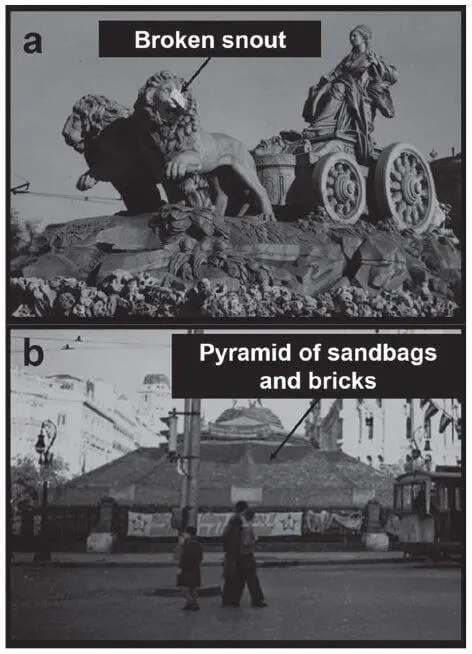
Figure 3: Fuente de Cibeles during the Spanish Civil War. a: Photograph, 1936. Lion with damaged snout; b: Photograph, between 1937 and 1939. Fuente de Cibeles was covered under a pyramid of sandbags and bricks on July 3th, 1937.
After the Spanish Civil War, an interim restoration was made. The snout was reconstructed with plaster and fastened with metal staples and the cast-iron perimeter fence was removed. Ornamental jets were added around the rocky promontory and on the interior perimeter of the basin. The two groups of lateral jets were replaced by two new groups of higher jets whose spouts were no longer coated with flint rocks (Fig. 4). The external perimeter of the fountain basin was landscaped (Fig. 4b). In addition, a lighting system bordering the jets and behind the carriage was installed for night illumination of the fountain (Fig. 4c).
Fuente de Cibeles gained its current appearance in 1968, with the addition of two granite basins with cascading water from the upper basin to the new external basins. The flint rock covering the base of the rocky promontory was also removed (Fig. 5).
Читать дальшеИнтервал:
Закладка:
Похожие книги на «Monument Future»
Представляем Вашему вниманию похожие книги на «Monument Future» списком для выбора. Мы отобрали схожую по названию и смыслу литературу в надежде предоставить читателям больше вариантов отыскать новые, интересные, ещё непрочитанные произведения.












Обсуждение, отзывы о книге «Monument Future» и просто собственные мнения читателей. Оставьте ваши комментарии, напишите, что Вы думаете о произведении, его смысле или главных героях. Укажите что конкретно понравилось, а что нет, и почему Вы так считаете.