Siegfried Siegesmund - Monument Future
Здесь есть возможность читать онлайн «Siegfried Siegesmund - Monument Future» — ознакомительный отрывок электронной книги совершенно бесплатно, а после прочтения отрывка купить полную версию. В некоторых случаях можно слушать аудио, скачать через торрент в формате fb2 и присутствует краткое содержание. Жанр: unrecognised, на немецком языке. Описание произведения, (предисловие) а так же отзывы посетителей доступны на портале библиотеки ЛибКат.
- Название:Monument Future
- Автор:
- Жанр:
- Год:неизвестен
- ISBN:нет данных
- Рейтинг книги:4 / 5. Голосов: 1
-
Избранное:Добавить в избранное
- Отзывы:
-
Ваша оценка:
Monument Future: краткое содержание, описание и аннотация
Предлагаем к чтению аннотацию, описание, краткое содержание или предисловие (зависит от того, что написал сам автор книги «Monument Future»). Если вы не нашли необходимую информацию о книге — напишите в комментариях, мы постараемся отыскать её.
Alle vier Jahre treffen sich auf einer internationalen Tagung Experten, die sich mit den entsprechenden Sachfragen beschäftigen. Der „14th International Congress on the Deterioration and Conservation of Stone“ findet im September 2020 in Göttingen statt. Er ist die wichtigste Veranstaltung zur Verbreitung des Wissens von Praktikern und Forschern, die im Bereich der Steinkonservierung zur Erhaltung des baulichen Kulturerbes arbeiten: Geowissenschaftler, Architekten, Bauspezialisten, Ingenieure, Restauratoren, Denkmalpfleger und Bauherren.
Der Tagungsband mit über 150 wissenschaftlichen Beiträgen repräsentiert und erfasst den neuesten Stand der Technik auf diesem Gebiet.
Themen sind:
– Charakterisierung von Schadensphänomenen von Steinen und verwandten Baumaterialien (Stuck, Putz, Mörtel usw.)
– Methoden zur Untersuchung des Steinverfalls in situ und zerstörungsfreie Prüfung
– Langzeitüberwachung von Steindenkmälern und Gebäuden
– Simulation und Modellierung des Zerfalls
– Technologien und Entwicklung verbesserter Bearbeitung und Verwendung von Stein in Neubauten
– Bewertung der Langzeitwirkung von Bearbeitungstechniken
– Auswirkungen des Klimawandels auf die Steinverwitterung des Kulturerbes
– Berichte zur Steinkonservierung: Fallstudien und Projekte
– Digitalisierung und Dokumentation von Steinkonservierung
–
The 14th International Congress on the Deterioration and Conservation of Stone, entitled MONUMENT FUTURE: DECAY AND CONSERVATION OF STONE is a quadrennial event that brings together a world-wide community of geoscientists, architects, building specialists, engineers, conservators, restorators, monument curators and building owners who are concerned about the conservation of cultural stone structures and objects. Since antiquity, the weathering and deterioration of historical buildings, masonry, monuments, sculptures etc. using natural stones has been a very well-known problem.
This conference is the main gathering for the dissemination of knowledge in the field of stone deterioration issues. It represents and captures the state-of-the-art in the field of stone conservation and cultural heritage conservation with regards to the following topics:
– Characterisation of damage phenomena of stone and related building materials (plaster, rendering, mortar etc.)
– Methods for the investigation of stone decay; in-situ and non-destructive testing
– Long-term monitoring of stone monuments and buildings
– Simulation and modelling of decay
– Technology and development of improved treatments and use of stone in new buildings
– Assessment of long-term effects of treatments
– Impact of climate change on stone decay of Cultural Heritage
– Reports about stone conservation: case studies and projects
– Digitalization and documentation in stone conservation
Monument Future — читать онлайн ознакомительный отрывок
Ниже представлен текст книги, разбитый по страницам. Система сохранения места последней прочитанной страницы, позволяет с удобством читать онлайн бесплатно книгу «Monument Future», без необходимости каждый раз заново искать на чём Вы остановились. Поставьте закладку, и сможете в любой момент перейти на страницу, на которой закончили чтение.
Интервал:
Закладка:
The velocity of the sound wave propagation in homogeneous materials generally depends on their modulus of elasticity in tension, density, and porosity. In heterogeneous materials, the propagation speed varies, resulting in different values when measured over various distances. The impact of probe distance was checked in the laboratory as well as on a stone wall.
The results presented in Figure 3 and Figure 5 indicate that on a practical scale the measured velocities are influenced less by distance than by other factors, namely the contact between the probe and the stone surface. Also, in real situations, differences are more the result of moisture content than variations in material quality. The surface layers of the stones in the masonry wall may be dryer or wetter than the inner layers of the wall, which can cause apparent variations in US velocity along the depth. However, the difference is only of the order of 3,2 % to 4,3 % in the tested Hořice sandstone wall.
Impact of consolidation treatment
The in-situ application of the method described above was tested on a quartz sandstone (Hořice quarry) wall after a demonstrative impregnation with a tetraethyl orthosilicate agent. Due to their chemical similarities to sandstones in particular, and their simple application, silicic acid esters 236(SAE) are one of the most commonly and most successfully applied materials in stone conservation, and therefore they were selected for the pilot tests. The average bulk density value of Hořice sandstone is 1,810 kg.m-3, its porosity is 25.84 %, and the diameter of the highest occurring pore is 40.22 mm. The measured US velocities correspond to the references in literature for sandstones of similar bulk density and porosity, e. g. S. Garia et al. or Freund (1992).
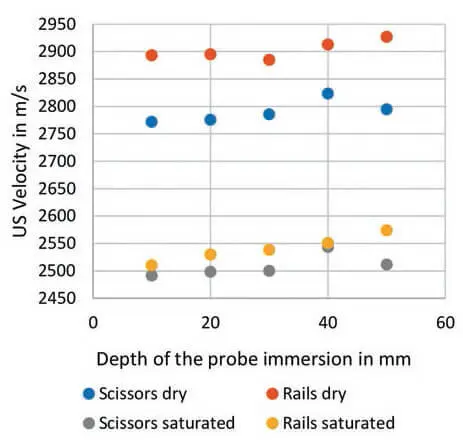
Figure 3:Comparison of US velocities measured with double-probe variants on dry and saturated sandstone.
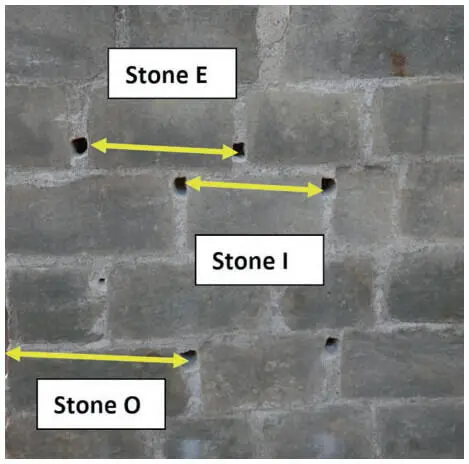
Figure 4: Testing of the influence of the probe distance and the contact effects.
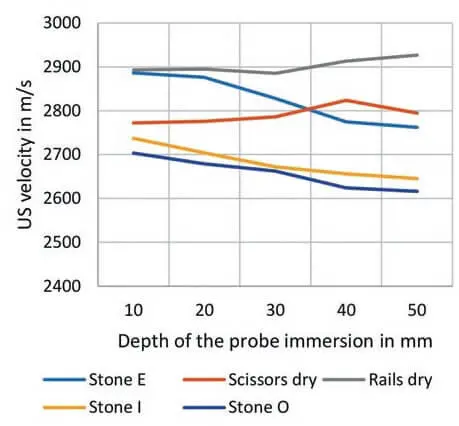
Figure 5: Measured US velocities in stones of different average travel length – 310 mm in stone E; 295 mm in stone I; 375 mm in stone O – compared to velocities for a stone block measured in the laboratory with the scissors device over a travel length of 50 mm and the rail device over a length of 170 mm.
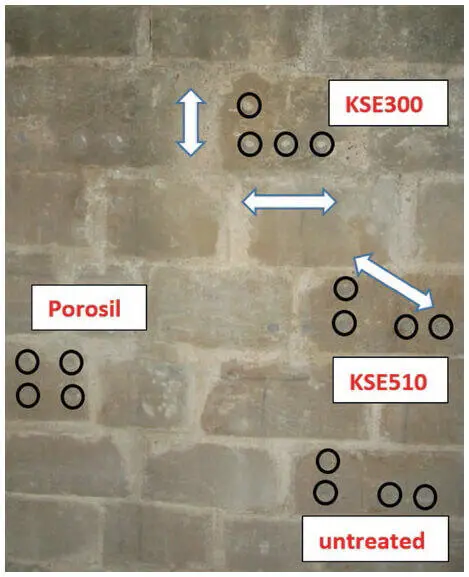
Figure 6: Drilled holes in the treated areas, and the orientations of the transmission waves.
A Hořice quartz sandstone masonry wall was treated, in limited and well-defined areas, with three types of agent: the Remmers KSE 300 – without solvent, with 30 % gel deposition potential; the Remmers KSE 510 – without solvent, with 45 % 237gel deposition potential; the Porosil Z – containing solvent (ethanol), acid catalyst, with 30 % gel deposition potential. The consolidants were applied to the sandstone blocks by brushing. Then a set of holes was drilled.
The impact of the consolidation effect is clearly visible from the obtained data in Figure 7, as are the gradient of its distribution along the depth profile starting from the surface and the attained penetration depth.
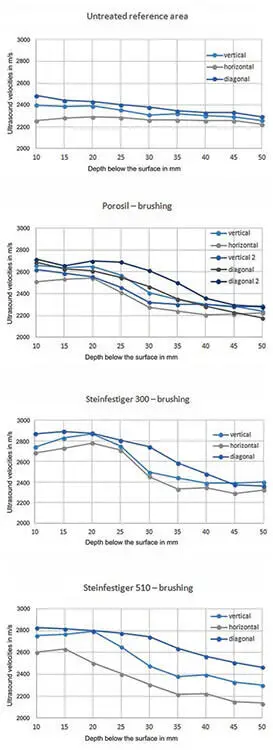
Figure 7: US velocities in stones treated with Porosil, KSE 300, and KSE 510 – all applied by brushing – and an untreated stone.
Conclusions
This method provides restorers with a unique capability to monitor the progress and results of consolidation. Measurement is quick and reliable, though problems may arise involving hidden material irregularities, unknown moisture distribution, or gross imperfections along the hole surfaces preventing the necessary probe contact.
Acknowledgement
This paper is based on the results of research supported by the institutional project RVO 68378297.
References
Drdácký, M. F., Slížková, Z. Performance of glauconitic sandstone treated with ethyl silicate consolidation agents, In Proc. of the 11th Int. Congr. on deter. and cons. of stone – J. W.Łukaszewicz, P.Niemcewicz (eds.), Vol.2. Toruń: Nicolaus Copernicus University Press; 2008. pp.1205–1212.
Sasse, H. R., Snethlage, R. Evaluation of stone consolidation treatments. Science and Technology for Cultural Heritage. 1996;5(1):85–92.
S. Garia, A. K. Pal, K. Ravi, A. M. Nair: A comprehensive analysis on the relationships between elastic wave velocities and petrophysical properties of sedimentary rocks based on laboratory measurements. Journal of Petroleum Exploration and Production Technology. 2019, Volume 9, Issue 3, pp. 1869–1881.
Freund D.: Ultrasonic compression and shear velocities in dry clastic rocks as a function of porosity, clay content and confining pressure. Geophys. J. Int. (1992), 108, 125–135.
238 
239
A NEW SYSTEM FOR FAST ULTRASOUND-TOMOGRAPHY AT MARBLE SCULPTURES
Frank Tiefensee, Christoph Degel, Peter Weber, Wolfgang Bost, Manfred Moses, Marc Schmieger
IN: SIEGESMUND, S. & MIDDENDORF, B. (EDS.): MONUMENT FUTURE: DECAY AND CONSERVATION OF STONE.
– PROCEEDINGS OF THE 14TH INTERNATIONAL CONGRESS ON THE DETERIORATION AND CONSERVATION OF STONE –
VOLUME I AND VOLUME II. MITTELDEUTSCHER VERLAG 2020.
Fraunhofer-Institute for Biomedical Engineering (IBMT), St. Ingbert, Germany
Abstract
The authors present a new ultrasonic system for the automatic determination of tomography on stone. The tomography can be determined with up to 32 ultrasonic transducers in a variable length holding system. The positions of the sensors are determined with a magnetic field tracking or optically with Aruco markers. The signal control is done by a single channel electronic with 32x multiplexer. In this way the determination of a tomography from 32 measuring positions could be reduced to approx. 1 hour.
Introduction
For about 50 years, various ultrasound-based methods have been developed for the examination of stone in the field of cultural heritage and building technology [1]. The review article by Chiesura et al. [2] and the book Architecture in Stone by S. Siegesmund and R. Snethlage [3] provide an informative overview. The speed of sound is the most widely used parameter in the investigation of marble, particularly the speed of sound of longitudinal waves used in 70 % of the articles sighted. The speed of ultrasound depends on the mineralogical, physical and mechanical properties [4], the degree of saturation of water [4, 5] and the degree of aging. The speed of sound in marble varies between 6000 m/s for freshly quarried material and 1500 m/s for heavily weathered material. Therefore, the determination of the speed of sound provides valuable information about the properties and condition of the marble. The most widespread method is the measurement of the sound velocity of longitudinal waves in transmission. Two ultrasonic transducers are mounted opposite each other on the stone to be examined and the sound velocity between them is determined. The transmission method can be modified in various ways by varying the arrangement of the transmitter and receiver in order to adapt them to different measurement tasks. There are, for example, the so-called radial transmission [6], the semi direct transmission [7] or refraction methods with surface waves [7]. A very meaningful technique is ultrasound tomography. It allows the representation of velocity distributions in cross-sections of marble objects and thus the assessment of the course of weathering [8] and the success of conservation measures [9]. Up to now, the measured values for the calculation of a tomography have been recorded manually with (digital) calipers and single-channel electronics with two ultrasonic transducers between 46 kHz and 250 kHz. First, the transmitter transducer is in any measuring position and the receiver transducer 240successively takes up the other measuring positions in the same plane. For each measuring position, the velocity of sound between the transmitter and receiver is determined. The amount of sound velocities that can be assigned to a transmitter position is called projection. After the data of the first projection has been acquired, the transmitter is moved to the next measuring position and the data set of the second projection is measured. A tomography of 32 measuring positions consists of 32 projections, i. e. 31 × 32 = 992 individual measurements. It is easy to understand that recording the data of an ultrasound tomography is very time-consuming and can take more than one working day. The ultrasound system presented here for the first time reduces the required time for a tomography with 32 measuring points to approximately 1 hour.
Читать дальшеИнтервал:
Закладка:
Похожие книги на «Monument Future»
Представляем Вашему вниманию похожие книги на «Monument Future» списком для выбора. Мы отобрали схожую по названию и смыслу литературу в надежде предоставить читателям больше вариантов отыскать новые, интересные, ещё непрочитанные произведения.







Обсуждение, отзывы о книге «Monument Future» и просто собственные мнения читателей. Оставьте ваши комментарии, напишите, что Вы думаете о произведении, его смысле или главных героях. Укажите что конкретно понравилось, а что нет, и почему Вы так считаете.