Siegfried Siegesmund - Monument Future
Здесь есть возможность читать онлайн «Siegfried Siegesmund - Monument Future» — ознакомительный отрывок электронной книги совершенно бесплатно, а после прочтения отрывка купить полную версию. В некоторых случаях можно слушать аудио, скачать через торрент в формате fb2 и присутствует краткое содержание. Жанр: unrecognised, на немецком языке. Описание произведения, (предисловие) а так же отзывы посетителей доступны на портале библиотеки ЛибКат.
- Название:Monument Future
- Автор:
- Жанр:
- Год:неизвестен
- ISBN:нет данных
- Рейтинг книги:4 / 5. Голосов: 1
-
Избранное:Добавить в избранное
- Отзывы:
-
Ваша оценка:
Monument Future: краткое содержание, описание и аннотация
Предлагаем к чтению аннотацию, описание, краткое содержание или предисловие (зависит от того, что написал сам автор книги «Monument Future»). Если вы не нашли необходимую информацию о книге — напишите в комментариях, мы постараемся отыскать её.
Alle vier Jahre treffen sich auf einer internationalen Tagung Experten, die sich mit den entsprechenden Sachfragen beschäftigen. Der „14th International Congress on the Deterioration and Conservation of Stone“ findet im September 2020 in Göttingen statt. Er ist die wichtigste Veranstaltung zur Verbreitung des Wissens von Praktikern und Forschern, die im Bereich der Steinkonservierung zur Erhaltung des baulichen Kulturerbes arbeiten: Geowissenschaftler, Architekten, Bauspezialisten, Ingenieure, Restauratoren, Denkmalpfleger und Bauherren.
Der Tagungsband mit über 150 wissenschaftlichen Beiträgen repräsentiert und erfasst den neuesten Stand der Technik auf diesem Gebiet.
Themen sind:
– Charakterisierung von Schadensphänomenen von Steinen und verwandten Baumaterialien (Stuck, Putz, Mörtel usw.)
– Methoden zur Untersuchung des Steinverfalls in situ und zerstörungsfreie Prüfung
– Langzeitüberwachung von Steindenkmälern und Gebäuden
– Simulation und Modellierung des Zerfalls
– Technologien und Entwicklung verbesserter Bearbeitung und Verwendung von Stein in Neubauten
– Bewertung der Langzeitwirkung von Bearbeitungstechniken
– Auswirkungen des Klimawandels auf die Steinverwitterung des Kulturerbes
– Berichte zur Steinkonservierung: Fallstudien und Projekte
– Digitalisierung und Dokumentation von Steinkonservierung
–
The 14th International Congress on the Deterioration and Conservation of Stone, entitled MONUMENT FUTURE: DECAY AND CONSERVATION OF STONE is a quadrennial event that brings together a world-wide community of geoscientists, architects, building specialists, engineers, conservators, restorators, monument curators and building owners who are concerned about the conservation of cultural stone structures and objects. Since antiquity, the weathering and deterioration of historical buildings, masonry, monuments, sculptures etc. using natural stones has been a very well-known problem.
This conference is the main gathering for the dissemination of knowledge in the field of stone deterioration issues. It represents and captures the state-of-the-art in the field of stone conservation and cultural heritage conservation with regards to the following topics:
– Characterisation of damage phenomena of stone and related building materials (plaster, rendering, mortar etc.)
– Methods for the investigation of stone decay; in-situ and non-destructive testing
– Long-term monitoring of stone monuments and buildings
– Simulation and modelling of decay
– Technology and development of improved treatments and use of stone in new buildings
– Assessment of long-term effects of treatments
– Impact of climate change on stone decay of Cultural Heritage
– Reports about stone conservation: case studies and projects
– Digitalization and documentation in stone conservation
Monument Future — читать онлайн ознакомительный отрывок
Ниже представлен текст книги, разбитый по страницам. Система сохранения места последней прочитанной страницы, позволяет с удобством читать онлайн бесплатно книгу «Monument Future», без необходимости каждый раз заново искать на чём Вы остановились. Поставьте закладку, и сможете в любой момент перейти на страницу, на которой закончили чтение.
Интервал:
Закладка:
Consolidation effects are typically tested on specimens extracted from the treated bodies in the form of drilled cylindrical cores or cuboids cut from the object. The specimens are further cut into thin slices beginning at the treated surface and continuing along the depth. The slices are then tested using destructive methods – typically as discs or short beams loaded in bending (Drdácký & Slížková 2008). The determined strengths indicate changes in mechanical characteristics of the treated material along the depth.
The individual specimens are also suitable for non-destructive laboratory investigation of the penetration depth of consolidants using ultrasonic measurement in the transmission mode (Sasse & Snethlage 1996).
Such monitoring should ideally be performed during the consolidation process, i. e. after each impregnation cycle. It is practically impossible, however, to cut samples from an object after each treatment cycle.
A semi-destructive method that exploits the measurement of resistance to drilling is also used for in-situ testing of stone, but the specific character of the method prevents repeated application at identical points, and the monitored data is thus 234unreliable due to the heterogeneity of the tested material. Ultrasonic measurement, on the other hand, can provide integral information across a larger domain of treated stone objects, and the monitored data is less sensitive to small-scale heterogeneity within the material.
This paper introduces a new portable ultrasonic double-probe for recording changes in material properties along a depth profile and assessing consolidant penetration depth.
Double-probe ultrasonic device
For quality control of stone-masonry conservation, an innovative ultrasonic device has been developed jointly with Rolf Krompholz (GEOTRON-ELEKTRONIK) within the EK FP7 Stonecore project.
The device consists of two probes: an US transmitter and receiver. They were basically designed to be inserted into holes of 20 mm in diameter drilled into the investigated surface layer at a distance of up to 100 mm from their centres and a depth of up to 60 mm. Certain design features (a flat base and adjustable rods for the transmitter and the receiver) allow for reproducible insertion of the device into prepared holes in order to acquire a reliable series of measurements for the investigation of changes in material characteristics. The device is portable and fully compatible with ultrasonic laboratory equipment, e. g. UKS 12 or UKS 14 Geotron Elektronik.
The device is robust and well-engineered for problematic outdoor measurement conditions. It is possible, for the first time, to measure the properties of materials in situ with an acceptable impact. The main advantage over the standard drilling technique is that it is possible to monitor the conservation effect during the intervention process because changes can be measured at an identical place and over the same volume of material after individual impregnation steps. This allows restorers to continue or terminate impregnation repetitions in response to the measured impact, i. e. consolidation depth and expected strengthening effects. In such cases, optimum control of conservation and reasonably low material consumption are desirable.
The device can be adapted for measurements across the dimensions of entire stones with holes drilled in joints, as this may be more acceptable on historic stone facades. During such measurements, the probes are fixed in a special rail rig allowing for longer distances between them and providing their firm fixture in the holes.
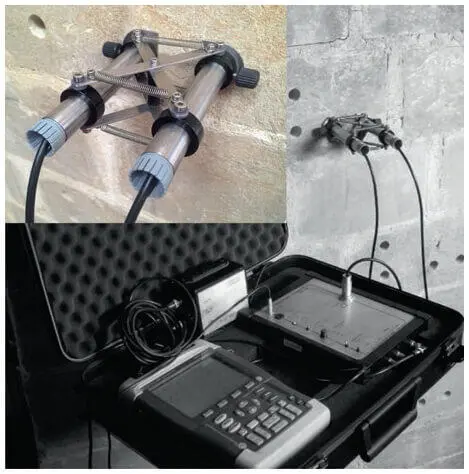
Figure 1: The double probe scissors set up with the UKS 14 ultrasonic testing system.
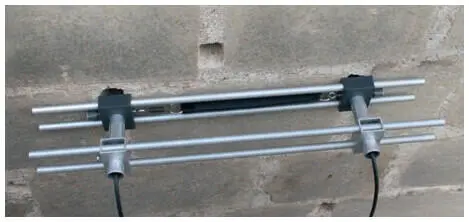
Figure 2: US measurement across the whole length of an ashlar block with probes inserted into holes drilled in the masonry joints.
Impact of measurement conditions
The uncertainty of the measurements depends on several factors. The application presented here only requires comparable data for an assessment of the attained consolidation effect. Therefore, consistent sets of relative values are adequate, and the absolute values of the US velocities are not necessary.
235When using the rail arrangement for measurement of probe distances above those possible with the standard scissors double-probe device, it is necessary to slightly adjust the oscilloscope parameters, which in turn impacts the determination of US velocities. This effect, however, does not hinder the reliable determination of relative material characteristics.
Another important consideration is that measurement is sensitive to faulty contacts between the tested material and the transmitting and receiving probes. This is crucial when drilling holes for the probes. Sandstone is heterogeneous – it does not have a uniform density throughout its volume – and parts of the stone with higher densities respond differently to drilling than those of lower density. The resulting hole may therefore be irregular in shape, i. e. neither perfectly cylindrical nor perpendicular to the surface.
Variations in the determined US velocities for Hořice quartz sandstone are presented in Table 1. The uncertainty characteristics were calculated from 20 sets of 10 measurements done on an ashlar block, with probe distances of around 50 mm for the scissors and 170 mm for the rail arrangement.
Table 1: Statistics of the wave propagation velocities.
| cond./type of device | average velocity [ms-1] | st. dev. [ms-1] | co. of var. [%] | aver. rep.dif [ms-1] |
| dry stone scissors | 2,790 | 27 | 1 | 20 |
| satur. stone scissors | 2,903 | 8 | 0.27 | 6 |
| dry stone rail | 2,509 | 42 | 1.7 | 35 |
| satur. stone rail | 2,541 | 10 | 0.4 | 8 |
Furthermore, the presence of water in the pores of the stone affects the propagation velocity of the sound wave. The wetting of stone causes either an increase or a decrease in the speed of sound wave propagation, up to a point when saturation of the stone reaches its maximum value. The character of the change in sound propagation due to water saturation is dependent on the properties of the stone as well as the wave propagation direction with respect to the sedimentation layers of the sandstone. Typical values for the Hořice quartz sandstone are shown in Table 2.
Table 2: Change of wave propagation velocities in m/s.
| Moisture condition | Direction of wave propagation | ||
| parallel | perpendic. | longitudin. | |
| dry | 2,690 | 2,662 | 2,742 |
| saturated | 2,588 | 2,775 | 2,189 |
The data in Table 2was acquired on specimens of dimensions 300 mm × 50 mm × 50 mm. The axis of the beam corresponds to the longitudinal direction of the wave propagation.
Graphical representation of the impact of water, as well as reproducibility of acquired data, is shown in Figure 3.
It is apparent that differences arising from repeated measurements are sufficiently lower than the difference resulting from water saturation.
Читать дальшеИнтервал:
Закладка:
Похожие книги на «Monument Future»
Представляем Вашему вниманию похожие книги на «Monument Future» списком для выбора. Мы отобрали схожую по названию и смыслу литературу в надежде предоставить читателям больше вариантов отыскать новые, интересные, ещё непрочитанные произведения.









Обсуждение, отзывы о книге «Monument Future» и просто собственные мнения читателей. Оставьте ваши комментарии, напишите, что Вы думаете о произведении, его смысле или главных героях. Укажите что конкретно понравилось, а что нет, и почему Вы так считаете.