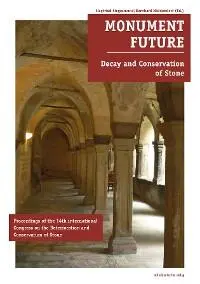
Siegfried Siegesmund - Monument Future
Здесь есть возможность читать онлайн «Siegfried Siegesmund - Monument Future» — ознакомительный отрывок электронной книги совершенно бесплатно, а после прочтения отрывка купить полную версию. В некоторых случаях можно слушать аудио, скачать через торрент в формате fb2 и присутствует краткое содержание. Жанр: unrecognised, на немецком языке. Описание произведения, (предисловие) а так же отзывы посетителей доступны на портале библиотеки ЛибКат.
- Название:Monument Future
- Автор:
- Жанр:
- Год:неизвестен
- ISBN:нет данных
- Рейтинг книги:4 / 5. Голосов: 1
-
Избранное:Добавить в избранное
- Отзывы:
-
Ваша оценка:
Monument Future: краткое содержание, описание и аннотация
Предлагаем к чтению аннотацию, описание, краткое содержание или предисловие (зависит от того, что написал сам автор книги «Monument Future»). Если вы не нашли необходимую информацию о книге — напишите в комментариях, мы постараемся отыскать её.
Alle vier Jahre treffen sich auf einer internationalen Tagung Experten, die sich mit den entsprechenden Sachfragen beschäftigen. Der „14th International Congress on the Deterioration and Conservation of Stone“ findet im September 2020 in Göttingen statt. Er ist die wichtigste Veranstaltung zur Verbreitung des Wissens von Praktikern und Forschern, die im Bereich der Steinkonservierung zur Erhaltung des baulichen Kulturerbes arbeiten: Geowissenschaftler, Architekten, Bauspezialisten, Ingenieure, Restauratoren, Denkmalpfleger und Bauherren.
Der Tagungsband mit über 150 wissenschaftlichen Beiträgen repräsentiert und erfasst den neuesten Stand der Technik auf diesem Gebiet.
Themen sind:
– Charakterisierung von Schadensphänomenen von Steinen und verwandten Baumaterialien (Stuck, Putz, Mörtel usw.)
– Methoden zur Untersuchung des Steinverfalls in situ und zerstörungsfreie Prüfung
– Langzeitüberwachung von Steindenkmälern und Gebäuden
– Simulation und Modellierung des Zerfalls
– Technologien und Entwicklung verbesserter Bearbeitung und Verwendung von Stein in Neubauten
– Bewertung der Langzeitwirkung von Bearbeitungstechniken
– Auswirkungen des Klimawandels auf die Steinverwitterung des Kulturerbes
– Berichte zur Steinkonservierung: Fallstudien und Projekte
– Digitalisierung und Dokumentation von Steinkonservierung
–
The 14th International Congress on the Deterioration and Conservation of Stone, entitled MONUMENT FUTURE: DECAY AND CONSERVATION OF STONE is a quadrennial event that brings together a world-wide community of geoscientists, architects, building specialists, engineers, conservators, restorators, monument curators and building owners who are concerned about the conservation of cultural stone structures and objects. Since antiquity, the weathering and deterioration of historical buildings, masonry, monuments, sculptures etc. using natural stones has been a very well-known problem.
This conference is the main gathering for the dissemination of knowledge in the field of stone deterioration issues. It represents and captures the state-of-the-art in the field of stone conservation and cultural heritage conservation with regards to the following topics:
– Characterisation of damage phenomena of stone and related building materials (plaster, rendering, mortar etc.)
– Methods for the investigation of stone decay; in-situ and non-destructive testing
– Long-term monitoring of stone monuments and buildings
– Simulation and modelling of decay
– Technology and development of improved treatments and use of stone in new buildings
– Assessment of long-term effects of treatments
– Impact of climate change on stone decay of Cultural Heritage
– Reports about stone conservation: case studies and projects
– Digitalization and documentation in stone conservation
Monument Future — читать онлайн ознакомительный отрывок
Ниже представлен текст книги, разбитый по страницам. Система сохранения места последней прочитанной страницы, позволяет с удобством читать онлайн бесплатно книгу «Monument Future», без необходимости каждый раз заново искать на чём Вы остановились. Поставьте закладку, и сможете в любой момент перейти на страницу, на которой закончили чтение.
Интервал:
Закладка:
References
Charola A. E., Pühringer J., Steiger M. (2007). Gypsum: a review of its role in the deterioration of building materials. Environmental Geology , 52, 339–352
Horiguchi T., Nakata M., Shikazono N., Honma H. (2000). Occurrence and formation process of alunogen and salt accumulation on the surface of tuff in Yoshimi Hills, Saitama prefecture, Japan. Journal of the Mineralogical Society of Japan , 29 (1), 3–16
Ikegami S. (2018). The development of rock-cut tombs in the Japanese archipelago. The Rissho International Journal of Academic Research in Culture and Society , 1, 171–199
Ogata K. (2019). The artistic qualities of religion reliefs in Taya-cave, Japan. In: JpGU Meeting 2019 , 26–30 May 2019, Chiba, Japan
Oguchi C., Takaya Y., Yamazaki M., Ohnishi R., Thidar A., Hatta T. (2010). High acidic sulphate salt production on the cave wall in the Yoshimi Hyaku-Ana historic site, central Japan. In: Proceedings of the XIX CBGA Congress , Thessaloniki, Greece, 100, 413–419
Oyama T., Chigira M. (1999). Weathering rate of mudstone and tuff on old unlined tunnel walls. Engineering Geology , 55, 15–27
Santi P. M. (1998). Improving the jar slake, slake index, and slake durability tests for shales. Environmental & Engineering Geoscience , 4 (3), 385–396
Seiki T., Nishi J., Nishida Y. (2007). Renovation Challenge of Underground Quarries for Oya Tuff. In: 11th ACUUS Conference – Underground space: expanding the frontiers , 10–13 Sept 2007, Athens, Greece
Steiger M., Asmussen S. (2008). Crystallization of sodium sulfate phases in porous materials: the phase diagram Na2SO 4–H2O and the generation of stress. Geochimica et Cosmochimica Acta , 72, 4291–4306
227
MATERIAL CHARACTERIZATION AND DECAY OF THE LIMESTONES USED IN HISTORICAL STRUCTURES OF MARDİN, TURKEY
Felat Dursun
IN: SIEGESMUND, S. & MIDDENDORF, B. (EDS.): MONUMENT FUTURE: DECAY AND CONSERVATION OF STONE.
– PROCEEDINGS OF THE 14TH INTERNATIONAL CONGRESS ON THE DETERIORATION AND CONSERVATION OF STONE –
VOLUME I AND VOLUME II. MITTELDEUTSCHER VERLAG 2020.
Dicle University, Department of Mining Engineering, Diyarbakır, Turkey
Abstract
Situated on a scenic hillslope overlooking the Mesopotamian plain, Mardin bears the traces of many civilizations from prehistoric to modern times. With its highly crafted historical structures, Mardin significantly contributes to the cultural heritage of Turkey. Most buildings of architectural heritage in Mardin and its surroundings are constructed with the locally quarried limestone. Like many other historical buildings, the historical structures located in Mardin are also suffering from stone deterioration. This deterioration of the structures damages their integrity, aesthetic value and structural stability. The major aim of this study is to investigate the material characterization of the limestone in which the historical structures of Mardin were constructed. In order to identify the physico-mechanical and petrographic properties of rock material, it is essential to analyze their index properties. For this purpose, limestones from different quarries were collected for laboratory studies. To determine their physical and mechanical properties, such parameters as effective porosity, water absorption, uniaxial compressive strength, thermal conductivity, volumetric heat capacity, saturation coefficient and wet to dry strength ratio of the material were studied. In addition to this, the major deterioration forms were determined. It is understood from the experimental studies that the presence of water has a great impact on the durability of the material. Moreover, it is observed that efflorescence, erosion, alveolization, scaling, and deposits are the most common weathering forms developed on the historical structures of Mardin.
Keywords: Decay, limestone, physico-mechanical properties, weathering, Mardin
Introduction
It is known that all naturally occurring materials on the earth’s surface are subject to destructive weathering processes, whether in their natural settings or in construction. Weathering is a continuous and destructive process that changes the characteristic properties of stone. The weathering of stone may result in the loss of integrity, aesthetic value and structural stability of the historical structures. Even a small amount of surface weathering may deteriorate priceless pieces of monuments (Bristow 1990; Vincente et al. 1993; Siegesmund et al. 2002). Stone monuments are the most visible and essential structures of our cultural heritage; however, many of the historical structures around the world are now suffering 228from the above-mentioned weathering and associated deterioration (Fitzner et al. 2002). Mardin is a historical city situated in southeastern Turkey. The city is medieval in origin and is located on a scenic rocky hill, crowned by a castle looking over the Mesopotamian plain (Gabriel 2014; UNESCO 2000). The city hosts various religious, ethnic groups and remarkable remains from different cultures. As a result of having such impressive interactions of religious, ethnic groups and architectural features, Mardin has been included in the Tentative List of UNESCO’s World Heritage List (Figure 1). The city hosts over one thousand registered monumental cultural properties, including the castle, monasteries, churches, mosques, madrasahs, administrative buildings, houses pavilions, tombs and hammams. Limestone is widely employed in the erection of the mentioned structures. It has not been employed only in masonry walls, also in decorative elements. Due to their availability, aesthetic value, color variety and ease to shape, limestone has been commonly utilized to construct stone monuments (Siegesmund et al. 2010). The limestones in the study area were deposited in the Early Eocene-Early Oligocene age Hoya formation. The thickness of the formation in the study area ranges between 50 to 600 meters. The Hoya formation is characterized by light gray or beige fossiliferous, micritic limestone with laminations and poorly sorted dolomite (Duran et al. 1988; Sallam et al. 2018). Similar to the other stone monuments around the world, the historical structures located in Mardin are also suffered from the decay of stone. A large variety of deterioration types can be seen in different historical structures of the Mardin. The stone deterioration observed on the historic structures of Mardin is not only weaken their physical and mechanical performance, also damages their structural integrity and aesthetic value.
The present study aims to identify the common weathering forms developed on the monuments of the Mardin and characterize the material properties of the limestones in which the historical structures of Mardin were constructed.
Material and Methods
This study was carried out in two main stages: field studies and laboratory research. These field studies consist of site observation and sampling. During the site observation, special emphasis was given to the forms of stone weathering on the monuments located in Mardin. More than 20 monuments located in the study area were visited and their major forms of deterioration were recorded. For the sampling, limestone blocks were extracted from a quarry, located in Midyat, a district of Mardin. The stone blocks extracted from the quarry were then cut into 5 centimeters cubic samples. For the laboratory studies, a total of 30 cubic samples with 5-centimeter edge lengths were prepared. The samples were used to determine such physico-mechanical properties of the stone material as effective porosity, unit weight, water absorption, uniaxial compressive strength (UCS), thermal conductivity, volumetric heat capacity and saturation coefficient.
Читать дальшеИнтервал:
Закладка:
Похожие книги на «Monument Future»
Представляем Вашему вниманию похожие книги на «Monument Future» списком для выбора. Мы отобрали схожую по названию и смыслу литературу в надежде предоставить читателям больше вариантов отыскать новые, интересные, ещё непрочитанные произведения.







Обсуждение, отзывы о книге «Monument Future» и просто собственные мнения читателей. Оставьте ваши комментарии, напишите, что Вы думаете о произведении, его смысле или главных героях. Укажите что конкретно понравилось, а что нет, и почему Вы так считаете.