Siegfried Siegesmund - Monument Future
Здесь есть возможность читать онлайн «Siegfried Siegesmund - Monument Future» — ознакомительный отрывок электронной книги совершенно бесплатно, а после прочтения отрывка купить полную версию. В некоторых случаях можно слушать аудио, скачать через торрент в формате fb2 и присутствует краткое содержание. Жанр: unrecognised, на немецком языке. Описание произведения, (предисловие) а так же отзывы посетителей доступны на портале библиотеки ЛибКат.
- Название:Monument Future
- Автор:
- Жанр:
- Год:неизвестен
- ISBN:нет данных
- Рейтинг книги:4 / 5. Голосов: 1
-
Избранное:Добавить в избранное
- Отзывы:
-
Ваша оценка:
Monument Future: краткое содержание, описание и аннотация
Предлагаем к чтению аннотацию, описание, краткое содержание или предисловие (зависит от того, что написал сам автор книги «Monument Future»). Если вы не нашли необходимую информацию о книге — напишите в комментариях, мы постараемся отыскать её.
Alle vier Jahre treffen sich auf einer internationalen Tagung Experten, die sich mit den entsprechenden Sachfragen beschäftigen. Der „14th International Congress on the Deterioration and Conservation of Stone“ findet im September 2020 in Göttingen statt. Er ist die wichtigste Veranstaltung zur Verbreitung des Wissens von Praktikern und Forschern, die im Bereich der Steinkonservierung zur Erhaltung des baulichen Kulturerbes arbeiten: Geowissenschaftler, Architekten, Bauspezialisten, Ingenieure, Restauratoren, Denkmalpfleger und Bauherren.
Der Tagungsband mit über 150 wissenschaftlichen Beiträgen repräsentiert und erfasst den neuesten Stand der Technik auf diesem Gebiet.
Themen sind:
– Charakterisierung von Schadensphänomenen von Steinen und verwandten Baumaterialien (Stuck, Putz, Mörtel usw.)
– Methoden zur Untersuchung des Steinverfalls in situ und zerstörungsfreie Prüfung
– Langzeitüberwachung von Steindenkmälern und Gebäuden
– Simulation und Modellierung des Zerfalls
– Technologien und Entwicklung verbesserter Bearbeitung und Verwendung von Stein in Neubauten
– Bewertung der Langzeitwirkung von Bearbeitungstechniken
– Auswirkungen des Klimawandels auf die Steinverwitterung des Kulturerbes
– Berichte zur Steinkonservierung: Fallstudien und Projekte
– Digitalisierung und Dokumentation von Steinkonservierung
–
The 14th International Congress on the Deterioration and Conservation of Stone, entitled MONUMENT FUTURE: DECAY AND CONSERVATION OF STONE is a quadrennial event that brings together a world-wide community of geoscientists, architects, building specialists, engineers, conservators, restorators, monument curators and building owners who are concerned about the conservation of cultural stone structures and objects. Since antiquity, the weathering and deterioration of historical buildings, masonry, monuments, sculptures etc. using natural stones has been a very well-known problem.
This conference is the main gathering for the dissemination of knowledge in the field of stone deterioration issues. It represents and captures the state-of-the-art in the field of stone conservation and cultural heritage conservation with regards to the following topics:
– Characterisation of damage phenomena of stone and related building materials (plaster, rendering, mortar etc.)
– Methods for the investigation of stone decay; in-situ and non-destructive testing
– Long-term monitoring of stone monuments and buildings
– Simulation and modelling of decay
– Technology and development of improved treatments and use of stone in new buildings
– Assessment of long-term effects of treatments
– Impact of climate change on stone decay of Cultural Heritage
– Reports about stone conservation: case studies and projects
– Digitalization and documentation in stone conservation
Monument Future — читать онлайн ознакомительный отрывок
Ниже представлен текст книги, разбитый по страницам. Система сохранения места последней прочитанной страницы, позволяет с удобством читать онлайн бесплатно книгу «Monument Future», без необходимости каждый раз заново искать на чём Вы остановились. Поставьте закладку, и сможете в любой момент перейти на страницу, на которой закончили чтение.
Интервал:
Закладка:
Lange, M. 2011 Befunduntersuchung Rathaus Erdgeschoss – Schloss Kaufungen 06/2011.
Siedel, H. (2006) Sächsische „Porphyrtuffe” aus dem Rotliegend als Baugesteine: Vorkommen und Abbau, Anwendung, Eigenschaften und Verwitterung. Institut für Steinkonservierung e. V. Bericht Nr. 22, Mainz.
Wedekind, W., López-Doncel, R., Dohrmann R., Kocher M.& Siegesmund S., 2013. Weathering of volcanic tuffrocks used as natural building stone caused by moisture expansion. Environmental Earth Science. 69:1203-1224. DOI 10.1007/s12665-012-2158-1.
Wendler, E., Sattler, L. (1996): Bohrwiderstandmessung als zerstörungsarmes Prüfverfahren. – In: Wittmann, F. H. Gerdes, A. (Hrg.): Proc. 4. Intern. Koll. Werkstoffwissenschaften und Bauinstandsetzen (MSR IV’96): 145–159, Esslingen.
220 
221
HISTORICAL MAN-MADE CAVES IN JAPAN: VULNERABILITY OF ROCKS AND CULTURAL ASSETS IN THE UNDERGROUND ENVIRONMENT
Luigi Germinario, Chiaki T. Oguchi
IN: SIEGESMUND, S. & MIDDENDORF, B. (EDS.): MONUMENT FUTURE: DECAY AND CONSERVATION OF STONE.
– PROCEEDINGS OF THE 14TH INTERNATIONAL CONGRESS ON THE DETERIORATION AND CONSERVATION OF STONE –
VOLUME I AND VOLUME II. MITTELDEUTSCHER VERLAG 2020.
Department of Civil and Environmental Engineering, Saitama University, 255 Shimo-Okubo, Sakura-ku, Saitama-shi, 338-8570 Saitama-ken, Japan
Abstract
Many social and religious traditions of Japan are deeply rooted in the underground landscape. Over the centuries, sacred hypogea have been frequented for Buddhist and Shinto practices and for burials, caves used as shelters during wars and persecutions, 222tunnels excavated for raw-material exploitation or industrial manufacturing. This study concerns man-made cave sites in central Japan (Kanto region) of diverse age, from the Kofun, about 1,500 years ago, through the Kamakura and Edo periods (13–19th century), until the modern era. They were dug into soft and porous sedimentary rocks, namely volcanic tuffs and tuffaceous mudrocks, which show varied signs of decay, related to salt weathering and water interaction. The first results of the characterization of the textural, mineralogical, petrophysical, and chemical properties of the rock and its weathering products are presented here. The vulnerability of the underground sites is correlated with the relevant environmental conditions, by the monitoring of air temperature and relative humidity. The secondary phases forming crusts and efflorescences on the cave surfaces are mostly sulfates of diverse chemistry. A critical parameter determining their crystallization, stability, or deliquescence is relative humidity, often extremely high, while their composition is controlled most notably by rock mineralogy. The eventual outcomes of this research are expected to support the adoption of countermeasures for preserving and promoting the underground cultural heritage and stone artifacts enshrined therein, and give indications about the influence and safety of visitor traffic.
Keywords: Anthropic cave; Stone decay; Microclimatic monitoring.
Introduction
The landscape of modern Japan is world-renowned for the vertical development and multiform skyline of its megalopolises, shaped by the intense urbanization begun in the post-war era. However, it endured changing fortunes in the course of history, in view of the countless natural catastrophes (earthquakes, tsunami, typhoons, volcanic eruptions) and human-made disasters (wars, fires). Indeed, many social and religious traditions in Japan rather keep a strong cultural bound with the underground world, and with the protection, isolation, and quietness that it offers. Over the centuries, sacred hypogea have been frequented for Buddhist and Shinto practices and for burials, caves used as shelters during wars and persecutions, tunnels excavated for raw-material exploitation or industrial manufacturing. Our interest dwelled on three among the many underground historical sites in the Kanto region, in central Japan (Fig. 1):
— Taya Caves (Yokohama) – excavated and sculpted by Buddhist monks of the Shingon Esoteric sect from the Kamakura until the Edo period (13th to 19th century), and dedicated to ascetic training, rituals, and later pilgrimage. The caves are a maze of halls and galleries extending for about 600 m on three stories, decorated with hundreds of rock-cut high and low reliefs, picturing deities and masters of Buddhism, shrines, real and fantastic animals, vegetal motifs, mandala, zodiac signs, and family crests (Ogata 2019).
— Yoshimi Hundred Caves (Yoshimi) – a composite Kofun, term used for sacred tumulus and megalithic burials of emperors, kings, and aristocrats, widespread in Japan about 1,500 years ago. The Yoshimi Kofun includes 219 hillside-cut tombs dated to the 6–7th century. A part of them were destroyed and tunneled during the Pacific War, making room for a production plant of aircraft parts and munitions, sheltered from the American air raids (Ikegami 2018).
— Oya quarry district (Utsunomiya) – a complex of underground sites of extraction of Oya stone, a popular building and carving material exploited since the Edo period (17th century) up to the present. Many quarries were abandoned, others converted into geoheritage and tourist attractions (e. g., History Museum, Heiwa Kannon monument, Keikan Park) (Seiki et al. 2017).
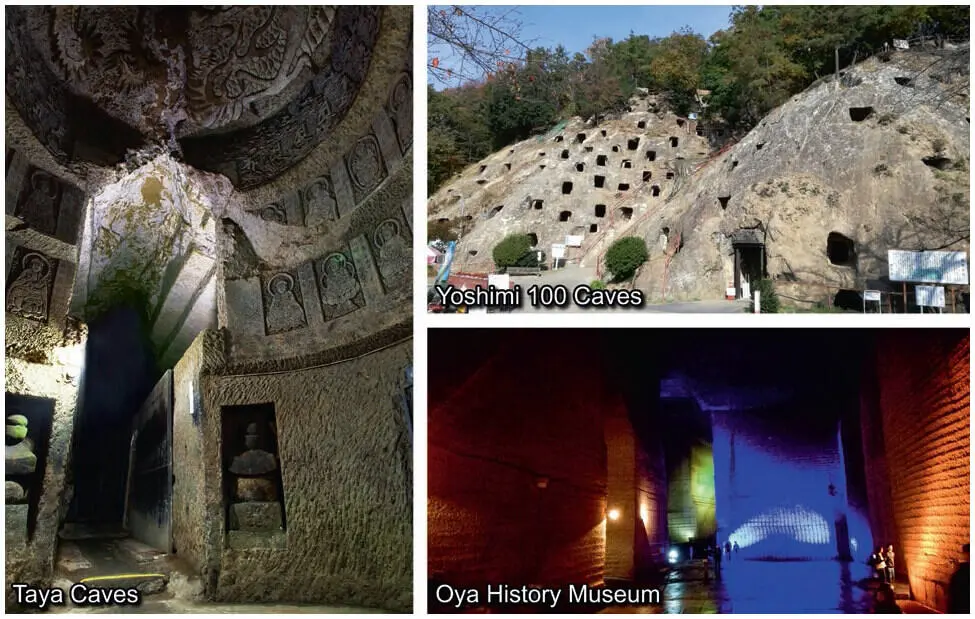
Figure 1: The underground sites under investigation (photo of Taya Caves by S. Sonoda).
Research outline
This study is aimed at investigating the vulnerability of the underground sites and its relationship with the relevant environmental and microenvironmental conditions, focusing on the properties and deterioration of the rock those caves are excavated into. The eventual outcomes are expected to support the adoption of countermeasures for preserving and promoting those sites and the stone artifacts enshrined therein, and give indications about the influence and safety of visitor traffic.
Here we introduce the first results of the characterization 223of the textural, mineralogical, petrophysical, and chemical properties of the rock and its alteration products, reserving particular attention to salt weathering and rock-water interaction. The principal techniques applied were optical microscopy, scanning electron microscope, X-ray powder diffraction, X-ray fluorescence, and mercury intrusion porosimetry. These were combined with the long-term monitoring of air temperature and relative humidity (RH).
Rock characterization
The rock of Taya Caves is a Pleistocene tuffaceous marine siltstone, grain-supported and well sorted, composed mainly of quartz, plagioclase, and lithoclasts rich in illite and smectite clay minerals, also distributed in the matrix. Two slightly different siltstone varieties are observable, which can be distinguished by their color and the presence (or not) of calcareous bioclasts.
Yoshimi Hundred Caves are excavated into a Miocene tuff with dacitic to andesitic composition, which shows a certain lithological variability, ranging from a coarse-grained pumiceous type – with porphyritic texture, plagioclase phenocrysts, abundant lithoclasts, and hypocrystalline groundmass – to a fine grained, mostly glassy type.
Читать дальшеИнтервал:
Закладка:
Похожие книги на «Monument Future»
Представляем Вашему вниманию похожие книги на «Monument Future» списком для выбора. Мы отобрали схожую по названию и смыслу литературу в надежде предоставить читателям больше вариантов отыскать новые, интересные, ещё непрочитанные произведения.










Обсуждение, отзывы о книге «Monument Future» и просто собственные мнения читателей. Оставьте ваши комментарии, напишите, что Вы думаете о произведении, его смысле или главных героях. Укажите что конкретно понравилось, а что нет, и почему Вы так считаете.