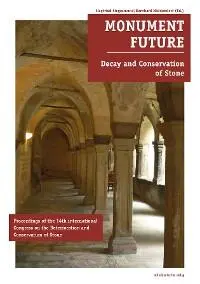
Siegfried Siegesmund - Monument Future
Здесь есть возможность читать онлайн «Siegfried Siegesmund - Monument Future» — ознакомительный отрывок электронной книги совершенно бесплатно, а после прочтения отрывка купить полную версию. В некоторых случаях можно слушать аудио, скачать через торрент в формате fb2 и присутствует краткое содержание. Жанр: unrecognised, на немецком языке. Описание произведения, (предисловие) а так же отзывы посетителей доступны на портале библиотеки ЛибКат.
- Название:Monument Future
- Автор:
- Жанр:
- Год:неизвестен
- ISBN:нет данных
- Рейтинг книги:4 / 5. Голосов: 1
-
Избранное:Добавить в избранное
- Отзывы:
-
Ваша оценка:
Monument Future: краткое содержание, описание и аннотация
Предлагаем к чтению аннотацию, описание, краткое содержание или предисловие (зависит от того, что написал сам автор книги «Monument Future»). Если вы не нашли необходимую информацию о книге — напишите в комментариях, мы постараемся отыскать её.
Alle vier Jahre treffen sich auf einer internationalen Tagung Experten, die sich mit den entsprechenden Sachfragen beschäftigen. Der „14th International Congress on the Deterioration and Conservation of Stone“ findet im September 2020 in Göttingen statt. Er ist die wichtigste Veranstaltung zur Verbreitung des Wissens von Praktikern und Forschern, die im Bereich der Steinkonservierung zur Erhaltung des baulichen Kulturerbes arbeiten: Geowissenschaftler, Architekten, Bauspezialisten, Ingenieure, Restauratoren, Denkmalpfleger und Bauherren.
Der Tagungsband mit über 150 wissenschaftlichen Beiträgen repräsentiert und erfasst den neuesten Stand der Technik auf diesem Gebiet.
Themen sind:
– Charakterisierung von Schadensphänomenen von Steinen und verwandten Baumaterialien (Stuck, Putz, Mörtel usw.)
– Methoden zur Untersuchung des Steinverfalls in situ und zerstörungsfreie Prüfung
– Langzeitüberwachung von Steindenkmälern und Gebäuden
– Simulation und Modellierung des Zerfalls
– Technologien und Entwicklung verbesserter Bearbeitung und Verwendung von Stein in Neubauten
– Bewertung der Langzeitwirkung von Bearbeitungstechniken
– Auswirkungen des Klimawandels auf die Steinverwitterung des Kulturerbes
– Berichte zur Steinkonservierung: Fallstudien und Projekte
– Digitalisierung und Dokumentation von Steinkonservierung
–
The 14th International Congress on the Deterioration and Conservation of Stone, entitled MONUMENT FUTURE: DECAY AND CONSERVATION OF STONE is a quadrennial event that brings together a world-wide community of geoscientists, architects, building specialists, engineers, conservators, restorators, monument curators and building owners who are concerned about the conservation of cultural stone structures and objects. Since antiquity, the weathering and deterioration of historical buildings, masonry, monuments, sculptures etc. using natural stones has been a very well-known problem.
This conference is the main gathering for the dissemination of knowledge in the field of stone deterioration issues. It represents and captures the state-of-the-art in the field of stone conservation and cultural heritage conservation with regards to the following topics:
– Characterisation of damage phenomena of stone and related building materials (plaster, rendering, mortar etc.)
– Methods for the investigation of stone decay; in-situ and non-destructive testing
– Long-term monitoring of stone monuments and buildings
– Simulation and modelling of decay
– Technology and development of improved treatments and use of stone in new buildings
– Assessment of long-term effects of treatments
– Impact of climate change on stone decay of Cultural Heritage
– Reports about stone conservation: case studies and projects
– Digitalization and documentation in stone conservation
Monument Future — читать онлайн ознакомительный отрывок
Ниже представлен текст книги, разбитый по страницам. Система сохранения места последней прочитанной страницы, позволяет с удобством читать онлайн бесплатно книгу «Monument Future», без необходимости каждый раз заново искать на чём Вы остановились. Поставьте закладку, и сможете в любой момент перейти на страницу, на которой закончили чтение.
Интервал:
Закладка:
The response to temperature changes is high in all investigated sandstone samples. Under dry conditions the sandstones expand about 0.8 mm/m. This expansion is increased up to 1.1 mm/m (S1, S3) when heating under wet conditions ( Tab. 1). The average thermal expansion coefficients α range between 11 and 13 × 10 –6K –1and can be considered very high. These high values, however, are not surprising, since quartz characteristically possesses a high thermal expansion coefficient and the investigated sandstones show high compositional maturity. The residual strains are considerably low under dry conditions and do not exceed 0.2mm/m under wet conditions.
The strength of the rock material is proportional to their dynamic modulus of elasticity (Young’s Modulus), which can be determined via the ultrasonic velocity. The ultrasonic velocity with up to 3.8 km/s as well as the Young’s Modulus with up to 32 GPa are significantly higher in group 1, meaning S1 and S3 possess a higher rock strength. In comparison, group two (S2, S4) shows ultrasonic velocities of 2.5 km/s and Young’s Moduli of up to 13 GPa.
Under laboratory conditions the sandstones show moderate resistance towards salt attack. After 30 cycles of salt bursting test (standard DIN EN 12370), the sandstones show a distinct darkening of their color tone and suffer minor material loss in the form of flaking and scaling (Fig. 7). Only S1 shows a constant loss of material in the form of bursting of edges and smaller components (Fig. 7a).

Figure 7: Discoloration and material loss of sample cubes S1–S4 after 30 cycles of salt bursting test.
Summary
The studied monoliths show diverse, partly exposure-specific weathering forms. Under laboratory 214conditions, the negative effects of thermal and thermohygric expansion were identified and are in accordance with the field observations. Water did show to increase the negative effect of thermal expansion on the investigated sandstones. Also its function as a transport medium has to be taken into account. The in-situ investigation showed severe damages associated with salt crystallization, which could be reproduced under laboratory conditions to a lesser extent. Possible protective measures for the future could be temporary roof constructions during seasons of high solar radiation and temperature or a protective planting of trees, which would be a permanent, but more natural solution. Nevertheless, individual monoliths should be considered for conservational treatment due to the high degree of weathering. Desalination and repairs with stone replacement mortars as well as measures to minimize the future salt input into the stone can be crucial. Regarding the origin of the monolith source material, the data from the in-situ and petrographic investigations, point towards a sandstone layer in the Paja Formation as origin of the sandstones S2 and S3. Therefore, further investigation should concentrate on the residual sandstone boulders covering the Paja Formation in the vicinity of the park.
Acknowledgements
We would like thank M. Silva Celis, director of the archaeological park Monquirá, for supporting our work as well as C. Gross for helping with the petrographical descriptions.
References
Etayo-Serna, F., 1968. Sinopsis Estratigrafica de la region de Villa de Leiva y zonas proximas. Boletín de Geología 8.
Hirschwald J (1912) Die Prüfung der natürlichen Bausteine auf ihre Wetterbeständigkeit. W. Ernst & Sohn, Berlin.
Öcal, A. D.; T. Cramer; S. Siegesmund, 2009. Caracterización de agentes del deterioro de los monolitos de piedra arenisca del Infiernito – Colombia, en 2do. Congreso Argentino y 1ro. Latinoamericano de Arqueometría 6–8 de julio de 2007, Tulio Palacios et al. – eds. – Buenos Aires: Comisión Nacional de Energía Atómica – CNEA, 2009, pp. 413–419.
Patarroyo Gama, P., 2008. La Formacion Ritoque en la zona de Vélez (Santander-Colombia). Geología colombiana 33, 109–110.
Renzoni, G., Rosas, H., Etayo-Serna, F., 1983. Mapa Geológico de la Plancha 171, Duitama, esc. 1:100.000. Ingeominas, Bogotá.
Siegesmund, S. and Dürrast, H. (2011), Physical and mechanical properties of rocks. In Siegesmund, S. and Snethlage, R. (Eds.), Stone in architecture, Springer, pp. 97–225.
Silva Celis, E. (1983) Descubrimiento Arqueológico en Villa de Leiva. Boletín de Antropología 5 (17–19), pp. 235–250.
Simón, P. 1981. Noticias Historiales de las Conquistas de Tierra Firme en las Indias Occidentales; Biblioteca del Banco Popular, Bogotá.
215
EVALUATION OF EFFECTIVE COMPRESSION STRENGTH OF NATURAL STONE BY DRILLING RESISTANCE MEASUREMENTS
Stephan Pfefferkorn 1 , Christoph Franzen 2
IN: SIEGESMUND, S. & MIDDENDORF, B. (EDS.): MONUMENT FUTURE: DECAY AND CONSERVATION OF STONE.
– PROCEEDINGS OF THE 14TH INTERNATIONAL CONGRESS ON THE DETERIORATION AND CONSERVATION OF STONE –
VOLUME I AND VOLUME II. MITTELDEUTSCHER VERLAG 2020.
1HTW Dresden, FB Bauingenieurwesen, Friedrich-List-Platz 1, 01069 Dresden, Germany
2Institut für Diagnostik und Konservierung an Denkmalen in Sachsen und Sachsen-Anhalt e. V. (IDK), Schlossplatz 1, 01067 Dresden, Germany
Abstract
The knowledge of strength parameters for material is necessary for the appraisal of the bearing behaviour of historic buildings. Usually these are determined by suitable check of drilling cores.
The columns under the vault in the ground floor of the historical city hall in Oederan (Germany, Saxony) are strongly loaded according to continuance statics. For the judgement their load-carrying capacity the pressure resistance should be determined. On account of the statics a cross section reduction was not admitted by taking drilling core. Besides, the columns from Hilbersdorfer Porphyrtuff showed considerable decomposition phenomena in its surfaces. The aim of the investigations was to find out the depth of the structure loosening and to estimate the pressure resistance of the uninjured rest cross section.
These questions could be answered with the drilling resistance measurement method. Besides, drillings with small diameter and a steady driving are introduced into the material. The measuring value of the drilling resistance arises from the contact force which is necessary for the realisation of the given driving. It can be given for every tenth millimetre of the drilling depth, so that a depth profile of the drilling resistance arises.
Between compressive strength and the drilling resistance a linear correlation exists. This relation could be determined on the basis of test specimens which were cut of simultaneous removal material. Drilling resistance as well as compressive strength were checked at these cubes and were confronted. Afterwards three drilling opposition measurements were executed per column. From the measuring profiles obtained could be read the depth of the structure decay as well as the drilling resistance of the unweathered core cross section be determined. With these values the compression strength was estimated under use of the before provided correlation function.
Initial situation and objective
Two columns made of Hilbersdorf porphyry tuff carry the vault on the ground floor of the town hall in Oederan, Germany (Figure 1). The volcanic Hilbersdorf porphyry tuff is a regionally used historic building material with a wide range of qualities (SIEDEL 2006, KREISSL 2010, WEDEKIND et al. 2013). The columns showed considerable surface loosening due to the influence of damaging salts leading to significant reduce in the static cross-section. Primary static assessments based of some assumed material parameters determined a high probability of failure. That’s why as an emergency 216measure a massive reinforced concrete jacket was placed around the shafts of the pillars to support the load transfer.
Читать дальшеИнтервал:
Закладка:
Похожие книги на «Monument Future»
Представляем Вашему вниманию похожие книги на «Monument Future» списком для выбора. Мы отобрали схожую по названию и смыслу литературу в надежде предоставить читателям больше вариантов отыскать новые, интересные, ещё непрочитанные произведения.







Обсуждение, отзывы о книге «Monument Future» и просто собственные мнения читателей. Оставьте ваши комментарии, напишите, что Вы думаете о произведении, его смысле или главных героях. Укажите что конкретно понравилось, а что нет, и почему Вы так считаете.