Siegfried Siegesmund - Monument Future
Здесь есть возможность читать онлайн «Siegfried Siegesmund - Monument Future» — ознакомительный отрывок электронной книги совершенно бесплатно, а после прочтения отрывка купить полную версию. В некоторых случаях можно слушать аудио, скачать через торрент в формате fb2 и присутствует краткое содержание. Жанр: unrecognised, на немецком языке. Описание произведения, (предисловие) а так же отзывы посетителей доступны на портале библиотеки ЛибКат.
- Название:Monument Future
- Автор:
- Жанр:
- Год:неизвестен
- ISBN:нет данных
- Рейтинг книги:4 / 5. Голосов: 1
-
Избранное:Добавить в избранное
- Отзывы:
-
Ваша оценка:
Monument Future: краткое содержание, описание и аннотация
Предлагаем к чтению аннотацию, описание, краткое содержание или предисловие (зависит от того, что написал сам автор книги «Monument Future»). Если вы не нашли необходимую информацию о книге — напишите в комментариях, мы постараемся отыскать её.
Alle vier Jahre treffen sich auf einer internationalen Tagung Experten, die sich mit den entsprechenden Sachfragen beschäftigen. Der „14th International Congress on the Deterioration and Conservation of Stone“ findet im September 2020 in Göttingen statt. Er ist die wichtigste Veranstaltung zur Verbreitung des Wissens von Praktikern und Forschern, die im Bereich der Steinkonservierung zur Erhaltung des baulichen Kulturerbes arbeiten: Geowissenschaftler, Architekten, Bauspezialisten, Ingenieure, Restauratoren, Denkmalpfleger und Bauherren.
Der Tagungsband mit über 150 wissenschaftlichen Beiträgen repräsentiert und erfasst den neuesten Stand der Technik auf diesem Gebiet.
Themen sind:
– Charakterisierung von Schadensphänomenen von Steinen und verwandten Baumaterialien (Stuck, Putz, Mörtel usw.)
– Methoden zur Untersuchung des Steinverfalls in situ und zerstörungsfreie Prüfung
– Langzeitüberwachung von Steindenkmälern und Gebäuden
– Simulation und Modellierung des Zerfalls
– Technologien und Entwicklung verbesserter Bearbeitung und Verwendung von Stein in Neubauten
– Bewertung der Langzeitwirkung von Bearbeitungstechniken
– Auswirkungen des Klimawandels auf die Steinverwitterung des Kulturerbes
– Berichte zur Steinkonservierung: Fallstudien und Projekte
– Digitalisierung und Dokumentation von Steinkonservierung
–
The 14th International Congress on the Deterioration and Conservation of Stone, entitled MONUMENT FUTURE: DECAY AND CONSERVATION OF STONE is a quadrennial event that brings together a world-wide community of geoscientists, architects, building specialists, engineers, conservators, restorators, monument curators and building owners who are concerned about the conservation of cultural stone structures and objects. Since antiquity, the weathering and deterioration of historical buildings, masonry, monuments, sculptures etc. using natural stones has been a very well-known problem.
This conference is the main gathering for the dissemination of knowledge in the field of stone deterioration issues. It represents and captures the state-of-the-art in the field of stone conservation and cultural heritage conservation with regards to the following topics:
– Characterisation of damage phenomena of stone and related building materials (plaster, rendering, mortar etc.)
– Methods for the investigation of stone decay; in-situ and non-destructive testing
– Long-term monitoring of stone monuments and buildings
– Simulation and modelling of decay
– Technology and development of improved treatments and use of stone in new buildings
– Assessment of long-term effects of treatments
– Impact of climate change on stone decay of Cultural Heritage
– Reports about stone conservation: case studies and projects
– Digitalization and documentation in stone conservation
Monument Future — читать онлайн ознакомительный отрывок
Ниже представлен текст книги, разбитый по страницам. Система сохранения места последней прочитанной страницы, позволяет с удобством читать онлайн бесплатно книгу «Monument Future», без необходимости каждый раз заново искать на чём Вы остановились. Поставьте закладку, и сможете в любой момент перейти на страницу, на которой закончили чтение.
Интервал:
Закладка:
Sanding, flaking, peeling (Fig. 2a, d), crumbling and exfoliation as well as transitional forms are evident. In addition to the relief formation, sanding 211is the second most common form of weathering with clearly varying intensities. Like sanding, scaling and flaking from plate-like areas parallel to the surface can lead to total loss. These phenomena are strongly connected to salt crystallization and expansional behavior, as may be fostered by strong sunshine during the day and followed by cold nights. Stress on the rocks’ fabric leads to the formation of cracks. However, the most noticeable damages to the stone surfaces are large, surface-parallel scales. Sometimes, nearly catastrophic damage events may occur on the exposed monoliths, like on Monolith V-0163, which was mapped in 2007 (Fig. 3 and 4), and was considerably damaged with a huge loss of material 12 years later (Fig. 3). In this example, material inhomogeneities like nearly invisible mica- and clay-layers inside the rock may have been an important primary damage factor. Scaling visibly occurs in connection with increased salt pollution, especially in the splash water area. Exposure-related scale formations are clearly recognizable. While on some monoliths only discoloration is observed, others show heavy break outs and material loss (Fig. 3).
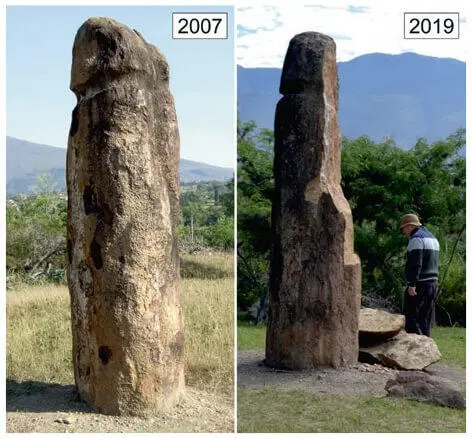
Figure 3: Monolith V-0163. Critical condition and strong deterioration between 2007 and 2019.
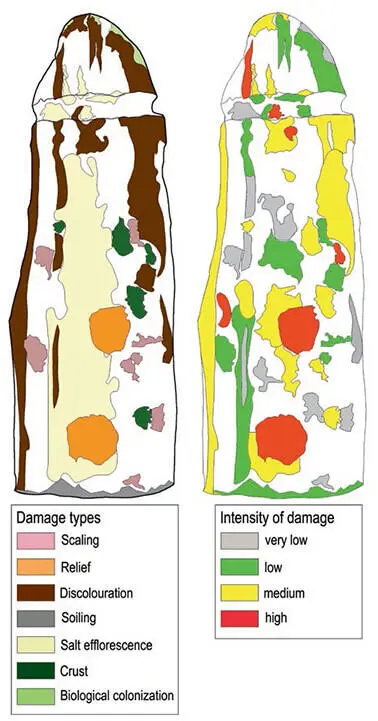
Figure 4: Damage mapping of Monolith V-0163 in 2007.
Rock material and its characterization
As possible source rocks for the monoliths, four comparable sandstones (S1–S4) were taken in the immediate vicinity of the archaeological park. They likely correspond to four sedimentary geological formations consisting of the Arcabuco, Ritoque, Paja, and Churuvita, which are Late Jurassic to Cretaceous in age. The formations are described in more detail by Etayo-Serna (1968), Patarroyo (2008) and Renzoni (1983). Field observations point towards a higher utilization of S2 and S3 as possible source rocks for the monoliths.
S1is a very fine-grained, gray sandstone, which appears heterogenous due to centimeter long white bands and dark gray to black colored lithic fragments (Fig. 5a). It shows sublitharenitic composition and a matrix (with argillaceous and organic components) supported fabric (Fig. 6a). Monocrystalline, angular quartz grains with various degrees of undulose extinction make > 75 % of the rock. 212Feldspar is occasionally visible (< 5 %). Quartz and feldspar show average grain sizes of < 0.2 mm. Mostly rounded, sometimes bent and elongated, chert fragments are greater in size and make up about 15 % of the rock. About 2 % phyllosilicates are found, preferably in the white bands of the sandstone. From the petrographical point of view, S1 could belong to the Ritoque Formation, which crops out near Villa de Leyva.
S2is a whitish and reddish mottled fine-grained quartz arenite (Fig. 5b). Like in S3 and S4, the homogenous fabric is grain supported (bound by silica cement). Angular quartz grains (> 95 %) are partly polycrystalline and between 0.1–0.01 mm in size. About 30 % of the quartz grains are coated by iron oxides (Fig. 6b). Less than 5 % lithic components of very fine grained quartz and argillaceous material, as well as minor amounts (< 1 %) of mica can be found. A quartz arenite layer of the normally silty to pelitic Paja Formation, which actually crops out at the park, could be the possible source of this sandstone.
S3shows macroscopically and microscopically strong similarities with S2. It has a whitish and reddish speckled appearance (like S2), but additionally contains white and red bands (similar to S1), which depicts a layering (Fig. 5c). The amount of very fine grained lithic fragments is higher than in S2 (> 5 %), the amount of iron oxides appears to be lower (Fig. 6c). Due to the strong similarities to S2, it can be assumed that S3 also originates from the Paja Formation.
S4is a very fine-grained and very light colored, whitish-grey (with tiny yellowish spots) sandstone of sublitharenitic to quartz arenitic composition (Fig. 5d). The homogenous fabric is grain supported and very porous (Fig. 6d). The sandstone consists of > 90 % subrounded to subangular, polycrystalline quartz, with minor undulose extinction. The average grain size is about 0.01 mm. Less than 5 % fine grained lithic fragments (consisting of almost exclusively quartz), 2 % of opaques and < 1 % of mica can be found. A possible origin could be a very fine grained subgroup of the Arcabuco Formation, cropping out near Villa de Leyva. Although the Churuvita Formation crops out further to the southeast of the park, it cannot be ruled out as a possible source material.

Figure 5: Macroscopic photographs of a) S1, b) S2, c) S3 and d) S4 (size of the photos: 4.5 cm × 4.5 cm).
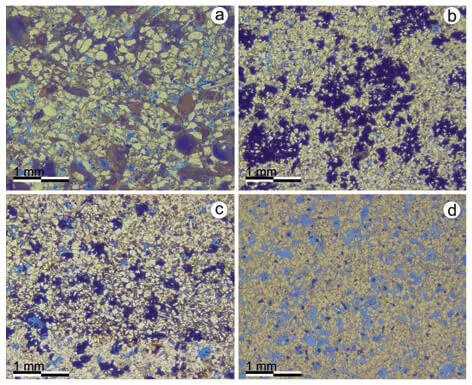
Figure 6: Thin section photomicrographs of a) S1, b) S2, c) S3, d) S4 in plane-polarized light and 2.5x objective. The blue resin visualizes the differences in pore space.
Petrophysical properties and weathering behavior
The petrophysical properties and weathering behavior of the sandstones were determined in accordance to the German industrial norms parallel (X-direction) and perpendicular (Z-direction) to the bedding. For further information see Siegesmund and Dürrast (2011). Table 1gives an overview of the laboratory results.
In general, the sandstones can be divided into 213group one (S1, S3) and group two (S2, S4) of similar petrophysical properties and weathering behavior. Group two is characterized by higher porosities (> 20 vol%) and bulk densities around 2.0 g/cm 3. Group two also shows unimodal pore radii distributions with large ratios of capillary pores (> 93 %) and mean pore radii between 0.9 and 5.7 µm. Group one (S1, S3) on the other hand, shows mean pore radii of 0.3–0.5 µm and contains considerable amounts of micropores (< 48 %). Up to nine times higher capillary water absorption (< 9 kg/m2√h) and lower resistance against water vapor diffusion in group two indicate better pore connection than in the sandstones S1 and S3 of group one ( Tab. 1). The saturation coefficient S, as an indication of the materials’ frost resistance (Hirschwald 1912), classifies S1, S3 and S4 as frost resistant and S2 as uncertain.
Table 1: Petrophysical properties and weathering behavior of the four analyzed sandstones.
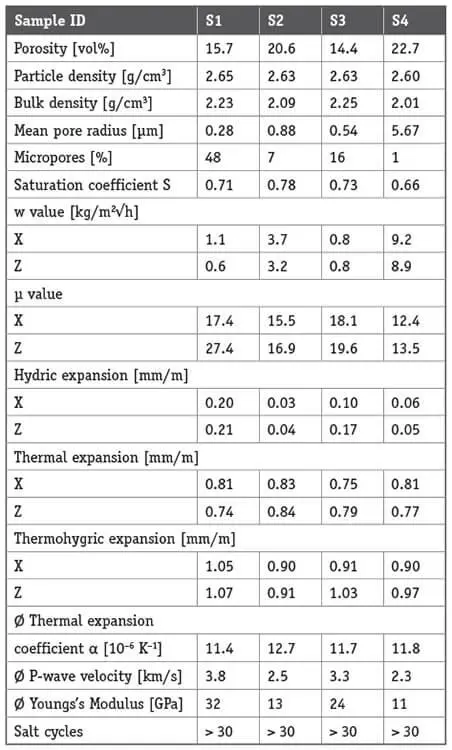
Regarding the moisture expansion, both groups show distinct differences when subjected to water ( Tab. 1). While group two (S2, S4) shows barely any expansion (< 0.06 mm/m), the sandstones of group one (S1, S3) expand up to 0.2 mm/m. However, the hydric expansion values of the investigated sandstones can be generally considered low when compared to other sandstones (Siegesmund and Dürrast 2011).
Читать дальшеИнтервал:
Закладка:
Похожие книги на «Monument Future»
Представляем Вашему вниманию похожие книги на «Monument Future» списком для выбора. Мы отобрали схожую по названию и смыслу литературу в надежде предоставить читателям больше вариантов отыскать новые, интересные, ещё непрочитанные произведения.







Обсуждение, отзывы о книге «Monument Future» и просто собственные мнения читателей. Оставьте ваши комментарии, напишите, что Вы думаете о произведении, его смысле или главных героях. Укажите что конкретно понравилось, а что нет, и почему Вы так считаете.