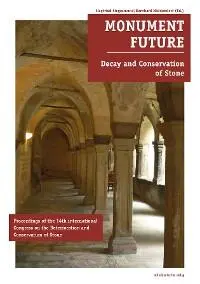
Siegfried Siegesmund - Monument Future
Здесь есть возможность читать онлайн «Siegfried Siegesmund - Monument Future» — ознакомительный отрывок электронной книги совершенно бесплатно, а после прочтения отрывка купить полную версию. В некоторых случаях можно слушать аудио, скачать через торрент в формате fb2 и присутствует краткое содержание. Жанр: unrecognised, на немецком языке. Описание произведения, (предисловие) а так же отзывы посетителей доступны на портале библиотеки ЛибКат.
- Название:Monument Future
- Автор:
- Жанр:
- Год:неизвестен
- ISBN:нет данных
- Рейтинг книги:4 / 5. Голосов: 1
-
Избранное:Добавить в избранное
- Отзывы:
-
Ваша оценка:
Monument Future: краткое содержание, описание и аннотация
Предлагаем к чтению аннотацию, описание, краткое содержание или предисловие (зависит от того, что написал сам автор книги «Monument Future»). Если вы не нашли необходимую информацию о книге — напишите в комментариях, мы постараемся отыскать её.
Alle vier Jahre treffen sich auf einer internationalen Tagung Experten, die sich mit den entsprechenden Sachfragen beschäftigen. Der „14th International Congress on the Deterioration and Conservation of Stone“ findet im September 2020 in Göttingen statt. Er ist die wichtigste Veranstaltung zur Verbreitung des Wissens von Praktikern und Forschern, die im Bereich der Steinkonservierung zur Erhaltung des baulichen Kulturerbes arbeiten: Geowissenschaftler, Architekten, Bauspezialisten, Ingenieure, Restauratoren, Denkmalpfleger und Bauherren.
Der Tagungsband mit über 150 wissenschaftlichen Beiträgen repräsentiert und erfasst den neuesten Stand der Technik auf diesem Gebiet.
Themen sind:
– Charakterisierung von Schadensphänomenen von Steinen und verwandten Baumaterialien (Stuck, Putz, Mörtel usw.)
– Methoden zur Untersuchung des Steinverfalls in situ und zerstörungsfreie Prüfung
– Langzeitüberwachung von Steindenkmälern und Gebäuden
– Simulation und Modellierung des Zerfalls
– Technologien und Entwicklung verbesserter Bearbeitung und Verwendung von Stein in Neubauten
– Bewertung der Langzeitwirkung von Bearbeitungstechniken
– Auswirkungen des Klimawandels auf die Steinverwitterung des Kulturerbes
– Berichte zur Steinkonservierung: Fallstudien und Projekte
– Digitalisierung und Dokumentation von Steinkonservierung
–
The 14th International Congress on the Deterioration and Conservation of Stone, entitled MONUMENT FUTURE: DECAY AND CONSERVATION OF STONE is a quadrennial event that brings together a world-wide community of geoscientists, architects, building specialists, engineers, conservators, restorators, monument curators and building owners who are concerned about the conservation of cultural stone structures and objects. Since antiquity, the weathering and deterioration of historical buildings, masonry, monuments, sculptures etc. using natural stones has been a very well-known problem.
This conference is the main gathering for the dissemination of knowledge in the field of stone deterioration issues. It represents and captures the state-of-the-art in the field of stone conservation and cultural heritage conservation with regards to the following topics:
– Characterisation of damage phenomena of stone and related building materials (plaster, rendering, mortar etc.)
– Methods for the investigation of stone decay; in-situ and non-destructive testing
– Long-term monitoring of stone monuments and buildings
– Simulation and modelling of decay
– Technology and development of improved treatments and use of stone in new buildings
– Assessment of long-term effects of treatments
– Impact of climate change on stone decay of Cultural Heritage
– Reports about stone conservation: case studies and projects
– Digitalization and documentation in stone conservation
Monument Future — читать онлайн ознакомительный отрывок
Ниже представлен текст книги, разбитый по страницам. Система сохранения места последней прочитанной страницы, позволяет с удобством читать онлайн бесплатно книгу «Monument Future», без необходимости каждый раз заново искать на чём Вы остановились. Поставьте закладку, и сможете в любой момент перейти на страницу, на которой закончили чтение.
Интервал:
Закладка:
The conservation treatment for the fossil sites was conducted by selecting three sites around the fossil sites and classifying them into supplementing and reinforcing cracks. As a result of supplementing cracks using epoxy type L-30, L-50 and KSE-500, L-30, the treatement revealed a relatively better effect in strengthening the physical properties than the other two adhesives. OH 100 and KSE 300 showed a similar effect; after conducting a pre-treatment of anti-swelling and applying two types of consolidation reagents three times, it was found that OH 100 was relatively stable.
The measuement of ultrasonic wave velocity at each site was performed to monitor the effect of the trial preservation treatment and revealed that the average values before the treatment(2,091 m/s) was increased to 2,394 m/s after the treatment. In particular, the Sanghanyeom-21, Hanyeom-30, and Gaemesom-31, which had belonged to the CW stage, were upgraded to the HW stage due to the ultrasonic wave velocity increase after the preservation treatment. Although a short-term effect can be expected for outdoor fossil sites, it seems necessary to apply additional measures, coupled with a conservation treatment, in the long run (Fig. 7).

Figure 7: Trial conservation treatments and monitoring for effects of the dinosaur egg fossil sites in Hwasung Gojeongri. (left) Resin treatments within the cracks, (middle) Reinforcing the surface and (right) Effect monitoring by ultrasonic velocity.
References
Lee, C. H. and Jo, Y.H, 2017, Correlation and correction factor between direct and indirect methods for the ultrasonic measurement of stone samples, Environmental Earth Science, 76:477.
Lee, Y. N., Jeong, K. S., Chang, S. K., Choi, M. Y., Choi, J. I., 2000, The preliminary research on the dinosaur eggs and nests found in the reclaimed area south to the Siwha Lake, Gyeonggi Province, Korea, Journal of the Paleontological Society of Korea, 16(1), 27–36. (in Korean with English abstract)
Lee, Y. N., 2003, Dinosaur bones and eggs in South Korea. Memoir of the Fukui Prefectural Dinosaur Museum, 2, 113–121.
Lee. S. J., 2009, Study on the consolidating mechanism of stone monuments containing clay minerals with swelling properties. Ph.D. Thesis, Kyeongju National University, 1-110 (in Korean with English abstract).
Zhao, Z. K., and S. R. Ding. 1976. Discovery of the dinosaur eggs from Alashanzuoqi and its stratigraphical meaning, Vertebrata PalAsiatica, 14, 42–44.
203
MATERIAL CHARACTERISTICS AND NON-DESTRUCTIVE DIAGNOSIS OF STONE STANDING BUDDHA AND STONE CHAMBER OF MIREUKRI TEMPLE SITE IN CHUNGJU, KOREA
Hee Young Park 1 , Sun Young Park 2 , Chan Hee Lee 2 * , Jun Hyoung Park 2
IN: SIEGESMUND, S. & MIDDENDORF, B. (EDS.): MONUMENT FUTURE: DECAY AND CONSERVATION OF STONE.
– PROCEEDINGS OF THE 14TH INTERNATIONAL CONGRESS ON THE DETERIORATION AND CONSERVATION OF STONE –
VOLUME I AND VOLUME II. MITTELDEUTSCHER VERLAG 2020.
1Chungbuk Research Institute of Cultural Heritage, Cheongju, 28443, Republic of Korea
2Dept. of Cultural Heritage Conservation Sciences, Kongju National University, Gongju, 32588, Republic of Korea
* chanlee@kongju.ac.kr
Abstract
The Stone Standing Buddha and the Stone Chamber of Mireukri temple site in Chungju is a semi-built artificial stone grotto temple that inherited the Gyeongju Seokguram Grotto (AD 751) in South Korea. It was designated as Korean Treasure No. 96 in recognition of its value as a cultural heritage site like the huge Stone Standing Buddha (10.6 m in height), a unique architectural structure.
However, the Stone Chamber had problems with its structural stability as its masonry was constructed after being built on top of weathered granite, where the original ground sloped to the west. Due to continuous creep, the structural deformation was clearly visible in the western wall of the Stone Chamber in 2014, which was decided to be dismantled in 2016. Currently, the dismantling and repair work is in progress on all sections of the western wall and some sections of the southern wall.
With the repair work, an overall conservation scientific investigation including non-destructive diagnosis for the Stone Standing Buddha and Stone Chamber was carried out. As a result, the main rocks that make up this study subject are pinkish medium-grained biotite granites, which as Wolaksan granite. The deterioration assessment on the Stone Standing Buddha indicated moderate conditions for all types of damage. However, in the analysis of surface contaminants, there was a singularity that the content of lead on the statue’s face was measured to be relatively higher than other parts.
The physical evaluation by ultrasonic velocity showed third grade deterioration (moderately weathered – MW) in the Stone Standing Buddha, while the Stone Chamber before dismantling was shown to be fourth grade (highly weathered – HW). Finally, by examining petrographic homogeneity with granitic rocks in the surrounding area, it was found that the rocks around Mireukri in Chungju and the quarry in Mungyeong are highly similar with those of the study subject.
Keywords: Mireukri temple site, Deterioration, Creep, Nondestructive diagnosis, Petrographic homogeneity
Introduction
The Stone Standing Buddha and the Stone Chamber, that is the main Buddha and Geumdang (the main temple) of the Mireukdaewonji, are located in 204Mireukri, Chungju City, Korea. The Mireukdaewonji is one of the important Buddhist temples in the Goryeo Dynasty (AD 918 to AD 1392) of ancient Korea. Within this cultural heritage zone, various stone cultural heritages such as the Five-story Stone Pagoda in Mireukri (Treasure No. 95) are widely distributed.
The Stone Standing Buddha is composed of six stones and is surrounded by masonry on three sides: east, south, and west. It is presumed that there was a wooden structure on the upper part of the Stone Chamber, but is no longer present (Ryoo, 2018). There is no exact historical record of when it was destroyed.
The temple’s history and name were revealed by conducting five excavation surveys from 1977 to 1991 (Kim, 2008). Since then, various art historical and archaeological studies have been carried out on the stone chamber structure, the only Stone Standing Buddha facing north in Korea, the form of the Bogae (a kind of stone hat), and the hand gestures holding a flower bud-shaped object (Jeong, 2008). On the other hand, conservation-related scientific investigation was not sufficient, and only visual observation of the physical, chemical and biological factors and surroundings was conducted.
With obvious structural deformation occurring in the western wall of the Stone Chamber, dismantling and repair work is currently underway (Fig. 1). In addition to this, to prepare the basic data for conservation and maintenance of the Stone Standing Buddha and Stone Chamber, a need for the scientific investigation has emerged. It is also required to examine the substitute stone for damaged parts of the Stone Chamber. Therefore, we expect that the results of this study will provide the basic data for the establishment of the long-term conservation management plan and the provenance interpretation for stone heritages.

Figure 1: Photographs showing the dismantling and repair work of the Stone Standing Buddha and Stone Chamber in the Mireukri temple site. (A) Before 2015, (B) March 2018, (C) March 2019.
Читать дальшеИнтервал:
Закладка:
Похожие книги на «Monument Future»
Представляем Вашему вниманию похожие книги на «Monument Future» списком для выбора. Мы отобрали схожую по названию и смыслу литературу в надежде предоставить читателям больше вариантов отыскать новые, интересные, ещё непрочитанные произведения.







Обсуждение, отзывы о книге «Monument Future» и просто собственные мнения читателей. Оставьте ваши комментарии, напишите, что Вы думаете о произведении, его смысле или главных героях. Укажите что конкретно понравилось, а что нет, и почему Вы так считаете.