Siegfried Siegesmund - Monument Future
Здесь есть возможность читать онлайн «Siegfried Siegesmund - Monument Future» — ознакомительный отрывок электронной книги совершенно бесплатно, а после прочтения отрывка купить полную версию. В некоторых случаях можно слушать аудио, скачать через торрент в формате fb2 и присутствует краткое содержание. Жанр: unrecognised, на немецком языке. Описание произведения, (предисловие) а так же отзывы посетителей доступны на портале библиотеки ЛибКат.
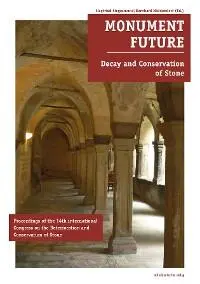
- Название:Monument Future
- Автор:
- Жанр:
- Год:неизвестен
- ISBN:нет данных
- Рейтинг книги:4 / 5. Голосов: 1
-
Избранное:Добавить в избранное
- Отзывы:
-
Ваша оценка:
Monument Future: краткое содержание, описание и аннотация
Предлагаем к чтению аннотацию, описание, краткое содержание или предисловие (зависит от того, что написал сам автор книги «Monument Future»). Если вы не нашли необходимую информацию о книге — напишите в комментариях, мы постараемся отыскать её.
Alle vier Jahre treffen sich auf einer internationalen Tagung Experten, die sich mit den entsprechenden Sachfragen beschäftigen. Der „14th International Congress on the Deterioration and Conservation of Stone“ findet im September 2020 in Göttingen statt. Er ist die wichtigste Veranstaltung zur Verbreitung des Wissens von Praktikern und Forschern, die im Bereich der Steinkonservierung zur Erhaltung des baulichen Kulturerbes arbeiten: Geowissenschaftler, Architekten, Bauspezialisten, Ingenieure, Restauratoren, Denkmalpfleger und Bauherren.
Der Tagungsband mit über 150 wissenschaftlichen Beiträgen repräsentiert und erfasst den neuesten Stand der Technik auf diesem Gebiet.
Themen sind:
– Charakterisierung von Schadensphänomenen von Steinen und verwandten Baumaterialien (Stuck, Putz, Mörtel usw.)
– Methoden zur Untersuchung des Steinverfalls in situ und zerstörungsfreie Prüfung
– Langzeitüberwachung von Steindenkmälern und Gebäuden
– Simulation und Modellierung des Zerfalls
– Technologien und Entwicklung verbesserter Bearbeitung und Verwendung von Stein in Neubauten
– Bewertung der Langzeitwirkung von Bearbeitungstechniken
– Auswirkungen des Klimawandels auf die Steinverwitterung des Kulturerbes
– Berichte zur Steinkonservierung: Fallstudien und Projekte
– Digitalisierung und Dokumentation von Steinkonservierung
–
The 14th International Congress on the Deterioration and Conservation of Stone, entitled MONUMENT FUTURE: DECAY AND CONSERVATION OF STONE is a quadrennial event that brings together a world-wide community of geoscientists, architects, building specialists, engineers, conservators, restorators, monument curators and building owners who are concerned about the conservation of cultural stone structures and objects. Since antiquity, the weathering and deterioration of historical buildings, masonry, monuments, sculptures etc. using natural stones has been a very well-known problem.
This conference is the main gathering for the dissemination of knowledge in the field of stone deterioration issues. It represents and captures the state-of-the-art in the field of stone conservation and cultural heritage conservation with regards to the following topics:
– Characterisation of damage phenomena of stone and related building materials (plaster, rendering, mortar etc.)
– Methods for the investigation of stone decay; in-situ and non-destructive testing
– Long-term monitoring of stone monuments and buildings
– Simulation and modelling of decay
– Technology and development of improved treatments and use of stone in new buildings
– Assessment of long-term effects of treatments
– Impact of climate change on stone decay of Cultural Heritage
– Reports about stone conservation: case studies and projects
– Digitalization and documentation in stone conservation
Monument Future — читать онлайн ознакомительный отрывок
Ниже представлен текст книги, разбитый по страницам. Система сохранения места последней прочитанной страницы, позволяет с удобством читать онлайн бесплатно книгу «Monument Future», без необходимости каждый раз заново искать на чём Вы остановились. Поставьте закладку, и сможете в любой момент перейти на страницу, на которой закончили чтение.
Интервал:
Закладка:
After the last conservation treatment, which was carried out in 2008 because the fossilized dinosaur eggs had been exposed to the ground’s surface for nine years and had been damaged by artificial damage, natural weathering, and erosion from acid rain, the fossil site’s host rock was in urgent need of conservation. Therefore, this study investigated the material properties of rocks with dinosaur eggs, evaluated its weathering and damage, and conducted various non-destructive precision diagnoses.
In addition, the exposure of fossil-bearing rock layers to the external environment accelerates damage through natural weathering due to physical, chemical, and biological factors. Therefore, in order to resist weathering, even if the fossil is directly exposed to outdoor, researching consolidation reagent and adhesives suitable for a fossil site is essential. This study carried out indoor and field application experiments on the same rock types and rocks that make up the fossil site to select the suitable consolidation reagent for actual conservation treatment. Furthermore, by evaluating suitability through field application experiments, they were used for conservation works.
Keywords: Dinosaur egg fossil sites, Deterioration, Diagnosis, Conservation, Consolidants
Introduction
Sihwa Lake is located at the Gojeongri, Hwaseong site in the Republic of Korea. The place where dinosaur egg fossils were discovered is reclaimed land on the south side of Sihwa Lake, which appeared after the construction of the Sihwa Lake Seawall. Gojeongri is the first location in Asia where a group of dinosaur egg fossils was discovered. The Asian countries in which the highest number of dinosaur eggs have been found are China and Mongolia. In China, however, a place where a group of dinosaurs had lain eggs has not yet been found. Recently, 198the second group-spawning site in Asia was discovered in Mongolia. Therefore, the Gojeongri site holds significant academic value as a globally-rare, group-spawning site.
The dinosaur egg fossils were found on twelve small islands that existed before the seawall was built. The fossil sites are distributed on the slopes and at the base of several small and large islands. Furthermore, there are now decks installed for visitors to look around the Mumyeongsom, Hahanyeom, Nudebawee, and Junghanyeom sites (Fig. 1).

Figure 1: Distribution map showing the dinosaur egg fossil sites in Hwasung Gojeongri.
The fossil sites, however, were submerged in seawater and are now located adjacent to industrial complexes and road networks, both of which emit toxic gases that cause acid rain that has a deadly effect on fossil conservation. As of today, 203 dinosaur egg fossils have been discovered at fifty-eight sites. Some basic research on the fossil sites has been conducted, according to which there are three types of dinosaur eggs: Faveoloothid, Dendroolithid, and Elongatoolith (Lee et al . 2000; Lee, 2003, Fig. 2). The type two dinosaur egg fossils, which were found only atthe Gaemesom site, have not been reported worldwide.
The first type of eggs are subspherical in shape, with an estimated maximum length of 13.5 cm and a width of 11.5 cm. The pores are large (0.34~0.45 mm in diameter), and are round or oval in cross section. The pore system is similar to multicanaliculate of the faveoloolithid-type eggs (Zhao and Ding, 1976).
The second type is smaller than the first type, and its pore system is similar to prolatocanaliculate of the dendroolithid-type eggs. The pore canals originate mainly in the interspaces between the shell units. These characteristics indicate that the dinosaur egg is a new dinosaur egg belonging to the dendrolithid-type (Lee, 2003).
The third type of eggs is represented by several pieces of eggshells in one location. These eggshells are 1 mm thick and have a linearituberculate surface texture, which differs from the sagenotuberculate ornamentation of the first egg type. This type of dinosaur egg is likely to be of theropod, and classed as an elongatoolith-type (Zhao and Ding, 1976).
On-site investigation revealed that the dinosaur egg fossils and the matrix rocks were damaged in several places. Because the fossils were exposed to rapid environmental changes and nature, various physical, chemical, and biological factors contributed to destroying the eggs’ original shapes. Therefore, it is necessary to investigate the fossil damage and to establish conservation measures in response to the rising attention toward accelerated damage of dinosaur egg fossils (Fig. 2).
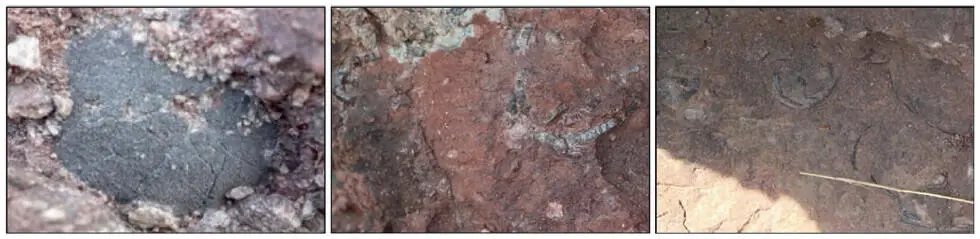
Figure 2: Representative types of the dinosaur egg fossils from Hwasung Gojeongri. (left) Type 1, (middle) Type 2 and (right) Type 3.
199Materials and Methods
This study conducted a non-destructive precise diagnosis to comprehensively examine the conservation status of the fossil sites, through which conservation schemes were established. To this end, the mineralogical characteristics of the fossil sites were analyzed, and a surface deterioration assessment and a test on the constituent rocks’ physical properties were carried out.
Furthermore, the damage types were recorded at the site to identify the damage type, location, and distribution of rocks generated by locality at the fossil site. Based on these recordings, a damage map was drawn up and quantitative damage rates were estimated. For blistering, which is difficult to observe with the naked eye, the location and actual area were determined by using both infrared thermography and a percussion technique. The infrared thermal imaging camera used in the analysis was FLIR’s T640 model. Thermographic images were obtained through an active method of detecting the blistering that is caused by instantaneous temperature changes due to artificial heat; a near-infrared electric heater was used as the heat source.
Additionally, ultrasonic measurements were performed to evaluate the properties of the research sites and dinosaur egg fossils. Pundit Lab, which is manufactured by Proceq, was used for evaluation. After converting the measured ultrasonic velocity into a weathering index, an image map was drawn up using the Kriging technique. Through this, the fossil site’s overall weathering status was investigated. Moreover, the petrographic characteristics were examined by using P-XRF (Oxford, JSM 6335F) to analyze the contaminants on the fossil surfaces and to determine the causes of weathering.
Based on these findings, the direction for the fossil site’s preservation was determined, and its effect was verified through an indoor reinforcement treatment test and a field application experiment prior to actual treatment. Additionally, a general reinforcement treatment was performed, including on cracks for the areas that required preservation; supports were also installed to mitigate structurally weak elements. Furthermore, monitoring was conducted to verify the preservation treatment’s effects. The data collected from each non-destructive device was immediately put together in the field to verify the data’s reliability. Based on this, the comprehensive precision safety diagnosis of the dinosaur egg fossil site at Gojeongri, Hwaseong, was reviewed.
Additionally, a trial experiment was performed to select a proper consolidation reagent to preserve the fossil sites’ rocks, whose physical properties had been weakened by weathering. The natural heritage consisting of rocks (such as fossil sites) is weathered by complex factors, including physical, chemical, and biological elements when rock matrix are exposed outdoors. Likewise, a stone cultural heritage consisting of rocks is also weathered by various factors; when the rock surface strength has deteriorated, it is common to apply a surface treatment to restore the rock’s physical properties.
Читать дальшеИнтервал:
Закладка:
Похожие книги на «Monument Future»
Представляем Вашему вниманию похожие книги на «Monument Future» списком для выбора. Мы отобрали схожую по названию и смыслу литературу в надежде предоставить читателям больше вариантов отыскать новые, интересные, ещё непрочитанные произведения.






Обсуждение, отзывы о книге «Monument Future» и просто собственные мнения читателей. Оставьте ваши комментарии, напишите, что Вы думаете о произведении, его смысле или главных героях. Укажите что конкретно понравилось, а что нет, и почему Вы так считаете.