Siegfried Siegesmund - Monument Future
Здесь есть возможность читать онлайн «Siegfried Siegesmund - Monument Future» — ознакомительный отрывок электронной книги совершенно бесплатно, а после прочтения отрывка купить полную версию. В некоторых случаях можно слушать аудио, скачать через торрент в формате fb2 и присутствует краткое содержание. Жанр: unrecognised, на немецком языке. Описание произведения, (предисловие) а так же отзывы посетителей доступны на портале библиотеки ЛибКат.
- Название:Monument Future
- Автор:
- Жанр:
- Год:неизвестен
- ISBN:нет данных
- Рейтинг книги:4 / 5. Голосов: 1
-
Избранное:Добавить в избранное
- Отзывы:
-
Ваша оценка:
Monument Future: краткое содержание, описание и аннотация
Предлагаем к чтению аннотацию, описание, краткое содержание или предисловие (зависит от того, что написал сам автор книги «Monument Future»). Если вы не нашли необходимую информацию о книге — напишите в комментариях, мы постараемся отыскать её.
Alle vier Jahre treffen sich auf einer internationalen Tagung Experten, die sich mit den entsprechenden Sachfragen beschäftigen. Der „14th International Congress on the Deterioration and Conservation of Stone“ findet im September 2020 in Göttingen statt. Er ist die wichtigste Veranstaltung zur Verbreitung des Wissens von Praktikern und Forschern, die im Bereich der Steinkonservierung zur Erhaltung des baulichen Kulturerbes arbeiten: Geowissenschaftler, Architekten, Bauspezialisten, Ingenieure, Restauratoren, Denkmalpfleger und Bauherren.
Der Tagungsband mit über 150 wissenschaftlichen Beiträgen repräsentiert und erfasst den neuesten Stand der Technik auf diesem Gebiet.
Themen sind:
– Charakterisierung von Schadensphänomenen von Steinen und verwandten Baumaterialien (Stuck, Putz, Mörtel usw.)
– Methoden zur Untersuchung des Steinverfalls in situ und zerstörungsfreie Prüfung
– Langzeitüberwachung von Steindenkmälern und Gebäuden
– Simulation und Modellierung des Zerfalls
– Technologien und Entwicklung verbesserter Bearbeitung und Verwendung von Stein in Neubauten
– Bewertung der Langzeitwirkung von Bearbeitungstechniken
– Auswirkungen des Klimawandels auf die Steinverwitterung des Kulturerbes
– Berichte zur Steinkonservierung: Fallstudien und Projekte
– Digitalisierung und Dokumentation von Steinkonservierung
–
The 14th International Congress on the Deterioration and Conservation of Stone, entitled MONUMENT FUTURE: DECAY AND CONSERVATION OF STONE is a quadrennial event that brings together a world-wide community of geoscientists, architects, building specialists, engineers, conservators, restorators, monument curators and building owners who are concerned about the conservation of cultural stone structures and objects. Since antiquity, the weathering and deterioration of historical buildings, masonry, monuments, sculptures etc. using natural stones has been a very well-known problem.
This conference is the main gathering for the dissemination of knowledge in the field of stone deterioration issues. It represents and captures the state-of-the-art in the field of stone conservation and cultural heritage conservation with regards to the following topics:
– Characterisation of damage phenomena of stone and related building materials (plaster, rendering, mortar etc.)
– Methods for the investigation of stone decay; in-situ and non-destructive testing
– Long-term monitoring of stone monuments and buildings
– Simulation and modelling of decay
– Technology and development of improved treatments and use of stone in new buildings
– Assessment of long-term effects of treatments
– Impact of climate change on stone decay of Cultural Heritage
– Reports about stone conservation: case studies and projects
– Digitalization and documentation in stone conservation
Monument Future — читать онлайн ознакомительный отрывок
Ниже представлен текст книги, разбитый по страницам. Система сохранения места последней прочитанной страницы, позволяет с удобством читать онлайн бесплатно книгу «Monument Future», без необходимости каждый раз заново искать на чём Вы остановились. Поставьте закладку, и сможете в любой момент перейти на страницу, на которой закончили чтение.
Интервал:
Закладка:
Their discrepancies are, on average, around 0.8 %, which is within the experimental error of the onset time picking measurements. However, these discrepancies increase for altered samples (2.9 %), which could be related to the surficial roughness and microstructure modification by crystallisation pressure and the presence of remaining salts.
As grain size and weathering increase, the determination of arrival time of S-waves becomes more problematic due to the contamination of S-waveforms by P-waves, a lower signal-to-noise ratio and an increase of wavelength. These difficulties are more prevalent in the weathered samples, where the manual picking of the onset-time becomes more difficult and time-consuming.
Despite experimental problems, S-wave velocity values are in agreement with previous published data for similar rock types. Therefore manual measurements can be considered as a “true” or reference value (e. g.: Siegesmund and Dürrast, 2011). When comparing manual and calculated S-wave values, it can be observed that the proposed methodology calculates accurate values S-wave velocity of the studied rock types (Fig. 3). Discrepancies between the manual and automatic methods are within experimental error of the onset time picking measurements of S waves velocities, with a discrepancy of around 5 %. Generally, V Svalues are slightly higher when calculated using the automatic method in comparison to the manual method (Fig. 3).
This methodology successfully distinguishes between P-waves and S-waves based on criteria relating to symmetry, amplitude and duration. One advantage of this method is the limitation of subjectivity of the human analyst. Moreover, this study has identified that the main peak frequency of P- and S-waves are comparatively different ( Table 1); a discrepancy that can be used as a further differentiating characteristic. This methodology is recommended for fresh and weathered stones with a medium-coarse grain size (0.5–1 mm). This methodology may be particularly helpful where the quality of the S-waveform signals are poor, resulting in difficulties with manual picking of the onset time.
195 Conclusions
This paper addresses determination of the picking of the onset of P- and S-waves in transmitted output waveforms on weathered sandstones. Stones weathered by salt crystallisation show an increase in surficial roughness and their microstructural properties are strongly modified by crystallisation pressure and the presence of remained salts. The wavelength of output signals depends on grain size and weathering, while microstructural components of stones and the presence of salts operate as a wavelength filter. Manual picking of the onset time for elastic waves becomes more difficult with increase in wavelength, although this observation is less important for P-waves than S-waves. Particularly, as grain size and stone alteration increase, the determination of arrival time of S-waves becomes more problematic due to the contamination of S-waveforms by P-waves, a lower signal-to-noise ratio and an increase of wavelength.
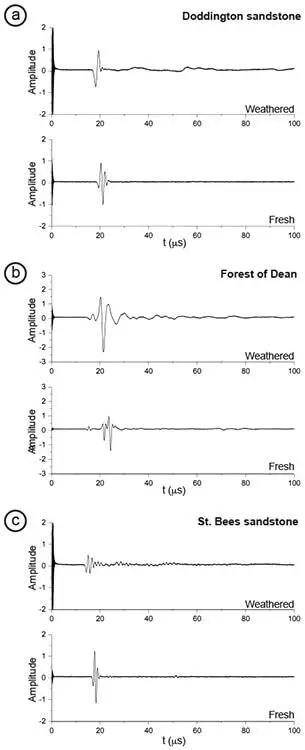
Figure 1: P signals for fresh and weathered samples for (a) Doddington sandstone, D; (b) Forest of Dean, F, measured in the parallel direction to bedding; and (c) St. Bees sandstone, BC.
196 
Figure 2: S signals for fresh and weathered samples for (a) Doddington sandstone, D; (b) Forest of Dean, F, measured in the parallel direction to bedding; and (c) St. Bees sandstone, BC.
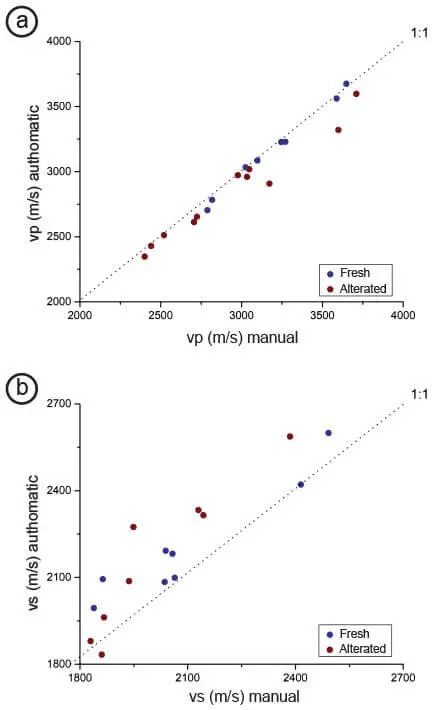
Figure 3: Comparison of P (a) and S (b) wave velocities obtained manually (manual) and automatically (authomatic).
The automatic onset time from recording P- and S- waveforms is compared to manual picking, which is considered as a true or reference value. The discrepancies between automatic and manual measurements are within the experimental error of the onset time picking measurements.
This methodology is recommended for fresh and weathered stones with a medium-coarse grain size (0.5–1 mm). This methodology may be particularly helpful in samples where the quality of the S-waveform signals is poor, resulting in difficulties with manual picking of the onset time. The great advantage of this methodology is the accuracy and reproducibility of the obtained results, which do not depend on human subjectivity.
Acknowledgements
This project was supported by a mobility scholarship awarded by the University of Glasgow Graduate School, and Historic Environment Scotland for funding the attendance at Stone2020 and the Regional Government of Madrid (Spain) [Top Heritage, grant number S2018/NMT-4372].
References
Benavente, D., Galiana-Merino, J. J., Pla, C., Martinez-Martinez, J., Crespo-Jimenez, D., 2020. Automatic detection and characterisation of the first P- and S-wave pulse in rocks using ultrasonic transmission method. Engineering Geology, 66, 105474.
Benavente, D., Martinez-Martinez, J., Cueto, N., Ordonez, S., Garcia-del-Cura, M. A., 2018. Impact of salt and frost weathering on the physical and durability properties of travertines and carbonate tufas used as building material. Environ. Earth Sci. 77, 147.
Galiana-Merino, J. J., Rosa-Herranz, J. L., Rosa-Cintas, S., Martinez-Espla, J. J., 2013. SeismicWaveTool: Continuous and discrete wavelet yyysis and filtering for multichannel seismic data. Comput. Phys. Commun. 184, 162–171.
Sarout, J., Ferjani, M., Gueguen, Y., 2009. A semi-automatic processing technique for elastic-wave laboratory data. Ultrasonics 49, 452–458.
Siegesmund S., Dürrast H. (2011) Physical and Mechanical Properties of Rocks. In: Siegesmund S., Snethlage R. (eds) Stone in Architecture. Springer, Berlin, Heidelberg.
Wang, Q., Ji, S., Sun, S., Marcotte, D., 2009. Correlations between compressional and shear wave velocities and corresponding Poisson’s ratios for some common rocks and sulfide ores. Tectonophysics 469, 61–72.
197
A STUDY ON NONDESTRUCTIVE DIAGNOSIS AND CONSERVATION SCHEME OF KOREAN DINOSAUR EGG FOSSIL SITES IN HWASEONG GOJEONGRI
Hyeri Yang 1 , Dong Woo Kim 2 , Chan Hee Lee 1, Ji Hyun Yoo 3
IN: SIEGESMUND, S. & MIDDENDORF, B. (EDS.): MONUMENT FUTURE: DECAY AND CONSERVATION OF STONE.
– PROCEEDINGS OF THE 14TH INTERNATIONAL CONGRESS ON THE DETERIORATION AND CONSERVATION OF STONE –
VOLUME I AND VOLUME II. MITTELDEUTSCHER VERLAG 2020.
1Dept. of Cultural Heritage Conservation Sciences, Kongju National University, Gongju, 32588, Republic of Korea
2Chungbuk Research Institute of Cultural Heritage, Cheongju, 28443, Republic of Korea
3Conservation Science Division, National Research Institute of Cultural Heritage, Daejeon, 34122, Republic of Korea
Abstract
The Dinosaur Egg Fossil Site at Hwaseong Gojeongri in the Republic of Korea (which was discovered while investigating the ecological changes of the tidal mudflats that were revealed after the Sihwa Lake Seawall’s completion) is the first place in Korea where a large number of fossilized dinosaur eggs and egg nests have been found. In particular, it is Korea’s largest dinosaur egg fossil site. Additionally, because it is rare to find so many dinosaur egg fossils in one location, it was designated as the Korean Natural Monument No. 414, in recognition of its natural historic and academic value.
Читать дальшеИнтервал:
Закладка:
Похожие книги на «Monument Future»
Представляем Вашему вниманию похожие книги на «Monument Future» списком для выбора. Мы отобрали схожую по названию и смыслу литературу в надежде предоставить читателям больше вариантов отыскать новые, интересные, ещё непрочитанные произведения.







Обсуждение, отзывы о книге «Monument Future» и просто собственные мнения читателей. Оставьте ваши комментарии, напишите, что Вы думаете о произведении, его смысле или главных героях. Укажите что конкретно понравилось, а что нет, и почему Вы так считаете.