Siegfried Siegesmund - Monument Future
Здесь есть возможность читать онлайн «Siegfried Siegesmund - Monument Future» — ознакомительный отрывок электронной книги совершенно бесплатно, а после прочтения отрывка купить полную версию. В некоторых случаях можно слушать аудио, скачать через торрент в формате fb2 и присутствует краткое содержание. Жанр: unrecognised, на немецком языке. Описание произведения, (предисловие) а так же отзывы посетителей доступны на портале библиотеки ЛибКат.
- Название:Monument Future
- Автор:
- Жанр:
- Год:неизвестен
- ISBN:нет данных
- Рейтинг книги:4 / 5. Голосов: 1
-
Избранное:Добавить в избранное
- Отзывы:
-
Ваша оценка:
Monument Future: краткое содержание, описание и аннотация
Предлагаем к чтению аннотацию, описание, краткое содержание или предисловие (зависит от того, что написал сам автор книги «Monument Future»). Если вы не нашли необходимую информацию о книге — напишите в комментариях, мы постараемся отыскать её.
Alle vier Jahre treffen sich auf einer internationalen Tagung Experten, die sich mit den entsprechenden Sachfragen beschäftigen. Der „14th International Congress on the Deterioration and Conservation of Stone“ findet im September 2020 in Göttingen statt. Er ist die wichtigste Veranstaltung zur Verbreitung des Wissens von Praktikern und Forschern, die im Bereich der Steinkonservierung zur Erhaltung des baulichen Kulturerbes arbeiten: Geowissenschaftler, Architekten, Bauspezialisten, Ingenieure, Restauratoren, Denkmalpfleger und Bauherren.
Der Tagungsband mit über 150 wissenschaftlichen Beiträgen repräsentiert und erfasst den neuesten Stand der Technik auf diesem Gebiet.
Themen sind:
– Charakterisierung von Schadensphänomenen von Steinen und verwandten Baumaterialien (Stuck, Putz, Mörtel usw.)
– Methoden zur Untersuchung des Steinverfalls in situ und zerstörungsfreie Prüfung
– Langzeitüberwachung von Steindenkmälern und Gebäuden
– Simulation und Modellierung des Zerfalls
– Technologien und Entwicklung verbesserter Bearbeitung und Verwendung von Stein in Neubauten
– Bewertung der Langzeitwirkung von Bearbeitungstechniken
– Auswirkungen des Klimawandels auf die Steinverwitterung des Kulturerbes
– Berichte zur Steinkonservierung: Fallstudien und Projekte
– Digitalisierung und Dokumentation von Steinkonservierung
–
The 14th International Congress on the Deterioration and Conservation of Stone, entitled MONUMENT FUTURE: DECAY AND CONSERVATION OF STONE is a quadrennial event that brings together a world-wide community of geoscientists, architects, building specialists, engineers, conservators, restorators, monument curators and building owners who are concerned about the conservation of cultural stone structures and objects. Since antiquity, the weathering and deterioration of historical buildings, masonry, monuments, sculptures etc. using natural stones has been a very well-known problem.
This conference is the main gathering for the dissemination of knowledge in the field of stone deterioration issues. It represents and captures the state-of-the-art in the field of stone conservation and cultural heritage conservation with regards to the following topics:
– Characterisation of damage phenomena of stone and related building materials (plaster, rendering, mortar etc.)
– Methods for the investigation of stone decay; in-situ and non-destructive testing
– Long-term monitoring of stone monuments and buildings
– Simulation and modelling of decay
– Technology and development of improved treatments and use of stone in new buildings
– Assessment of long-term effects of treatments
– Impact of climate change on stone decay of Cultural Heritage
– Reports about stone conservation: case studies and projects
– Digitalization and documentation in stone conservation
Monument Future — читать онлайн ознакомительный отрывок
Ниже представлен текст книги, разбитый по страницам. Система сохранения места последней прочитанной страницы, позволяет с удобством читать онлайн бесплатно книгу «Monument Future», без необходимости каждый раз заново искать на чём Вы остановились. Поставьте закладку, и сможете в любой момент перейти на страницу, на которой закончили чтение.
Интервал:
Закладка:
References
Jeong, S. K., 2008, A study on the opening period of ‘Jungwon Mirekri temple site’. Dongak Art History of Korea, 9, 145–172 (in Korean with English abstract).
Jo, Y. H., Lee, C. H., 2014, Quantitative modeling of blistering zones by active thermography for deterioration evaluation of stone monuments. Journal of Cultural Heritage, 15, 621–627.
Kim, H. R., 2008, A study on the Construction method of the Stone chamber for protection at mireukri temple site in Jungwon. Journal of Chungbuk Research Institute of Cultural Heritage, 1, 51–70 (in Korean with English abstract).
Kim, K. H., Shin, Y. S., 1990, Petrochemistry of the granitic rocks in the Chungju, Wolaksan and Jecheon granite batholiths. Economic and Environmental Geology, 23, 245–259 (in Korean with English abstract).
208Lee, C. H. and Jo, Y. H., 2017, Correlation and correction factor between direct and indirect methods for the ultrasonic measurement of stone samples. Environmental Earth Science, 76, 477–489.
Lee, S. H., 1998, Weathering and crack development in the rocks of protecting-chamber for Standing-Buddha of Mireuk-ri temple site at Jungwon. Journal of the Korea Society of Conservation Science for Cultural Properties, 7, 68–79 (in Korean with English abstract).
Ryoo, S. L., 2018, A study on the original shape of the stone structure of Maitreya temple in Chungju City. The Journal of Cultural Heritage, 22, 263–293 (in Korean with English abstract).
209
DECAY OF PRE-COLUMBIAN PHALLIC STONE MONOLITHS
Christopher Pötzl 1 , Ali D. Öcal 2 , Thomas Cramer 3 , Siegfried Siegesmund 1
IN: SIEGESMUND, S. & MIDDENDORF, B. (EDS.): MONUMENT FUTURE: DECAY AND CONSERVATION OF STONE.
– PROCEEDINGS OF THE 14TH INTERNATIONAL CONGRESS ON THE DETERIORATION AND CONSERVATION OF STONE –
VOLUME I AND VOLUME II. MITTELDEUTSCHER VERLAG 2020.
1Geoscience Centre of the Georg August University Göttingen, Germany
2Department of Anthropology of the National University of Colombia, Bogota, Colombia
3Department of Geosciences of the National University of Colombia, Bogota, Colombia
Abstract
The pre-Columbian astronomical and meteorological observatory of El Infiernito or ‘Little Hell’ is situated within the Monquirá Archaeological Park, near the colonial town of Villa de Leyva in the Colombian Boyacá-Department. Several burial mounds and a variety of phallic-shaped monoliths, made of local sandstone, bear witness to the culture and unique masonry of the ancient Muisca culture. The El Infiernito ranks among the most important historical and cultural monuments in Colombia. The monoliths were erected nearly two millennia ago and show severe damages today that developed over the time since its construction. Depending on their exposition, various weathering phenomena like differential back-weathering, scaling, cracking and discoloration can be observed. In order to identify the main damage causes and understand their relation with the stone properties, in-situ investigations, in the form of lithology and damage mapping, as well as laboratory work regarding petrography, petrophysical properties and weathering behavior of four sandstones were done. The research demonstrates the differential weathering behavior of the analyzed sandstones and identifies thermal and thermohygric expansion as the main weathering agents.
Keywords: Colombia, El Infiernito, monoliths, sandstone decay, damage assessment, weathering processes
El Infiernito: Historical Background
The stone monoliths at El Infiernito (Fig. 1) have been the subject of much attention ever since the earliest Spanish missionaries, because of their claimed associations with controversial Muisca rituals and alleged riotous ceremonies (Simon 1981). The arrangement of 26 finely carved and equidistant cylindrical pillars in two parallel rows led Silva Celis (1981) to the conclusion that the archaeological 210site had been a sacred field of astronomical and meteorological observation. The natives had measured the movements of the sun, and thus, solstices and equinoxes were calculated and periods of rain and drought were established, which regulated the production activities of the natives (Silva Celis 1981). A dolmen tomb found in 2006 together with 54 phallic-formed sandstone monoliths and indications of feasting events, suggest that El Infiernito was a central place where inter-community activities were carried out.
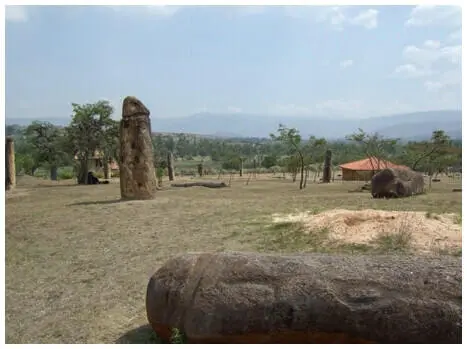
Figure 1: General view of the archaeological park.
In this study, preliminary results of an investigation on the main characteristics of the deterioration processes that affect the monoliths of the Monquirá archaeological park El Infiernito are presented. This work will serve as a base for later conservation and restoration activities.
Decay Phenomena
The exposed monoliths present significant problems due to the environmental conditions (Öcal et al. 2009) and show diverse, partly exposure-specific forms of weathering (Fig. 2). Approximately 200 monoliths and stone columns were used to visually assess and characterize the weathering behavior.
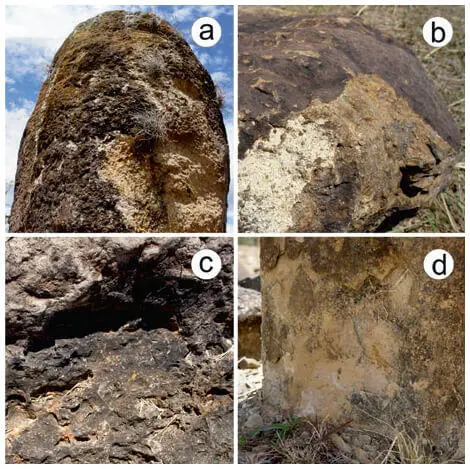
Figure 2: Decay phenomena on the monoliths. a) biological colonization and sanding, b) crust formation and salt efflorescence, c) alveolization, d) scaling.
The tropical climate at the ~2000 m a. s. l. El Infiernito area is characterized by two rainy and two dry seasons. The rainiest months are May and October with up to 200 mm, whereas January is the driest month with 40 mm followed by July with 90 mm. In addition to the rain, in the mostly semiarid microclimate, air humidity plays an important role as a water supplier. The relative air humidity fluctuates between 70–85 % depending on the season. Direct water absorption during rain events or capillary suction of surface and soil water, control the humidity regime. The monthly average temperatures are above 20 °C throughout the year, with lowest mean temperatures of 10 °C and highest mean temperatures of 22 °C and can rise to over 30 °C. Especially during the long dry and cloudless seasons, the temperatures on the monoliths’ surface can reach high values.
The monoliths show a large variety of different damage types, such as relief, back-weathering, bursting, rounding, covings and alveolization, which predominantly occurs. Neighboring areas of the stone surface weather back to different degrees, and create a moving relief, e. g. by weathering parallel to the layer or by the loss of components. Often honeycomb-like structures are formed, which are typical for alveolar weathering (Fig. 2c). The causes can be of a very different nature. These can include salt weathering and wind erosion, as well as structural and lithological peculiarities.
The deposition of dirt and dust particles in the pore space leads to a gradual compaction of the rock surface, and may favor biological growth on some monolith surfaces. Gray to brownish crusts (Fig. 2b) can be found on the stone surface as coherent layers, millimeter to centimeters thick. Visually, the limit between the natural patina and the damage pattern crust cannot always be clearly determined. Biological colonization by green algae, lichens and higher plants was observed on all monoliths (Fig. 2a). Loosely adhering whitish salt efflorescence is an indication of the build-up of harmful salts enriched in the stone (Fig. 2b).
Читать дальшеИнтервал:
Закладка:
Похожие книги на «Monument Future»
Представляем Вашему вниманию похожие книги на «Monument Future» списком для выбора. Мы отобрали схожую по названию и смыслу литературу в надежде предоставить читателям больше вариантов отыскать новые, интересные, ещё непрочитанные произведения.







Обсуждение, отзывы о книге «Monument Future» и просто собственные мнения читателей. Оставьте ваши комментарии, напишите, что Вы думаете о произведении, его смысле или главных героях. Укажите что конкретно понравилось, а что нет, и почему Вы так считаете.