Siegfried Siegesmund - Monument Future
Здесь есть возможность читать онлайн «Siegfried Siegesmund - Monument Future» — ознакомительный отрывок электронной книги совершенно бесплатно, а после прочтения отрывка купить полную версию. В некоторых случаях можно слушать аудио, скачать через торрент в формате fb2 и присутствует краткое содержание. Жанр: unrecognised, на немецком языке. Описание произведения, (предисловие) а так же отзывы посетителей доступны на портале библиотеки ЛибКат.
- Название:Monument Future
- Автор:
- Жанр:
- Год:неизвестен
- ISBN:нет данных
- Рейтинг книги:4 / 5. Голосов: 1
-
Избранное:Добавить в избранное
- Отзывы:
-
Ваша оценка:
Monument Future: краткое содержание, описание и аннотация
Предлагаем к чтению аннотацию, описание, краткое содержание или предисловие (зависит от того, что написал сам автор книги «Monument Future»). Если вы не нашли необходимую информацию о книге — напишите в комментариях, мы постараемся отыскать её.
Alle vier Jahre treffen sich auf einer internationalen Tagung Experten, die sich mit den entsprechenden Sachfragen beschäftigen. Der „14th International Congress on the Deterioration and Conservation of Stone“ findet im September 2020 in Göttingen statt. Er ist die wichtigste Veranstaltung zur Verbreitung des Wissens von Praktikern und Forschern, die im Bereich der Steinkonservierung zur Erhaltung des baulichen Kulturerbes arbeiten: Geowissenschaftler, Architekten, Bauspezialisten, Ingenieure, Restauratoren, Denkmalpfleger und Bauherren.
Der Tagungsband mit über 150 wissenschaftlichen Beiträgen repräsentiert und erfasst den neuesten Stand der Technik auf diesem Gebiet.
Themen sind:
– Charakterisierung von Schadensphänomenen von Steinen und verwandten Baumaterialien (Stuck, Putz, Mörtel usw.)
– Methoden zur Untersuchung des Steinverfalls in situ und zerstörungsfreie Prüfung
– Langzeitüberwachung von Steindenkmälern und Gebäuden
– Simulation und Modellierung des Zerfalls
– Technologien und Entwicklung verbesserter Bearbeitung und Verwendung von Stein in Neubauten
– Bewertung der Langzeitwirkung von Bearbeitungstechniken
– Auswirkungen des Klimawandels auf die Steinverwitterung des Kulturerbes
– Berichte zur Steinkonservierung: Fallstudien und Projekte
– Digitalisierung und Dokumentation von Steinkonservierung
–
The 14th International Congress on the Deterioration and Conservation of Stone, entitled MONUMENT FUTURE: DECAY AND CONSERVATION OF STONE is a quadrennial event that brings together a world-wide community of geoscientists, architects, building specialists, engineers, conservators, restorators, monument curators and building owners who are concerned about the conservation of cultural stone structures and objects. Since antiquity, the weathering and deterioration of historical buildings, masonry, monuments, sculptures etc. using natural stones has been a very well-known problem.
This conference is the main gathering for the dissemination of knowledge in the field of stone deterioration issues. It represents and captures the state-of-the-art in the field of stone conservation and cultural heritage conservation with regards to the following topics:
– Characterisation of damage phenomena of stone and related building materials (plaster, rendering, mortar etc.)
– Methods for the investigation of stone decay; in-situ and non-destructive testing
– Long-term monitoring of stone monuments and buildings
– Simulation and modelling of decay
– Technology and development of improved treatments and use of stone in new buildings
– Assessment of long-term effects of treatments
– Impact of climate change on stone decay of Cultural Heritage
– Reports about stone conservation: case studies and projects
– Digitalization and documentation in stone conservation
Monument Future — читать онлайн ознакомительный отрывок
Ниже представлен текст книги, разбитый по страницам. Система сохранения места последней прочитанной страницы, позволяет с удобством читать онлайн бесплатно книгу «Monument Future», без необходимости каждый раз заново искать на чём Вы остановились. Поставьте закладку, и сможете в любой момент перейти на страницу, на которой закончили чтение.
Интервал:
Закладка:
Mn/Fe counts ratio
The simplest approach to quantification consists of calculating the ratio of Mn counts to Fe counts. This takes advantage of the fact that the Fe content of the bulk sandstone dominates over any Fe content in the varnish, at least in the case of red Triassic sandstone. Hence, the Fe can serve as a 163reference value for normalizing the Mn variations and thus confirms that the varnish has enriched Mn. As shown in Fig. 2, the Fe Ka peaks overlap the Mn peaks. Consequently, the attenuation factors are essentially the same for the two elements, and the counts ratio approximates the mass ratio. This avoids the need to convert the counts into masses. In practice, pXRF spectra are acquired for several points in the varnish along with a similar number of points on the adjacent bare stone for comparison. Fig. 3 presents an example of the application of the Mn/Fe ratio method to an area on the Smithsonian Castle, which shows that the points within varnish patches have significantly elevated levels of Mn.
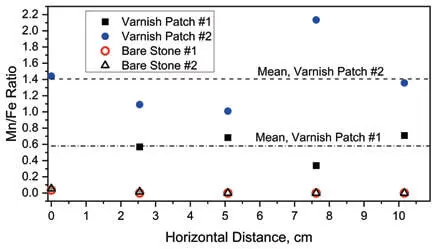
Figure 3: Plot of Mn/Fe ratios for SW corner of the Smithsonian Castle.
Direct estimate of Mn areal density
The Mn/Fe counts ratio is essentially a qualitative indicator of elevated Mn levels. For a quantitative result the most straightforward approach is to estimate the mass of Mn. To accomplish this, a suitable calibration standard is required. In this project we used a well-characterized set of mudrock (shales, sandstones) samples (HR_01 – HR_65) provided by the manufacturer of the pXRF instrument. To more closely simulate the desert layer structure, McNeill and Cecil prepared a standard consisting of a thin layer of Mn on a glass substrate (McNeil et al. 2009). In either case the result is the total mass of Mn in the beam. This can be normalized to an areal density by dividing the mass of Mn by the beam area. One drawback of this calibration method is that it is valid only for a specific set of instrument settings such as beam current, standoff distance, etc. Thus, these have to be replicated in the field.
Areal density to thickness conversion
Portable XRF is an elemental analysis technique, and consequently the result of the measurements of the varnish is the areal density of the element Mn. However, the conventional literature on desert varnish usually is in terms of layer thickness, because the measurement method is based on optical microscope analysis of cross sections through the varnish (Dorn 2007). Therefore, in order to make comparisons with this literature it is necessary to convert the areal density into an equivalent thickness. However, this gives a nominal or effectiveness thickness that assumes no other minerals are present. This is not directly comparable to desert varnish thicknesses, which usually contains interlayers of clay minerals (Dorn 2007), but it is useful for comparing urban varnish layers on different structures.
Fe/Fe ratio estimate of Mn layer thickness
An alternative approach to estimating the amount of Mn that does not require a calibration standard arises from the overlapping of the Fe and Mn X-ray peaks as illustrated in Fig. 2. A corollary to this relationship is that the two Fe K lines at 6.3 and 7.0 keV bracket the K absorption edge at 6.5 keV in the attenuation factor of Mn. This means that the attenuation of the Fe Kβ is 6 times greater than for the Kα line. This differential attenuation makes it possible to measure very thin layers of Mn on the order of microns on top of the sandstone substrate (Livingston et al. 2020). The Fe X-rays are generated primarily in the bulk of the sandstone, but they are attenuated mainly in the surface layer of Mn. The method requires two pXRF measurements: one on the varnish patch and the other on a nearby area of bare stone. The effective thickness of the Mn layer can be calculated from the decrease of the Fe Kβ/Kα ratio of the varnish point compared to that of the bare stone. This method requires the 164assumption that the Mn is in the form of birnessite. In theory the presence of Fe in the varnish could lead to underestimates of thickness. However, microanalyses of varnish samples have shown that the varnish has very low Fe content (Macholdt et al. 2017b, Sharps et al. 2020). Moreover, sensitivity calculations have shown that the Fe content would have to be greater than 10 % to produce significant error (Livingston et al. 2020).
Field survey design
In order to make the pXRF measurements of urban varnish, it is obviously necessary to find their occurrences. Some have been found simply by random sighting, but there are more systematic approaches. One factor is the type of stone substrate. Most cases have been found on Triassic red sandstone in the United States, occurring in the Newark Supergroup, which is a geological formation that extends from South Carolina to Massachusetts, as shown in the map in Fig. 4.
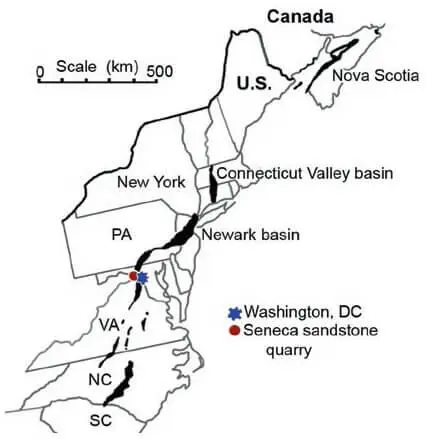
Figure 4: Map of Newark Supergroup (Grissom et al. 2018).
Triassic building stone can have different local trade names, for instance, Seneca sandstone in the Washington area and Belleville sandstone from New Jersey in the New York City area, but it is essentially the same rock. Lists of buildings constructed with a specific building stone can be found in state geological surveys reports (Merrill and Matthews 1898), histories of local quarries (Peck 2013), architects’ catalogues raisonnés (Ochsner 1982), and architectural preservation studies (Matero and Teutonico 1982). It may be possible to minimize time in field searching for varnish by doing preliminary viewing of candidate buildings online with images from Google Earth.
Preliminary geographical distribution
Selected occurrences of Mn-rich urban varnish identified to date are listed in Table 1. These are divided into two categories: probable, based only on visual appearance; and confirmed, based on XRF detection of elevated Mn levels. In the second category those sites measured by pXRF are indicated in plain font. Asterisk indicate cases where the varnish was sampled and measured using laboratory XRF instruments.
Table 1: Locations with urban rock varnish. * Analyzed by laboratory XRF
| Probable | Confirmed by XRF |
| St. Matthews Cathedral (1895), Washington, DC | Smithsonian Castle (1847–55), Washington, DC |
| Oak Hill Cemetery Gateposts (1865), Washington, DC | Bethesda Fountain Plaza (1864), New York, NY |
| Phillips Collection (c. 1900), Washington, DC | St. James Church (1884), New York, NY |
| Basilica of St. Peter & St. Paul (1864), Philadelphia, PA | Albany City Hall (1880-83), Albany, NY |
| Old Bennet School (1908–1909), Manassas, VA | Albany Academy Building (1815), Albany, NY |
| Crown Cork & Seal building (1904), Baltimore, MD | Salem Street Church (1871–73), Springfield, MA |
| Austin Hall (1881–84), Cambridge, MA | City Hall, East Longmeadow, MA |
| B. & A. Railroad Station (1883–85), Framingham, MA | James Hill House (1891), St. Paul, MN* |
At this time, insufficient data points preclude statistical analyses, but some preliminary observations 165can be made. It is evident that urban varnish is a widespread phenomenon and not just a local Washington problem. Second, on structures built with more than one type of stone, the varnish occurs only on the Triassic sandstone. This suggests that some property of this stone encourages the growth of the varnish. An exception to this rule is the identification of varnish on the Carboniferous sandstone of the Central Park’s Bethesda Fountain Plaza in New York City. Finally, the occurrence of varnish appeared to be an anomaly on the James Hill House in St. Paul, Minnesota, since it is located far from the Newark Supergroup region. However, records show that the building stone was shipped by railroad to St. Paul from Triassic red sandstone quarries at East Longmeadow, Massachusetts, which is within the Newark Supergroup.
Читать дальшеИнтервал:
Закладка:
Похожие книги на «Monument Future»
Представляем Вашему вниманию похожие книги на «Monument Future» списком для выбора. Мы отобрали схожую по названию и смыслу литературу в надежде предоставить читателям больше вариантов отыскать новые, интересные, ещё непрочитанные произведения.









Обсуждение, отзывы о книге «Monument Future» и просто собственные мнения читателей. Оставьте ваши комментарии, напишите, что Вы думаете о произведении, его смысле или главных героях. Укажите что конкретно понравилось, а что нет, и почему Вы так считаете.