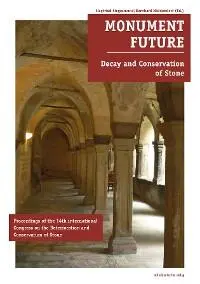
Siegfried Siegesmund - Monument Future
Здесь есть возможность читать онлайн «Siegfried Siegesmund - Monument Future» — ознакомительный отрывок электронной книги совершенно бесплатно, а после прочтения отрывка купить полную версию. В некоторых случаях можно слушать аудио, скачать через торрент в формате fb2 и присутствует краткое содержание. Жанр: unrecognised, на немецком языке. Описание произведения, (предисловие) а так же отзывы посетителей доступны на портале библиотеки ЛибКат.
- Название:Monument Future
- Автор:
- Жанр:
- Год:неизвестен
- ISBN:нет данных
- Рейтинг книги:4 / 5. Голосов: 1
-
Избранное:Добавить в избранное
- Отзывы:
-
Ваша оценка:
Monument Future: краткое содержание, описание и аннотация
Предлагаем к чтению аннотацию, описание, краткое содержание или предисловие (зависит от того, что написал сам автор книги «Monument Future»). Если вы не нашли необходимую информацию о книге — напишите в комментариях, мы постараемся отыскать её.
Alle vier Jahre treffen sich auf einer internationalen Tagung Experten, die sich mit den entsprechenden Sachfragen beschäftigen. Der „14th International Congress on the Deterioration and Conservation of Stone“ findet im September 2020 in Göttingen statt. Er ist die wichtigste Veranstaltung zur Verbreitung des Wissens von Praktikern und Forschern, die im Bereich der Steinkonservierung zur Erhaltung des baulichen Kulturerbes arbeiten: Geowissenschaftler, Architekten, Bauspezialisten, Ingenieure, Restauratoren, Denkmalpfleger und Bauherren.
Der Tagungsband mit über 150 wissenschaftlichen Beiträgen repräsentiert und erfasst den neuesten Stand der Technik auf diesem Gebiet.
Themen sind:
– Charakterisierung von Schadensphänomenen von Steinen und verwandten Baumaterialien (Stuck, Putz, Mörtel usw.)
– Methoden zur Untersuchung des Steinverfalls in situ und zerstörungsfreie Prüfung
– Langzeitüberwachung von Steindenkmälern und Gebäuden
– Simulation und Modellierung des Zerfalls
– Technologien und Entwicklung verbesserter Bearbeitung und Verwendung von Stein in Neubauten
– Bewertung der Langzeitwirkung von Bearbeitungstechniken
– Auswirkungen des Klimawandels auf die Steinverwitterung des Kulturerbes
– Berichte zur Steinkonservierung: Fallstudien und Projekte
– Digitalisierung und Dokumentation von Steinkonservierung
–
The 14th International Congress on the Deterioration and Conservation of Stone, entitled MONUMENT FUTURE: DECAY AND CONSERVATION OF STONE is a quadrennial event that brings together a world-wide community of geoscientists, architects, building specialists, engineers, conservators, restorators, monument curators and building owners who are concerned about the conservation of cultural stone structures and objects. Since antiquity, the weathering and deterioration of historical buildings, masonry, monuments, sculptures etc. using natural stones has been a very well-known problem.
This conference is the main gathering for the dissemination of knowledge in the field of stone deterioration issues. It represents and captures the state-of-the-art in the field of stone conservation and cultural heritage conservation with regards to the following topics:
– Characterisation of damage phenomena of stone and related building materials (plaster, rendering, mortar etc.)
– Methods for the investigation of stone decay; in-situ and non-destructive testing
– Long-term monitoring of stone monuments and buildings
– Simulation and modelling of decay
– Technology and development of improved treatments and use of stone in new buildings
– Assessment of long-term effects of treatments
– Impact of climate change on stone decay of Cultural Heritage
– Reports about stone conservation: case studies and projects
– Digitalization and documentation in stone conservation
Monument Future — читать онлайн ознакомительный отрывок
Ниже представлен текст книги, разбитый по страницам. Система сохранения места последней прочитанной страницы, позволяет с удобством читать онлайн бесплатно книгу «Monument Future», без необходимости каждый раз заново искать на чём Вы остановились. Поставьте закладку, и сможете в любой момент перейти на страницу, на которой закончили чтение.
Интервал:
Закладка:
Estimated growth rates on the Smithsonian Castle
At the time of writing the analysis of the most recent pXRF data from New York and Massachusetts sites has not been completed. However, the results from the 165-year-old Smithsonian Castle, which is located on the National Mall in Washington, can serve as an example of the method for calculating growth rates.
Three locations around the Castle were measured by pXRF. In addition to the southwest corner (Fig. 1), a patch at the east entrance was measured, which historic photographs show was free of varnish as late as 1985. A third patch was measured on a gate post of the Enid Haupt Garden, built in 1987 adjacent to the Castle using the same Seneca sandstone. Ten points each were measured on the varnish patch and a bare stone area at the SW corner, and five points each at the other locations. The pXRF counts data were converted to Mn layer thickness using the Fe/Fe ratio method for the Mn patch and bare stone.
The results are presented in Table 2along with estimated ages. The calculated growth rates for the east entrance and the gatepost are reasonably close, on the order of 90 nm/yr. This is significantly higher than the maximum rate of 40 nm/yr observed for desert varnish (Liu & Broecker, 2008). However, the growth rate for the southwest corner is only a third of this, if its estimated age is based on the assumption that the layer began to grow as soon as the stone was put in place. Although historic photographic documentation is mainly in black and white and insufficiently detailed for conclusive determination, it appears that growth actually started much later. Dividing the thickness of the layer, 4 microns, by the rate of 90 nm/yr gives an age of 45 years or a start date of 1970. This is consistent with the period of great population growth and associated increase in automobile traffic around the Washington urban area.
Table 2: Varnish growth rates on the Smithsonian Castle, based on Fe/Fe ratios measured on Mn patches and bare stone using pXRF.
| Location | Thickness, µm | Time, years | Growth Rate, nm/yr |
| S.W. Corner | 4.0 ± 0.57 | 155 | 26 ± 3.7 |
| Gatepost | 2.41 ± 0.06 | 29 | 83 ± 2.0 |
| East Entrance | 2.38 ± 0.06 | 25 | 95 ± 2.4 |
Conclusions
Portable XRF provides a nondestructive method of acquiring data on its geographical distribution and rate of growth. The Mn/Fe counts ratio can be used to distinguish the Mn-rich varnish from other types of surface deposits. The direct Mn and indirect Fe/Fe ratio methods can be used to estimate the layer thickness and hence the growth rate. Patches of urban rock varnish have been identified by pXRF on buildings across the northern United States from Washington to New York City to Minneapolis. These patches have typically been observed on red Triassic sandstone. However, they have also been found growing on older Carboniferous sandstone in New York City’s Central Park. Growth rates estimated from datable patches on the Smithsonian Castle and nearby gate posts are in the range of 83 ± 2.0 to 95 ± 2.4 nm/yr. This is significantly higher than the maximum rate of 40 nm/yr observed for desert varnish.
166 Acknowledgements
The authors would like to thank Bill Rebel of American Engineering Testing, Inc., for providing the XRF analysis of the James Hill House varnish sample.
References
Dorn R. I. 2007. Rock varnish. In: Geochemical Sediments and Landscapes. Nash D. J., McLaren S. J. (eds). London, Blackwell, pp. 246–297.
Grissom C., Aloiz E., Vicenzi E., Livingston R. A. 2018. Seneca sandstone: A heritage stone from the United States. In: Global Heritage Stone: Worldwide Examples of Heritage Stones, GSL Special Publication 486. London, Geological Society of London. https://doi.org/10.1144/SP486.4.
Gatuingt L. S. et al. 2016. Intrinsic parameters conditioning the formation of Mn-rich patinas on Luneville sandstones. In: Proceedings of the 13th international congress on the deterioration and conservation of stone. Hughes J. J., Howind T. (eds), vol 1. Paisley, Scotland, University of the West of Scotland, pp. 317–324.
Liu T., Broecker W. S. 2008. Rock varnish microexamination dating of late Quaternary geomorphic features in the drylands of western USA. Geomorphology 93:501–523.
Livingston R. A., Grissom C., Kavich G., Douglas J. 2020. Thickness measurement of thin manganese-rich layers on sandstone buildings using X-ray fluorescence attenuation, unpublished manuscript.
Livingston R. A. et al. 2016. Investigation of urban rock varnish on the sandstone of the Smithsonian. In: Proceedings of the 13th international congress on the deterioration and conservation of stone. Hughes J. J., Howind T. (eds), vol. 2. Paisley, Scotland, University of the West of Scotland, pp. 399–406.
Macholdt D. S. et al. 2017a. Black manganese-rich crusts on a Gothic cathedral, Atmospheric Environment 2017:205–220.
Macholdt D. S. et al. 2017b. Characterization and differentiation of rock varnish types from different environments by microanalytical techniques, Chemical Geology 459:91–118.
Matero F. G., Teutonico J. M. 1982. The use of architectural sandstone in New York City in the 19th century, APT Bulletin 14:11–17.
McNeil J. A., Cecil F. E. 2014. X-ray fluorescence measurements of manganese in petroglyphs and graffiti in the Bluff, Utah Area, Colorado School of Mines, unpublished manuscript. http://inside.mines.edu/~jamcneil/XRF_Report_Bluff_Ut.pdf
Merrill G. P., Matthews E. B. 1898. The Building and Decorative Stones of Maryland. Baltimore, MD, Maryland Geological Survey.
Ochsner J. K. 1982. H. H. Richardson: Complete Architectural Works. Cambridge, MA, MIT Press.
Peck G. 2013. The Smithsonian Castle and the Seneca Quarry. Charleston, SC, The History Press.
Sharps M. C., Grissom C. A., Vicenzi E. P. 2020. Nano-scale structure and compositional analysis of manganese oxide coatings on the Smithsonian Castle, Washington, DC, Chemical Geology 537: 119486.
Vicenzi E. P., Grissom C. A., Livingston R. A., Weldon-Yochim Z. 2016. Rock varnish on architectural stone: Microscopy and analysis of nanoscale manganese oxide deposits on the Smithsonian Castle, Washington, DC. Heritage Science 4:26.
167
MICRODRILLING RESISTANCE MEASUREMENTS SYSTEM AND MORTAR PENETROMETER: TWO METHODS FOR EVALUATING IN SITU MORTAR RESISTANCE
Barbara Sacchi 1 , Emma Cantisani 1 , Teresa Salvatici 2 , Carlo Alberto Garzonio 2
IN: SIEGESMUND, S. & MIDDENDORF, B. (EDS.): MONUMENT FUTURE: DECAY AND CONSERVATION OF STONE.
– PROCEEDINGS OF THE 14TH INTERNATIONAL CONGRESS ON THE DETERIORATION AND CONSERVATION OF STONE –
VOLUME I AND VOLUME II. MITTELDEUTSCHER VERLAG 2020.
1Institute for Heritage Science – National Research Council of Italy (CNR-ISPC), Via Madonna del Piano 10, 50019 Sesto Fiorentino (FI), Italy
2Department of Earth Sciences, University of Florence, 50121 Florence, Italy
Abstract
In situ evaluation of mortars’ resistance and consolidant treatments’ performance in ancient buildings is an essential argument in their conservation. Moreover, the mechanical properties of an ancient mortar are directly connected with the state of preservation of the building or the structure in which it is included, and it is not a parameter easy to be determined, especially for the masonry joints. Mechanical methods often request sampling and laboratory tests, while only few micro destructive techniques are known as penetrometric tests. They can be either static (with action of a pressure drills) or dynamic (with action of a percussion drills) and commonly usable in situ. Among them, Microdrilling Resistance Measurement System and Mortar Penetrometer are two important methods for determining the resistance of a mortar.
Читать дальшеИнтервал:
Закладка:
Похожие книги на «Monument Future»
Представляем Вашему вниманию похожие книги на «Monument Future» списком для выбора. Мы отобрали схожую по названию и смыслу литературу в надежде предоставить читателям больше вариантов отыскать новые, интересные, ещё непрочитанные произведения.








Обсуждение, отзывы о книге «Monument Future» и просто собственные мнения читателей. Оставьте ваши комментарии, напишите, что Вы думаете о произведении, его смысле или главных героях. Укажите что конкретно понравилось, а что нет, и почему Вы так считаете.