Siegfried Siegesmund - Monument Future
Здесь есть возможность читать онлайн «Siegfried Siegesmund - Monument Future» — ознакомительный отрывок электронной книги совершенно бесплатно, а после прочтения отрывка купить полную версию. В некоторых случаях можно слушать аудио, скачать через торрент в формате fb2 и присутствует краткое содержание. Жанр: unrecognised, на немецком языке. Описание произведения, (предисловие) а так же отзывы посетителей доступны на портале библиотеки ЛибКат.
- Название:Monument Future
- Автор:
- Жанр:
- Год:неизвестен
- ISBN:нет данных
- Рейтинг книги:4 / 5. Голосов: 1
-
Избранное:Добавить в избранное
- Отзывы:
-
Ваша оценка:
Monument Future: краткое содержание, описание и аннотация
Предлагаем к чтению аннотацию, описание, краткое содержание или предисловие (зависит от того, что написал сам автор книги «Monument Future»). Если вы не нашли необходимую информацию о книге — напишите в комментариях, мы постараемся отыскать её.
Alle vier Jahre treffen sich auf einer internationalen Tagung Experten, die sich mit den entsprechenden Sachfragen beschäftigen. Der „14th International Congress on the Deterioration and Conservation of Stone“ findet im September 2020 in Göttingen statt. Er ist die wichtigste Veranstaltung zur Verbreitung des Wissens von Praktikern und Forschern, die im Bereich der Steinkonservierung zur Erhaltung des baulichen Kulturerbes arbeiten: Geowissenschaftler, Architekten, Bauspezialisten, Ingenieure, Restauratoren, Denkmalpfleger und Bauherren.
Der Tagungsband mit über 150 wissenschaftlichen Beiträgen repräsentiert und erfasst den neuesten Stand der Technik auf diesem Gebiet.
Themen sind:
– Charakterisierung von Schadensphänomenen von Steinen und verwandten Baumaterialien (Stuck, Putz, Mörtel usw.)
– Methoden zur Untersuchung des Steinverfalls in situ und zerstörungsfreie Prüfung
– Langzeitüberwachung von Steindenkmälern und Gebäuden
– Simulation und Modellierung des Zerfalls
– Technologien und Entwicklung verbesserter Bearbeitung und Verwendung von Stein in Neubauten
– Bewertung der Langzeitwirkung von Bearbeitungstechniken
– Auswirkungen des Klimawandels auf die Steinverwitterung des Kulturerbes
– Berichte zur Steinkonservierung: Fallstudien und Projekte
– Digitalisierung und Dokumentation von Steinkonservierung
–
The 14th International Congress on the Deterioration and Conservation of Stone, entitled MONUMENT FUTURE: DECAY AND CONSERVATION OF STONE is a quadrennial event that brings together a world-wide community of geoscientists, architects, building specialists, engineers, conservators, restorators, monument curators and building owners who are concerned about the conservation of cultural stone structures and objects. Since antiquity, the weathering and deterioration of historical buildings, masonry, monuments, sculptures etc. using natural stones has been a very well-known problem.
This conference is the main gathering for the dissemination of knowledge in the field of stone deterioration issues. It represents and captures the state-of-the-art in the field of stone conservation and cultural heritage conservation with regards to the following topics:
– Characterisation of damage phenomena of stone and related building materials (plaster, rendering, mortar etc.)
– Methods for the investigation of stone decay; in-situ and non-destructive testing
– Long-term monitoring of stone monuments and buildings
– Simulation and modelling of decay
– Technology and development of improved treatments and use of stone in new buildings
– Assessment of long-term effects of treatments
– Impact of climate change on stone decay of Cultural Heritage
– Reports about stone conservation: case studies and projects
– Digitalization and documentation in stone conservation
Monument Future — читать онлайн ознакомительный отрывок
Ниже представлен текст книги, разбитый по страницам. Система сохранения места последней прочитанной страницы, позволяет с удобством читать онлайн бесплатно книгу «Monument Future», без необходимости каждый раз заново искать на чём Вы остановились. Поставьте закладку, и сможете в любой момент перейти на страницу, на которой закончили чтение.
Интервал:
Закладка:
The chemical, mineralogical and petrographic studies carried out on these mortar samples allowed us to classify these mortars as aerial lime mortars or weakly hydraulic mortars. They have a fine grained aggregate (mean grain size ranges from 500 to 200 mm, maximum grain size from 1 mm to 1.2 mm) with a prevalently silicatic composition and a binder/aggregate ratio from 1/1 to 1/3.
Results and Discussion
Microdrilling tests should be performed on quite homogeneous materials, while bedding mortars are heterogeneous mixtures of materials, expecially when cut from nucleous of historical walls built in different centuries. Nevertheless, having the aim to compare the mechanical resistance that a mortar opposes to the penetration of a rotating drill and an advancing pin, it was decided to express drilling results by average values of resistance, without any kind of correction. Sometimes indeed the distribution presented great variations, but it was considered that the resistence of a mortar to penetration is connected both to binder and to aggregate, and to the different composition, grain size and grain size distribution of aggregate, too. The average value of drilling resistance was calculated on the first 10 mm from the surface for two main reasones. First of all, the same depth was always reached from penetrometer measurements, too. Moreover, a greater depth could have been difficult to be reached without bumping into brick or stone fragments, since both in situ and from core drilling, the mortars are bedding mortars of old and irregular walls.
170Microdrilling tests performed in situ on different areas of masonries of San Francesco Church in Pisa showed values of drilling resistance from 0.7 N as minimum to 6.0 N as maximum. Penetrometer measurements on the same areas showed a similar variability (resistance on 10 impacts from 0.7 MPa to 2.2 MPa), but the values did not show a linear correlation (Fig. 2), as in other studies was found for Drilling vs. Ultrasonic and/or Compressive Strenght (Costa et al. 2010).
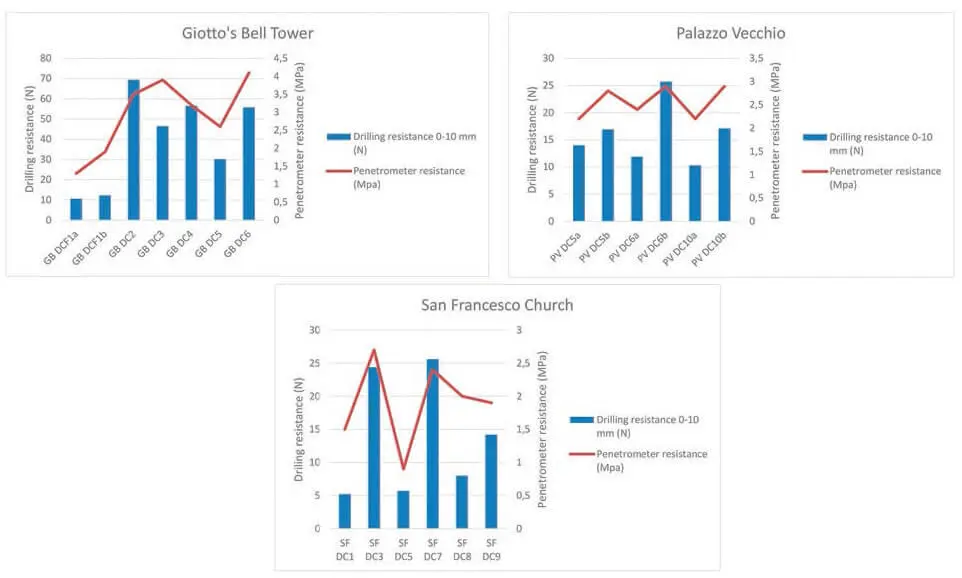
Figure 2: “Drilling resistance” vs. “penetrometer measurements” results.
A better, even if not fully satisfactory, corrispondence was shown by measures performed on drilling core samples extracted from the different historical sites previously described, in particular from Giotto’s Bell Tower, where values of drilling resistance start from 10.6 N as minimum value up to 69.4 N as maximum, and resistance on 10 impacts varies from 1.3 MPa to 4.1 MPa.
This variability is certainly due to the high number of variables that impact on this kind of measures on mortars (different binder, different aggregate and dimensions of aggregate, different direction of penetration of drill bit or pin, and so on).
Moreover, mortars coming from Giotto’s Bell Tower and from Palazzo Vecchio show higher values in respect to San Francesco’s Church mortars both from penetrometer measures and drilling tests. This is in agreement with the different composition of binder used to prepare mortars: a natural hydraulic lime was used for mortars of Giotto’s bell Tower and Palazzo Vecchio, an aerial lime for mortars of San Francesco’s Church. Moreover, the mortars of San Francesco’ Church are in situ and structural features and environmental parameters, as the moisture, may affect their mechanical behaviour. While the superficial moisture of the drill core mortars is around 1.4(±0.1)% for all samples, in situ mesaures of investigated surfaces revealed higher values: on the left wall of the nave the moisture values range from 0.2 to 2.4 %, on the right wall (having in fact a different conservation state) they reach values of 5.4 %.
This further underlines the difficulty in finding standard methods for quantify the mechanical resistance of such heterogeneous materials.
Therefore, having so different samples of mortars and consequently so variable data, other data processing methods were verified, and polynomial trendline was find as the best one. Even in this case, the correlation gets worse for high values of drilling resistance.
171In Fig. 3, a polynomial trendline correlation between “Drilling resistance” and “penetrometer measurements” results is showed: on the left side of the picture, all the data are included, while on the right side, the samples having a ratio value (“resistance to drilling” / “penetrometer resistance”) > 10 were excluded, leading to a considerable improvement of correlation (R 2from 0.79 to 0.91).

Figure 3: Polynomial trendline correlation between “Drilling resistance” and “penetrometer measurements” results, including all samples (left) and excluding samples having ratio value “mean resistance to drilling”/“penetrometer resistance” > 10 (right).
Conclusions
In this work, drilling resistance measurement was compared for the first time to mortar penetrometer method, to find a correlation between two micro destructive techniques usable in situ for the evaluation of mechanical resistance of mortars.
Results of tests carried out on ancient mortars belonging to different monuments of different periods and locations proved to be promising.
A good polynomial correlation was showed by drilling and penetrometer data, expecially for low-strenght mortars.
Nevertheless, the study should take considerable advantages from a systematic investigation on a high number of samples having known characteristics. To this aim further work is required to enhance the quality of the collected and compared data, designing specific artificial mortars ad hoc and testing their mechanical data. This kind of data collection could be usefull for the application of the tests in situ in order to have a simple classification of type of mortars.
Another purpose for the future work is to enrich the collected data with compressive strenght and Ultrasonic pulse velocity tests.
References
Boschi S., Bernardini C., Borghini A., Ciavattone A., Del Monte E., Giordano S., Vignoli A., Signorini N., Mechanical characterization of particular masonry panels in Tuscany. Proceedings of the 16th International Brick and Block Masonry Conference, IBMAC 2016, Pages 1447–1456. Padova; Italy; 26–30 June 2016.
Costa D., Magalhães A., do Rosário Veiga M., Characterization of Mortars Using DRMS: Tests on Field Panels Samples. 2nd Historic Mortars Conference HMC2010 and RILEM TC 203-RHM Final Workshop, 22–24 September 2010, Prague, Czech Republic.
Delgado Rodrigues J. & Ferreira Pinto, A., Costa, D. (2002): Tracing of decay profiles and evaluation of stone treatments by means of microdrilling techniques. – Int. J. Cultural Heritage, 3: 117–125, Paris.
Delgado Rodrigues J., Costa, D. (2016): A new interpretation methodology for microdrilling data from soft mortars. – J. Cultural Heritage, 22: 951–955.
Del Monte E., Vignoli A. (2008). In situ mechanical characterization of the mortar in masonry buildings with DRMS. In: 1st International RILEM Symposium in site assessment of concrete, masonry and timber structures, Ravenna, Italy, 1–2 September, 421–430.
172Del Monte E., Boschi S., Vignoli A. (2020) Prediction of compression strenght of ancient mortars throughin situ drilling resistance technique. Construction and Building Materials 237, 117563.
Читать дальшеИнтервал:
Закладка:
Похожие книги на «Monument Future»
Представляем Вашему вниманию похожие книги на «Monument Future» списком для выбора. Мы отобрали схожую по названию и смыслу литературу в надежде предоставить читателям больше вариантов отыскать новые, интересные, ещё непрочитанные произведения.










Обсуждение, отзывы о книге «Monument Future» и просто собственные мнения читателей. Оставьте ваши комментарии, напишите, что Вы думаете о произведении, его смысле или главных героях. Укажите что конкретно понравилось, а что нет, и почему Вы так считаете.