Siegfried Siegesmund - Monument Future
Здесь есть возможность читать онлайн «Siegfried Siegesmund - Monument Future» — ознакомительный отрывок электронной книги совершенно бесплатно, а после прочтения отрывка купить полную версию. В некоторых случаях можно слушать аудио, скачать через торрент в формате fb2 и присутствует краткое содержание. Жанр: unrecognised, на немецком языке. Описание произведения, (предисловие) а так же отзывы посетителей доступны на портале библиотеки ЛибКат.
- Название:Monument Future
- Автор:
- Жанр:
- Год:неизвестен
- ISBN:нет данных
- Рейтинг книги:4 / 5. Голосов: 1
-
Избранное:Добавить в избранное
- Отзывы:
-
Ваша оценка:
Monument Future: краткое содержание, описание и аннотация
Предлагаем к чтению аннотацию, описание, краткое содержание или предисловие (зависит от того, что написал сам автор книги «Monument Future»). Если вы не нашли необходимую информацию о книге — напишите в комментариях, мы постараемся отыскать её.
Alle vier Jahre treffen sich auf einer internationalen Tagung Experten, die sich mit den entsprechenden Sachfragen beschäftigen. Der „14th International Congress on the Deterioration and Conservation of Stone“ findet im September 2020 in Göttingen statt. Er ist die wichtigste Veranstaltung zur Verbreitung des Wissens von Praktikern und Forschern, die im Bereich der Steinkonservierung zur Erhaltung des baulichen Kulturerbes arbeiten: Geowissenschaftler, Architekten, Bauspezialisten, Ingenieure, Restauratoren, Denkmalpfleger und Bauherren.
Der Tagungsband mit über 150 wissenschaftlichen Beiträgen repräsentiert und erfasst den neuesten Stand der Technik auf diesem Gebiet.
Themen sind:
– Charakterisierung von Schadensphänomenen von Steinen und verwandten Baumaterialien (Stuck, Putz, Mörtel usw.)
– Methoden zur Untersuchung des Steinverfalls in situ und zerstörungsfreie Prüfung
– Langzeitüberwachung von Steindenkmälern und Gebäuden
– Simulation und Modellierung des Zerfalls
– Technologien und Entwicklung verbesserter Bearbeitung und Verwendung von Stein in Neubauten
– Bewertung der Langzeitwirkung von Bearbeitungstechniken
– Auswirkungen des Klimawandels auf die Steinverwitterung des Kulturerbes
– Berichte zur Steinkonservierung: Fallstudien und Projekte
– Digitalisierung und Dokumentation von Steinkonservierung
–
The 14th International Congress on the Deterioration and Conservation of Stone, entitled MONUMENT FUTURE: DECAY AND CONSERVATION OF STONE is a quadrennial event that brings together a world-wide community of geoscientists, architects, building specialists, engineers, conservators, restorators, monument curators and building owners who are concerned about the conservation of cultural stone structures and objects. Since antiquity, the weathering and deterioration of historical buildings, masonry, monuments, sculptures etc. using natural stones has been a very well-known problem.
This conference is the main gathering for the dissemination of knowledge in the field of stone deterioration issues. It represents and captures the state-of-the-art in the field of stone conservation and cultural heritage conservation with regards to the following topics:
– Characterisation of damage phenomena of stone and related building materials (plaster, rendering, mortar etc.)
– Methods for the investigation of stone decay; in-situ and non-destructive testing
– Long-term monitoring of stone monuments and buildings
– Simulation and modelling of decay
– Technology and development of improved treatments and use of stone in new buildings
– Assessment of long-term effects of treatments
– Impact of climate change on stone decay of Cultural Heritage
– Reports about stone conservation: case studies and projects
– Digitalization and documentation in stone conservation
Monument Future — читать онлайн ознакомительный отрывок
Ниже представлен текст книги, разбитый по страницам. Система сохранения места последней прочитанной страницы, позволяет с удобством читать онлайн бесплатно книгу «Monument Future», без необходимости каждый раз заново искать на чём Вы остановились. Поставьте закладку, и сможете в любой момент перейти на страницу, на которой закончили чтение.
Интервал:
Закладка:
In the present work these two useful techniques are compared, in order to find a correlation between them which help to control and determine the resistance of a mortar, in addition to define the state of preservation or the effectiveness of the application of a consolidant product on a mortar surface.
Keywords: Mortar’s resistance, mechanical tests, consolidation, microdestructive techniques
Introduction
Mechanical characterization of stone materials (i.e natural stones, mortars, bricks) belonging to historic building is a very important issue for structural evaluation, prevention of risk and definition of best restoration practices. In practice it is very difficult to perform destructive test on single elements of masonry of historic building due to high cost and impact on constructions (Boschi et al. 2016; Del Monte et al. 2020).
The effort to have a sufficient amount of samples for the application of mechanical tests in laboratory (i. e. UNI EN 1015-11 2019; UNI EN 12504-1 2019; UNI EN 12390-13 2013; UNI EN 12390-6 2010) or the difficulty to reproduce exactly an ancient mortar with similar composition, microstructure and state of conservation, forces the use of in situ tests. Most of used methods (penetrometric, percussion or rotational techniques) provide data that are indirectly correlated to the strength through measurements like resistance to abrasion, to compression and to penetration, micro sandblasting, etc (Fratini et al. 2006; Yang et al. 2016; Pelà et al. 2018).
Microdrilling Resistance Measurement System is a micro-destructive static technique used in built heritage to assess the superficial cohesion of natural and artificial stone materials, both in laboratory 168and in situ. The instrument is constituted by a modified drill in which a load cell allows to measure drilling resistance of the material under examination, maintaining constant rotational speed and penetration rate (Delgado et al. 2002; Pamplona et al. 2007; Nogueira et al. 2014; Nogueira et al. 2018).
Mortar penetrometer is a dynamic penetrometer and is comparable to an adapted Schmidt rebound hammer, in which the impact plunger is replaced by a metal pin. In this type of test, calibrated impact mass is used to insert a metal pin into the mortar, measuring the penetration depth. This penetration depth corresponds to compressive strength of mortar according to a penetrometer correlation curve.
In this paper we performed both in situ and laboratory tests on ancient mortars in order to identify a correlation among data obtained with drilling and penetrometric techniques.
Similar attempt to correlate drilling measurements with non destructive techniques, was performed by Costa et al. 2010 and Noguiera et al. 2014, comparing DRMS data and ultrasonic tests, concluding that ultrasonic velocity, measured in direct mode, is in good agreement with the drilling results, although expressed by the average values of the distributions with great variations.
Microdrilling measurement system (DRMS)
Drilling Resistance Measurement System (DRMS) measures the force that the tested material opposes to perforation, keeping constant penetration rate (ν) and rotational speed (ω). The first applications of this technique date back to the beginning of 20th century to study the weak points of stone surfaces (Pamplona et al. 2007). Nowadays drilling resistance instrument is used both for natural and artificial stones, particularly for mortars, even if the application on heterogeneous materials is still a discussed and studied argument from many researchers (Costa et al. 2010, Del Monte et al. 2008, Delgado Rodrigues et al. 2016, Dumitrescu et al. 2017). Recent devices were developed by SINT Technology, and DRMS Cordless became quite widespread. In such instruments, drill bit diameter can vary between 3 and 10 mm, the penetration rate (ν) between 1 and 80 mm/min, the rotational speed (ω) between 20 and 1000 rpm, and the maximum achievable load is 100 N.
In this study ancient mortars were examined, and drilling tests were performed both in situ on bedding mortars and in laboratory on drilling core samples extracted from some Tuscan monuments (see Case Studies paragraph). The used instrument is a Cordless Drilling Resistance Measurement System by SINT Technologies S. r. l. (Italy). On the base of preliminary tests, the chosen parameters were 300 rpm/20 mm/min for in situ measures and 150 rpm/20 mm/min for tests on core samples. Three holes were performed on each area in situ, while two holes were made on each core sample. A 5 mm diameter Fischer SDD widia drill bit was used.
Penetrometer
Penetrometer gives information about the conditions of preservation and homogeneity of a mortar. The penetrometer consists of a striking mass connected through a spring to a striker, in which a pin is inserted. The pin, subjected to constant dynamic shocks advances inside the mortar joint which pushes and compresses the mortar along its path.
The resistance that the mortar offers to the pin advancement is proportional to the mechanical strength of the material (Łątka and Matysek, 2018). The pin is made of steel, has a diameter of 3 mm and a conic tip at an angle of 25°.
The instrument used is a Penetrometer RSM-15 Version 0.1 of Diagnostic Research Company (DRC Srl) and it is supplied with a KIT including a striker, an automatic measuring body, a manual comparator, a series of tips and measuring tips and support accessories for measuring driving depth. The impact energy is 4.55 Nm, the impact mass is 835 g and stroke of 82 mm.
The result is the needle penetration depth (RPMs, mm), after a number of impacts defined according to the type of procedure used (in the study case 10 impacts). It’s possible to calculate the compressive 169strength (R, in MPa) with a correlation curve and equation of the instrument [1]:
R = 4.489exp –0.106RPMs[1]
In the case studies two penetrometer tests on each core sample were carried out. The test was executed verifying previously the length of the initial steel needle L0 (80 mm), then applying n. 10 impacts, removing the penetrometer, leaving the needle in the mortar and calculating L10, the length of the needle outside the mortar and finally calculating the absolute penetration depth [2]:
RPMs = L0–L10 [2]
Case studies
DRMS and penetrometric tests were applied directly on site on bedding mortars of bricks in San Francesco Church, in Pisa (Tuscany, Italy ) and on drilling core samples of nucleus of walls (Fig. 1) coming from San Francesco Church (Pisa), Giotto’s Bell Tower and Palazzo Vecchio (Florence, Italy).
San Francesco Church (Pisa, Italy), built between XIII and XV century, is a very important catholic church in Italy, now undergoing to an extensive restoration plan.
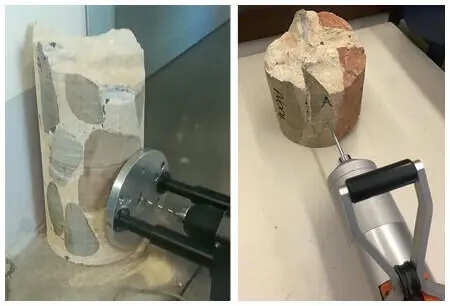
Figure 1: Examples of drilling core samples subjected to drilling (left side) and penetrometer (right side) tests.
During the most recent diagnostic campaign promoted by Opera del Duomo of Florence and conducted on the Giotto’s Bell Tower to investigate the history, the structures and the materials of external façades and masonry, some samples of mortars were obtained. The mortar samples were taken from the foundations and from the masonry of the II and V levels of the bell tower, using a core drill.
Core samples of foundation structures from Palazzo Vecchio (headquarters of municipality of Florence town) were also tested.
Tested mortars were prepared before the measurements: for San Francesco Church on site case study, the plaster of the wall was removed, in order to have bedding mortars of bricks exposed; the core samples were cleaned from coring residues.
Читать дальшеИнтервал:
Закладка:
Похожие книги на «Monument Future»
Представляем Вашему вниманию похожие книги на «Monument Future» списком для выбора. Мы отобрали схожую по названию и смыслу литературу в надежде предоставить читателям больше вариантов отыскать новые, интересные, ещё непрочитанные произведения.









Обсуждение, отзывы о книге «Monument Future» и просто собственные мнения читателей. Оставьте ваши комментарии, напишите, что Вы думаете о произведении, его смысле или главных героях. Укажите что конкретно понравилось, а что нет, и почему Вы так считаете.