Siegfried Siegesmund - Monument Future
Здесь есть возможность читать онлайн «Siegfried Siegesmund - Monument Future» — ознакомительный отрывок электронной книги совершенно бесплатно, а после прочтения отрывка купить полную версию. В некоторых случаях можно слушать аудио, скачать через торрент в формате fb2 и присутствует краткое содержание. Жанр: unrecognised, на немецком языке. Описание произведения, (предисловие) а так же отзывы посетителей доступны на портале библиотеки ЛибКат.
- Название:Monument Future
- Автор:
- Жанр:
- Год:неизвестен
- ISBN:нет данных
- Рейтинг книги:4 / 5. Голосов: 1
-
Избранное:Добавить в избранное
- Отзывы:
-
Ваша оценка:
Monument Future: краткое содержание, описание и аннотация
Предлагаем к чтению аннотацию, описание, краткое содержание или предисловие (зависит от того, что написал сам автор книги «Monument Future»). Если вы не нашли необходимую информацию о книге — напишите в комментариях, мы постараемся отыскать её.
Alle vier Jahre treffen sich auf einer internationalen Tagung Experten, die sich mit den entsprechenden Sachfragen beschäftigen. Der „14th International Congress on the Deterioration and Conservation of Stone“ findet im September 2020 in Göttingen statt. Er ist die wichtigste Veranstaltung zur Verbreitung des Wissens von Praktikern und Forschern, die im Bereich der Steinkonservierung zur Erhaltung des baulichen Kulturerbes arbeiten: Geowissenschaftler, Architekten, Bauspezialisten, Ingenieure, Restauratoren, Denkmalpfleger und Bauherren.
Der Tagungsband mit über 150 wissenschaftlichen Beiträgen repräsentiert und erfasst den neuesten Stand der Technik auf diesem Gebiet.
Themen sind:
– Charakterisierung von Schadensphänomenen von Steinen und verwandten Baumaterialien (Stuck, Putz, Mörtel usw.)
– Methoden zur Untersuchung des Steinverfalls in situ und zerstörungsfreie Prüfung
– Langzeitüberwachung von Steindenkmälern und Gebäuden
– Simulation und Modellierung des Zerfalls
– Technologien und Entwicklung verbesserter Bearbeitung und Verwendung von Stein in Neubauten
– Bewertung der Langzeitwirkung von Bearbeitungstechniken
– Auswirkungen des Klimawandels auf die Steinverwitterung des Kulturerbes
– Berichte zur Steinkonservierung: Fallstudien und Projekte
– Digitalisierung und Dokumentation von Steinkonservierung
–
The 14th International Congress on the Deterioration and Conservation of Stone, entitled MONUMENT FUTURE: DECAY AND CONSERVATION OF STONE is a quadrennial event that brings together a world-wide community of geoscientists, architects, building specialists, engineers, conservators, restorators, monument curators and building owners who are concerned about the conservation of cultural stone structures and objects. Since antiquity, the weathering and deterioration of historical buildings, masonry, monuments, sculptures etc. using natural stones has been a very well-known problem.
This conference is the main gathering for the dissemination of knowledge in the field of stone deterioration issues. It represents and captures the state-of-the-art in the field of stone conservation and cultural heritage conservation with regards to the following topics:
– Characterisation of damage phenomena of stone and related building materials (plaster, rendering, mortar etc.)
– Methods for the investigation of stone decay; in-situ and non-destructive testing
– Long-term monitoring of stone monuments and buildings
– Simulation and modelling of decay
– Technology and development of improved treatments and use of stone in new buildings
– Assessment of long-term effects of treatments
– Impact of climate change on stone decay of Cultural Heritage
– Reports about stone conservation: case studies and projects
– Digitalization and documentation in stone conservation
Monument Future — читать онлайн ознакомительный отрывок
Ниже представлен текст книги, разбитый по страницам. Система сохранения места последней прочитанной страницы, позволяет с удобством читать онлайн бесплатно книгу «Monument Future», без необходимости каждый раз заново искать на чём Вы остановились. Поставьте закладку, и сможете в любой момент перейти на страницу, на которой закончили чтение.
Интервал:
Закладка:
For evaluating the stone weathering level, we use the P-wave velocity V normalized with respect to the velocity of an unweathered sample V 0as shown in table 1, which is normally used by conservators. For the Fangshan Hanbaiyu marble V 0is about 4,500 m/s.
175 Table 1:Normalized velocity ratios for the definition of stone weathering levels.
| Weathering Level | Vi / V0 |
| Not Weathered | ≥ 0.9 |
| Void ratio increased | 0.75–0.9 |
| Floor level of weathering | 0.75 |
| Slightly waethered | 0.5–0.75 |
| Moderately weathered | 0.25–0.5 |
| Severly weathered | ≤ 0.25 |
Crack depth detection
In case of open cracks the ultrasonic waves run from the emitting probe to the end of a crack, and then back to the receiving probe. Assuming that the crack is perpendicular to the surface and the ultrasonic waves propagate with constant velocity, the depth can be easily calculated.
We measure the ultrasonic transit times between points A and B for the path ACB and between points D and F for the path DCF, and also the distances AE and DE for mode A. For mode B, the respective transit times are for the paths ACB and ACE and the distances AD and DB as shown in Fig. 5. The choice of mode A or B depends on the field situation. The data is evaluated with respect to the crack depth by Equation 1 (mode A) or Equation 2 (mode B). Both equations can be deduced by geometrical reasoning from the sketches in Fig. 3.

Figure 3:Crack depth detection modes.
Ultrasonic CT method
The principle of ultrasonic CT is shown in Fig. 4. Abundant data of wave time are collected by fanshaped testing. S 1–S nare the emitting points, R 11, R 12…R ni, R njare the corresponding receiving points.
Hypothesize that there are N testing line in the section plane, and the section plane may be separated to M grids on request of calculating accuracy.

Equation 1:Crack depth equation of mode A T 1 – ultrasound wave time DCF; T 2– ultrasound wave time ACB L 1– distance DE; L 2– distance AE H – height of the triangle, depth of the crack
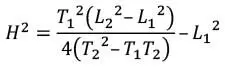
Equation 2:Crack depth equation of mode B T 1 – ultrasound wave time ACE; T 2– ultrasound wave time ACB L 1– distance AD; L 2– distance BD H – height of the triangle, depth of the crack
The result will be got by solving the matrix equation below:

Equation 3:USCT matrix equation l ij – length of path i in unit j; S j= 1/ V j – slowness of unit j; t i – wave time of path i.
The velocity V jof ultrasonic wave in each unit of the section is given by the reciprocal of each S j.
Detecting of the statue
Detecting for the depth of the cracks
There were 77 micro cracks observed on the surface of the statue and 15 of them were chosen for testing with either mode A or B, depending on the position of the crack.
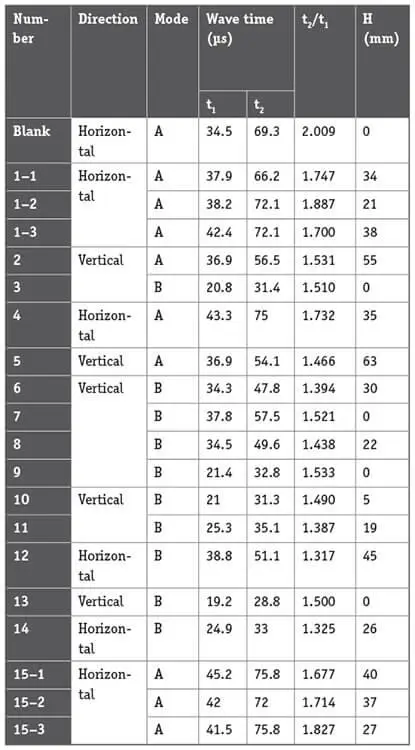
The ultrasonic device used was a Proceq PunditLab+, with the precision of 0.1 µs on wavetime reading and the probes were Proceq 40 17-B 54 KHz conical probes (Fig. 5), with the contact area of diameter 4 mm, that ensures the precision of the contact points and the accurcy of testing results. Fig. 6 shows examples of cracks detected. Table 2shows the calculated depth results of fifteen cracks and the depth ranged from 0 to 68 mm.
176 
Figure 4:Principle of ultrasonic CT.
USCT testing of the head
The authors have developed a USCT system that can be used for testing wood and stone structures. It comprises a Proceq Pundit Lab+ non-metal ultrasonic device, an amplifier between the receiving probe and the detector, a sensor diameter convertor, a multi sensor fixator and the USCT analysis software. We have 20 Sonotec L40 54 kHz sensors of diameter 50 mm, and the convertors transmit the diameter to 10 mm when contacted the tested object. That makes the coordinates of each contacting points more precise. Non couplant is used for testing thus avoiding the penetration of couplants into the object through open cracks.
Laboratory tests were made with several wood and limestone samples, and the USCT images correspond very well with the visible appearance of the samples commendably. Fig. 7 shows four of them. All the equipment can be packed into one suitcase and easily transported for on-site testing.
For the on-site testing of the statue, a section of the cranial region of the statue was chosen as shown in Fig. 8, and sixteen probes were used. Fig. 9 shows the USCT detecting array and USCT image.

Figure 5:Probe for crack depth detection.
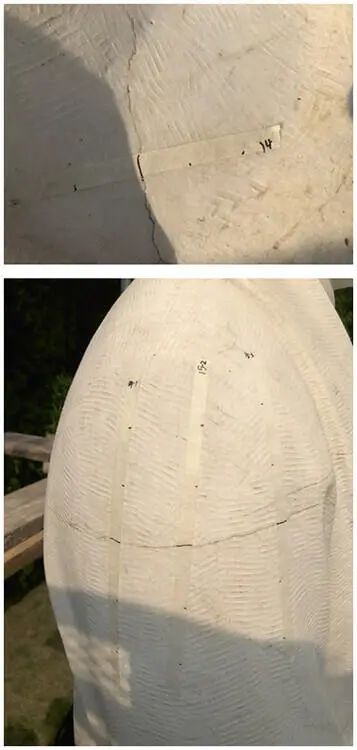
Figure 6:Cracks in the marble of the Soong Ching-ling statue.
The ultrasonic velocity in fresh marble similar to 177the material of the statue is about 4,500 m/s, and the measured velocities shown in the result image range between 1,000–4,500 m/s.
According to the USCT results no penetrative severe cracks were found. The depth of the superficial cracks on the top of the head was not more than 50 mm. However, a clearly deteriorated zone with a thickness from 10 to 50 mm, caused by the disintegration of the crystal fabric, was found around the head.
Conclusion
According to the observation, almost all of the 77 cracks should be developed from the stone interlayers. The depth of 15 cracks has been detected and the results are between 0–68 mm. By USCT, a loosened zone with thickness up to 50 mm has also been found.
Table 2:Crack depth data.
For the reason of the statue has just been exposed to the natural environment for only 35 years, the marble should be in the early stage of deterioration, that is surface crystal fabric loosing and surface cracks developing.
Читать дальшеИнтервал:
Закладка:
Похожие книги на «Monument Future»
Представляем Вашему вниманию похожие книги на «Monument Future» списком для выбора. Мы отобрали схожую по названию и смыслу литературу в надежде предоставить читателям больше вариантов отыскать новые, интересные, ещё непрочитанные произведения.







Обсуждение, отзывы о книге «Monument Future» и просто собственные мнения читателей. Оставьте ваши комментарии, напишите, что Вы думаете о произведении, его смысле или главных героях. Укажите что конкретно понравилось, а что нет, и почему Вы так считаете.