Siegfried Siegesmund - Monument Future
Здесь есть возможность читать онлайн «Siegfried Siegesmund - Monument Future» — ознакомительный отрывок электронной книги совершенно бесплатно, а после прочтения отрывка купить полную версию. В некоторых случаях можно слушать аудио, скачать через торрент в формате fb2 и присутствует краткое содержание. Жанр: unrecognised, на немецком языке. Описание произведения, (предисловие) а так же отзывы посетителей доступны на портале библиотеки ЛибКат.
- Название:Monument Future
- Автор:
- Жанр:
- Год:неизвестен
- ISBN:нет данных
- Рейтинг книги:4 / 5. Голосов: 1
-
Избранное:Добавить в избранное
- Отзывы:
-
Ваша оценка:
Monument Future: краткое содержание, описание и аннотация
Предлагаем к чтению аннотацию, описание, краткое содержание или предисловие (зависит от того, что написал сам автор книги «Monument Future»). Если вы не нашли необходимую информацию о книге — напишите в комментариях, мы постараемся отыскать её.
Alle vier Jahre treffen sich auf einer internationalen Tagung Experten, die sich mit den entsprechenden Sachfragen beschäftigen. Der „14th International Congress on the Deterioration and Conservation of Stone“ findet im September 2020 in Göttingen statt. Er ist die wichtigste Veranstaltung zur Verbreitung des Wissens von Praktikern und Forschern, die im Bereich der Steinkonservierung zur Erhaltung des baulichen Kulturerbes arbeiten: Geowissenschaftler, Architekten, Bauspezialisten, Ingenieure, Restauratoren, Denkmalpfleger und Bauherren.
Der Tagungsband mit über 150 wissenschaftlichen Beiträgen repräsentiert und erfasst den neuesten Stand der Technik auf diesem Gebiet.
Themen sind:
– Charakterisierung von Schadensphänomenen von Steinen und verwandten Baumaterialien (Stuck, Putz, Mörtel usw.)
– Methoden zur Untersuchung des Steinverfalls in situ und zerstörungsfreie Prüfung
– Langzeitüberwachung von Steindenkmälern und Gebäuden
– Simulation und Modellierung des Zerfalls
– Technologien und Entwicklung verbesserter Bearbeitung und Verwendung von Stein in Neubauten
– Bewertung der Langzeitwirkung von Bearbeitungstechniken
– Auswirkungen des Klimawandels auf die Steinverwitterung des Kulturerbes
– Berichte zur Steinkonservierung: Fallstudien und Projekte
– Digitalisierung und Dokumentation von Steinkonservierung
–
The 14th International Congress on the Deterioration and Conservation of Stone, entitled MONUMENT FUTURE: DECAY AND CONSERVATION OF STONE is a quadrennial event that brings together a world-wide community of geoscientists, architects, building specialists, engineers, conservators, restorators, monument curators and building owners who are concerned about the conservation of cultural stone structures and objects. Since antiquity, the weathering and deterioration of historical buildings, masonry, monuments, sculptures etc. using natural stones has been a very well-known problem.
This conference is the main gathering for the dissemination of knowledge in the field of stone deterioration issues. It represents and captures the state-of-the-art in the field of stone conservation and cultural heritage conservation with regards to the following topics:
– Characterisation of damage phenomena of stone and related building materials (plaster, rendering, mortar etc.)
– Methods for the investigation of stone decay; in-situ and non-destructive testing
– Long-term monitoring of stone monuments and buildings
– Simulation and modelling of decay
– Technology and development of improved treatments and use of stone in new buildings
– Assessment of long-term effects of treatments
– Impact of climate change on stone decay of Cultural Heritage
– Reports about stone conservation: case studies and projects
– Digitalization and documentation in stone conservation
Monument Future — читать онлайн ознакомительный отрывок
Ниже представлен текст книги, разбитый по страницам. Система сохранения места последней прочитанной страницы, позволяет с удобством читать онлайн бесплатно книгу «Monument Future», без необходимости каждый раз заново искать на чём Вы остановились. Поставьте закладку, и сможете в любой момент перейти на страницу, на которой закончили чтение.
Интервал:
Закладка:
Description of rock specimens
Rock types that have frequently been used for stone items or edifices important to cultural heritage are granite, marble, and sandstone. We selected these three rock types as test rock.
The first rock selected is a granite collected in Inada, Japan, and which is used for buildings and tombstones. The second is a marble (Bianco Carrara) from Italy used for sculptures and building decor. The third is a sandstone from Cambodia used for the historical temples of Angkor, a World Heritage Site.
These selected rocks have different characteristics as follows. The granite selected has a polymineralic structure and is mainly composed of quartz, plagioclase, microcline, biotite, and amphibole. Although the average mineral size is approximately 2 mm, some quartz and plagioclase have a grain size > 5 mm. Meanwhile, the marble is practically monomineralic (calcite) metamorphic rock. The average size of the calcite is < 0.5 mm. Major minerals in the sandstone are quartz and albite; its average size is < 0.5 mm. Clinochlore and illite occur between the major minerals as a matrix of the sandstone. At the microscopic level, the granitic minerals have cleavage planes and previously formed intramineral microcracks. Regarding the marble and sandstone, the mineral cleavage planes and microcracks are obscure.
Regarding the physical and mechanical properties of samples, specific gravity ranges from 2.60 for the granite to 2.72 for the marble, and the porosity shows 0.64 % for the granite, 2.23 % for the marble, and 13.5 % for the sandstone. Mechanically, the granite is more brittle, and the granite and sandstone (9.4 MPa) have a higher tensile strength than that of the marble (6.4 MPa).
The P-wave velocity was determined for each specimen (50 mm in diameter and 100 mm in height) before testing using a TICO instrument (Proceq). The velocity shows 4,654 m/s for the granite, 4,410 m/s for the marble, and 3,092 m/s for the sandstone.
Methodology for the AE and strain monitoring
To monitor the AE and strain, specimens were formed into a cylindrical shape with a diameter of 50 mm and a length of 100 mm. Before the test, each specimen was washed using water to remove contaminants and dried for 10 days in a vacuum desiccator. The specimen was installed in a temperature-controlled chamber after setting up equipment for AE, strain, and air and rock surface temperature measurement. The AE and strain data were recorded using a laptop computer.
The AE equipment employed during the test consisted of an amplifier and a piezoelectric sensor (Fig. 1). In this study, peak amplitude, which is an important parameter in the test because it determines AE signal detectability, was continuously monitored during the entire test period at 1/100 s. 181The sensor was placed on an axis face of the specimen. Notably, vaseline was smeared in the contact area of the sensor and specimen to ensure their coupling effect; then, a c-clamp was used to fix the sensor on the specimen.
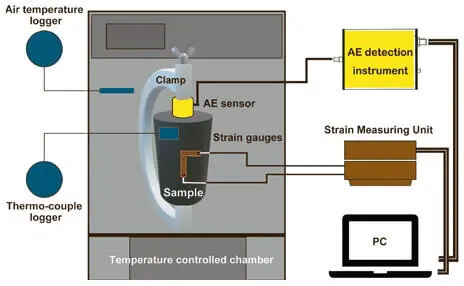
Figure 1:A schematic diagram of the AE and strain monitoring system.
Self-temperature-compensated strain gauges (10 mm in length) were installed on the center of the specimen in the axial and lateral directions using a three-wire system to reduce thermally induced apparent strain. A dedicated adhesive was used to glue strain gauges to the specimens. The specimen strain was continuously recorded using a measuring unit.
The surface temperature of the specimens was monitored at a 1-s interval using a thermocouple sheet and logger. Air temperature in the chamber was also recorded by a logger at a 10-s interval.
The chamber was programed with a heating–cooling range of 4–84 °C and an RTC of ±2 °C/min based on field measurements. Namely, Peel (1974) reported a maximum rock surface temperature (dark sandstone) of 79.3 °C in the Tibesti Mountains. This temperature is thought to be the highest rock surface temperature ever recorded. Meanwhile, Waragai (2019) reported the results of field measurements conducted during the dry season at Cambodia. The range of the surface temperature of the sandstone specimen varied from a 1.50 °C/min increasing rate to a −1.88 °C/min decreasing rate. As possible temperatures due to insolation, the heating–cooling range and RTC were therefore set inside the chamber: the specimens were heated from 4 °C to 84 °C over 40 min after cooling from room temperature to 4 °C over 8 h and 8 min. Then, the specimens were maintained at 84 °C for 4 h and then cooled to the initial temperature of 4 °C over 40 min. In the test, the temperature change of 4–84 °C was repeated four times. After that, the P-wave velocity of the specimen was measured using a TICO.
Results and Discussion
AE amplitude and strain
Generally, the thermal expansion behavior of rock is affected by the temperature history. To avoid the influence of such a history, termed the Kaiser effect, the peak amplitude of the AE (mV) within the large temperature change that the specimens were first exposed to is shown in Figure 2. The air and rock surface temperatures shown in Figure 2 are data obtained by thinning out every 10 s from the data recorded at each time interval. Regarding 182the AE signal, the integrated peak amplitude for 10 s, excluding the peak amplitude < 100 mV from the measured data, is shown.
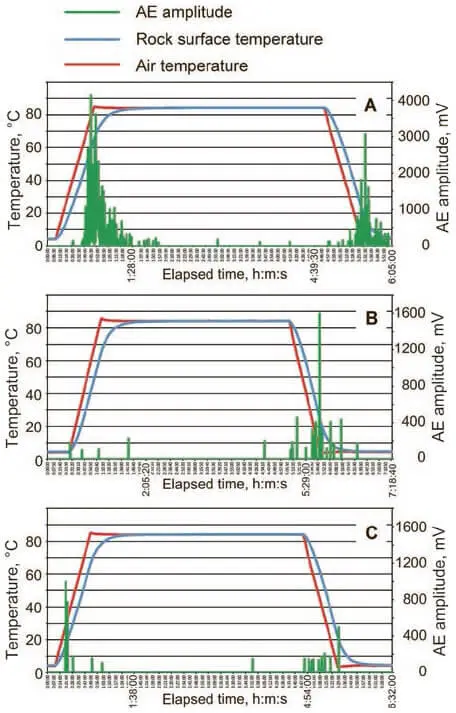
Figure 2:The AE amplitude and the rock and air temperatures versus time evolutions of the rock samples. A: granite, B: marble, C: sandstone.
There is a difference in the size of the amplitude and the appearance frequency over time of the AE amplitude depending on the rock types; however, it can be seen that the AE signal occurred in all specimens when the temperature increased and decreased. Following the test, no apparent damage such as cracks was found in the specimens. However, the P-wave velocity decreased by 25 % for the granite (3,476 m/s), 7 % for the marble (4,090 m/s), and 0.1 % for the sandstone (3,014 m/s). Therefore, the AE signal is considered to correspond to stress waves when microcracks form at grain boundaries.
The range of the strain due to the temperature change is the largest for the strains of granite (the range of axial strain = 380) followed by that of the marble (351) and sandstone (262). The occurrence of the AE amplitude corresponds to this amount of strain, and the maximum peak amplitude is greatest in the granite (4,140 mV), followed by that of the marble (1,597 mV) and sandstone (1,000 mV). Excluding the effects of crack opening and closing due to temperature changes and the hysteresis effect, the amount of strain and generation of AE signals are closely related. The porosity is lowest for the granite and highest for the sandstone. In other words, microcracks are more likely to occur with the temperature change at the grain boundaries of the granite where the minerals are in closer contact. Because the sandstone has a higher porosity than that of the granite and marble and is not dense, the microcrack occurrence at grain boundaries is considered to be the smallest. Very heterogeneous textures such as sandstone are thought to be less responsive to thermal changes.
AE amplitude and temperature
The rock surface temperature at the time of the generation of the AE amplitude and its frequency by temperature are shown in Figure 3; in Figure 3, data of an AE amplitude = 0 are excluded.
Читать дальшеИнтервал:
Закладка:
Похожие книги на «Monument Future»
Представляем Вашему вниманию похожие книги на «Monument Future» списком для выбора. Мы отобрали схожую по названию и смыслу литературу в надежде предоставить читателям больше вариантов отыскать новые, интересные, ещё непрочитанные произведения.












Обсуждение, отзывы о книге «Monument Future» и просто собственные мнения читателей. Оставьте ваши комментарии, напишите, что Вы думаете о произведении, его смысле или главных героях. Укажите что конкретно понравилось, а что нет, и почему Вы так считаете.