Siegfried Siegesmund - Monument Future
Здесь есть возможность читать онлайн «Siegfried Siegesmund - Monument Future» — ознакомительный отрывок электронной книги совершенно бесплатно, а после прочтения отрывка купить полную версию. В некоторых случаях можно слушать аудио, скачать через торрент в формате fb2 и присутствует краткое содержание. Жанр: unrecognised, на немецком языке. Описание произведения, (предисловие) а так же отзывы посетителей доступны на портале библиотеки ЛибКат.
- Название:Monument Future
- Автор:
- Жанр:
- Год:неизвестен
- ISBN:нет данных
- Рейтинг книги:4 / 5. Голосов: 1
-
Избранное:Добавить в избранное
- Отзывы:
-
Ваша оценка:
Monument Future: краткое содержание, описание и аннотация
Предлагаем к чтению аннотацию, описание, краткое содержание или предисловие (зависит от того, что написал сам автор книги «Monument Future»). Если вы не нашли необходимую информацию о книге — напишите в комментариях, мы постараемся отыскать её.
Alle vier Jahre treffen sich auf einer internationalen Tagung Experten, die sich mit den entsprechenden Sachfragen beschäftigen. Der „14th International Congress on the Deterioration and Conservation of Stone“ findet im September 2020 in Göttingen statt. Er ist die wichtigste Veranstaltung zur Verbreitung des Wissens von Praktikern und Forschern, die im Bereich der Steinkonservierung zur Erhaltung des baulichen Kulturerbes arbeiten: Geowissenschaftler, Architekten, Bauspezialisten, Ingenieure, Restauratoren, Denkmalpfleger und Bauherren.
Der Tagungsband mit über 150 wissenschaftlichen Beiträgen repräsentiert und erfasst den neuesten Stand der Technik auf diesem Gebiet.
Themen sind:
– Charakterisierung von Schadensphänomenen von Steinen und verwandten Baumaterialien (Stuck, Putz, Mörtel usw.)
– Methoden zur Untersuchung des Steinverfalls in situ und zerstörungsfreie Prüfung
– Langzeitüberwachung von Steindenkmälern und Gebäuden
– Simulation und Modellierung des Zerfalls
– Technologien und Entwicklung verbesserter Bearbeitung und Verwendung von Stein in Neubauten
– Bewertung der Langzeitwirkung von Bearbeitungstechniken
– Auswirkungen des Klimawandels auf die Steinverwitterung des Kulturerbes
– Berichte zur Steinkonservierung: Fallstudien und Projekte
– Digitalisierung und Dokumentation von Steinkonservierung
–
The 14th International Congress on the Deterioration and Conservation of Stone, entitled MONUMENT FUTURE: DECAY AND CONSERVATION OF STONE is a quadrennial event that brings together a world-wide community of geoscientists, architects, building specialists, engineers, conservators, restorators, monument curators and building owners who are concerned about the conservation of cultural stone structures and objects. Since antiquity, the weathering and deterioration of historical buildings, masonry, monuments, sculptures etc. using natural stones has been a very well-known problem.
This conference is the main gathering for the dissemination of knowledge in the field of stone deterioration issues. It represents and captures the state-of-the-art in the field of stone conservation and cultural heritage conservation with regards to the following topics:
– Characterisation of damage phenomena of stone and related building materials (plaster, rendering, mortar etc.)
– Methods for the investigation of stone decay; in-situ and non-destructive testing
– Long-term monitoring of stone monuments and buildings
– Simulation and modelling of decay
– Technology and development of improved treatments and use of stone in new buildings
– Assessment of long-term effects of treatments
– Impact of climate change on stone decay of Cultural Heritage
– Reports about stone conservation: case studies and projects
– Digitalization and documentation in stone conservation
Monument Future — читать онлайн ознакомительный отрывок
Ниже представлен текст книги, разбитый по страницам. Система сохранения места последней прочитанной страницы, позволяет с удобством читать онлайн бесплатно книгу «Monument Future», без необходимости каждый раз заново искать на чём Вы остановились. Поставьте закладку, и сможете в любой момент перейти на страницу, на которой закончили чтение.
Интервал:
Закладка:
Skinner B. J. 1966. Thermal expansions. In: Clark, S. P. (ed) Handbook of Physical Constants. Geol Society of America Memoirs 97: pp 75–96.
Waragai T. 2019. Measurements of thermic damage of Angkor dimension sandstone used for World Heritage temples. IAG Regional Conference on Geomorph. Abstr. Athens.
Yamaguchi U., Miyazaki M. 1970. A study of the strength or failure of rocks heated to high temperatures. J Min Metall Inst Japan 86: 346–351.
185
ACOUSTIC EMISSIONS – INSIGHTS INTO THE DECAY MECHANISMS OF THERMALLY TREATED MARBLES
Stephan Pirskawetz 1 , Johanna Menningen 2 , Siegfried Siegesmund 2
IN: SIEGESMUND, S. & MIDDENDORF, B. (EDS.): MONUMENT FUTURE: DECAY AND CONSERVATION OF STONE.
– PROCEEDINGS OF THE 14TH INTERNATIONAL CONGRESS ON THE DETERIORATION AND CONSERVATION OF STONE –
VOLUME I AND VOLUME II. MITTELDEUTSCHER VERLAG 2020.
1Bundesanstalt für Materialforschung und -prüfung (BAM), Berlin, Germany
2Geoscience Centre of the Georg August University Göttingen, Germany
Abstract
Since ancient times, marble has been the preferred material for monuments, sculptures, ornaments and architecture. Though the stone is often a chosen material, long-term exposure of marble results in cumulative deterioration of the rock fabric. The rate and extent of deterioration depends on the rock fabric and the climatic conditions. Besides the thermal vulnerability of marble, a combination of thermal and hygric fluctuation accelerates the deterioration process. The weathering sensitivity of marbles can be characterised by the irreversible length change of samples after heating under thermohygric conditions as residual strain. This residual strain is a non-reversible deterioration and caused by microcracking induced by a pronounced anisotropy of the thermal dilatation coefficient of calcite. In brittle materials like marble, cracking and crack growth or friction on crack surfaces are accompanied by release of acoustic waves. The analysis of these acoustic emissions can give a deeper insight into the deterioration mechanism of marble.
In this study, acoustic emissions of thermohygric treated marble were analysed and correlated with ultrasonic velocities, thermal dilatation and residual strains. Therefore, different types of calcitic marble were cyclically heated from 20 °C to 90 °C and after equilibration of the samples cooled down again to 20 °C. While the first cycles were performed under dry conditions, the following were executed in a humid environment. The analysis of acoustic emissions enables one to determine when cracking occurs during the thermal treatment. It is also possible to differentiate microcracking from internal friction. Furthermore, the evolution of deterioration can be estimated based on ultrasonic velocities. The combination of acoustic methods and strain measurement gives an insight into the disintegration mechanism and supports the development of prevention strategies.
Introduction
Due to the exceptional microstructure of marble, thermal fluctuations initially cause an integral decohesion of the calcite crystal grains. This opens the intrinsically dense and tight structure to the ingress of water. Then, starting from the surface, ongoing weather-related temperature change and especially frost-thaw action accelerate the deterioration process. Conventional test methods as described in European standards are not adequate to evaluate the weathering resistance of the various types of marble. For a reliable assessment of the weathering resistance of marbles new methods are needed, covering the special deterioration mechanisms 186of marble. In this study, acoustic emissions of thermohygric treated marble were analysed and correlated with ultrasonic velocities, thermal dilatation and residual strains. The analysis of acoustic emissions enables one to determine when cracking occurs during the thermal treatment.
Marble weathering
The reason for the high sensitivity of calcitic marbles can be found by the pronounced anisotropy of the thermal expansion coefficient of the calcite single crystals (Fig. 1a). Temperature changes lead to anisotropic volume changes of the crystals, resulting in microstresses and microcracks. Even moderate repetitive temperature changes can cause significant deterioration. The extent of the local stresses and the resulting cracks are controlled by grain size, grain-to-grain misorientation as well as type and contact of grain boundaries (Rüdrich 2003, Shushakova 2013).

Figure 1:Schematic sketch of the thermal dilatation of calcite (modified after Rüdrich 2003). a) Coefficients of thermal expansion in different directions. b) Sketch of a single calcite crystal in its initial state. Volume change due to c) heating and d) cooling.
Marble varieties
Four different calcitic marble varieties were analysed using acoustic emission (Figure 2).
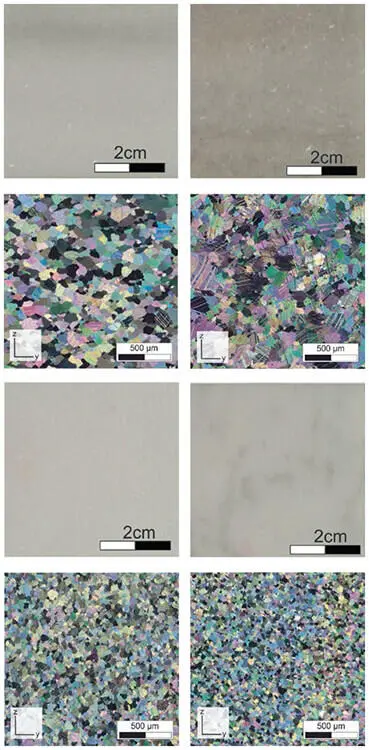
Figure 2:Macroscopic and microscopic image of all analysed marble varieties. Top left depicts the Blanco Macael, top right the Großkunzendorfer, bottom left, Lasa and bottom right the Gioia.
The white spanish Blanco Macael (BM) shows a granoblastic grain fabric, with almost polygonal grain to grain contacts and a median grain size of 395 µm. The greyish Polish Großkunzendorfer (GK) shows a seriate to interlobate grain fabric, interlocking grain boundaries and a median grain size of about 545 µm. An equigranular-interlobate grain fabric was analysed for both Italian marble varieties. The white Lasa marble (LA) has a higher 187median grain size of 419 µm compared to the fine-grained Carrara Gioia (GI, 284 µm), a whitish variety decorated with greyish streaks. Textural analyses showed that, with the exception of the Lasa, all varieties have charateristics of a c-axis fibre type, with a single c-axis maximum for their lattice preferred orientation. They show moderate to slightly higher intensities between 1.6 mrd (multiple of random distribution) for the Großkunzendorfer and 2.9 mrd for the Blanco Macael. The Lasa marble shows a girdle-like c-axes distribution, surrounding the a-axis maxima.
Thermal Expansion
All four marble varieties have been analysed with regard to their thermal dilatation behaviour under dry and wet conditions (for details see Koch and Siegesmund, 2004). The irreversible length change (residual strain, RS), was determined for all samples (15 mm × 50 mm cylinders) after each heating-cooling cycle (20°–90°–20 °C).
Acoustic Emission
Cracking, crack growth and friction of fracture planes in brittle materials like marble generate short pulses of acoustic waves. These acoustic emissions (AE) can be detected by piezoelectric sensors on the surface of the material. The analysis of AE signal features can give a deeper insight into deterioration mechanisms (Tschegg, 2016).
Figure 3 shows the experimental setup that was used to study the decay mechanism of thermally treated marbles. All parts are glued together with silicone, which is a good acoustic couplant between marble and sensors. The cylindrical marble samples have a diameter of 20 mm and a height of 50 mm.
In each experiment four marble samples and one reference sample of stainless steel were tested simultaneously in a climate chamber. In each cycle the temperature changed from 20 °C to 90 °C and back to 20 °C with a rate of 1 °K/min. The temperature was measured on the inner side of the acrylic glass cylinder with a thermocouple. Every temperature level was held for at least four hours. Ultrasonic velocity was measured automatically at 20 °C at the end of each cycle. For wet cycles the acrylic glass cylinders were filled with demineralized water before heating.
Читать дальшеИнтервал:
Закладка:
Похожие книги на «Monument Future»
Представляем Вашему вниманию похожие книги на «Monument Future» списком для выбора. Мы отобрали схожую по названию и смыслу литературу в надежде предоставить читателям больше вариантов отыскать новые, интересные, ещё непрочитанные произведения.







Обсуждение, отзывы о книге «Monument Future» и просто собственные мнения читателей. Оставьте ваши комментарии, напишите, что Вы думаете о произведении, его смысле или главных героях. Укажите что конкретно понравилось, а что нет, и почему Вы так считаете.