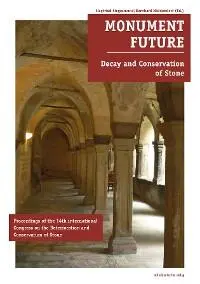
Siegfried Siegesmund - Monument Future
Здесь есть возможность читать онлайн «Siegfried Siegesmund - Monument Future» — ознакомительный отрывок электронной книги совершенно бесплатно, а после прочтения отрывка купить полную версию. В некоторых случаях можно слушать аудио, скачать через торрент в формате fb2 и присутствует краткое содержание. Жанр: unrecognised, на немецком языке. Описание произведения, (предисловие) а так же отзывы посетителей доступны на портале библиотеки ЛибКат.
- Название:Monument Future
- Автор:
- Жанр:
- Год:неизвестен
- ISBN:нет данных
- Рейтинг книги:4 / 5. Голосов: 1
-
Избранное:Добавить в избранное
- Отзывы:
-
Ваша оценка:
Monument Future: краткое содержание, описание и аннотация
Предлагаем к чтению аннотацию, описание, краткое содержание или предисловие (зависит от того, что написал сам автор книги «Monument Future»). Если вы не нашли необходимую информацию о книге — напишите в комментариях, мы постараемся отыскать её.
Alle vier Jahre treffen sich auf einer internationalen Tagung Experten, die sich mit den entsprechenden Sachfragen beschäftigen. Der „14th International Congress on the Deterioration and Conservation of Stone“ findet im September 2020 in Göttingen statt. Er ist die wichtigste Veranstaltung zur Verbreitung des Wissens von Praktikern und Forschern, die im Bereich der Steinkonservierung zur Erhaltung des baulichen Kulturerbes arbeiten: Geowissenschaftler, Architekten, Bauspezialisten, Ingenieure, Restauratoren, Denkmalpfleger und Bauherren.
Der Tagungsband mit über 150 wissenschaftlichen Beiträgen repräsentiert und erfasst den neuesten Stand der Technik auf diesem Gebiet.
Themen sind:
– Charakterisierung von Schadensphänomenen von Steinen und verwandten Baumaterialien (Stuck, Putz, Mörtel usw.)
– Methoden zur Untersuchung des Steinverfalls in situ und zerstörungsfreie Prüfung
– Langzeitüberwachung von Steindenkmälern und Gebäuden
– Simulation und Modellierung des Zerfalls
– Technologien und Entwicklung verbesserter Bearbeitung und Verwendung von Stein in Neubauten
– Bewertung der Langzeitwirkung von Bearbeitungstechniken
– Auswirkungen des Klimawandels auf die Steinverwitterung des Kulturerbes
– Berichte zur Steinkonservierung: Fallstudien und Projekte
– Digitalisierung und Dokumentation von Steinkonservierung
–
The 14th International Congress on the Deterioration and Conservation of Stone, entitled MONUMENT FUTURE: DECAY AND CONSERVATION OF STONE is a quadrennial event that brings together a world-wide community of geoscientists, architects, building specialists, engineers, conservators, restorators, monument curators and building owners who are concerned about the conservation of cultural stone structures and objects. Since antiquity, the weathering and deterioration of historical buildings, masonry, monuments, sculptures etc. using natural stones has been a very well-known problem.
This conference is the main gathering for the dissemination of knowledge in the field of stone deterioration issues. It represents and captures the state-of-the-art in the field of stone conservation and cultural heritage conservation with regards to the following topics:
– Characterisation of damage phenomena of stone and related building materials (plaster, rendering, mortar etc.)
– Methods for the investigation of stone decay; in-situ and non-destructive testing
– Long-term monitoring of stone monuments and buildings
– Simulation and modelling of decay
– Technology and development of improved treatments and use of stone in new buildings
– Assessment of long-term effects of treatments
– Impact of climate change on stone decay of Cultural Heritage
– Reports about stone conservation: case studies and projects
– Digitalization and documentation in stone conservation
Monument Future — читать онлайн ознакомительный отрывок
Ниже представлен текст книги, разбитый по страницам. Система сохранения места последней прочитанной страницы, позволяет с удобством читать онлайн бесплатно книгу «Monument Future», без необходимости каждый раз заново искать на чём Вы остановились. Поставьте закладку, и сможете в любой момент перейти на страницу, на которой закончили чтение.
Интервал:
Закладка:
Lazzarini L. 1997, Le pietre e i marmi colorati della Basilica di S. Marco a Venezia. In “Storia dell’arte marciana: l’Architettura” (a cura di R. Polacco), Venezia, 309–326.
Lazzarini L. 2007, Poikiloi lithoi, versiculores maculae. I marmi colorati della Grecia antica, Pisa-Roma.
Lazzarini L. 2015a, Il reimpiego del marmo proconnesio a Venezia, in “Pietre di Venezia, spolia in se, spolia in re”, (a cura di M. Centanni e L. Sperti), Ariccia (Rm), 135–157.
Lazzarini L. 2015b, Indagini di laboratorio sui materiali delle colonne del ciborio, Quaderni della Procuratoria. Arte, Storia, Restauri della Basilica di San Marco a Venezia, Vicenza, 57–63, 88.
Lorenzetti G., 1994, Venice and its lagoon. Historical-artistic guide, Trieste.
Mills J. S., White R. 1994, The organic chemistry of museums objects, 2nd ed., Oxford.
Monna D., Pensabene P. 1977, Marmi dell’Asia Minore, Roma.
Pensabene P. 2011, Cave di marmo bianco e pavonazzetto in Frigia. Sulla produzione e sui dati epigrafici, Marmora 6, 71–134.
Weigel T. 2015, Le colonne istoriate del ciborio dell’altar maggiore, in “Le colonne del ciborio”, Quaderni della Procuratoria. Arte, Storia, Restauri della Basilica di San Marco a Venezia, Vicenza, 11–23.
Wolters W. 2014, San Marco a Venezia, Caselle di Sommacampagna (VR).
158
METHODS FOR THE INVESTIGATION OF STONE DECAY; IN-SITU AND NON-DESTRUCTIVE TESTING
159 
161
PORTABLE XRF STUDY OF THE GEOGRAPHIC DISTRIBUTION AND GROWTH RATE OF MN-RICH ROCK VARNISH
Richard Livingston 1 , Carol Grissom 2 , Yuri Gorokhovich 3
IN: SIEGESMUND, S. & MIDDENDORF, B. (EDS.): MONUMENT FUTURE: DECAY AND CONSERVATION OF STONE.
– PROCEEDINGS OF THE 14TH INTERNATIONAL CONGRESS ON THE DETERIORATION AND CONSERVATION OF STONE –
VOLUME I AND VOLUME II. MITTELDEUTSCHER VERLAG 2020.
1University of Maryland, College Park, MD 20742 USA, rliving1@umd.edu
2The Smithsonian Institution, Washington, DC 20560, USA
3City University of New York, Lehman College, Bronx, NY 10468, USA
Abstract
Manganese-rich surface layers of urban rock varnish have been observed growing on sandstone buildings and monuments. Portable X-ray fluorescence provides a nondestructive method of distinguishing this type of dark layer from ordinary soiling by the detection of elevated levels of Mn relative to the underlying stone. On certain iron-rich sandstones the pXRF method can also be used to estimate the Mn layer thickness by the differential attenuation of the Fe Kα and Fe Kβ lines. If the age of the layer is known, the growth rate can then be inferred. Patches of urban rock varnish have been identified by pXRF on buildings across the northern United States from Washington (DC) to New York City (NY), Boston (MA), and Minneapolis (MN). These patches have typically been observed on red Triassic sandstone. However, they have also been found growing on older Carboniferous sandstone in New York City’s Central Park. Growth rates estimated from datable patches on the Smithsonian Castle and nearby gate posts are in the range of 83 ± 2.0 to 95 ± 2.4 nm/yr. This is significantly higher than the maximum rate of 40 nm/yr observed for desert varnish.
Keywords: Rock varnish, manganese, portable XRF, Triassic sandstone
Introduction
Our study of manganese-rich urban rock varnish initially focused on blue-black patches found on the Smithsonian Castle (1855), built of red Seneca sandstone (Fig. 1); microanalysis reveals that this Mn varnish occurs as the mineral birnessite: (Na,Ca) 0.5(Mn 4+,Mn 3+) 2O 4·1.5H 2O (Sharps et al. 2020). More recently we have observed Mn-rich rock varnish growing on sandstone buildings and monuments in the United States and Scotland, and Mn-rich rock varnish has also been reported in France and Germany (Gatuingt et al.; Macholdt et al. 2017a).

Figure 1: Patch of urban varnish on the southwest corner of the Smithsonian Castle. Note bluish appearance.
Research has indicated that this varnish has a biological origin (Livingston et al. 2016). Preliminary 162DNA studies have found fungi and bacteria growing in the varnish, but the role of Mn in their metabolic processes is still not clear. In order to gain a better understanding of the phenomenon it is necessary to increase knowledge of its origin, geographic distribution, rate of growth, and vulnerable types of stone. This could be used to develop a model to predict its spread and may also assist in developing treatments to control it. Obtaining this knowledge involves collecting data from actual cases of occurrence.
A crucial step in data collecting is the correct identification of an occurrence of the varnish as opposed to ordinary inorganic soiling or other types of biological growth such as cyanobacteria. A visual clue is the appearance, because the urban varnish tends to be slightly glossy and ranges from light blue to dark blue-black in color (Fig. 1) compared to the dark black matte appearance of other types. However, the essential diagnostic feature is the elevated level of Mn. This element can be measured very accurately on samples in the laboratory using X-ray fluorescence (Vicenzi et al. 2016; Sharps et al. 2020) or laser ablation mass spectroscopy (Macholdt et al. 2017b). However, taking samples can be problematic, because the varnish can be very thin and adherent to the stone. There is also the issue of the representativeness of the sample, since the varnish thickness can vary significantly on a local scale of mm (Macholdt et al. 2017b). Finally, taking samples is destructive and may not be acceptable on monuments for aesthetic reasons. The alternative is measurement on site using a portable XRF (pXRF). This is nondestructive, which makes it possible to measure multiple points on the varnish for a more representative characterization of the varnish layer.
The pXRF technique
Several companies market portable XRF instruments. These consist of an X-ray generating tube, typically with a rhodium target, a silicon semiconductor X-ray detector, and electronics for pulse height analysis and data storage. The output spectrum is a histogram of the X-ray photon counts per energy bin, which is roughly one eV wide. The individual elements are represented in the spectrum by their peaks at characteristics energies. For example, the Mn peaks at 5.90 keV and 6.49 keV are shown in Fig. 2. The mass of the element in the material is proportional to the number of photon counts in the peak. A suitable calibration standard is required to convert the counts data into mass, discussed in more detail below. The pXRF instrument is designed to be handheld, but for accurate measurement in the field it is preferable to mount it on a tripod to maintain a constant standoff distance.
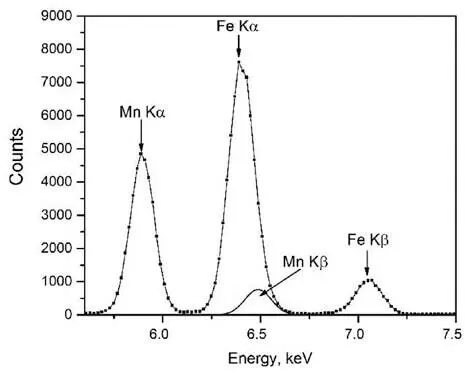
Figure 2: Mn and Fe peaks in a pXRF spectrum of urban varnish.
Interpretation of pXRF data
As discussed above, the raw counts data are total counts, or counts per second, in the peaks of the elements of interest. To be useful these data must be converted into physically meaningful quantities. There are several approaches to this.
Читать дальшеИнтервал:
Закладка:
Похожие книги на «Monument Future»
Представляем Вашему вниманию похожие книги на «Monument Future» списком для выбора. Мы отобрали схожую по названию и смыслу литературу в надежде предоставить читателям больше вариантов отыскать новые, интересные, ещё непрочитанные произведения.








Обсуждение, отзывы о книге «Monument Future» и просто собственные мнения читателей. Оставьте ваши комментарии, напишите, что Вы думаете о произведении, его смысле или главных героях. Укажите что конкретно понравилось, а что нет, и почему Вы так считаете.