Siegfried Siegesmund - Monument Future
Здесь есть возможность читать онлайн «Siegfried Siegesmund - Monument Future» — ознакомительный отрывок электронной книги совершенно бесплатно, а после прочтения отрывка купить полную версию. В некоторых случаях можно слушать аудио, скачать через торрент в формате fb2 и присутствует краткое содержание. Жанр: unrecognised, на немецком языке. Описание произведения, (предисловие) а так же отзывы посетителей доступны на портале библиотеки ЛибКат.
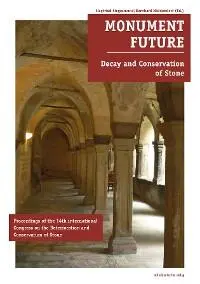
- Название:Monument Future
- Автор:
- Жанр:
- Год:неизвестен
- ISBN:нет данных
- Рейтинг книги:4 / 5. Голосов: 1
-
Избранное:Добавить в избранное
- Отзывы:
-
Ваша оценка:
Monument Future: краткое содержание, описание и аннотация
Предлагаем к чтению аннотацию, описание, краткое содержание или предисловие (зависит от того, что написал сам автор книги «Monument Future»). Если вы не нашли необходимую информацию о книге — напишите в комментариях, мы постараемся отыскать её.
Alle vier Jahre treffen sich auf einer internationalen Tagung Experten, die sich mit den entsprechenden Sachfragen beschäftigen. Der „14th International Congress on the Deterioration and Conservation of Stone“ findet im September 2020 in Göttingen statt. Er ist die wichtigste Veranstaltung zur Verbreitung des Wissens von Praktikern und Forschern, die im Bereich der Steinkonservierung zur Erhaltung des baulichen Kulturerbes arbeiten: Geowissenschaftler, Architekten, Bauspezialisten, Ingenieure, Restauratoren, Denkmalpfleger und Bauherren.
Der Tagungsband mit über 150 wissenschaftlichen Beiträgen repräsentiert und erfasst den neuesten Stand der Technik auf diesem Gebiet.
Themen sind:
– Charakterisierung von Schadensphänomenen von Steinen und verwandten Baumaterialien (Stuck, Putz, Mörtel usw.)
– Methoden zur Untersuchung des Steinverfalls in situ und zerstörungsfreie Prüfung
– Langzeitüberwachung von Steindenkmälern und Gebäuden
– Simulation und Modellierung des Zerfalls
– Technologien und Entwicklung verbesserter Bearbeitung und Verwendung von Stein in Neubauten
– Bewertung der Langzeitwirkung von Bearbeitungstechniken
– Auswirkungen des Klimawandels auf die Steinverwitterung des Kulturerbes
– Berichte zur Steinkonservierung: Fallstudien und Projekte
– Digitalisierung und Dokumentation von Steinkonservierung
–
The 14th International Congress on the Deterioration and Conservation of Stone, entitled MONUMENT FUTURE: DECAY AND CONSERVATION OF STONE is a quadrennial event that brings together a world-wide community of geoscientists, architects, building specialists, engineers, conservators, restorators, monument curators and building owners who are concerned about the conservation of cultural stone structures and objects. Since antiquity, the weathering and deterioration of historical buildings, masonry, monuments, sculptures etc. using natural stones has been a very well-known problem.
This conference is the main gathering for the dissemination of knowledge in the field of stone deterioration issues. It represents and captures the state-of-the-art in the field of stone conservation and cultural heritage conservation with regards to the following topics:
– Characterisation of damage phenomena of stone and related building materials (plaster, rendering, mortar etc.)
– Methods for the investigation of stone decay; in-situ and non-destructive testing
– Long-term monitoring of stone monuments and buildings
– Simulation and modelling of decay
– Technology and development of improved treatments and use of stone in new buildings
– Assessment of long-term effects of treatments
– Impact of climate change on stone decay of Cultural Heritage
– Reports about stone conservation: case studies and projects
– Digitalization and documentation in stone conservation
Monument Future — читать онлайн ознакомительный отрывок
Ниже представлен текст книги, разбитый по страницам. Система сохранения места последней прочитанной страницы, позволяет с удобством читать онлайн бесплатно книгу «Monument Future», без необходимости каждый раз заново искать на чём Вы остановились. Поставьте закладку, и сможете в любой момент перейти на страницу, на которой закончили чтение.
Интервал:
Закладка:
155 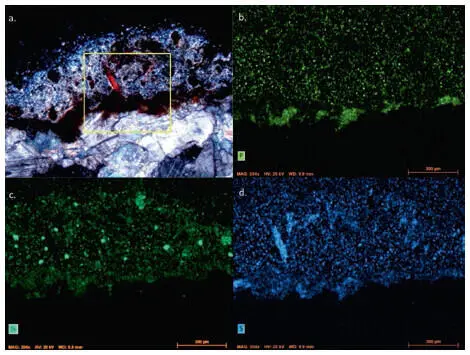
Figure 6:Photomicrograph of the thin section of column D: a) showing the old brown treatment layer on top of the marble substratum, covered by a thick gypsum layer, N+, long side = 0.96 mm; b) SEM-EDS mapping of the phosphorous distribution; c) same for Si; d) same for S.
The microscopic study (OM and SEM) of several unmounted samples and of four cross sections has allowed us to conclude that the columns were originally most probably painted. A white-yellowish layer made of lead-white was mixed with a small amount of calcium carbonate, orpiment, minium, vermilion and yellow ochre (in decreasing order of abundance) identified by Raman spectroscopy and SEM-EDX (Fig. 7, 8). It is approximately 0.15 mm thick, and may be considered as a sort of imprimitura (priming) applied directly over the marble substratum, very much likely the one often found in variously dated panel paintings (Gettens et al. 1967: 123). Over this layer, was a much thinner one (around 0.06 mm) composed of white-lead mixed with a proteinaceous medium, likely an animal glue, as in preparation for gold leaf. This original gilding is covered by dirt, carbonaceous matter likely from candle-burning, and by two later gildings; the first again applied on a thin lead-white layer mixed with a proteinaceous binder. The second is not preserved, however from the presence of a thick red layer of minium (0.2 mm) it can be assumed this was another preparation for gold leaf, as commonly used in the Venetian Renaissance. A natural oil-resin, most probably dammar impregnating all layers (Fig. 9), was applied in order to fix and consolidate the gildings: its discolouration into a brownish matter is probably responsible for the overall brown aspect currently assumed by the columns.

Figure 7:Photomicrographs of the polished cross section of sample A3 (column A), a) in reflected light mag; b) stratigraphic scheme; c) SEM in backscattered electrons; d) same as c), but detail of the strata. The strata represented in b) and d) are: 1) painted preparation layer, 2) preparation for the gold leaf, 3) the original gilding, 4) dirt layer, 5) preparation for the gold leaf, 6) the second gilding, 7) dirt laye, 8) red layer of minium.

Figure 8:Detail of sample A3, a) SEM in backscattered electrons.; b) EDS mapping of the distribution of Pb; c) same of Ca; d) same of Au.
Conclusion and future research
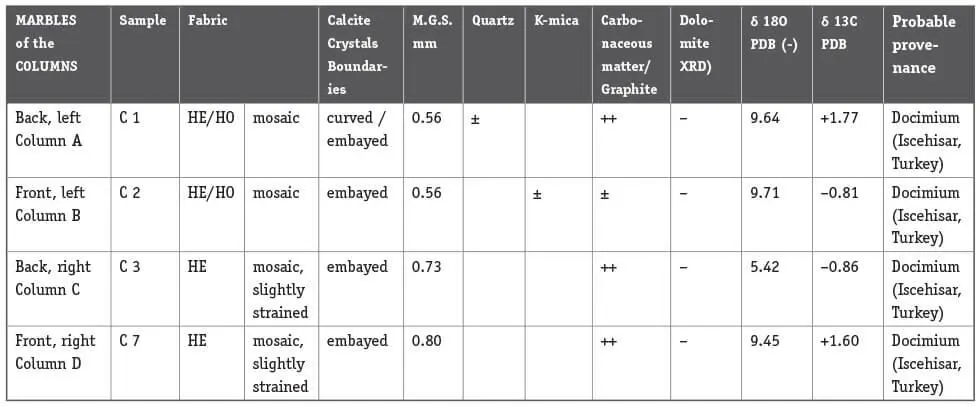
Considering the overall results of the petrographic and isotopic analysis of the four marbles, it is 156possible to conclude that they were carved out of the white Dokymaean marble. Two of them (A and D) originated from the same quarrying locus, while the marble of column C was extracted from a different quarry. The provenance of column B could not be positively identified but likely comes from an unknown ancient Dokymaean quarry. The ancient quarrying area of Docimium was one of the largest of Roman and Byzantine times, active from Late Hellenistic to at least the X c. (Pensabene 2011:131) adding weight to our hypothesis. This quarry has been massively re-exploited in modern times and is now the largest white marble supplying area in Turkey. It may well be that one or more ancient quarries have been completely destroyed by modern exploitation therefore escaping study and sampling by archaeologists and archaeometrists. The high quality of the Dokymaean marble, namely its uniform fine grain size, allowed the two sculptors to obtain the beautiful details of the small figures narrating the life of Christ and Mary. The different quarries of origin of the marbles support Weigel’s hypothesis of Byzantine re-use of the four columns, pillaged from an ancient Roman monument. Dokymaean marble was often used for prestigious statuary, portraits (Attanasio et al.2019:178), sarcophagi and architectural elements, and widely exported from its quarries especially in all the Microasiatic provinces (Monna and Pensabene 1977:29–71).
As for the gildings present on the columns, the first and most ancient one was made of two layers: a thicker yellow stratum obtained by mixing a small amount of orpiment, minium, cinnabar and yellow ochre to lead-white (Gettens et al. 1966), and a much thinner one of the same white pigment mixed with a proteinaceous medium. This type of preparation is quite unusual, similar only in colour to those found on the contemporaneous sculpted external arches over the main portal of the Basilica (Lazzarini 1979: 60) (Lazzarini 1995: 232–234). In both structures, the second gilding was obtained in the same way by applying a gold leaf on a minium ground, indicating similar re-gilding of internal and external sculptures of St. Mark’s. Analysis of the brown organic medium impregnating all the superficial layers of the columns revealed a composition of discoloured dammar, a resin much used for consolidating and protecting ancient gilding. This resin began to be used in the West as a varnish for paintings in the first half of the XIX century (Mills, White, 1994: 107), therefore we suggest this conservative treatment should be dated after that period.

Figure 9:FTIR spectrum of the brown patina of sample A1, showing all the peaks of dammar.
The present aspect of the four columns of the St. Mark’s ciborium is far from being satisfactory. The brown patina which almost uniformly covers both areas where gilding remains as well as the exposed marble surfaces, reduces both the impact and legibility of the figures narrating the lives of Christ and Mary and the beauty of the sculpture which leads us to suggest a thorough but delicate cleaning.
Acknowledgements
The authors are grateful to Arch. Prof. Mario Piana, protomagister of the St. Mark’s Basilica for authorizing the sampling, and to Dr. Alberto Conventi of LAMA for his collaboration in the SEM-EDS analyses.
References
Antonelli F., Lazzarini L. 2015, An isotopic reference database for white cristalline marbles used in antiquity, Rendiconti Lincei Scienze Fisiche e Naturali, Vol. 26, 4, 399–413.
Attanasio D., Bruno M., Prochaska W. 2019, The marbles of Roman portraits, Jahrbuch des Deutschen Archaeologischen Instituts, Band 134, 167–277.
157Gettens R. J., Kuhn H., Chase W. T. 1967, 3.Lead white, Studies in Conservation vol. 12, N°4, 123–139.
Gettens R. J., Stout G. L., Painting material. A short Encyclopedia, New York, 1966.
Lazzarini L. 1979, I rilievi degli arconi dei portali della Basilica di San Marco a Venezia: ricerche tecnico-scientifiche, in “Die Skulpturen von San Marco in Venedig. Die figürlichen Skulpturen der Aussenfassaden bis zum 14. Jahrhundert” (her.W.Wolters), Berlin, 58–65.
Lazzarini L. 1995, Nuovi studi tecnico-scientifici sui rilievi degli arconi della Basilica Marciana, in AA. VV., “Le sculture esterne di San Marco”, Milano, 228–234.
Читать дальшеИнтервал:
Закладка:
Похожие книги на «Monument Future»
Представляем Вашему вниманию похожие книги на «Monument Future» списком для выбора. Мы отобрали схожую по названию и смыслу литературу в надежде предоставить читателям больше вариантов отыскать новые, интересные, ещё непрочитанные произведения.








Обсуждение, отзывы о книге «Monument Future» и просто собственные мнения читателей. Оставьте ваши комментарии, напишите, что Вы думаете о произведении, его смысле или главных героях. Укажите что конкретно понравилось, а что нет, и почему Вы так считаете.