Siegfried Siegesmund - Monument Future
Здесь есть возможность читать онлайн «Siegfried Siegesmund - Monument Future» — ознакомительный отрывок электронной книги совершенно бесплатно, а после прочтения отрывка купить полную версию. В некоторых случаях можно слушать аудио, скачать через торрент в формате fb2 и присутствует краткое содержание. Жанр: unrecognised, на немецком языке. Описание произведения, (предисловие) а так же отзывы посетителей доступны на портале библиотеки ЛибКат.
- Название:Monument Future
- Автор:
- Жанр:
- Год:неизвестен
- ISBN:нет данных
- Рейтинг книги:4 / 5. Голосов: 1
-
Избранное:Добавить в избранное
- Отзывы:
-
Ваша оценка:
Monument Future: краткое содержание, описание и аннотация
Предлагаем к чтению аннотацию, описание, краткое содержание или предисловие (зависит от того, что написал сам автор книги «Monument Future»). Если вы не нашли необходимую информацию о книге — напишите в комментариях, мы постараемся отыскать её.
Alle vier Jahre treffen sich auf einer internationalen Tagung Experten, die sich mit den entsprechenden Sachfragen beschäftigen. Der „14th International Congress on the Deterioration and Conservation of Stone“ findet im September 2020 in Göttingen statt. Er ist die wichtigste Veranstaltung zur Verbreitung des Wissens von Praktikern und Forschern, die im Bereich der Steinkonservierung zur Erhaltung des baulichen Kulturerbes arbeiten: Geowissenschaftler, Architekten, Bauspezialisten, Ingenieure, Restauratoren, Denkmalpfleger und Bauherren.
Der Tagungsband mit über 150 wissenschaftlichen Beiträgen repräsentiert und erfasst den neuesten Stand der Technik auf diesem Gebiet.
Themen sind:
– Charakterisierung von Schadensphänomenen von Steinen und verwandten Baumaterialien (Stuck, Putz, Mörtel usw.)
– Methoden zur Untersuchung des Steinverfalls in situ und zerstörungsfreie Prüfung
– Langzeitüberwachung von Steindenkmälern und Gebäuden
– Simulation und Modellierung des Zerfalls
– Technologien und Entwicklung verbesserter Bearbeitung und Verwendung von Stein in Neubauten
– Bewertung der Langzeitwirkung von Bearbeitungstechniken
– Auswirkungen des Klimawandels auf die Steinverwitterung des Kulturerbes
– Berichte zur Steinkonservierung: Fallstudien und Projekte
– Digitalisierung und Dokumentation von Steinkonservierung
–
The 14th International Congress on the Deterioration and Conservation of Stone, entitled MONUMENT FUTURE: DECAY AND CONSERVATION OF STONE is a quadrennial event that brings together a world-wide community of geoscientists, architects, building specialists, engineers, conservators, restorators, monument curators and building owners who are concerned about the conservation of cultural stone structures and objects. Since antiquity, the weathering and deterioration of historical buildings, masonry, monuments, sculptures etc. using natural stones has been a very well-known problem.
This conference is the main gathering for the dissemination of knowledge in the field of stone deterioration issues. It represents and captures the state-of-the-art in the field of stone conservation and cultural heritage conservation with regards to the following topics:
– Characterisation of damage phenomena of stone and related building materials (plaster, rendering, mortar etc.)
– Methods for the investigation of stone decay; in-situ and non-destructive testing
– Long-term monitoring of stone monuments and buildings
– Simulation and modelling of decay
– Technology and development of improved treatments and use of stone in new buildings
– Assessment of long-term effects of treatments
– Impact of climate change on stone decay of Cultural Heritage
– Reports about stone conservation: case studies and projects
– Digitalization and documentation in stone conservation
Monument Future — читать онлайн ознакомительный отрывок
Ниже представлен текст книги, разбитый по страницам. Система сохранения места последней прочитанной страницы, позволяет с удобством читать онлайн бесплатно книгу «Monument Future», без необходимости каждый раз заново искать на чём Вы остановились. Поставьте закладку, и сможете в любой момент перейти на страницу, на которой закончили чтение.
Интервал:
Закладка:
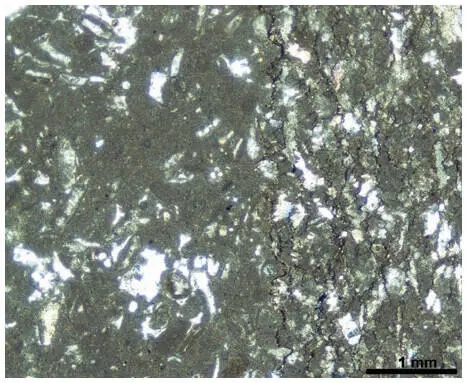
Figure 2:Microstylolites (right in the photo) and non-disturbed matrix (left in the photo) in the sample VAV (crossed polars).
147Besides a petrographic characterization, the hydric expansion caused by moisture exposure was evaluated as well as the bowing potential and thermal expansion measurements were performed.
Material
The detailed petrographic characterization of the Valverde sample highlights some interesting features; the limestone shows a partially recrystallized groundmass, consisting of around 50 % micritic and 20 % of dismicritic components and peloidal microsparit.
Microscopically it is possible to recognize that there are zones (patches) composed of micritic matrix and an other one composed of sparitic cement, giving the rock an inhomogeneous effect similar to bioturbation. All components are smaller than 2 mm composed of bioclasts, pelloids, pseudo-pelloids, benthic foraminifers, echinoderms and several spicules of crinoids. The fabric of the sample varies locally from mud- to grain- supported.
An interesting aspect of this sample is the presence of disturbed areas where parallel microstylolites appear, affecting the groundmass. The microstylolites consist of an opaque material (black) probably accumulations (laminaes) of organic material and clays.
According to Flügel (2004) this limestone belongs to the RMT 14, Bioclastic packstone and wackestone with skeletal grains, various amounts of intraclasts and some ooids (shoal-near). These sediments are common for the open marine, inner ramp zone.
Methods
The hydric expansion was determined for all limestones on cylindrical samples (Ø 15 mm × 100 mm). The length change of those cylinders was measured under water-saturated conditions. The samples were completely immersed in demineralized water for 24 hours, meanwhile the expansion of the samples was measured with a displacement transducer. The resolution of the transducer is 0.1 µm and the accuracy is about 0.5 µm.

Figure 3:Evolution of the moisture expansion during a 24 hours test.
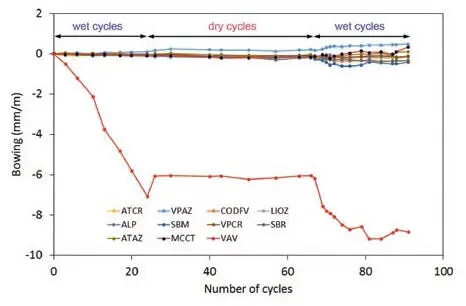
Figure 4:Bowing behavior of the selected limestones under wet and dry cycles.
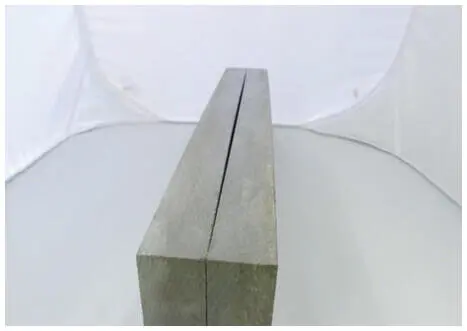
Figure 5:Bowing effect after heating cycles.
To determine the bowing potential and its directional dependence, slabs of 40 × 10 × 3 cm were exposed to heating cycles (20–80–20 °C per day) simulating in an accelerated procedure the conditions at the building. Additionally, the specimens were 148exposed to thermohydric conditions, as the slabs were moistened on one side and cyclically heated on the reverse slab surface. The slabs were heated for 6 hours before they cool down to ambient temperature and the water was refilled 2 hours before the next heating cycle started. The bowing was measured by means of a measuring bridge with an accuracy of l µm/35 cm. A total of 91 cycles were performed (for details see Koch and Siegesmund 2002).
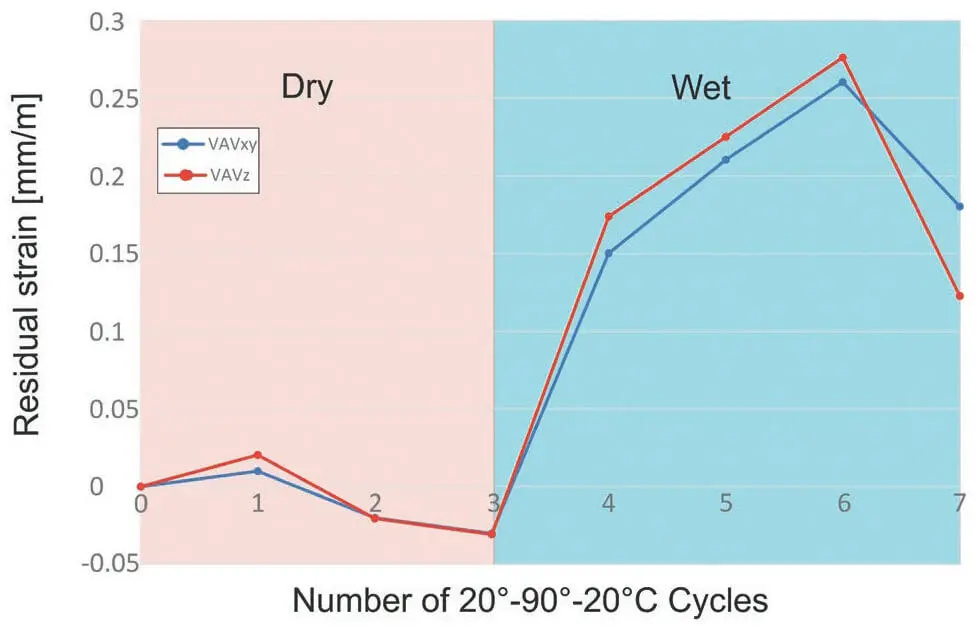
Figure 6:Progressive increase of residual strain for 20–90–20 °C cycles of the VAV samples. Investigated as a function of the number of heating cycles under dry (3 cycles, red background) and wet (4 cycles, blue background) conditions.
Thermal expansion measurements took place in the temperature range of 20–90 °C using a pushrod dilatometer (for details see Koch and Siegesmund 2004). The specimens had a length of 50 mm and a diameter of 15 mm. The residual strain (RS) was determined within seven heating–cooling cycles: 3 dry cycles 20–90–20 °C and 4 wet cycles 20–90–20 °C, in the Z and XY directions. RS is determined by the ratio between the sample length change after the heating–cooling cycles and the initial length (Shushakova et al. 2013).
Results and Discussion
The values of hydric dilatation are lower than 0.09 mm/m, with excepetion of the Valverde (VAV) samples which reach 0.22–0.26 mm/m.
Usually limestones show low hydric dilatation values, because these rocks have low clay content (Siegesmund and Dürrast, 2014). The dilatation of the VAV sample could be explained by some possible clay content within the dark material observed in microstylolites. Further investigations must be performed to clarify this hypothesis.
The bowing tests show the absence of permanent changes in almost all of the selected limestone. In fact, only the Valverde (VAV) sample is affected by this experiment. In the first 24 wet cycles the bending increases continuosly and reaches the value of 7 mm/m. Followed by dry conditions, the sample shows some recovery down to 6 mm/m within the first cycles. This value remains stable during the next 41 dry cycles. When the wet cycles start again a new increase of the bowing is evident with a maximum expansion around 9 mm/m.
149High values of bowing are frequently observed in marbles (e. g. Siegesmund et al. 2008) but unknown in limestones. Furthermore, as the mineralogy of all selected limestones is similar the bowing of the VAV sample turns strange. The only different factor are the microstylolites, which therefore seem to be the reason for the bowing potential. Since no bending occurs when dry cycles are performed, the water is an important factor. The interaction of heat and water seems to open and offset the microstylitic cracks, avoiding the recontraction and resulting in an irreversible deformation.
The thermal expansion measurements for the VAV sample show some residual strain about 0.25 mm/m after 4 wet cycles, while the performed dry cycles do not exhibit permanent deformation. Additionally, the sample has been measured in two directions, Z and XY, perpendicular and parallel to the microstylolites considering any effect caused by directional dependence. As depicted in Fig. 4, the expansion of both directions is comparable. Consequently no directional dependence of the expansion can be observed.
Residual strain is only observed under wet conditions as well as the bowing behavior is only evident under wet conditions. Despite the values of residual strain are lower than the range of values found in marbles exhibiting bowing (Mennigen et al. 2018), they confirm the bowing behavior of this sample. The areas with parallel microstylolites affecting the groundmass are aleatory distributed in the limestone and each one possibly contributes the total bending of the sample.
These preliminary results show the influence of the water in the bowing behavior under thermal cycles. However the nature of the microstylolites needs to be completely analysed, especially if clays are present. Therefore, more studies are necessary to understand completely the anomalous bowing behavior of the Valverde limestone.
Conclusions
Интервал:
Закладка:
Похожие книги на «Monument Future»
Представляем Вашему вниманию похожие книги на «Monument Future» списком для выбора. Мы отобрали схожую по названию и смыслу литературу в надежде предоставить читателям больше вариантов отыскать новые, интересные, ещё непрочитанные произведения.








Обсуждение, отзывы о книге «Monument Future» и просто собственные мнения читателей. Оставьте ваши комментарии, напишите, что Вы думаете о произведении, его смысле или главных героях. Укажите что конкретно понравилось, а что нет, и почему Вы так считаете.