Siegfried Siegesmund - Monument Future
Здесь есть возможность читать онлайн «Siegfried Siegesmund - Monument Future» — ознакомительный отрывок электронной книги совершенно бесплатно, а после прочтения отрывка купить полную версию. В некоторых случаях можно слушать аудио, скачать через торрент в формате fb2 и присутствует краткое содержание. Жанр: unrecognised, на немецком языке. Описание произведения, (предисловие) а так же отзывы посетителей доступны на портале библиотеки ЛибКат.
- Название:Monument Future
- Автор:
- Жанр:
- Год:неизвестен
- ISBN:нет данных
- Рейтинг книги:4 / 5. Голосов: 1
-
Избранное:Добавить в избранное
- Отзывы:
-
Ваша оценка:
Monument Future: краткое содержание, описание и аннотация
Предлагаем к чтению аннотацию, описание, краткое содержание или предисловие (зависит от того, что написал сам автор книги «Monument Future»). Если вы не нашли необходимую информацию о книге — напишите в комментариях, мы постараемся отыскать её.
Alle vier Jahre treffen sich auf einer internationalen Tagung Experten, die sich mit den entsprechenden Sachfragen beschäftigen. Der „14th International Congress on the Deterioration and Conservation of Stone“ findet im September 2020 in Göttingen statt. Er ist die wichtigste Veranstaltung zur Verbreitung des Wissens von Praktikern und Forschern, die im Bereich der Steinkonservierung zur Erhaltung des baulichen Kulturerbes arbeiten: Geowissenschaftler, Architekten, Bauspezialisten, Ingenieure, Restauratoren, Denkmalpfleger und Bauherren.
Der Tagungsband mit über 150 wissenschaftlichen Beiträgen repräsentiert und erfasst den neuesten Stand der Technik auf diesem Gebiet.
Themen sind:
– Charakterisierung von Schadensphänomenen von Steinen und verwandten Baumaterialien (Stuck, Putz, Mörtel usw.)
– Methoden zur Untersuchung des Steinverfalls in situ und zerstörungsfreie Prüfung
– Langzeitüberwachung von Steindenkmälern und Gebäuden
– Simulation und Modellierung des Zerfalls
– Technologien und Entwicklung verbesserter Bearbeitung und Verwendung von Stein in Neubauten
– Bewertung der Langzeitwirkung von Bearbeitungstechniken
– Auswirkungen des Klimawandels auf die Steinverwitterung des Kulturerbes
– Berichte zur Steinkonservierung: Fallstudien und Projekte
– Digitalisierung und Dokumentation von Steinkonservierung
–
The 14th International Congress on the Deterioration and Conservation of Stone, entitled MONUMENT FUTURE: DECAY AND CONSERVATION OF STONE is a quadrennial event that brings together a world-wide community of geoscientists, architects, building specialists, engineers, conservators, restorators, monument curators and building owners who are concerned about the conservation of cultural stone structures and objects. Since antiquity, the weathering and deterioration of historical buildings, masonry, monuments, sculptures etc. using natural stones has been a very well-known problem.
This conference is the main gathering for the dissemination of knowledge in the field of stone deterioration issues. It represents and captures the state-of-the-art in the field of stone conservation and cultural heritage conservation with regards to the following topics:
– Characterisation of damage phenomena of stone and related building materials (plaster, rendering, mortar etc.)
– Methods for the investigation of stone decay; in-situ and non-destructive testing
– Long-term monitoring of stone monuments and buildings
– Simulation and modelling of decay
– Technology and development of improved treatments and use of stone in new buildings
– Assessment of long-term effects of treatments
– Impact of climate change on stone decay of Cultural Heritage
– Reports about stone conservation: case studies and projects
– Digitalization and documentation in stone conservation
Monument Future — читать онлайн ознакомительный отрывок
Ниже представлен текст книги, разбитый по страницам. Система сохранения места последней прочитанной страницы, позволяет с удобством читать онлайн бесплатно книгу «Monument Future», без необходимости каждый раз заново искать на чём Вы остановились. Поставьте закладку, и сможете в любой момент перейти на страницу, на которой закончили чтение.
Интервал:
Закладка:
The architectural historian Toros Toramanian (1864–1934) made the assumption that the Avan Church once had five domes (published in Maroutyan 1976). A single larger dome in the middle and four smaller domes over each corner of the church, over the round corner chambers. Thus, Avan would be the first such example of a church with five domes. The church has a four-pass floor plan with an octagonal central bay over which there was probably originally a dome (Fig. 1b).
A low, arched door leads from the west wall into the church and is surrounded by an ornate covering with three-quarter columns, which are decorated with capitals and bezels. A vischap stone from pagan times was used as a lintel above the main portal. Another door on the north wall, which was probably built at a later date, after the church was built, leads to the Catholic Palace. The church is also of immense architectural importance as the prototype of the much better known masterpiece, the St Hripsime in Ejmiatzin, Armenia.
Restoration history
In 1940–1941, 1956–1966 and 1968 restoration work was carried out on the church. Of note here is the oldest restoration from 1940–41, which was carried out according to the then most modern and still current principles of restoration theory (Brandi 2006). Compatible dry slaked lime mortars were used, which also has to be emphasized in terms of materials.
Damage forms and deterioration
The damages observed at Avan Cathedral are dominated by cracks and crackles of single ashlar, back-weathering, scaling and static problems of the top of the single building walls and pillars (Fig. 2c). At the Zvartnots ruins, the damage is primarily caused by widespread salt contamination associated with back-weathering and rounding (Fig. 2d, 4).
Historical photographs from the beginning of the 20th century show, that at some parts of the original walls even the historical whitish plaster was 139preserved (Fig. 2e). Today all the plaster surfaces are destroyed. Many of the stones are damaged by typical weathering forms associated with the presence and crystallization of salt (Fig. 2d, 4).
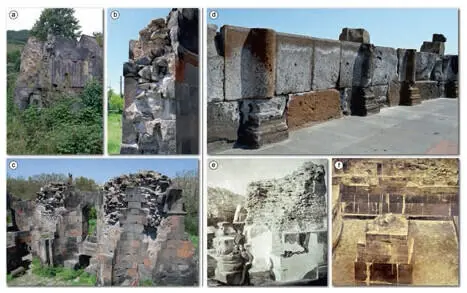
Figure 2:a) The remains of medieval architectural structures in Sanahin, Armenia shows the huge amounts of mortar within the building structure. b) Cross section of a wall at the Avan Cathedral. c) The critical static situation at the top of the walls at Avan Cathdral. Restoration mortar from the 1941 campaign is exposed in the lower parts of inner masonry. d) Widespread salt contamination and weathering at the Zvartnots Cathedral. e) Huge remnants of the inner masonry and preserved plaster on some walls at the Zwartnots Cathedral shown in the museum of the site (early 20 thcentury). f) Cement mortar injections done by restoration in the 1960 s also documented in the museum.
Methods of investigations
Onsite investigations were done by comparable observations, damage mapping, electrical capacity and conductivity measurements on single building stones.
The electrical conductivity and capacity is basically dependent on the material and is also influenced by the moisture content of the material and the presence of ionic compounds. The used device (surveymaster/protimeter) measures moisture in buildings and other related structures both on (conductivity) and below (capacity) the surface.
Sampling of the drilling powder was also done. Field studies were done on a southwestern wall of the Zwartnotz ruins and the westen front facade of the Avan Cathedral.
This study concentrates on the historical mortars of the Zvartnots Cathedral (ZM), the Avan Cathedral (AM) and the restoration mortar (RM) from 1941 used for Avan (Fig. 4). From these three mortars an analysis of their aggregate/binder ratio and the grading curve of its aggregate were done in a mobile laboratory. Petrographical and fabric analyses of the building materials were performed on thin sections under a polarization microscope and cathodoluminescence (CL) microscopy. Hydrostatic weighing on the samples was carried out to acquire the particle and bulk density as well as the porosity (DIN 52102). Mercury intrusion porosimetry was used to acquire the pore radii distribution (Fig. 3d, h, l).
Results
Methods of construction
Double shell masonry structures are characteristic of many ruins of the rich cultural heritage in Armenia. The building stones that form the exterior and interior masonry are held together between the two masonry shells by lime mortar and quarry stone masonry. The percentage of both structural elements in rising walls is about 50 % (Fig. 2a, b and e).
The inner shell of the masonry has a very solid and durable mortar. This mortar seems to literally glue the two wall shells together and seems to be the reason why many church buildings, as ruins, have still been partly preserved (Fig. 2a).
The mortars
The mortars of both historical buildings are lime mortars with volcanic aggregates with a high amount of glass-rich, amorphous material. These are characterized by a predominantly dense and binder-rich, light and dense matrix surrounded by aggregates of different sizes and color (Fig. 3a–3h). In contrast, the restoration mortar of the Avan Cathedral shows single quartz grains, feldspar crystals and sub-rounded inclusions clearly identified as lime accumulations (Fig. 3i). The historical Avan mortar (AM) mostly shows reddish, large pumice-rich grains (Fig. 3e). They reach a size up to 5 mm. The Zvartnots mortar shows more basaltic and andesitic fragments of sand particle size (0.063–2 mm). The matrix of both historical 140mortars is extremely dense and shows a firm connection to the grains (Fig. 3b, c and f and g). The Zvartnots mortar shows larger accumulations (–1 mm) of crystallized lime, which show multicolored effects in polarized light (Fig. 3b). These accumulations show a distinct red color under cathodoluminescence (CL) and could be a dolomitic lime. The matrix of the historical mortar shows a slight dark reddish structure, that can be identified as calcite-silica compounds (3c). A similar slight dark red color of the matrix could be observed for the mortar of the Avan Cathedral, while only light reddish lime accumulations are visible in CL-light (3g). The lime inclusions within the restoration mortar (RM) shows a similar intense light reddish color but no crystallization (Fig. 3k). The binding cement of the mortar is made from fine crystals, showing a multicolored birefringence in polarized light (Fig. 3j). These crystals are identified as calcium hydroxide or portlandite, which only forms single grain contacts. The blue glowing areas are probably claystone fragments (Fig. 3k) or alteration products (Fig. 3c).
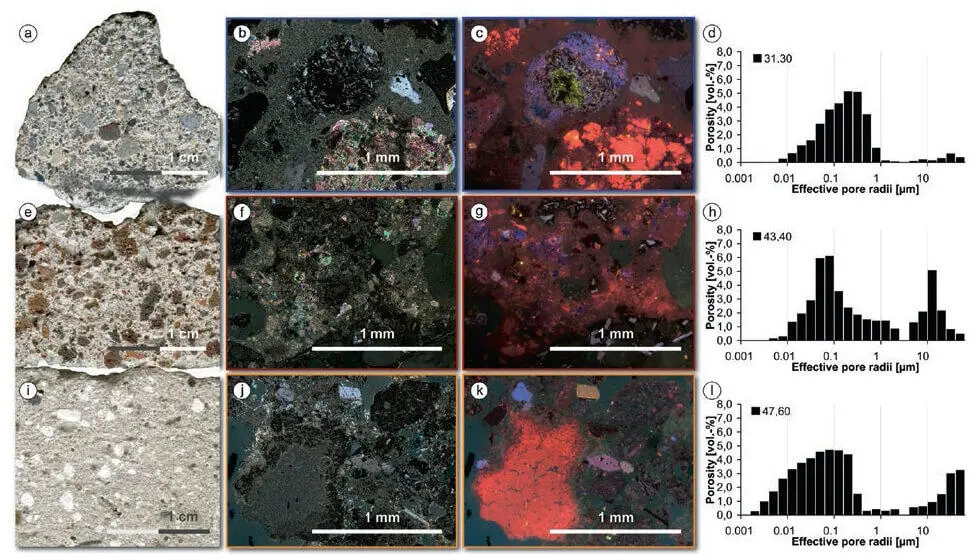
Figure 3:The three investigated mortars. a–d) The mortar of the Zvartnots Cathedral (ZM), a) hand specimen, b) thin section under polarized light and c) under cathodoluminescence. d) The pore size distribution. e–h) The mortar of the Avan Church (AM) and i–l) the restoration mortar of Avan (RM) in the same order.
The pore size distribution of the three mortars is different. In the Zvartnots mortar smaller capillary active pores dominate the pore structure attaining 73 %. The microporosity (0.001–0.1 µm) reaches 20 % for the ZM and 28 % for the AM. Both mortars are characterized by a bimodal pore size structure, while the finer pores dominate (Fig. 3d, 3 h). The restoration mortar of the Avan Cathedral attains an amount of micropores of 64 %. A bimodal pore size structure is also formed in this case, dominated by small pores as well (Fig. 3l).
Читать дальшеИнтервал:
Закладка:
Похожие книги на «Monument Future»
Представляем Вашему вниманию похожие книги на «Monument Future» списком для выбора. Мы отобрали схожую по названию и смыслу литературу в надежде предоставить читателям больше вариантов отыскать новые, интересные, ещё непрочитанные произведения.







Обсуждение, отзывы о книге «Monument Future» и просто собственные мнения читателей. Оставьте ваши комментарии, напишите, что Вы думаете о произведении, его смысле или главных героях. Укажите что конкретно понравилось, а что нет, и почему Вы так считаете.