Siegfried Siegesmund - Monument Future
Здесь есть возможность читать онлайн «Siegfried Siegesmund - Monument Future» — ознакомительный отрывок электронной книги совершенно бесплатно, а после прочтения отрывка купить полную версию. В некоторых случаях можно слушать аудио, скачать через торрент в формате fb2 и присутствует краткое содержание. Жанр: unrecognised, на немецком языке. Описание произведения, (предисловие) а так же отзывы посетителей доступны на портале библиотеки ЛибКат.
- Название:Monument Future
- Автор:
- Жанр:
- Год:неизвестен
- ISBN:нет данных
- Рейтинг книги:4 / 5. Голосов: 1
-
Избранное:Добавить в избранное
- Отзывы:
-
Ваша оценка:
Monument Future: краткое содержание, описание и аннотация
Предлагаем к чтению аннотацию, описание, краткое содержание или предисловие (зависит от того, что написал сам автор книги «Monument Future»). Если вы не нашли необходимую информацию о книге — напишите в комментариях, мы постараемся отыскать её.
Alle vier Jahre treffen sich auf einer internationalen Tagung Experten, die sich mit den entsprechenden Sachfragen beschäftigen. Der „14th International Congress on the Deterioration and Conservation of Stone“ findet im September 2020 in Göttingen statt. Er ist die wichtigste Veranstaltung zur Verbreitung des Wissens von Praktikern und Forschern, die im Bereich der Steinkonservierung zur Erhaltung des baulichen Kulturerbes arbeiten: Geowissenschaftler, Architekten, Bauspezialisten, Ingenieure, Restauratoren, Denkmalpfleger und Bauherren.
Der Tagungsband mit über 150 wissenschaftlichen Beiträgen repräsentiert und erfasst den neuesten Stand der Technik auf diesem Gebiet.
Themen sind:
– Charakterisierung von Schadensphänomenen von Steinen und verwandten Baumaterialien (Stuck, Putz, Mörtel usw.)
– Methoden zur Untersuchung des Steinverfalls in situ und zerstörungsfreie Prüfung
– Langzeitüberwachung von Steindenkmälern und Gebäuden
– Simulation und Modellierung des Zerfalls
– Technologien und Entwicklung verbesserter Bearbeitung und Verwendung von Stein in Neubauten
– Bewertung der Langzeitwirkung von Bearbeitungstechniken
– Auswirkungen des Klimawandels auf die Steinverwitterung des Kulturerbes
– Berichte zur Steinkonservierung: Fallstudien und Projekte
– Digitalisierung und Dokumentation von Steinkonservierung
–
The 14th International Congress on the Deterioration and Conservation of Stone, entitled MONUMENT FUTURE: DECAY AND CONSERVATION OF STONE is a quadrennial event that brings together a world-wide community of geoscientists, architects, building specialists, engineers, conservators, restorators, monument curators and building owners who are concerned about the conservation of cultural stone structures and objects. Since antiquity, the weathering and deterioration of historical buildings, masonry, monuments, sculptures etc. using natural stones has been a very well-known problem.
This conference is the main gathering for the dissemination of knowledge in the field of stone deterioration issues. It represents and captures the state-of-the-art in the field of stone conservation and cultural heritage conservation with regards to the following topics:
– Characterisation of damage phenomena of stone and related building materials (plaster, rendering, mortar etc.)
– Methods for the investigation of stone decay; in-situ and non-destructive testing
– Long-term monitoring of stone monuments and buildings
– Simulation and modelling of decay
– Technology and development of improved treatments and use of stone in new buildings
– Assessment of long-term effects of treatments
– Impact of climate change on stone decay of Cultural Heritage
– Reports about stone conservation: case studies and projects
– Digitalization and documentation in stone conservation
Monument Future — читать онлайн ознакомительный отрывок
Ниже представлен текст книги, разбитый по страницам. Система сохранения места последней прочитанной страницы, позволяет с удобством читать онлайн бесплатно книгу «Monument Future», без необходимости каждый раз заново искать на чём Вы остановились. Поставьте закладку, и сможете в любой момент перейти на страницу, на которой закончили чтение.
Интервал:
Закладка:
Conclusions
The tuffs are broadly used in the monuments of Europe, Asia and North-America. The physical properties of the studied mostly acid tuffs are very different. Despite the high porosity (from 17 to nearly 37 vol%), tuffs can have relatively high tensile strength in dry conditions. This is significantly reduced with water saturation. The loss in strength can be one-fourth of the original one, but for most of the studied tuffs, it is half or two-thirds of the initial dry value. Not only water saturation but also freeze-thaw cycles and salt crystallization lead to a loss in strength or even an ultimate disintegration. There are tuff lithologies that can survive more than 100 salt crystallization cycles or 90 freeze-thaw cycles, while others disintegrate after few cycles. These differences in durability are attributed not only to porosity but also to pore-size distribution and micro-fabric, and are influenced by formation processes such as welding. Despite these findings and variations of durability, the usage of tuffs is still common, but at several sites the tuff elements show signs of deterioration.
Acknowledgements
ÁT acknowledges the financial support of National Research, Development and Innovation Fund of Hungary (K 116532). CP was supported by the German Federal Environmental Foundation (AZ20017/481).
References
Germinario L., Török Á. (2019). Variability of technical properties and durability in volcanic tuffs from the same quarry region – examples from Northern Hungary. Engineering Geology, 262, 105319.
López-Doncel, R. A., Wedekind, W., Cardona-Velázquez, N., Gon-Zález-Sámano, P. S., Dohrmann, R., Siegesmund, S. Pötzl, Chr. (2016): Geological studies on volcanic tuffs used as natural building stones in the historical center of San Luis Potosí, Mexico. Proceedings of the 13th International Congress on Deterioration and Conservation of Stone, vol. I, 107–115 pp., Glasgow. ISBN: 978-1-903978-59-7
Pötzl, C., Dohrmann, R. and Siegesmund, S. (2018a). Clay swelling mechanism in tuff stones: an example of the Hilbersdorf Tuff from Chemnitz, Germany. Environmental Earth Sciences, 77 (5), p. 188.
Pötzl, C., Siegesmund, S., Dohrmann, R., Koning, J. M. and Wedekind, W. (2018b) Deterioration of volcanic tuff rocks from Armenia. Constraints on salt crystallization and hydric expansion. Environmental Earth Sciences, 77 (19), p. 660.
Stück H., Forgó L. Z., Rüdrich J., Siegesmund S., Török Á. (2008). The behaviour of consolidated volcanic tuffs: weathering mechanisms under simulated laboratory conditions. Environmental Geology, 56, 699–713.
Török Á. (2007). Geology for Engineers. (in Hungarian with English summary) Müegyetemi Kiadó, Budapest, Megyetemi Kiadó, Budapest, 384 p.
Wedekind, W., López-Doncel, R., Dohrmann, R., Kocher, M. and Siegesmund, S. (2013). Weathering of volcanic tuff rocks caused by moisture expansion. Environmental Earth Sciences, 69 (4), 1203–1224.
137
THE CATHEDRAL-RUINS OF ZVARTNOTS AND AVAN (ARMENIA) – A COMPARATIVE STUDY ON DECAY AND RESTORATION
Wanja Wedekind 1 , Emma Harutyunyan 2 , Siegfried Siegesmund 1
IN: SIEGESMUND, S. & MIDDENDORF, B. (EDS.): MONUMENT FUTURE: DECAY AND CONSERVATION OF STONE.
– PROCEEDINGS OF THE 14TH INTERNATIONAL CONGRESS ON THE DETERIORATION AND CONSERVATION OF STONE –
VOLUME I AND VOLUME II. MITTELDEUTSCHER VERLAG 2020.
1Geoscience Centre of the University of Göttingen, Goldschmidtstr. 3, 37077 Göttingen, Germany
2National University of Architecture and Construction of Armenia, Teryan 105, 0009 Yerevan, Armenia
Abstract
The Zvartnots Cathedral was built from basalts and tuffs in the 7th century. Since the year 2000, it has been listed on the UNESCO World Heritage list. The Avan Cathedral is even older and was built in the 6th century, mainly from tuff. Both monuments are now ruins and have been restored several times with different materials. This applies primarily to the restoration mortar used.
The tuff material used for both cathedral ruins is comparable.While damage to Avan Cathedral is dominated by cracks and static problems, the Zvartnots ruin is primarily damaged by widespread salt contamination.
In this study, the restoration history of both cathedral ruins were worked out and the petro-physical properties of the building stones were investigated. The historical and modern mortars used in both structures were analysed and examined in the laboratory. Onsite object investigations were carried out, which includes damage mapping, surface hardness, electrical conductivity and the sampling of salts. The investigation clarify the high quality and weathering resistance of the historical mortars.
Introduction
The Zvartnots and Avan Cathedrals are two outstanding examples of the high point of Armenian medieval architecture (Fig. 1a). Today both buildings are only preserved as ruins.
Zvartnots Cathedral
The ruins of Zvartnots Cathedral are located near Echmiadzin, about 17 km west of Yerevan. The complex consists of the ruins of a round cathedral, which was built in the mid 7th century and dedicated to Saint Gregory. Beside the cathedral there are also the ruins of the palace of the Catholic Nerses III, who officiated from 641 to 662.
The church of St. Gregory in Zvartnotz was destroyed in the 10th century and is considered to be the oldest and largest tetrakonchos in the Caucasus Region. The structure has been imitated several times with similar forms. The four conches of the central building were surrounded by a circular corridor, the diameter of which was 37.7 meters, with a presumed height of the triple-tiered cylindrical structure of around 45 meters (Fig. 1a).
The Gregory Church is mentioned in several medieval sources and is one of the best-known architectural symbols of the Armenian Apostolic Church. The Armenian Apostolic Church is the oldest “self-sufficient” state church in the world.
138Archaelogical investigations and restoration
After the first excavation work in 1901, a systematic archaeological investigation began in 1904 and was lead by Toros Toramanian (1864–1934). He presented a three-stage reconstruction model, that initially raised doubts, but was accepted by most experts as probably the right one in 1906. This model is considered a pilot project of reconstructive restoration work in Armenia (Fig. 1a).
From 1958 to 1967 the remains of the wall were being secured. Further restoration measures were carried out in the 1980 s, with large areas of cement-containing mortar and suspensions being used in both cases (Fig. 2f). The most recent restorations were carried out under the direction of Grigor Nalbandyan using cementless materials.
Avan Cathedral
The Catholic Cathedral of the Holy Mother of God of Avan is located in the Avan Yerevan district on the outskirts of the capital of Armenia. The Avan Cathedral is the oldest surviving church within the city limits of Yerevan.
The church was built in the late 6th century, between 591 and 602. Construction began shortly after the Byzantine-Sasan War ended (572–591), which led to the expansion of direct Byzantine rule over all western regions of Armenia.
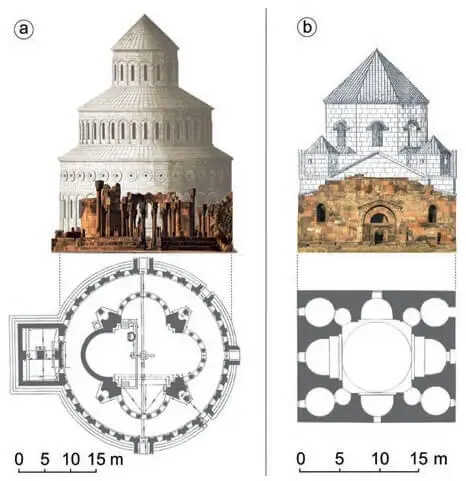
Figure 1:a) The cathedral ruin of Zvartnots and the reconstruction model by Toramanian with the floor plan of the buildung. b) The cathedral ruin of Avan, a hypothetical reconstruction and the floor plan of the church.
Читать дальшеИнтервал:
Закладка:
Похожие книги на «Monument Future»
Представляем Вашему вниманию похожие книги на «Monument Future» списком для выбора. Мы отобрали схожую по названию и смыслу литературу в надежде предоставить читателям больше вариантов отыскать новые, интересные, ещё непрочитанные произведения.







Обсуждение, отзывы о книге «Monument Future» и просто собственные мнения читателей. Оставьте ваши комментарии, напишите, что Вы думаете о произведении, его смысле или главных героях. Укажите что конкретно понравилось, а что нет, и почему Вы так считаете.