Siegfried Siegesmund - Monument Future
Здесь есть возможность читать онлайн «Siegfried Siegesmund - Monument Future» — ознакомительный отрывок электронной книги совершенно бесплатно, а после прочтения отрывка купить полную версию. В некоторых случаях можно слушать аудио, скачать через торрент в формате fb2 и присутствует краткое содержание. Жанр: unrecognised, на немецком языке. Описание произведения, (предисловие) а так же отзывы посетителей доступны на портале библиотеки ЛибКат.
- Название:Monument Future
- Автор:
- Жанр:
- Год:неизвестен
- ISBN:нет данных
- Рейтинг книги:4 / 5. Голосов: 1
-
Избранное:Добавить в избранное
- Отзывы:
-
Ваша оценка:
Monument Future: краткое содержание, описание и аннотация
Предлагаем к чтению аннотацию, описание, краткое содержание или предисловие (зависит от того, что написал сам автор книги «Monument Future»). Если вы не нашли необходимую информацию о книге — напишите в комментариях, мы постараемся отыскать её.
Alle vier Jahre treffen sich auf einer internationalen Tagung Experten, die sich mit den entsprechenden Sachfragen beschäftigen. Der „14th International Congress on the Deterioration and Conservation of Stone“ findet im September 2020 in Göttingen statt. Er ist die wichtigste Veranstaltung zur Verbreitung des Wissens von Praktikern und Forschern, die im Bereich der Steinkonservierung zur Erhaltung des baulichen Kulturerbes arbeiten: Geowissenschaftler, Architekten, Bauspezialisten, Ingenieure, Restauratoren, Denkmalpfleger und Bauherren.
Der Tagungsband mit über 150 wissenschaftlichen Beiträgen repräsentiert und erfasst den neuesten Stand der Technik auf diesem Gebiet.
Themen sind:
– Charakterisierung von Schadensphänomenen von Steinen und verwandten Baumaterialien (Stuck, Putz, Mörtel usw.)
– Methoden zur Untersuchung des Steinverfalls in situ und zerstörungsfreie Prüfung
– Langzeitüberwachung von Steindenkmälern und Gebäuden
– Simulation und Modellierung des Zerfalls
– Technologien und Entwicklung verbesserter Bearbeitung und Verwendung von Stein in Neubauten
– Bewertung der Langzeitwirkung von Bearbeitungstechniken
– Auswirkungen des Klimawandels auf die Steinverwitterung des Kulturerbes
– Berichte zur Steinkonservierung: Fallstudien und Projekte
– Digitalisierung und Dokumentation von Steinkonservierung
–
The 14th International Congress on the Deterioration and Conservation of Stone, entitled MONUMENT FUTURE: DECAY AND CONSERVATION OF STONE is a quadrennial event that brings together a world-wide community of geoscientists, architects, building specialists, engineers, conservators, restorators, monument curators and building owners who are concerned about the conservation of cultural stone structures and objects. Since antiquity, the weathering and deterioration of historical buildings, masonry, monuments, sculptures etc. using natural stones has been a very well-known problem.
This conference is the main gathering for the dissemination of knowledge in the field of stone deterioration issues. It represents and captures the state-of-the-art in the field of stone conservation and cultural heritage conservation with regards to the following topics:
– Characterisation of damage phenomena of stone and related building materials (plaster, rendering, mortar etc.)
– Methods for the investigation of stone decay; in-situ and non-destructive testing
– Long-term monitoring of stone monuments and buildings
– Simulation and modelling of decay
– Technology and development of improved treatments and use of stone in new buildings
– Assessment of long-term effects of treatments
– Impact of climate change on stone decay of Cultural Heritage
– Reports about stone conservation: case studies and projects
– Digitalization and documentation in stone conservation
Monument Future — читать онлайн ознакомительный отрывок
Ниже представлен текст книги, разбитый по страницам. Система сохранения места последней прочитанной страницы, позволяет с удобством читать онлайн бесплатно книгу «Monument Future», без необходимости каждый раз заново искать на чём Вы остановились. Поставьте закладку, и сможете в любой момент перейти на страницу, на которой закончили чтение.
Интервал:
Закладка:
The historical mortars are lime mortars and show different binder contents. In the case of the original Avan Cathedral mortar, the lime content is 60 %, and only 25 % for the Zvartnots Cathedral. However, it must be taken in mind that the percentages are by weight and not by parts by volume. The Zwartnots mortar has a comparatively heavy aggregate mainly from basalt, which is why it also has the highest density of all mortars ( Tab. 1). Therefore, the binder content appears relatively low. The binder-aggregate ratio of the restoration mortar (RM) shows a lime content of 34 %. In terms 141of the grading curve, there are huge differences between the historical mortars and the restoration mortar of the 1941 work. The historical mortars show a falling aggregate content from 0.5 mm to 63 µm and only a small amount of fine sands (Fig. 4). In contrast, the restoration mortar (RM) is dominated by fine sands with a clear domination of the grain size > 5 mm.
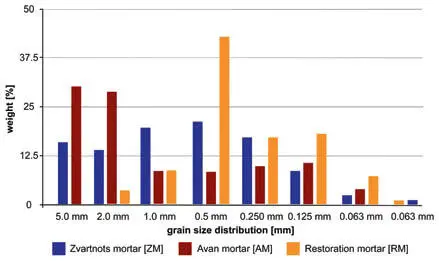
Figure 4:The grading curve of the three mortars.
Volcanic building stones
The tuffs, which were used in the Yerevan region in historical times, belong to the varieties of the Hoktemberyan Brown (HB) and the Hoktemberyan Red (HR) or the Hoktemberyan Black (HBl). Basalt is partly found at the Zvartnots Cathedral and can be compared with the Armenia Black (AB) variety. A detailed description of all building stones is given in Pötzl et al. 2018.
The porosity of the building stones ranges between 14.1–35.6 %, the particle density between 2.46 and 2.93 g/cm 3( Tab. 1). The porosity of the different mortars differs between 31.3 and 47.6 %, with densities between 1.2 and 1.7 g/cm 3. Their particle densities range between 2.2 and 2.6 g/cm 3( Tab. 1).
Table 1:Porosity and density of the investigated stone and mortar samples. * Pötzl et. al 2018
| Sample | Porosity (%) | Density (g/cm3) | Particle density (g/cm3) |
| HB* | 35.0 | 1.62 | 2.49 |
| HR*/Bl | 35.6 | 1.59 | 2.46 |
| AB* | 15.9 | 2.25 | 2.67 |
| ZM | 31.3 | 1.78 | 2.60 |
| AM | 43.4 | 1.29 | 2.28 |
| RM | 47.6 | 1.28 | 2.45 |
Onsite investigations
The results of the mapping of the south-west wall of the Zvartnots complex show, that back-weathering, concentrated at the lower part of the wall is the main damage form covering more than 13 square meters of ashlar and more than 70 % of the whole study object (Fig. 5c).
These damages can be clearly associated with the effloresences of salts. Using test stripes, high amounts of sulfate (> 1,600 mg/l), chloride (1,000 mg/l) and nitrate (500 mg/l) could be detected. Loss of material, rounding and scaling only took place at around 3.5 m 2of the investigated wall. Biological growth is not observable (Fig. 5c).
In a comparison of both buildings, which were built with comparable rock materials, values between 0–15 RF and 0–200 % WME speak for a largely intact condition.
For the Zwartnots cathedral electrical conductivity and capacity shows critical values in all measurement points by reaching more than 15 (% WME) in case of the conductivity and more than 400 (RF) for the capacity.
At the Avan Cathedral crack formation is the predominant weathering form, following by back-weathering and scaling. In Figure 6, these damage forms are depicted at one half of the façade, where also no relevant salt weathering was found. The electrical conductivity and capacity show critical values only in the lower part of the building, which is also partly effected by rising dampness (Fig. 6).
Discussion
Due to the lime inclusions, the RM mortar can be classified as a dry slaked mortar, that is known due to its sandwich-like preparation (Wedekind 2014). The RM mortar was made in a traditional way, but its durability is limited and not comparable with a hot mixed mortar by using amorphous aggregates, like the two described historical mortars. However, 142the RM mortar from the 1941 restoration work was still preserved in huge amounts. The RM mortar does not show any harmful side effects unlike the modern, cement-containing mortars used for the main restoration works in Zvartnots.

Figure 5:Damage mapping of a wall at the Zvartnots Cathedral ruin.
The two different historical mortars can be classified as hot-prepared mortars. In this case, the burned lime was probably mixed and slaked together with the amorphous siliceous aggregate. This could be the reason why no visible lime accumulation is visible. It is known, that the solubility of amorphous silicate increases sharply at a high pH in combination with heat (Iler 1979). All conditions are present during the mortar preparation, heat, a high pH of 14 and a lot of amorphous silicate material used as aggregate.
The high temperature reached by the exothermic reaction of the burned lime slaked with water and the high pH (14) seems to soften and chemically desolve the fine amorphous silicious particles within the aggregate and to form calicite-silica compounds. These cement-like, but salt-free and highly porous mortars seem to be the main reason, why very large parts of the Armenian cultural heritage is still preserved. These mortars also show a perfect compatibility with the highly porous building stones ( Tab. 1). The tuff material has a high water uptake capacity and shows a comparably high resistance agains salt weathering (Pötzl et. al 2018).
Conclusions and further investigations
The high values of sulfate measured at the Zvartnots Cathedral could probably be due to the use 143of cement mortar, implemeted during restoration works at the ruins in the 1950s–1980s (Fig. 2f). Rain water could also be one possible source, since immense infiltration took place at many walls of the ruins. However, aggressive magnesium sulfpher salts could be formed if a dolomitic lime was used for the historical mortar. This should be clarified by further investigations.

Figure 6:Damage mapping of the right half of the main façade at the Avan Cathedral.
A proper desalination method has to be tested and applied. The first experimental conservation works during the summer school 2019 using poultices and the sprinkling method (Wedekind, Ruedrich 2006) have shown promising results.
The observations and results show that the restoration mortar, which is comparable to the historical mortar could be a proper material for both historical objects.
To discover the secret of its eternity and to prepare and develop a suitable and sustainable mortar for restoration, should be the main goal of future research.
Acknowledgements
We would like to thank all the participants of the 1th Summer School “Stones in Armenian Architecture” for their great work. We also thank the administration of heritage preservation of the Zvartnots side for their friendly cooperation, especially Grigor Nalbandyan as well as the Armenian Apostolic Church. We are grateful to Alfons van den Kerkof for allowing us access to the cathodoluminescence microscope at the Geoscience Centre of the University of Göttingen and for his friendly help and cooperation.
Читать дальшеИнтервал:
Закладка:
Похожие книги на «Monument Future»
Представляем Вашему вниманию похожие книги на «Monument Future» списком для выбора. Мы отобрали схожую по названию и смыслу литературу в надежде предоставить читателям больше вариантов отыскать новые, интересные, ещё непрочитанные произведения.





Обсуждение, отзывы о книге «Monument Future» и просто собственные мнения читателей. Оставьте ваши комментарии, напишите, что Вы думаете о произведении, его смысле или главных героях. Укажите что конкретно понравилось, а что нет, и почему Вы так считаете.