Siegfried Siegesmund - Monument Future
Здесь есть возможность читать онлайн «Siegfried Siegesmund - Monument Future» — ознакомительный отрывок электронной книги совершенно бесплатно, а после прочтения отрывка купить полную версию. В некоторых случаях можно слушать аудио, скачать через торрент в формате fb2 и присутствует краткое содержание. Жанр: unrecognised, на немецком языке. Описание произведения, (предисловие) а так же отзывы посетителей доступны на портале библиотеки ЛибКат.
- Название:Monument Future
- Автор:
- Жанр:
- Год:неизвестен
- ISBN:нет данных
- Рейтинг книги:4 / 5. Голосов: 1
-
Избранное:Добавить в избранное
- Отзывы:
-
Ваша оценка:
Monument Future: краткое содержание, описание и аннотация
Предлагаем к чтению аннотацию, описание, краткое содержание или предисловие (зависит от того, что написал сам автор книги «Monument Future»). Если вы не нашли необходимую информацию о книге — напишите в комментариях, мы постараемся отыскать её.
Alle vier Jahre treffen sich auf einer internationalen Tagung Experten, die sich mit den entsprechenden Sachfragen beschäftigen. Der „14th International Congress on the Deterioration and Conservation of Stone“ findet im September 2020 in Göttingen statt. Er ist die wichtigste Veranstaltung zur Verbreitung des Wissens von Praktikern und Forschern, die im Bereich der Steinkonservierung zur Erhaltung des baulichen Kulturerbes arbeiten: Geowissenschaftler, Architekten, Bauspezialisten, Ingenieure, Restauratoren, Denkmalpfleger und Bauherren.
Der Tagungsband mit über 150 wissenschaftlichen Beiträgen repräsentiert und erfasst den neuesten Stand der Technik auf diesem Gebiet.
Themen sind:
– Charakterisierung von Schadensphänomenen von Steinen und verwandten Baumaterialien (Stuck, Putz, Mörtel usw.)
– Methoden zur Untersuchung des Steinverfalls in situ und zerstörungsfreie Prüfung
– Langzeitüberwachung von Steindenkmälern und Gebäuden
– Simulation und Modellierung des Zerfalls
– Technologien und Entwicklung verbesserter Bearbeitung und Verwendung von Stein in Neubauten
– Bewertung der Langzeitwirkung von Bearbeitungstechniken
– Auswirkungen des Klimawandels auf die Steinverwitterung des Kulturerbes
– Berichte zur Steinkonservierung: Fallstudien und Projekte
– Digitalisierung und Dokumentation von Steinkonservierung
–
The 14th International Congress on the Deterioration and Conservation of Stone, entitled MONUMENT FUTURE: DECAY AND CONSERVATION OF STONE is a quadrennial event that brings together a world-wide community of geoscientists, architects, building specialists, engineers, conservators, restorators, monument curators and building owners who are concerned about the conservation of cultural stone structures and objects. Since antiquity, the weathering and deterioration of historical buildings, masonry, monuments, sculptures etc. using natural stones has been a very well-known problem.
This conference is the main gathering for the dissemination of knowledge in the field of stone deterioration issues. It represents and captures the state-of-the-art in the field of stone conservation and cultural heritage conservation with regards to the following topics:
– Characterisation of damage phenomena of stone and related building materials (plaster, rendering, mortar etc.)
– Methods for the investigation of stone decay; in-situ and non-destructive testing
– Long-term monitoring of stone monuments and buildings
– Simulation and modelling of decay
– Technology and development of improved treatments and use of stone in new buildings
– Assessment of long-term effects of treatments
– Impact of climate change on stone decay of Cultural Heritage
– Reports about stone conservation: case studies and projects
– Digitalization and documentation in stone conservation
Monument Future — читать онлайн ознакомительный отрывок
Ниже представлен текст книги, разбитый по страницам. Система сохранения места последней прочитанной страницы, позволяет с удобством читать онлайн бесплатно книгу «Monument Future», без необходимости каждый раз заново искать на чём Вы остановились. Поставьте закладку, и сможете в любой момент перейти на страницу, на которой закончили чтение.
Интервал:
Закладка:
The Armenian Hoktemberyan tuffs are trachydacites, while the Golden Armenia varieties have rhyolitic composition. The most popular Hoktemberyan tuff is of characteristic brick-red color, but transitions to orange-brownish and blackish also exist, often given different local trade names. In its fine-grained brick-red groundmass (~75 %), small elongated pumice clasts of red and black colour are embedded. Grey to black rock fragments, as well as huge amounts of white, elongated feldspars and glass particles in the millimetre range give a slightly speckled appearance. Thin-section analyses show feldspar and amphibole phenocrysts as well as volcanic lithoclasts and hematite located in a cryptocrystalline matrix (Figure 2). The yellowish-golden groundmass of Golden Armenia tuff embeds beige, grey and slightly reddish clasts. In thin section, volcanic lithoclasts, quarz phenocrysts, feldspar relics and vitric fragments are oberserved in a glass-rich matrix. Considerable amounts of swellable clay minerals (corrensite) are verified in Pötzl et al. (2018b).
All the Mexican volcanic tuffs of SLP have rhyolitic composition. The percentage of crystals and matrix vary of 30 %–70 %. The rocks contain mainly 134quartz, with an average abundance of 45 %, alkali feldspar (mostly sanidine and orthoclase) with 35 %, and plagioclase (oligoclase to anorthite) not exceeding 30 %. The texture of these rhyolitic ignimbritic tuffs varies from porphyritic hypocrystalline to vitrophyric (Figure 2).
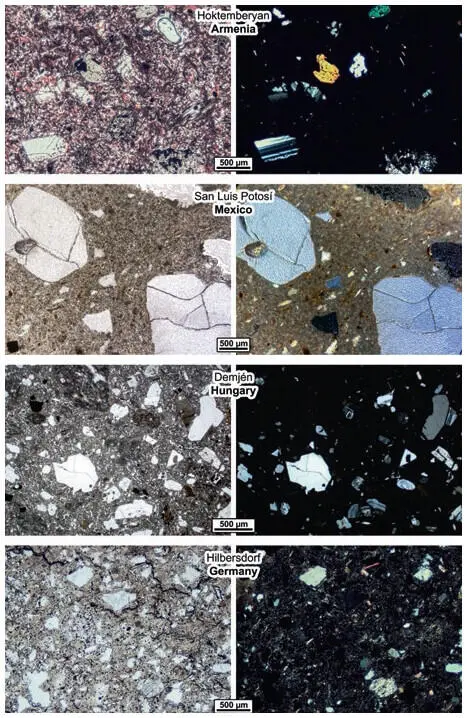
Figure 2:Thin-section photomicrographs in plane- and cross-polarized light from a selection of the studied tuffs (see detailed explanations in the text).
Physical properties
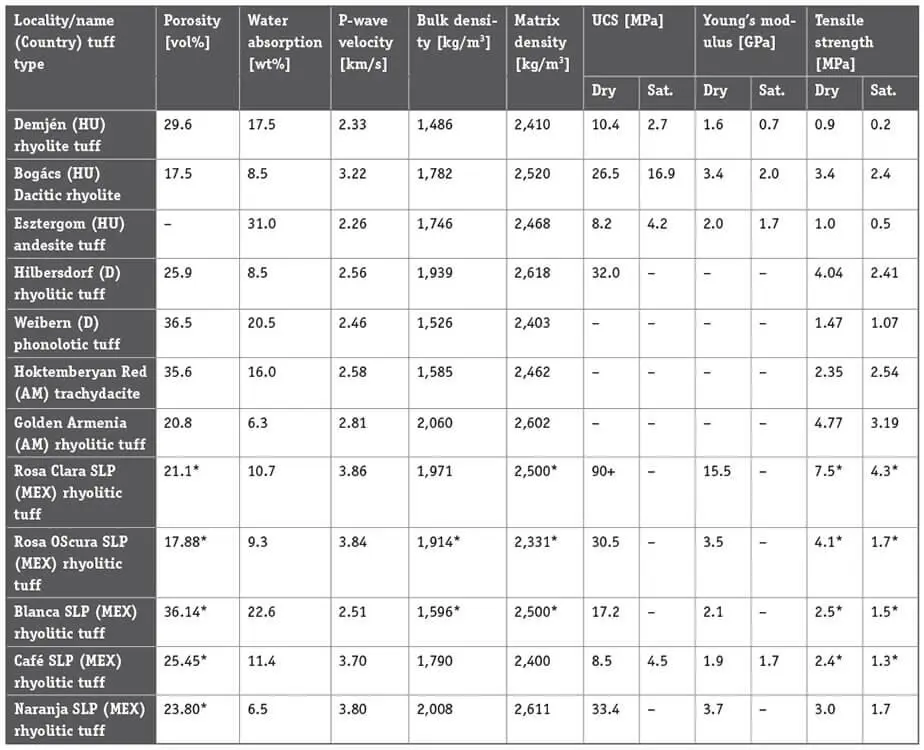
The Hungarian tuffs generally have high effective porosity, from 17 % to 30 % approximately, with a well interconnected pore network, accounting for the almost exclusive presence of open pores in the rock volume. Capillary pores (> 0.1 µm) represent distinctively the most abundant size. The low bulk density, 1.5 g/cm 3on average, is directly related to the high porosity, as well as to the abundance of low-density pumice clasts and glass shards. Considering the mechanical properties, the studied tuffs are weak to moderately strong rocks with compressive strength of 7 and 28 MPa. Saturated conditions produce an extreme deterioration of the mechanical properties, with the strength that may decrease even by 90 % in the weakest tuff varieties ( Table 1).
The Hilbersdorf and Weibern tuffs of Germany have high effective porosities of 26 % and 37 %, respectively. While Hilbersdorf tuff contains substantial amounts of micropores (43 %), Weibern tuff is characterized by huge portions (> 86 %) of capillary pores. In comparison to the other tuffs of this study, the Hilbersdorf tuff shows considerably high bulk (1.9 g/cm 3) and matrix (2.6 g/cm 3) densities, as well as moderate to high p-wave velocity (2.6 km/s), tensile (4 MPa) and compressive strength (32 MPa). The Weibern tuff, on the other hand, is characterized by lower densities and p-wave velocity and tensile strength (1.5 MPa) ( Table 1). Both tuffs suffer a strong decrease (up to 40 %) in their mechanical properties when tested under saturated conditions ( Table 1).
The Armenian tuffs show a broad range of petrophysical properties. The tuffs of this study have a high effective porosity of 21 % to 36 %. However, the Hoktemberyan tuff is characterized by a much lower ratio of micropores (9 %) and bulk density (1.6 g/cm 3). Mechanical properties display the Armenian tuffs as moderately strong with maximum tensile strength values of 5 MPa. While Golden Armenia suffers from a distinct strength decrease under saturated conditions, the Hoktemberyan tuff does not seem to be affected by water in its mechanical properties.
The porosity of the Mexican tuffs ranges from 18 % to 36 % and the density values vary from 2.3 g/cm 3to 2.6 g/cm 3, respectively. The pore-size distribution of the studied tuffs are unimodal and bimodal, in addition the average pore radius fluctuates from 0.15 µm to 4.02 µm, dominating the capillary pores. SLP volcanic rocks are also very soft to moderately hard, depending on the degree of welding and showing average values of tensile strength in dry conditions of around 8 MPa, falling extremely to values down to 1.33 MPa in water-saturated conditions. Well-welded ignimbritic tuff samples of SLP can have uniaxial compressive strength of 90 MPa (Wedekind et al. 2013).
Water saturation reduces the strength (both uniaxial compressive and tensile strength) of the tuffs with one exception (Hoktemberyan) ( Table 1). The strength of the saturated samples can be as low as one-fourth, but in general, the value is half or two-thirds of the dry one. The porosity of the tuffs is in between 18 to 37 vol%, while matrix densities are relatively uniform with 2.3 to 2.6 g/ cm 3. The P-wave velocity of the studied tuffs is in between 2.3 and 3.9 km/s. However, these values do not necessarily indicate differences in porosity ( Table 1).
Durability
The durability of the Hungarian rhyolitic least porous welded tuffs may reach 90 freeze-thaw cycles and 20 salt crystallization cycles with minor or no decay in structure and technical properties. However, the most porous softest varieties, which have found a larger application in the historical built heritage, can withstand only few weathering cycles, before disintegration, erosion, and cracking. The magnitude of the differences in porosity, and consequently in the absorption of water and salt solutions, controls primarily the diverse durability.
135Secondary factors are pore-size distribution especially in the range 0.1–10 µm – critical for ice and salt crystallization damage. Considering the textural features, the most significant discriminating factor is the proportions between crystals and the weaker pumice and groundmass.
Table 1:Physical properties of studied tuffs (data of Hungarian rhyolitic tuffs is from Germinario and Török 2019, Hungarian andesite tuff is from Török 2007, data of the German and Armenian tuffs are from Pötzl et al. 2018a and Pötzl et al. 2018b, data marked by * is from López-Doncel et al. 2016; and marked by + is from Wedekind et al. 2013).
The Hilbersdorf tuffs withstand 11 to 21 cycles before complete disintegration due to its high porosity, bimodal pore radii distribution and high amounts of micropores.. The hydric and thermal expansion of these tuffs is greatly influenced by their clay mineral content and ratio of micropores. Maximum hydric expansion can reach values of 7.5 mm/m (Pötzl et al. 2018a).
Armenian tuffs also show great variation in their durability and weathering behaviour, dependent on their petrophysical properties. The resistance against salt attack varies from 16 to way over 150 cycles. Even considerably soft tuffs, like the Hoktemberyan varieties, are not strongly attacked by the salt crystallization and withstand more than 150 cycles. The Golden Armenia, on the other hand, disintegrates after 34 cycles. The main difference between both tuffs is the clay mineral content as well as the much higher ratio of micropores in Golden Armenia.
Regarding the durability of the Mexican tuffs, the conducted salt bursting tests show that after 14 cycles the most porous sample was completely destroyed and two samples, both with a bimodal pore distribution, have resisted at the end of the test 47 and 48 cycles, respectively. All SLP samples 136were tested for hydric and thermal expansion and all of them did not show any expansion, and one sample showed even hydric contraction with values around 0.03 mm/m.
Читать дальшеИнтервал:
Закладка:
Похожие книги на «Monument Future»
Представляем Вашему вниманию похожие книги на «Monument Future» списком для выбора. Мы отобрали схожую по названию и смыслу литературу в надежде предоставить читателям больше вариантов отыскать новые, интересные, ещё непрочитанные произведения.






Обсуждение, отзывы о книге «Monument Future» и просто собственные мнения читателей. Оставьте ваши комментарии, напишите, что Вы думаете о произведении, его смысле или главных героях. Укажите что конкретно понравилось, а что нет, и почему Вы так считаете.