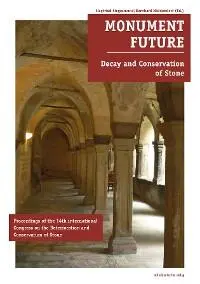
Siegfried Siegesmund - Monument Future
Здесь есть возможность читать онлайн «Siegfried Siegesmund - Monument Future» — ознакомительный отрывок электронной книги совершенно бесплатно, а после прочтения отрывка купить полную версию. В некоторых случаях можно слушать аудио, скачать через торрент в формате fb2 и присутствует краткое содержание. Жанр: unrecognised, на немецком языке. Описание произведения, (предисловие) а так же отзывы посетителей доступны на портале библиотеки ЛибКат.
- Название:Monument Future
- Автор:
- Жанр:
- Год:неизвестен
- ISBN:нет данных
- Рейтинг книги:4 / 5. Голосов: 1
-
Избранное:Добавить в избранное
- Отзывы:
-
Ваша оценка:
Monument Future: краткое содержание, описание и аннотация
Предлагаем к чтению аннотацию, описание, краткое содержание или предисловие (зависит от того, что написал сам автор книги «Monument Future»). Если вы не нашли необходимую информацию о книге — напишите в комментариях, мы постараемся отыскать её.
Alle vier Jahre treffen sich auf einer internationalen Tagung Experten, die sich mit den entsprechenden Sachfragen beschäftigen. Der „14th International Congress on the Deterioration and Conservation of Stone“ findet im September 2020 in Göttingen statt. Er ist die wichtigste Veranstaltung zur Verbreitung des Wissens von Praktikern und Forschern, die im Bereich der Steinkonservierung zur Erhaltung des baulichen Kulturerbes arbeiten: Geowissenschaftler, Architekten, Bauspezialisten, Ingenieure, Restauratoren, Denkmalpfleger und Bauherren.
Der Tagungsband mit über 150 wissenschaftlichen Beiträgen repräsentiert und erfasst den neuesten Stand der Technik auf diesem Gebiet.
Themen sind:
– Charakterisierung von Schadensphänomenen von Steinen und verwandten Baumaterialien (Stuck, Putz, Mörtel usw.)
– Methoden zur Untersuchung des Steinverfalls in situ und zerstörungsfreie Prüfung
– Langzeitüberwachung von Steindenkmälern und Gebäuden
– Simulation und Modellierung des Zerfalls
– Technologien und Entwicklung verbesserter Bearbeitung und Verwendung von Stein in Neubauten
– Bewertung der Langzeitwirkung von Bearbeitungstechniken
– Auswirkungen des Klimawandels auf die Steinverwitterung des Kulturerbes
– Berichte zur Steinkonservierung: Fallstudien und Projekte
– Digitalisierung und Dokumentation von Steinkonservierung
–
The 14th International Congress on the Deterioration and Conservation of Stone, entitled MONUMENT FUTURE: DECAY AND CONSERVATION OF STONE is a quadrennial event that brings together a world-wide community of geoscientists, architects, building specialists, engineers, conservators, restorators, monument curators and building owners who are concerned about the conservation of cultural stone structures and objects. Since antiquity, the weathering and deterioration of historical buildings, masonry, monuments, sculptures etc. using natural stones has been a very well-known problem.
This conference is the main gathering for the dissemination of knowledge in the field of stone deterioration issues. It represents and captures the state-of-the-art in the field of stone conservation and cultural heritage conservation with regards to the following topics:
– Characterisation of damage phenomena of stone and related building materials (plaster, rendering, mortar etc.)
– Methods for the investigation of stone decay; in-situ and non-destructive testing
– Long-term monitoring of stone monuments and buildings
– Simulation and modelling of decay
– Technology and development of improved treatments and use of stone in new buildings
– Assessment of long-term effects of treatments
– Impact of climate change on stone decay of Cultural Heritage
– Reports about stone conservation: case studies and projects
– Digitalization and documentation in stone conservation
Monument Future — читать онлайн ознакомительный отрывок
Ниже представлен текст книги, разбитый по страницам. Система сохранения места последней прочитанной страницы, позволяет с удобством читать онлайн бесплатно книгу «Monument Future», без необходимости каждый раз заново искать на чём Вы остановились. Поставьте закладку, и сможете в любой момент перейти на страницу, на которой закончили чтение.
Интервал:
Закладка:
Saba, M., Hernandez-Romero, N., Quiñones-Bolaños, E., & Lizarazo-Marriaga, J. (2019). Petrographic of Limestone Cultural Heritage as the Basis of a Methodology to Rock Replacement and Masonry Assessment: Cartagena de Indias Case of Study. Case Studies in Construction Materials . https://doi.org/https://doi.org/10.1016/j.cscm.2019.e00281
UNESCO. (1984). Port, Fortresses and Group of Monuments, Cartagena .
UNESCO. (2017). List of World Heritage in Danger .
Zoghlami, K., Lopez-Arce, P., & Zornoza-Indart, A. (2016). Differential Stone Decay of the Spanish Tower Façade in Bizerte, Tunisia. J. of Materials in Civil Engineering 1–14. https://doi.org/10.1061/(ASCE)MT.1943-5533.0001774.
131
COMPARATIVE ANALYSIS OF VOLCANIC TUFFS FROM EUROPE, ASIA AND NORTH-AMERICA
Ákos Török 1, Luigi Germinario 1, Rubén López-Doncel 2, Christopher Pötzl 3, Siegfried Siegesmund 3
IN: SIEGESMUND, S. & MIDDENDORF, B. (EDS.): MONUMENT FUTURE: DECAY AND CONSERVATION OF STONE.
– PROCEEDINGS OF THE 14TH INTERNATIONAL CONGRESS ON THE DETERIORATION AND CONSERVATION OF STONE –
VOLUME I AND VOLUME II. MITTELDEUTSCHER VERLAG 2020.
1Budapest University of Technology and Economics, Department of Engineering Geology and Geotechnics, Megyetem rkp. 3, H-1111 Budapest, Hungary ( torokakos@mail.bme.hu)
2Geological Institute, Autonomous University of San Luis Potosí, Mexico
3Geoscience Centre of the University of Göttingen, Goldschmidtstr. 3, 37077 Göttingen, Germany
Abstract
In this study, volcanic tuffs from Europe (Germany and Hungary), Asia (Armenia) and North-America (Mexico) are compared. The physical properties (density, porosity and pore-size distribution, strength) and mineralogical composition of basic, intermediate and acid volcanic tuffs were measured in laboratory conditions aiming to evaluate these parameters in terms of stone durability. The colour of rhyolitic to andesitic tuffs, the amount of lithic clasts and the proportion of groundmass vary. The mineralogical composition, porosity and textural characteristics of the studied tuffs are very different. The comparative analysis suggested that clay content and distribution within the pores, the amount of glassy groundmass, porosity and pore-size distribution, as well as hygric swelling and thermal behaviour of the tuffs, are the main control factors of the durability.
Introduction
Volcanic tuffs are important lithotypes of our cultural heritage. The material characteristics and the worldwide occurrence allow a widespread use from sculptural elements to massive built structures such as castles and fortresses. Despite the extensive use of tuffs, these materials are prone to weathering and show various forms of decay due to their mechanical properties, textural variability and high porosity.
The current paper provides an overview of the petrophysical, mechanical and petrographic properties of tuffs from Europe, Asia, and North-America. It presents the geological setting and utilisation of these tuffs. It outlines the decay features that are linked to external factors and discusses the differences in durability linked to textural/mineralogical characteristics and stress conditions such as freeze-thaw and salt action. The study also provides a background for the material selections for restoration.
Materials
In the course of its geological history, immense amounts of volcaniclastic material were deposited in the territory of Armenia. Armenian tuffs show a wide variety of color, grain size, clast content and chemical composition. The two examples presented in this study, Hoktemberyan and Golden Armenia, are frequently used in the past and recent construction in many parts of the country (Figure 1a shows the utilization of Qasakh tuff).
In Mexico, volcanic tuffs were and are widely used in the construction of pre-Hispanic, colonial and 132modern monuments. The type and variety of these tuffs exceed half a hundred. In the present study, five tuffs of Central Mexico (San Luis Potosí, SLP), are presented as examples (Figure 1b). The volcanic tuffs of SLP belong to the Paleogene Silicic Large Igneous Province, the Sierra Madre Occidental, the largest ignimbritic province in the world.

Figure 1:Examples of the historical use of the studied tuffs and relevant geographic locations: a) Hovhannavank Monastery, Ohanavan (Armenia), 5th c.; b) Templo del Carmen, San Luis Potosí (Mexico), 17th–18th c.; c) Eger Castle, Eger (Hungary), 13th–18th c.; d) Porphyry house, Chemnitz (Germany), 1868.
Miocene volcanic activity produced a large amount of welded and unwelded pumiceous tuffs in Hungary. Besides the prevailing rhyolitic composition, dacitic and andesitic tuffs also formed in Eastern Hungary. Rhyolitic tuffs are particularly common in a 50 × 10 km area known as Bükkalja Volcanic Field in Northern Hungary.
Emblematic monuments such as the castle or the minaret of Eger were constructed from this material (Figure 1c).
Significant volcanic tuff deposits in Germany are mainly found in the eastern and western Central part of the country. Permian volcanism led to the deposition of the Hilbersdorf tuffs in eastern Central Germany, near the city of Chemnitz.
The Quaternary Weibern tuff is located in western Central Germany, in the municipality of Weibern.
Prominent examples of its application as building stone are, e. g. the Kaiser Wilhelm Memorial Church in Berlin, the Castle Church of Chemnitz or the porphyry house of master stonemason Findewirth in Chemnitz (Figure 1d).
Methods
The tuffs were described using polarized-light microscopy. Bulk and material density, porosity (EN 1936:2006), and water absorption at atmospheric pressure (EN 13755:2008) were measured. Pore-size distribution was analyzed by mercury intrusion porosimetry (MIP) (ASTM D4404-84). Ultrasonic 133p-wave velocity was recorded by direct transmission method (EN 14579:2004). Strength parameters such as uniaxial compressive strength (UCS), tensile strength (ASTM D3967-16) were measured, and Young’s modulus of elasticity was also recorded (ASTM D7012-14). Durability was assessed by resistance to freeze-thaw (EN 12371:2001 with modifications) and resistance to salt attack (EN 12370:1999).
Petrology and Mineralogy
The creamy rhyolitic tuffs from Northern Hungary are characterized by a porphyritic texture with plagioclase phenocrysts. The pumice content is high, and the groundmass is mostly glassy (Figure 2). Critical parameters associated with high textural variability are crystal-groundmass-pumice ratio; grain size; welding degree. These features may vary in outcrops a few kilometres away, and even within the same quarry, to a lesser extent (Germinario & Török 2019).
The German Hilbersdorf Regular tuff, appears in irregularly speckled and marbled in pale pink to dark purple and bright beige to greenish colours. A variety of elongated lapilli inclusions are embedded in the groundmass and millimetre to centimetre-large cavities are partly filled with loose, clayey material. It has a porphyritic texture with mono- and polycrystalline quartz, muscovite, hematite, calcite, feldspar relics and lithic clasts in the glassy matrix (Figure 2). The porphyritic Weibern tuff consists of a fine-grained yellowish-brownish matrix in which pumice lapilli of yellow colour and partly elongated clasts of different but mostly grey colour are embedded. The rock fragments are mostly sandstone and shale as well as basalt and volcanic glass fragments. The matrix mainly consists of analcime, muscovite/illite, quartz and calcite (Wedekind et al. 2013).
Читать дальшеИнтервал:
Закладка:
Похожие книги на «Monument Future»
Представляем Вашему вниманию похожие книги на «Monument Future» списком для выбора. Мы отобрали схожую по названию и смыслу литературу в надежде предоставить читателям больше вариантов отыскать новые, интересные, ещё непрочитанные произведения.







Обсуждение, отзывы о книге «Monument Future» и просто собственные мнения читателей. Оставьте ваши комментарии, напишите, что Вы думаете о произведении, его смысле или главных героях. Укажите что конкретно понравилось, а что нет, и почему Вы так считаете.