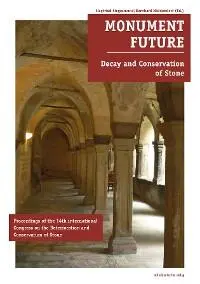
Siegfried Siegesmund - Monument Future
Здесь есть возможность читать онлайн «Siegfried Siegesmund - Monument Future» — ознакомительный отрывок электронной книги совершенно бесплатно, а после прочтения отрывка купить полную версию. В некоторых случаях можно слушать аудио, скачать через торрент в формате fb2 и присутствует краткое содержание. Жанр: unrecognised, на немецком языке. Описание произведения, (предисловие) а так же отзывы посетителей доступны на портале библиотеки ЛибКат.
- Название:Monument Future
- Автор:
- Жанр:
- Год:неизвестен
- ISBN:нет данных
- Рейтинг книги:4 / 5. Голосов: 1
-
Избранное:Добавить в избранное
- Отзывы:
-
Ваша оценка:
Monument Future: краткое содержание, описание и аннотация
Предлагаем к чтению аннотацию, описание, краткое содержание или предисловие (зависит от того, что написал сам автор книги «Monument Future»). Если вы не нашли необходимую информацию о книге — напишите в комментариях, мы постараемся отыскать её.
Alle vier Jahre treffen sich auf einer internationalen Tagung Experten, die sich mit den entsprechenden Sachfragen beschäftigen. Der „14th International Congress on the Deterioration and Conservation of Stone“ findet im September 2020 in Göttingen statt. Er ist die wichtigste Veranstaltung zur Verbreitung des Wissens von Praktikern und Forschern, die im Bereich der Steinkonservierung zur Erhaltung des baulichen Kulturerbes arbeiten: Geowissenschaftler, Architekten, Bauspezialisten, Ingenieure, Restauratoren, Denkmalpfleger und Bauherren.
Der Tagungsband mit über 150 wissenschaftlichen Beiträgen repräsentiert und erfasst den neuesten Stand der Technik auf diesem Gebiet.
Themen sind:
– Charakterisierung von Schadensphänomenen von Steinen und verwandten Baumaterialien (Stuck, Putz, Mörtel usw.)
– Methoden zur Untersuchung des Steinverfalls in situ und zerstörungsfreie Prüfung
– Langzeitüberwachung von Steindenkmälern und Gebäuden
– Simulation und Modellierung des Zerfalls
– Technologien und Entwicklung verbesserter Bearbeitung und Verwendung von Stein in Neubauten
– Bewertung der Langzeitwirkung von Bearbeitungstechniken
– Auswirkungen des Klimawandels auf die Steinverwitterung des Kulturerbes
– Berichte zur Steinkonservierung: Fallstudien und Projekte
– Digitalisierung und Dokumentation von Steinkonservierung
–
The 14th International Congress on the Deterioration and Conservation of Stone, entitled MONUMENT FUTURE: DECAY AND CONSERVATION OF STONE is a quadrennial event that brings together a world-wide community of geoscientists, architects, building specialists, engineers, conservators, restorators, monument curators and building owners who are concerned about the conservation of cultural stone structures and objects. Since antiquity, the weathering and deterioration of historical buildings, masonry, monuments, sculptures etc. using natural stones has been a very well-known problem.
This conference is the main gathering for the dissemination of knowledge in the field of stone deterioration issues. It represents and captures the state-of-the-art in the field of stone conservation and cultural heritage conservation with regards to the following topics:
– Characterisation of damage phenomena of stone and related building materials (plaster, rendering, mortar etc.)
– Methods for the investigation of stone decay; in-situ and non-destructive testing
– Long-term monitoring of stone monuments and buildings
– Simulation and modelling of decay
– Technology and development of improved treatments and use of stone in new buildings
– Assessment of long-term effects of treatments
– Impact of climate change on stone decay of Cultural Heritage
– Reports about stone conservation: case studies and projects
– Digitalization and documentation in stone conservation
Monument Future — читать онлайн ознакомительный отрывок
Ниже представлен текст книги, разбитый по страницам. Система сохранения места последней прочитанной страницы, позволяет с удобством читать онлайн бесплатно книгу «Monument Future», без необходимости каждый раз заново искать на чём Вы остановились. Поставьте закладку, и сможете в любой момент перейти на страницу, на которой закончили чтение.
Интервал:
Закладка:

Figure 5:Correlation between a: hydric expansion [mm/m] and CEC [meq/100 g], b: hydric expansion [mm/m] and BET [m 2/g].

Figure 6:Correlation between a) hygroscopic water sorption at 95 % rh [wt.-%] and CEC [meq/100 g], b) hygroscopic water sorption at 95 % rh [wt.-%] and BET [m 2/g].
Acknowledgements
This work was supported by the German Research Foundation (Si-438/52-1) and the German Federal Environmental Foundation (AZ20017/481). We would like to thank J. L. Noria Sánchez, A. E. Andrade Cuautle and M. Á. González for their support of the onsite work. For the laboratory support and helpful comments we thank K. Wemmer, J. Menningen, W. Wedekind and C. Gross.
References
Colella, C., Gennaro, M. d.’ and Aiello, R. (2001), Use of zeolitic tuff in the building industry, Reviews in Mineralogy and Geochemistry, Vol. 45 No. 1, pp. 551–587.
Di Tchernev (1978), Solar energy application of natural zeolites, Natural zeolites: Occurrence, properties, use, Vol. 474, p. 485.
Gonzalez, I. J. and Scherer, G. W. (2004), Effect of swelling inhibitors on the swelling and stress relaxation of clay bearing stones, Environmental Geology, Vol. 46 No. 3–4, pp. 364–377.
Korkuna, O., Leboda, R., Skubiszewska-Zie, J., Vrublevska, T., Gunko, V. M. and Ryczkowski, J. (2006), Structural and physicochemical properties of natural zeolites: clinoptilolite and mordenite, Microporous and Mesoporous Materials, Vol. 87 No. 3, pp. 243–254.
Kück, A., Pötzl, C., López-Doncel, R. A., Dohrmann, R. and Siegesmund, S. (2020a), Tuffs in pre-Columbian and colonial architecture of Oaxaca, Mexico, in Siegesmund, S. and Middendorf, B. (Eds.), Monument future: Decay and conservation of stone, Göttingen, Kassel, Mitteldeutscher Verlag, Halle.
Pablo-Galán, L. de (1986), Geochemical trends in the alteration of Miocene vitric tuffs to economic zeolite deposits, Oaxaca, Mexico, Applied geochemistry, Vol. 1 No. 2, pp. 273–285.
Pötzl, C., Dohrmann, R. and Siegesmund, S. (2018a), Clay swelling mechanism in tuff stones: an example of the Hilbersdorf Tuff from Chemnitz, Germany, Environmental earth sciences, Vol. 77 No. 5, p. 188.
Pötzl, C., Siegesmund, S., Dohrmann, R., Koning, J. M. and Wedekind, W. (2018b), Deterioration of volcanic tuff rocks from Armenia. Constraints on salt crystallization and hydric expansion, Environmental earth sciences, Vol. 77 No. 19, p. 660.
Ruedrich, J., Bartelsen, T., Dohrmann, R. and Siegesmund, S. (2011), Moisture expansion as a deterioration factor for sandstone used in buildings, Environmental earth sciences, Vol. 63 No. 7–8, pp. 1545–1564.
Siegesmund, S. and Dürrast, H. (2011), Physical and mechanical properties of rocks, in Siegesmund, S. and Snethlage, R. (Eds.), Stone in architecture, Springer, pp. 97–225.
Snethlage, R., Wendler, E. and Klemm, D. D. (1995), Tenside im Gesteinsschutz-bisherige Resultate mit einem neuen Konzept zur Erhaltung von Denkmälern aus Naturstein, Denkmalpflege und Naturwissenschaft-Natursteinkonservierung I. Verlag Ernst & Sohn, Berlin, pp. 127–146.
Wedekind, W., López-Doncel, R., Dohrmann, R., Kocher, M. and Siegesmund, S. (2013), Weathering of volcanic tuff rocks caused by moisture expansion, Environmental earth sciences, Vol. 69 No. 4, pp. 1203–1224.
125
PHYSICO-CHEMICAL CHARACTERIZATION OF THE CARTAGENA WALL AND QUARRY MATERIAL STONE USED FOR ITS RESTORATION
Manuel Saba 1 , Juan Lizarazo-Marriaga 2 , Nicole Hernández-Romero 2, Cristina Tedeschi 3 , Edgar Quiñones-Bolaños 1
IN: SIEGESMUND, S. & MIDDENDORF, B. (EDS.): MONUMENT FUTURE: DECAY AND CONSERVATION OF STONE.
– PROCEEDINGS OF THE 14TH INTERNATIONAL CONGRESS ON THE DETERIORATION AND CONSERVATION OF STONE –
VOLUME I AND VOLUME II. MITTELDEUTSCHER VERLAG 2020.
1University of Cartagena, Research Group Esconpat, Faculty of Engineering, Cartagena, Colombia
2Universidad Nacional de Colombia, Department of Civil and Agricultural Engineering, Bogotá, Colombia
3Department of Civil and Environmental Engineering, Politecnico di Milano, Italy
4University of Cartagena, Research Group Environmental Modelling, Faculty of Engineering, Cartagena, Colombia
Abstract
The deterioration of historical structures is a topic of primary importance due to their historical, cultural and economic importance. Aggressive environments around structures can depend on anthropogenic factors such as NO 2, SO 2gases among others, and environmental factors such as differential dilation, differential hydric dilation and crystallization. In the present study is proposed a physical-chemical characterization of the structure and quarry stone used for the replacement of deteriorated blocks of the defensive Wall of Cartagena, Colombia, UNESCO Cultural Heritage since 1984. X-ray and ionic chromatography identification were done in the structure stone. Furthermore, is proposed a Petrographical comparison between structure and quarry material as well as mechanical characterization of the quarry material.
The structure is composed mainly by soft limestone. Similar physico-chemical characteristics were found through X-Ray and Petrographical comparison, while salt crystallization is found playing a secondary role in the structure deterioration.
Introduction
According to the United Nations’ Educational, Scientific and Cultural Organization (UNESCO), there are around 869 sites of cultural interest around the world (UNESCO 2019). They were selected for their historical relevance and uniqueness. All of them struggle with surrounding aggressive climate conditions that accelerate their deterioration. Currently, 53 of those sites are rated as being in imminent danger due to anthropogenic and natural factors (UNESCO 2019).
For example, the Fortifications on the Caribbean Side of Panama (Portobelo-San Lorenzo), part of the defensive colonial system built by the Spanish Crown to protect transatlantic trade, constitute a valuable example of 17th and 18th-century military architecture, whose integrity has been compromised by environmental factors, uncontrolled urban extension, development and the lack of maintenance and management. Dozens of structures have been destroyed in the past in the name of Civilization, or because of high deterioration and/or earthquakes. An example of this is the Noto Cathedral, Italy, a historic masonry building that suddenly collapsed in 1996 (Binda et al. 1999) 126producing during centuries a redistribution of stresses from the core of lime mortar concrete to the external cladding of stiff masonry. This is likely one of the causes of long-time damage of some ancient masonry towers. With these motivations, coupled processes of moisture diffusion, carbon dioxide diffusion and carbonation reaction are analyzed numerically. Due to the absence of models and data for lime mortar, one of the simplest models proposed for Portland cement concrete is adapted for this purpose. The results reveal the time scales of the processes involved and their dependence on wall thickness (size. Factors responsible for over-stressing and damaging the monuments and thus inhibiting their conservation are high levels of air pollution in the atmosphere, daily and seasonal cycles of temperature and humidity, sea spray (or salt spray), rising damp, atmospheric conditions (rainwater, wind and sunlight exposure (Kameni & Orosa 2016)).
Читать дальшеИнтервал:
Закладка:
Похожие книги на «Monument Future»
Представляем Вашему вниманию похожие книги на «Monument Future» списком для выбора. Мы отобрали схожую по названию и смыслу литературу в надежде предоставить читателям больше вариантов отыскать новые, интересные, ещё непрочитанные произведения.







Обсуждение, отзывы о книге «Monument Future» и просто собственные мнения читателей. Оставьте ваши комментарии, напишите, что Вы думаете о произведении, его смысле или главных героях. Укажите что конкретно понравилось, а что нет, и почему Вы так считаете.