Siegfried Siegesmund - Monument Future
Здесь есть возможность читать онлайн «Siegfried Siegesmund - Monument Future» — ознакомительный отрывок электронной книги совершенно бесплатно, а после прочтения отрывка купить полную версию. В некоторых случаях можно слушать аудио, скачать через торрент в формате fb2 и присутствует краткое содержание. Жанр: unrecognised, на немецком языке. Описание произведения, (предисловие) а так же отзывы посетителей доступны на портале библиотеки ЛибКат.
- Название:Monument Future
- Автор:
- Жанр:
- Год:неизвестен
- ISBN:нет данных
- Рейтинг книги:4 / 5. Голосов: 1
-
Избранное:Добавить в избранное
- Отзывы:
-
Ваша оценка:
Monument Future: краткое содержание, описание и аннотация
Предлагаем к чтению аннотацию, описание, краткое содержание или предисловие (зависит от того, что написал сам автор книги «Monument Future»). Если вы не нашли необходимую информацию о книге — напишите в комментариях, мы постараемся отыскать её.
Alle vier Jahre treffen sich auf einer internationalen Tagung Experten, die sich mit den entsprechenden Sachfragen beschäftigen. Der „14th International Congress on the Deterioration and Conservation of Stone“ findet im September 2020 in Göttingen statt. Er ist die wichtigste Veranstaltung zur Verbreitung des Wissens von Praktikern und Forschern, die im Bereich der Steinkonservierung zur Erhaltung des baulichen Kulturerbes arbeiten: Geowissenschaftler, Architekten, Bauspezialisten, Ingenieure, Restauratoren, Denkmalpfleger und Bauherren.
Der Tagungsband mit über 150 wissenschaftlichen Beiträgen repräsentiert und erfasst den neuesten Stand der Technik auf diesem Gebiet.
Themen sind:
– Charakterisierung von Schadensphänomenen von Steinen und verwandten Baumaterialien (Stuck, Putz, Mörtel usw.)
– Methoden zur Untersuchung des Steinverfalls in situ und zerstörungsfreie Prüfung
– Langzeitüberwachung von Steindenkmälern und Gebäuden
– Simulation und Modellierung des Zerfalls
– Technologien und Entwicklung verbesserter Bearbeitung und Verwendung von Stein in Neubauten
– Bewertung der Langzeitwirkung von Bearbeitungstechniken
– Auswirkungen des Klimawandels auf die Steinverwitterung des Kulturerbes
– Berichte zur Steinkonservierung: Fallstudien und Projekte
– Digitalisierung und Dokumentation von Steinkonservierung
–
The 14th International Congress on the Deterioration and Conservation of Stone, entitled MONUMENT FUTURE: DECAY AND CONSERVATION OF STONE is a quadrennial event that brings together a world-wide community of geoscientists, architects, building specialists, engineers, conservators, restorators, monument curators and building owners who are concerned about the conservation of cultural stone structures and objects. Since antiquity, the weathering and deterioration of historical buildings, masonry, monuments, sculptures etc. using natural stones has been a very well-known problem.
This conference is the main gathering for the dissemination of knowledge in the field of stone deterioration issues. It represents and captures the state-of-the-art in the field of stone conservation and cultural heritage conservation with regards to the following topics:
– Characterisation of damage phenomena of stone and related building materials (plaster, rendering, mortar etc.)
– Methods for the investigation of stone decay; in-situ and non-destructive testing
– Long-term monitoring of stone monuments and buildings
– Simulation and modelling of decay
– Technology and development of improved treatments and use of stone in new buildings
– Assessment of long-term effects of treatments
– Impact of climate change on stone decay of Cultural Heritage
– Reports about stone conservation: case studies and projects
– Digitalization and documentation in stone conservation
Monument Future — читать онлайн ознакомительный отрывок
Ниже представлен текст книги, разбитый по страницам. Система сохранения места последней прочитанной страницы, позволяет с удобством читать онлайн бесплатно книгу «Monument Future», без необходимости каждый раз заново искать на чём Вы остановились. Поставьте закладку, и сможете в любой момент перейти на страницу, на которой закончили чтение.
Интервал:
Закладка:
Mitla Tuff Rosa (MR) is a dense, rhyolitic tuff with small pores and crystals of up to 3 mm size. It has a pink matrix, which is in some parts discolored to white (Fig. 1h). The thin section (Fig. 2h) shows an overall small proportion (10 %) of cryptocrystalline to microcrystalline matrix with seriate texture. The crystals are hypidiomorphic and poorly altered.
Querétaro Blanco (QB) is a white to gray rhyolitic lapilli tuff with a high amount of pumice and glass within the matrix. Lithic fragments of more than 1 cm size are macroscopically visible in the lithoscan (Fig. 1i). The thin section of QB shows a vitrophyric texture with very few crystals and lithoclasts embedded in a glassy matrix (Fig. 2i).
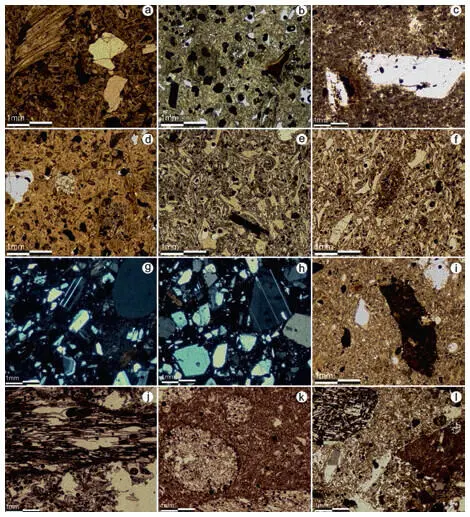
Figure 2:Thin sections of he investigated tuffs. a) CV O, b) CV E, c) CA O, d) CA E, e) CR O, f) CR E, g) MG, h) MR, i) QB, j) QM, k) QA, l) QN with parallel nicols except g and h with crossed nicols.
Querétaro Melon (QM) is a rhyolithic, vitric lapilli tuff of orange-melon color with lithic fragments, as well as small crystals and big clasts of pumice in a glassy matrix (Fig. 1j). QM shows an eutaxitic texture with firmly welded glassy matrix and few smaller crystals under the microscope (Fig. 2j).
Querétaro Amarillo (QA) is a dacitic, heterogenous tuff breccia with clasts of several centimeters in size. The matrix is yellowish-brown and contains clasts that are often whitish-gray. The clasts are partly pumice, mostly xenoliths and a small amount of crystals (Fig. 1k). The matrix of QA is 122strongly altered to clay minerals. The pumice are mostly unwelded and show little signs of elongation or compression (Fig. 2k).
Querétaro Naranja (QN) is a vitric lapilli tuff of trachydacitic composition with lithic fragments in the centimeter scale. Small fragments of orange pumice and strongly altered crystals in a devitrified matrix of orange color are visible in Figure 1l. The thin section shows round and angular xenocrysts and altered feldspar in the fine-grained matrix (Fig. 2l).
In sum, all samples have an acidic composition. Particularly glass-rich samples are CR O, CR E, QM, QA and QN. Feldspar could be detected in all samples, while quartz was not detected by XRD in CV E, CR E, QB and QM. CV Eand QB instead contain the high temperature modifications of SiO 2(tridymite and cristobalite). The cation exchange capacity (CEC) and the specific surface area (BET), as well as the content of clay minerals and zeolites in all samples are presented in Table 1.
Samples with significant amounts of zeolites are CV O, CV Eand CA E. The specific surface area (BET) is high for these samples. The main zeolites are heulandite and clinoptilolite, minor amounts of mordenite were detected in CV E. Clay minerals were detected in all samples. The content of swellable clay minerals indicated by a high CEC value is especially high in CA O, MG and CV O. Smectite and muscovite-illite make up the main content of the clay fraction. Chlorite was only detected in CV Eand kaolinite was found in MG and could be present in small amounts in CV O, CV E, CA Oand QA.
Influence of zeolites and swellable clay minerals
Scanning electron microscopy (SEM) images reveal the type and location of clay minerals in MG and CV O(Fig. 3a–d). Swellable smectite, muscovite and kaolinite are located in both pore space (Fig. 3a) and in the matrix (Fig. 3b,d) as well as on grain boundaries (Fig. 3c). Smectite has the ability to cause volume increase by swelling, especially when it is located on grain contacts. The alteration of feldspar to clay minerals often leads to the formation of intracrystalline porosity and therefore increases the effective porosity (Fig. 3c).
The scanning electron microscopy (SEM) images (Fig. 3e–h) reveal very small mordenite needles and clinotilolite laths in CV E, which cause a high specific surface area (Fig. 3e–h).
The zeolite-rich samples CV O, CV Eand CA Eshow the highest hygroscopic water sorption and hydric expansion of all samples (see Kück et al. 2020a in this issue). During thermal expansion, the zeolite-rich samples (CV O, CV Eand CA E) show a large difference between the first and the second heating cycle, with high residual strain (Fig. 4). After the first wet cycle the samples show a decrease in residual strain. CA Oand CA Edo not recover from contraction after the second drying cycle. The Mitla samples and QB are rather unaffected by both thermal and thermohyric dilatation (see Kück et al. 2020a).

Figure 3:a–d: Different appearances of swellable clay minerals. a): smectite appears as a ‘spiderweb’ in the pore space as relict of weathered pumice clast in MG, b): kaolinite booklet and smectite in densely packed matrix, c): dissolved feldspar with clay minerals on the grain boundary reveals intracrystalline porosity, d): smectite in the matrix of CVO; e–h): Zeolites in CVE cause a high specific surface area. e): flaky zeolite in the matrix, f): zeolites grow into pore space, g): clinoptilolite laths in the matrix, h): 100 nm thin mordenite needles in a pore.
123 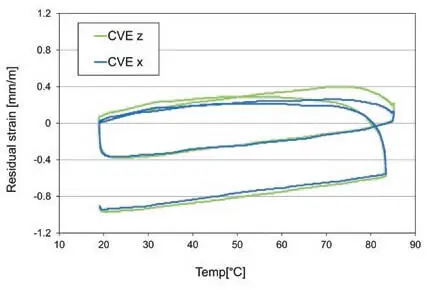
Figure 4:Residual strain [mm/m] of CVE in the X- and Z-direction for two heating cycles from 20–90 °C. Noticeable are intense shrinking and non-reversible thermal dilatation.
Discussion and conclusions
The cation exchange capacity (CEC) value depends on both clay minerals and zeolites, however, the CEC method used is not suitable for CEC analysis of zeolites because the large colored Cu-trien cations cannot enter the cavities of zeolites (Meier and Kahr 1999). For the analysed samples a clear trend between CEC and hydric expansion could not be observed (Fig. 5a). On the other hand, a linear dependency of hydric expansion and hygroscopic sorption on the specific surface area is observable (Fig. 5b, Fig. 6b). The specific surface area increases when clay minerals and zeolites are present in a volcanic tuff, because they yield a high share of micropores (often in the nanometer-scale) within the rock fabric. The higher the specific surface area is, the more water can interact with the rock and the expansion is resultingly larger. Zeolites can adsorb and release substantial amounts of water and therefore passively lead to hydric expansion, whenever water is released during dehydration.
The results of this study show, that the presence of both zeolites and swellable clay minerals has a combined effect on the water-related weathering behavior of tuff building stones. The porespace properties (e. g. pore radii, specific surface area) and the water transport and storage properties 124of volcanic tuff rocks are significantly influenced, by either of them. Volcanic tuff rocks with a significant amount of swellable clay minerals as well as zeolites show extremely high hygroscopic water sorption and hydric swelling. Thermal effects like shrinkage and fracturing during drying are particularly high. This study showed that the identification of the clay mineral and zeolite content, as well as their location and shape within the rock fabric is an important measure for the prediction of the weathering behavior of tuff building stones. For the planning of effective conservational treatment of tuff building stones a clay mineral and zeolite analysis should be considered substantial.
Читать дальшеИнтервал:
Закладка:
Похожие книги на «Monument Future»
Представляем Вашему вниманию похожие книги на «Monument Future» списком для выбора. Мы отобрали схожую по названию и смыслу литературу в надежде предоставить читателям больше вариантов отыскать новые, интересные, ещё непрочитанные произведения.







Обсуждение, отзывы о книге «Monument Future» и просто собственные мнения читателей. Оставьте ваши комментарии, напишите, что Вы думаете о произведении, его смысле или главных героях. Укажите что конкретно понравилось, а что нет, и почему Вы так считаете.