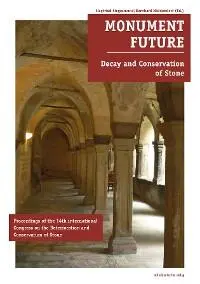
Siegfried Siegesmund - Monument Future
Здесь есть возможность читать онлайн «Siegfried Siegesmund - Monument Future» — ознакомительный отрывок электронной книги совершенно бесплатно, а после прочтения отрывка купить полную версию. В некоторых случаях можно слушать аудио, скачать через торрент в формате fb2 и присутствует краткое содержание. Жанр: unrecognised, на немецком языке. Описание произведения, (предисловие) а так же отзывы посетителей доступны на портале библиотеки ЛибКат.
- Название:Monument Future
- Автор:
- Жанр:
- Год:неизвестен
- ISBN:нет данных
- Рейтинг книги:4 / 5. Голосов: 1
-
Избранное:Добавить в избранное
- Отзывы:
-
Ваша оценка:
Monument Future: краткое содержание, описание и аннотация
Предлагаем к чтению аннотацию, описание, краткое содержание или предисловие (зависит от того, что написал сам автор книги «Monument Future»). Если вы не нашли необходимую информацию о книге — напишите в комментариях, мы постараемся отыскать её.
Alle vier Jahre treffen sich auf einer internationalen Tagung Experten, die sich mit den entsprechenden Sachfragen beschäftigen. Der „14th International Congress on the Deterioration and Conservation of Stone“ findet im September 2020 in Göttingen statt. Er ist die wichtigste Veranstaltung zur Verbreitung des Wissens von Praktikern und Forschern, die im Bereich der Steinkonservierung zur Erhaltung des baulichen Kulturerbes arbeiten: Geowissenschaftler, Architekten, Bauspezialisten, Ingenieure, Restauratoren, Denkmalpfleger und Bauherren.
Der Tagungsband mit über 150 wissenschaftlichen Beiträgen repräsentiert und erfasst den neuesten Stand der Technik auf diesem Gebiet.
Themen sind:
– Charakterisierung von Schadensphänomenen von Steinen und verwandten Baumaterialien (Stuck, Putz, Mörtel usw.)
– Methoden zur Untersuchung des Steinverfalls in situ und zerstörungsfreie Prüfung
– Langzeitüberwachung von Steindenkmälern und Gebäuden
– Simulation und Modellierung des Zerfalls
– Technologien und Entwicklung verbesserter Bearbeitung und Verwendung von Stein in Neubauten
– Bewertung der Langzeitwirkung von Bearbeitungstechniken
– Auswirkungen des Klimawandels auf die Steinverwitterung des Kulturerbes
– Berichte zur Steinkonservierung: Fallstudien und Projekte
– Digitalisierung und Dokumentation von Steinkonservierung
–
The 14th International Congress on the Deterioration and Conservation of Stone, entitled MONUMENT FUTURE: DECAY AND CONSERVATION OF STONE is a quadrennial event that brings together a world-wide community of geoscientists, architects, building specialists, engineers, conservators, restorators, monument curators and building owners who are concerned about the conservation of cultural stone structures and objects. Since antiquity, the weathering and deterioration of historical buildings, masonry, monuments, sculptures etc. using natural stones has been a very well-known problem.
This conference is the main gathering for the dissemination of knowledge in the field of stone deterioration issues. It represents and captures the state-of-the-art in the field of stone conservation and cultural heritage conservation with regards to the following topics:
– Characterisation of damage phenomena of stone and related building materials (plaster, rendering, mortar etc.)
– Methods for the investigation of stone decay; in-situ and non-destructive testing
– Long-term monitoring of stone monuments and buildings
– Simulation and modelling of decay
– Technology and development of improved treatments and use of stone in new buildings
– Assessment of long-term effects of treatments
– Impact of climate change on stone decay of Cultural Heritage
– Reports about stone conservation: case studies and projects
– Digitalization and documentation in stone conservation
Monument Future — читать онлайн ознакомительный отрывок
Ниже представлен текст книги, разбитый по страницам. Система сохранения места последней прочитанной страницы, позволяет с удобством читать онлайн бесплатно книгу «Monument Future», без необходимости каждый раз заново искать на чём Вы остановились. Поставьте закладку, и сможете в любой момент перейти на страницу, на которой закончили чтение.
Интервал:
Закладка:
117Reactivity of the new gypsum mortar
Variable amounts of dehydrated or partly dehydrated calcium sulfate phases in the dry mortar and different crystal habits of the phases are the reasons for a variable reactivity of the mixture. For example, the low degree of hydration of the sample fired for 5 hours at 600 °C is possibly due to the radial fibrous structure of anhydrite crystals. The degree of hydration after 3 days and 1 year was determined gravimetrically and by X-Ray diffraction (Rietveld method), respectively, for samples fired at different temperatures and for different times. The results are summarized in Table 1.
As stated above the fired material is a variable mixture of components with different hydration reaction rates (Glasenapp 1910). Unlike α- and β-hemihydrate, anhydrite III and low fired anhydrite II which hydrate very quickly, high fired anhydrite II reacts very slowly with water. This retarded reaction of anhydrite II can produce cracks in the plaster if the mortar fabric is very dense and cannot compensate the volume increase of the hydrated calcium sulfate phase. Therefore the hydration of high fired anhydrite II has to be activated by a suitable chemical such as citric acid or potassium sulfate. Experiments and analyses proved superfine calcium hydoxide Ca(OH) 2to be a suitable activator to prevent a retarded hydration of high fired anhydrite II. The linear expansion coefficient of the high fired gypsum injection mortar measured after 280 days was reduced to less than 2 mm/m. The compressive strength of the set mortar measured after 28 days was 6.1 MPa and decreased to 2.9 MPa after storage of the samples under water. No cracking was observed in test walls which were built in 2016 and injected with this mortar. Obviously its properties are favourable for the repair and reinforcement of the historic masonry and it is now successfully applied since two years.
Table 1:Degree of rehydration of fired gypsum as a function of firing temperature and time.
| Run No. | Firing temperature | Firing time | Reaction time | Degree of hydration |
| 1 | 200 °C | – | 3 days | 85 % |
| 2 | 200 °C | – | 365 days | ~100 % |
| 3 | 600 °C | 5 hours | 3 days | 4 % |
| 4 | 600 °C | 24 hours | 3 days | 15 % |
| 5 | 600 °C | – | 365 days | 94 % |
| 6 | 800 °C | 5 hours | 3 days | 13 % |
| 7 | ≥ 800 °C | > 5 hours | 3 days | 1 % |
| 8 | 1,100 °C | 5 hours | 365 days | 72 % |
Static safeguarding of the west iwan
In a first step of the strengthening of the west iwan the masonry was grouted with a gypsum suspension developed by University of Technology Dresden (TUD) and Jäger Consulting Engineers Ltd. The worm pump SP-20 from Desoi was absolutely necessary for the grouting of large caverns, cavities and crack systems in the north wall of the west iwan. The water-to-gypsum ratio of the aggregate-free suspension was 0.63. The chemical Retardan 200 P by SIKA Company was added as a retarder. Tests with ViscoCrete by SIKA Company showed that the addition of a plasticizer to the suspension was not necessary to guarantee sufficient flowability. The gypsum suspension could easily be mixed and processed on-site. Observation of the injection process confirmed the very good flow behaviour of the suspension which ensured the closing of the cracks and cavities in the masonry. The grout remained flowable long enough and the quantity of the water taken from the surroundings were within limits. The masonry showed heavy vertical cracks and numerous holes and cavities in the interior, which had to be grouted from the bottom to the top of the wall with the developed gypsum suspension. First holes were drilled at a spacing of 30 to 50 cm along the course of the crack to grout the masonry. The holes had a diameter of 24 mm and depths of 30 to 80 cm. After completion of drilling, the entire masonry including the cracks was prepared for the subsequent rising grouting. For this purpose the cracks were cleaned of dust and loose objects and the parts of the masonry facade near the masonry facade were secured with loam mortar. This prevented contamination of the masonry during the grouting work and the preceding filling of the cracks. Then grouting was started from bottom to top (Figure 7).
118 
Figure 7:Gypsum mortar injection into the cracked north wall of the west iwan. Right side: Bottom to top injection in sealed crack.
It was frequently the case that the masonry could be grouted up to 1 m of height from one hole. This demonstrated an effective internal transport of material, with continuous grouting of the entire masonry being guaranteed. At each level, grout escaped at the various holes drilled round the buttress. In total, 7 tons of gypsum suspension were grouted to the east part of the north wall of the west iwan.
References
Bräunel, M. (2016). Takht-e Soleyman – vertiefende Bestandsaufnahme der Ruinenteile des westlichen Iwans in Vorbereitung der notwendigen statisch-konstruktiven Sicherung. Diplomarbeit an der Technischen Universität Dresden, Lehrstuhl für Tragwerksplanung, Fakultät Architektur, 2016, unpublished.
Burkert, T., Fuchs, C., Sobott, R. (2019). Statisch-konstruktive Sicherungsarbeiten am westlichen Iwan der UNESCO-Welterbestätte Takht-e Soleyman, Iran. in Mauerwerk Kalender 2019, Ernst und Sohn, Berlin, 295–331.
Glasenapp, M. (1910). Plaster, Overburnt Gypsum and Hydraulic Gypsum. – Cement & Engineering News, Chicago, Illinois, 47 pp.
Fucke, D., Hansen, M. (2012). Takht-e Soleyman – vorbereitende Untersuchungen und Varianten zur Sicherung der Ruinenteile des westlichen Iwans. Diplomarbeit an der Technischen Universität Dresden, Lehrstuhl für Tragwerksplanung, Fakultät Architektur, 2012, unpublished.
Huff, D. (2006). The Ilkhanid Palace at Takht-i Sulayman. Excavation Results, in: Komaroff, Linda (Ed.): Beyond the Legacy of Genghis Khan. Brill, Leiden 2006, 94–110.
Jäger, W. (2017). Burning process of gypsum in the kiln in Tahkt-e Soleyman 20.05.2016. – Technische Universität Dresden, Faculty of Architecture, Chair of Structural Design, 12 pp.
Jafarpanah, M. (2017). Burning process of gypsum in the kiln in Tahkt-e Soleyman 13.08.2017. – Takht-e Soleyman – UNESCO World Heritage Site, 13 pp.
Lenz, R., Sobott, R. (2008). Beobachtungen zu Gefügen historischer Gipsmörtel. In: Gipsmörtel im historischen Mauerwerk und an den Fassaden. – Hrsg. von M. Auras und H.-W. Zier, WTA Schriftenreihe, Heft 30, 23–34.
Lucas, H. G. (1992). Gips als historischer Außenbaustoff in der Windsheimer Bucht. Dissertation, Fakultät für Bergbau, Hüttenwesen und Geowissenschaften der RWTH Aachen.
Müller, T., Baumgartner, L. P., Foster, C. T. Bowman, J. R. (2009). Crystal Size Distribution of Periclase in Contact Metamorphic Dolomite Marbles from Southern Adamello Massif, Italy. – Journal of Petrology, Vol. 50/3, 451–465.
Naumann, R. (1977). Die Ruinen von Tacht-e-Suleiman und Zendan-e-Suleiman und Umgebung.
Dietrich Reimer Verlag, Berlin, 126 pp.
Sobott, R. (2018). Historic and modern gypsum mortar application at the Takht-e Soleyman, Iran. Report about on-site studies and results of sample analyses. unpublished, 25 pp.
Читать дальшеИнтервал:
Закладка:
Похожие книги на «Monument Future»
Представляем Вашему вниманию похожие книги на «Monument Future» списком для выбора. Мы отобрали схожую по названию и смыслу литературу в надежде предоставить читателям больше вариантов отыскать новые, интересные, ещё непрочитанные произведения.






Обсуждение, отзывы о книге «Monument Future» и просто собственные мнения читателей. Оставьте ваши комментарии, напишите, что Вы думаете о произведении, его смысле или главных героях. Укажите что конкретно понравилось, а что нет, и почему Вы так считаете.