Siegfried Siegesmund - Monument Future
Здесь есть возможность читать онлайн «Siegfried Siegesmund - Monument Future» — ознакомительный отрывок электронной книги совершенно бесплатно, а после прочтения отрывка купить полную версию. В некоторых случаях можно слушать аудио, скачать через торрент в формате fb2 и присутствует краткое содержание. Жанр: unrecognised, на немецком языке. Описание произведения, (предисловие) а так же отзывы посетителей доступны на портале библиотеки ЛибКат.
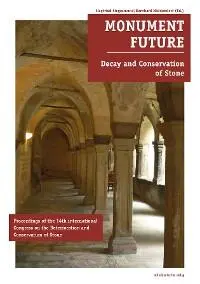
- Название:Monument Future
- Автор:
- Жанр:
- Год:неизвестен
- ISBN:нет данных
- Рейтинг книги:4 / 5. Голосов: 1
-
Избранное:Добавить в избранное
- Отзывы:
-
Ваша оценка:
Monument Future: краткое содержание, описание и аннотация
Предлагаем к чтению аннотацию, описание, краткое содержание или предисловие (зависит от того, что написал сам автор книги «Monument Future»). Если вы не нашли необходимую информацию о книге — напишите в комментариях, мы постараемся отыскать её.
Alle vier Jahre treffen sich auf einer internationalen Tagung Experten, die sich mit den entsprechenden Sachfragen beschäftigen. Der „14th International Congress on the Deterioration and Conservation of Stone“ findet im September 2020 in Göttingen statt. Er ist die wichtigste Veranstaltung zur Verbreitung des Wissens von Praktikern und Forschern, die im Bereich der Steinkonservierung zur Erhaltung des baulichen Kulturerbes arbeiten: Geowissenschaftler, Architekten, Bauspezialisten, Ingenieure, Restauratoren, Denkmalpfleger und Bauherren.
Der Tagungsband mit über 150 wissenschaftlichen Beiträgen repräsentiert und erfasst den neuesten Stand der Technik auf diesem Gebiet.
Themen sind:
– Charakterisierung von Schadensphänomenen von Steinen und verwandten Baumaterialien (Stuck, Putz, Mörtel usw.)
– Methoden zur Untersuchung des Steinverfalls in situ und zerstörungsfreie Prüfung
– Langzeitüberwachung von Steindenkmälern und Gebäuden
– Simulation und Modellierung des Zerfalls
– Technologien und Entwicklung verbesserter Bearbeitung und Verwendung von Stein in Neubauten
– Bewertung der Langzeitwirkung von Bearbeitungstechniken
– Auswirkungen des Klimawandels auf die Steinverwitterung des Kulturerbes
– Berichte zur Steinkonservierung: Fallstudien und Projekte
– Digitalisierung und Dokumentation von Steinkonservierung
–
The 14th International Congress on the Deterioration and Conservation of Stone, entitled MONUMENT FUTURE: DECAY AND CONSERVATION OF STONE is a quadrennial event that brings together a world-wide community of geoscientists, architects, building specialists, engineers, conservators, restorators, monument curators and building owners who are concerned about the conservation of cultural stone structures and objects. Since antiquity, the weathering and deterioration of historical buildings, masonry, monuments, sculptures etc. using natural stones has been a very well-known problem.
This conference is the main gathering for the dissemination of knowledge in the field of stone deterioration issues. It represents and captures the state-of-the-art in the field of stone conservation and cultural heritage conservation with regards to the following topics:
– Characterisation of damage phenomena of stone and related building materials (plaster, rendering, mortar etc.)
– Methods for the investigation of stone decay; in-situ and non-destructive testing
– Long-term monitoring of stone monuments and buildings
– Simulation and modelling of decay
– Technology and development of improved treatments and use of stone in new buildings
– Assessment of long-term effects of treatments
– Impact of climate change on stone decay of Cultural Heritage
– Reports about stone conservation: case studies and projects
– Digitalization and documentation in stone conservation
Monument Future — читать онлайн ознакомительный отрывок
Ниже представлен текст книги, разбитый по страницам. Система сохранения места последней прочитанной страницы, позволяет с удобством читать онлайн бесплатно книгу «Monument Future», без необходимости каждый раз заново искать на чём Вы остановились. Поставьте закладку, и сможете в любой момент перейти на страницу, на которой закончили чтение.
Интервал:
Закладка:
Deposits weakly attached and spider nets should be removed by mechanical means (soft brush, plastic spatula). Soiling and deposits strongly attached could be removed by steam jet, as described in Siegesmund & Snethlage (2011). Oxide staining could be mobilized by chemical complexing or sequestering agents that can be soaked up or flushed away (Matero & Tagle, 1995). Following these authors, poultices with different chemical compounds could be used to remove oxide staining, grafitti, paint films, and eventually deposits of cement, and others that could not be removed by the previous methods.
Conclusions
The present study is the first documented case of a deterioration assessment of a dimensional stone façade in Uruguay performed by a geological team. The rock applied is identified as Kösseine Granite, of Wunsiedel, Germany.
No conservation program was developed prior to this study in Palacio Salvo, although minor reparations have been recognized. Using ICOMOS (2011) deterioration glossary, five deterioration families were recognized, being Features induced by material loss and Discoloration and deposit the most represented. Of the first family rounding, perforation (with and without metallic insert), and missing part are the most frequent, both in pilasters, columns and steps, being abrasion very frequent in the latter. They are all related with anthropogenic activities and not a consequence of poor rock quality. Of the second family, the most frequent deteriorations are deposits and soiling.
Other relevant alterations are replacement of original pieces in steps, mostly by monolithic and Pan de Azúcar Syenite, that matches the décor of Kösseine Granite. The good performance of Kösseine Granite in Palacio Salvo after 92 years of exposure is related to its excellent physical and mechanical properties.
References
IC-FADU (Instituto de Construcción, Facultad de Arquitectura, Diseño y Urbanismo) (2019) Propuesta de intervención para la conservación de las fachadas del Palacio Salvo.
Grimm WD (2018) Bildatlas wichtiger Denkmalgesteine der Bundesrepublik Deutschland. Ebner Verlag GmbH & Co.
Matero FG, Tagle AA (1995) Cleaning, Iron Stain Removal, and Surface Repair of Architectural Marble and Crystalline Limestone: The Metropolitan Club. J. Am. Inst. Conserv. Vol.34 I.1.
Morales Demarco M (2012) Mineralogical, Petrophysical and Economical Characterization of the Dimensional Stones of Uruguay; Implications for Deposit Exploration. Diss Univ Göttingen.
Mosch S (2008) Optimierung der Exploration, Gewinnung und Materialcharakterisierung von Naturwerksteinen. Diss Univ Göttingen.
Oyhantçabal P (2005) The Sierra Ballena Shear zone: kinematics, timing and its significance for the geotectonic evolution of southeast Uruguay. Diss Univ Göttingen.
113
2000 YEARS OF USE OF PLASTER AS BUILDING AND RESTORATION MATERIAL FOR THE „TAKHT-E SOLEYMAN“ IN WESTERN AZERBAIJAN, IRAN
Angela Eckart 1, Robert Sobott 2 , Holger Kletti 3 , Toralf Burkert 1 , Wolfram Jäger 4
IN: SIEGESMUND, S. & MIDDENDORF, B. (EDS.): MONUMENT FUTURE: DECAY AND CONSERVATION OF STONE.
– PROCEEDINGS OF THE 14TH INTERNATIONAL CONGRESS ON THE DETERIORATION AND CONSERVATION OF STONE –
VOLUME I AND VOLUME II. MITTELDEUTSCHER VERLAG 2020.
1Jäger Ingenieure GmbH, Paul-Schneider-Straße 17, 99423 Weimar, Germany
2Labor für Baudenkmalpflege Naumburg, Rudelsburgpromenade 20C, 06628 Naumburg, Germany
3Bauhaus Universität Weimar, Fakultät Bauingenieurwesen, F. A.Finger-Institut für Baustoffkunde, Professur Werkstoffe des Bauens, Coudraystr. 11B, 99423 Weimar, Germany
4Jäger Ingenieure GmbH, Wichernstraße 12, 01445 Radebeul, Germany
Abstract
The preservation of the UNESCO World Heritage Site Takht-e Soleyman is supported by German experts who are working on the 114reinforcement of the badly cracked north wall of the west iwan (large audience hall). The building material gypsum which was used in the past is now also used for up-to-date repair work such as grouting and filling cracks and voids in the historic masonry. Locally quarried gypsum was used to produce a high-fired gypsum mortar in the traditional way. On the basis of laboratory experiments the activation of the hydration of anhydrite and the flow behavior of the mortar suspension was optimized.
Kewords: Ilkhanid palace, calcium sulfate phases, gypsum calcination, grouting, static safeguarding of masonry
Introduction
The UNESCO World Heritage Site Takht-e Soleymann (“Throne of Solomon”) is situated in the West Azerbaijan Province of Iran. The site lies 2200 m above the sea level and has a dry continental climate. In the 6th century AD under Sasanian rule a Zorastrian fire temple and palace complex was built at an artesian lake over the ruins of Achaemenid and Parthian buildings. After the end of the Sasanian dynasty in the 7th century AD the complex fell derelict. In 1221 the Mongols started the invasion of the Islamic world and about 1275 the site was used once again for the construction of an Ilkhanid summer palace. The greatest building within the palace complex was the west iwan, a vaulted audience hall, 11,5 m wide and 27 m long and closed on three sides (Naumann 1977, Huff 2006) which was lavishly decorated inside. With the decline of the Ilkhanid empire the buildings were abandoned and fell into ruin again. Beginning in 1956, the area was investigated by archaeologists and a restoration program was initiated with German support. A huge scaffold was erected on the east side of the west iwan in order to stabilize the ruinous north wall and stop the progressive decay. What was meant as a temporary measure is still in place and actually became an iconic landmark (Figure 1).
Since 2016 the preservation of the remains of the west iwan is part of a restoration project funded by the Cultural Preservation Program of the Federal Foreign Office. Experts are working on the reinforcement of the badly cracked north wall by strengthening the historic masonry with injection anchors and filling voids and cracks in the wall structure by mortar injections (Fucke, Hansen 2012, Bräunel 2016, Burkert et al. 2019). Gypsum mortar was used for the repair work because plaster is present in Sasanian as well as in Ilkhanid wall structures and its reaction with hydraulic cement mortar may cause the problem of sulphate attack. The project is aiming to strengthen of the wall so that it can withstand earthquakes in a seismically active region and the dismantling of the scaffold which is then no longer required.
Sasanian and Ilkhanid plaster
The historic multi-leaf masonry has a filling of stone rubble and mortar. The external leaf was built of travertine worked stones, rubblestones and bricks. Plaster was the binder for the mortar of all building periods and masonry types. Chemical and phase analyses of Sasanian and Ilkhanid plaster samples yielded fairly pure gypsum mortars. Maximum silicon dioxide impurities, mainly as quartz, did not exceed 8.3 mass%.
The thin section of a Sasanian gypsum mortar revealed a secondray very porous structure (Figure 2). The firing products are more or less dissolved, creating pore space which is surrounded by a gypsum matrix. Brown inclusions in the leached remnants of the fired gypsum must be regarded as impurities in the raw material.
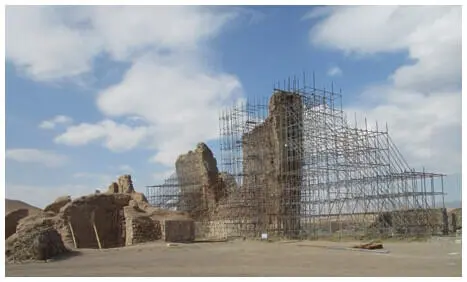
Figure 1:North wall of the west iwan in the centre, Takht-e Soleyman.
Читать дальшеИнтервал:
Закладка:
Похожие книги на «Monument Future»
Представляем Вашему вниманию похожие книги на «Monument Future» списком для выбора. Мы отобрали схожую по названию и смыслу литературу в надежде предоставить читателям больше вариантов отыскать новые, интересные, ещё непрочитанные произведения.







Обсуждение, отзывы о книге «Monument Future» и просто собственные мнения читателей. Оставьте ваши комментарии, напишите, что Вы думаете о произведении, его смысле или главных героях. Укажите что конкретно понравилось, а что нет, и почему Вы так считаете.