Siegfried Siegesmund - Monument Future
Здесь есть возможность читать онлайн «Siegfried Siegesmund - Monument Future» — ознакомительный отрывок электронной книги совершенно бесплатно, а после прочтения отрывка купить полную версию. В некоторых случаях можно слушать аудио, скачать через торрент в формате fb2 и присутствует краткое содержание. Жанр: unrecognised, на немецком языке. Описание произведения, (предисловие) а так же отзывы посетителей доступны на портале библиотеки ЛибКат.
- Название:Monument Future
- Автор:
- Жанр:
- Год:неизвестен
- ISBN:нет данных
- Рейтинг книги:4 / 5. Голосов: 1
-
Избранное:Добавить в избранное
- Отзывы:
-
Ваша оценка:
Monument Future: краткое содержание, описание и аннотация
Предлагаем к чтению аннотацию, описание, краткое содержание или предисловие (зависит от того, что написал сам автор книги «Monument Future»). Если вы не нашли необходимую информацию о книге — напишите в комментариях, мы постараемся отыскать её.
Alle vier Jahre treffen sich auf einer internationalen Tagung Experten, die sich mit den entsprechenden Sachfragen beschäftigen. Der „14th International Congress on the Deterioration and Conservation of Stone“ findet im September 2020 in Göttingen statt. Er ist die wichtigste Veranstaltung zur Verbreitung des Wissens von Praktikern und Forschern, die im Bereich der Steinkonservierung zur Erhaltung des baulichen Kulturerbes arbeiten: Geowissenschaftler, Architekten, Bauspezialisten, Ingenieure, Restauratoren, Denkmalpfleger und Bauherren.
Der Tagungsband mit über 150 wissenschaftlichen Beiträgen repräsentiert und erfasst den neuesten Stand der Technik auf diesem Gebiet.
Themen sind:
– Charakterisierung von Schadensphänomenen von Steinen und verwandten Baumaterialien (Stuck, Putz, Mörtel usw.)
– Methoden zur Untersuchung des Steinverfalls in situ und zerstörungsfreie Prüfung
– Langzeitüberwachung von Steindenkmälern und Gebäuden
– Simulation und Modellierung des Zerfalls
– Technologien und Entwicklung verbesserter Bearbeitung und Verwendung von Stein in Neubauten
– Bewertung der Langzeitwirkung von Bearbeitungstechniken
– Auswirkungen des Klimawandels auf die Steinverwitterung des Kulturerbes
– Berichte zur Steinkonservierung: Fallstudien und Projekte
– Digitalisierung und Dokumentation von Steinkonservierung
–
The 14th International Congress on the Deterioration and Conservation of Stone, entitled MONUMENT FUTURE: DECAY AND CONSERVATION OF STONE is a quadrennial event that brings together a world-wide community of geoscientists, architects, building specialists, engineers, conservators, restorators, monument curators and building owners who are concerned about the conservation of cultural stone structures and objects. Since antiquity, the weathering and deterioration of historical buildings, masonry, monuments, sculptures etc. using natural stones has been a very well-known problem.
This conference is the main gathering for the dissemination of knowledge in the field of stone deterioration issues. It represents and captures the state-of-the-art in the field of stone conservation and cultural heritage conservation with regards to the following topics:
– Characterisation of damage phenomena of stone and related building materials (plaster, rendering, mortar etc.)
– Methods for the investigation of stone decay; in-situ and non-destructive testing
– Long-term monitoring of stone monuments and buildings
– Simulation and modelling of decay
– Technology and development of improved treatments and use of stone in new buildings
– Assessment of long-term effects of treatments
– Impact of climate change on stone decay of Cultural Heritage
– Reports about stone conservation: case studies and projects
– Digitalization and documentation in stone conservation
Monument Future — читать онлайн ознакомительный отрывок
Ниже представлен текст книги, разбитый по страницам. Система сохранения места последней прочитанной страницы, позволяет с удобством читать онлайн бесплатно книгу «Monument Future», без необходимости каждый раз заново искать на чём Вы остановились. Поставьте закладку, и сможете в любой момент перейти на страницу, на которой закончили чтение.
Интервал:
Закладка:
There was some controversy about the origin of the rock applied. In the Uruguayan small geological community, it was believed it was a facies of Pan de Azúcar Pluton. This pluton, studied in detail by Oyhantçabal (2005), is a km-size syenitic, quartz-syenitic and granitic circular intrusion, historically exploited with ornamental purpose (Morales Demarco, 2012). All efforts to localize the variety supposdly applied in Palacio Salvo in the area of the pluton were unsuccessful.
At the beginning of this study, 15 blueprints of the entire granitic façade were found by FADU in the General Archive of the Nation (Archivo General de la Nación). These blueprints have the localization and dimensions of around 1,000 pieces of the granitic façade of Palacio Salvo (the external façade and the façade of the passage, not studied in the present work), and some inscriptions written in German: Kösseine Granit Poliert , Grasyma Wunsiedel , Januar 1925 .
The ICG team compare the dimensions of the pieces applied in Palacio Salvo, with those stated in the blueprints. The match is perfectly accurate. Simultaneously, a communication with the German company allowed the confirmation as the providers of the rock and the undoubtedly identification as Kösseine Granite (Figure 1).
Characterization of Kösseine Granite
Petrography
Due to the impossibility of sampling the rock in the buidling, as it is a National Historical Monument, a preliminary petrographic characterization was performed in situ . It is a very coarsed-grained leucocratic rock, yellowish white, to beige and greyish light brown. This is not the typical color of Kösseine Granite, but a yellowish variety that is also widely used in Germany.
The rock shows a porphyritic texture, due to the presence of alkali feldspar up to 3.5 cm, most around 2 cm, subhedral, frequently rounded. Some show zoning with a light brown core, sometimes euhedral, surrounded by a greyish white mantle. Most are grey. Inclusions of biotite (Strohmeyer, 2003) are very frequent, often evidencing growth rims. Occasionally, a translucent mineral can be observed, that gives the rock a pearl luster, this is probably plagioclase.
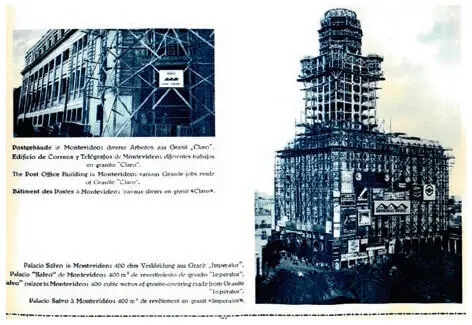
Figure 1:Right: Brochure of Palacio Salvo in construction with promotional poster of Grasyma (courtesy of Claus Wölfel).
Quartz is interstitial between feldspar and biotite, with light brown to beige color. Biotite shows sometimes hexagonal sections with dark reddish to coppery color. Muscovite is silver grey sometimes with greenish hues. Both minerals frequently form nests, and the biotitic sometimes show orange oxidation rims.
Garnet is present as an accessory mineral in mm euhedral to subhedral red crystals with vitreous luster. They occur occassionally as inclusions in alkali felspars, sometimes in matrix minerals.
Table 1: Mineralogical composition of Kösseine Granite.
| Mineral (%) | Grimm (2018) | Strohmeyer (2003) |
| Alkali feldspar | 41 | 32 |
| Quartz | 36 | 26 |
| Plagioclase | 13 | 30 |
| Biotite | 6 | 10 |
| Muscovite y chlorite | 2 | 1 |
| Accessory | 2 | < 1% |
The rock structure is characterized by the presences of elongated mafic enclaves, up to 20 cm with aspect ratio up to 1 : 20, some banded (mafic and felsic bands). Small rounded mafic enclaves are also present (2–3 cm). Felsic enclaves up to 40 cm 109ocurr either as fine to very fine-grained or as very coarsed-grained. All these structural elements disrupt the rocks décor. The rock is classified according to its mineral composition ( Table 1) as a granite (Strohmeyer, 2003; Grimm, 2018).
Table 2: Physical properties of Kösseine Granite.
| Physical properties (units) | Grimm (2018) | Strohmeyer (2003) |
| Bulk density (g/cm 3) | 2.67 | 2.67 |
| Matrix density (g/cm 3) | 2.69 | 2.68 |
| Porosity (% vol) | 0.71 | 0.11 |
| Average pore radii (µm) | 0.02 | |
| Volume of capillary pores (% vol) | 0.02 | |
| Water absorption (wt%) | ||
| Water absorption (atm) (wt%) | 0.21 | |
| Water absorption (vac) (wt%) | 0.27 | |
| Saturation coefficient S | 0.79 | |
| Water absorption coefficient [kg/m 2*√t] | 0.003 | |
| Permeability (mD) | 0.002 | |
| Specific surface (m 2/g) | 0.22 | |
| Thermal expansion coefficient (10 –6K –1) | 9.22 |
Table 3: Mechanical properties of Kösseine Granite.
| Mechanical properties (units) | Strohmeyer (2003) | |||
| x-direction | y-direction | z-direction | Average | |
| UCS (MPa) | 194 ± 11 | 194 ± 10 | 199 ± 8 | 195 ± 17 |
| Indirect Tensile Strength (MPa) | 12.2 ± 1.2 | 10.9 ± 1.3 | 12.5 ± 1.5 | 11.9 ± 2.3 |
| Flexural Strength (MPa) | 18.0 ± 1.1 | 19.7 ± 1.1 | 22.6 ± 0.8 | 20.1 ± 1.7 |
| Abrasion Strength (cm 3/50 cm 2) | 5.8 ± 0.2 | 5.7 ± 0.1 | 5.6 ± 0.1 | 5.7 ± 0.2 |
Physical and mechanical properties
No physical or mechanical tests were performed, nevertheless, results of Strohmeyer (2003) and Grimm (2018) were considered (Tables 2and 3).
Kösseine Granite shows a very good behavior against atmospheric agents, directly related to its physical properties: very low porosity, low water absorption, low water uptake coefficient and permeability. These properties show that the rock is practically impermeable, and consequently extremely stable to weathering conditions.
Mechanical properties for Kösseine Granite are typical of granitic rocks, even slightly higher. Comparing its UCS (uniaxial compressive strength) values to those of the statistical study of Mosch (2008), it can be observed that they are above the median. Flexural strength is also above the median of Mosch (2008), but the indirect tension is slightly below this parameter.
Abrasion resistance values are slightly higher than those reported by Morales Demarco (2012) for Uruguayan granitic rocks, but in the range of values given by Siegesmund & Snethlage (2011).
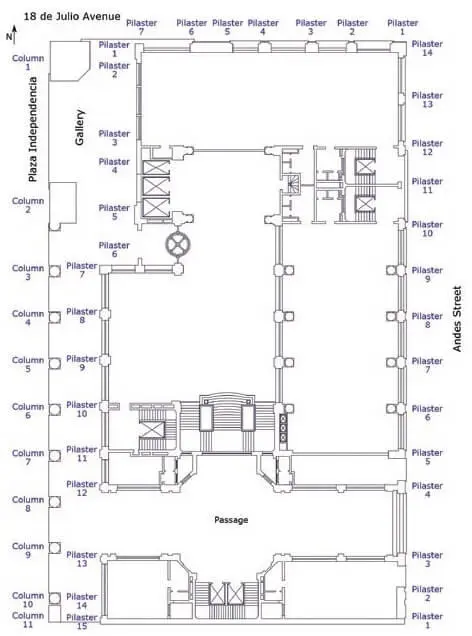
Figure 2:Ground floor plan (modified from FADU, 2019).

Figure 3:a. Perforation with metallic insert, oxide staining and star crack; b. Missing gap presumably a product of bursting or removal of metallic insert.
110Deterioration assessment
Интервал:
Закладка:
Похожие книги на «Monument Future»
Представляем Вашему вниманию похожие книги на «Monument Future» списком для выбора. Мы отобрали схожую по названию и смыслу литературу в надежде предоставить читателям больше вариантов отыскать новые, интересные, ещё непрочитанные произведения.







Обсуждение, отзывы о книге «Monument Future» и просто собственные мнения читателей. Оставьте ваши комментарии, напишите, что Вы думаете о произведении, его смысле или главных героях. Укажите что конкретно понравилось, а что нет, и почему Вы так считаете.