Siegfried Siegesmund - Monument Future
Здесь есть возможность читать онлайн «Siegfried Siegesmund - Monument Future» — ознакомительный отрывок электронной книги совершенно бесплатно, а после прочтения отрывка купить полную версию. В некоторых случаях можно слушать аудио, скачать через торрент в формате fb2 и присутствует краткое содержание. Жанр: unrecognised, на немецком языке. Описание произведения, (предисловие) а так же отзывы посетителей доступны на портале библиотеки ЛибКат.
- Название:Monument Future
- Автор:
- Жанр:
- Год:неизвестен
- ISBN:нет данных
- Рейтинг книги:4 / 5. Голосов: 1
-
Избранное:Добавить в избранное
- Отзывы:
-
Ваша оценка:
Monument Future: краткое содержание, описание и аннотация
Предлагаем к чтению аннотацию, описание, краткое содержание или предисловие (зависит от того, что написал сам автор книги «Monument Future»). Если вы не нашли необходимую информацию о книге — напишите в комментариях, мы постараемся отыскать её.
Alle vier Jahre treffen sich auf einer internationalen Tagung Experten, die sich mit den entsprechenden Sachfragen beschäftigen. Der „14th International Congress on the Deterioration and Conservation of Stone“ findet im September 2020 in Göttingen statt. Er ist die wichtigste Veranstaltung zur Verbreitung des Wissens von Praktikern und Forschern, die im Bereich der Steinkonservierung zur Erhaltung des baulichen Kulturerbes arbeiten: Geowissenschaftler, Architekten, Bauspezialisten, Ingenieure, Restauratoren, Denkmalpfleger und Bauherren.
Der Tagungsband mit über 150 wissenschaftlichen Beiträgen repräsentiert und erfasst den neuesten Stand der Technik auf diesem Gebiet.
Themen sind:
– Charakterisierung von Schadensphänomenen von Steinen und verwandten Baumaterialien (Stuck, Putz, Mörtel usw.)
– Methoden zur Untersuchung des Steinverfalls in situ und zerstörungsfreie Prüfung
– Langzeitüberwachung von Steindenkmälern und Gebäuden
– Simulation und Modellierung des Zerfalls
– Technologien und Entwicklung verbesserter Bearbeitung und Verwendung von Stein in Neubauten
– Bewertung der Langzeitwirkung von Bearbeitungstechniken
– Auswirkungen des Klimawandels auf die Steinverwitterung des Kulturerbes
– Berichte zur Steinkonservierung: Fallstudien und Projekte
– Digitalisierung und Dokumentation von Steinkonservierung
–
The 14th International Congress on the Deterioration and Conservation of Stone, entitled MONUMENT FUTURE: DECAY AND CONSERVATION OF STONE is a quadrennial event that brings together a world-wide community of geoscientists, architects, building specialists, engineers, conservators, restorators, monument curators and building owners who are concerned about the conservation of cultural stone structures and objects. Since antiquity, the weathering and deterioration of historical buildings, masonry, monuments, sculptures etc. using natural stones has been a very well-known problem.
This conference is the main gathering for the dissemination of knowledge in the field of stone deterioration issues. It represents and captures the state-of-the-art in the field of stone conservation and cultural heritage conservation with regards to the following topics:
– Characterisation of damage phenomena of stone and related building materials (plaster, rendering, mortar etc.)
– Methods for the investigation of stone decay; in-situ and non-destructive testing
– Long-term monitoring of stone monuments and buildings
– Simulation and modelling of decay
– Technology and development of improved treatments and use of stone in new buildings
– Assessment of long-term effects of treatments
– Impact of climate change on stone decay of Cultural Heritage
– Reports about stone conservation: case studies and projects
– Digitalization and documentation in stone conservation
Monument Future — читать онлайн ознакомительный отрывок
Ниже представлен текст книги, разбитый по страницам. Система сохранения места последней прочитанной страницы, позволяет с удобством читать онлайн бесплатно книгу «Monument Future», без необходимости каждый раз заново искать на чём Вы остановились. Поставьте закладку, и сможете в любой момент перейти на страницу, на которой закончили чтение.
Интервал:
Закладка:
2National Center for Cultural Heritage, Ulaanbaatar, Mongolia
3Institute of Art & Technology, University of Applied Arts Vienna, Austria *corresponding author
Abstract
The monument of Turegs Kul’Chur at Ikh Khöshööt is among the numerous funerary monuments spread over the Mongolian countryside dating back to the Turkic period. It comprises steles with inscriptions, humanand animal-shaped sculptures and remnants of a sarcophagus all made of different varieties of local granitoids. Since 2016, Austrian-Mongolian conservation training workshops have been held there. The aim was to preserve the site and achieve a better understanding of physical and chemical properties of the used material, weathering and decay processes and the impact of the climatic conditions and environment to the site, in-depth research that is only at the beginning in Mongolia.
Two decay patterns common for granites, delamination and disintegration, pose a considerable threat to the original substance. It is supposed that thermal loads, temperature gradient, stone-intrinsic properties including stress release (Winkler 2013) and quarrying may have caused and accelerated the decay.
Visual inspections in situ were combined with petrographic studies of samples using instrumental analysis to determine composition, structure and texture of the stone and to describe decay patterns. The combined use and evaluation of three non-destructive field tests – two tests on water absorption and ultrasonic pulse velocity measurement – enabled to characterize the degree of weathering and decay of the different stone elements. Results were put in context with surface temperature measurements to characterize heating and cooling behavior and meteorological and climate data. Thus, the hypotheses on environmental and material intrinsic factors that accelerate and contribute to decay could be partly supported. Based on the condition survey underpinned with extensive analyses, a conservation treatment concept was developed and carried out.
The Complex
Over centuries the Mongolian nomads had influenced art, culture and religion in Central Asia significantly and left a remarkable legacy including numerous funerary monuments. They are spread over the area of today’s Mongolia, often remote and far away from settlements. Among them is the monument of Ikh Khöshööt, situated in the Delgerkhaan soum (sub-district) of Tov Province in 102Eastern Mongolia. It is acknowledged as tomb for a Turkic military leader from the beginning of the 8th century. The complex comprises 15 main stone sculptures arranged over an area of many square metres. They include two rectangular steles, whereby the larger shows Turkic runic inscriptions on three sides. The other animal- and human-shaped sculptures are present in pairs, as already observed by Kotwicz and Samoïovitch (1928: 69). While the animal-like ones probably depict lions and sheeps (Kotwicz and Samoïovitch 1928), the human-likes appear as simple torsos.
In addition fragments of a former sarcophagus are lying dispersed on the West side of the complex. The original arrangement and positioning of the single objects is no longer comprehensible as the objects have been repeatedly dislocated in the framework of expeditions and site visits. Nevertheless, a linear arrangement is assumed following an axis running along the former sarcophagus and the steles with the remaining sculptures arranged alongside this straight. Research on the complex site was pursued since the beginning of the 20th century, whereby emphasis was placed on documentation (visual and descriptive) and transcription of the inscriptions. Conservation scientific research on the site has started in 2016 in the framework of the collaboration between the University of Applied Arts Vienna and the National Center for Cultural Heritage (NCCH) in Mongolia. On site campaigns in 2016, 2018 and 2019 co-funded by the Eurasia-Pacific Uninet and the NCCH were dedicated to the documentation, the condition survey, non-invasive tests, the implementation of conservation measures and monitoring as well as to the training of Mongolian colleagues. In parallel, analyses of taken samples were carried out in Vienna.
Condition, Damage and Decay Patterns
The sculptures comprising the complex monument are made of three varieties of granitoids, which were identified on the basis of petrographical studies of samples using thin-section microscopy (transmitted and reflected light) and scanning electron microscopy (SEM-BSE): a fine-grained lithotype A1 (c. 1.5 mm grain size), a medium-grained lithotype A2 (c. 4 mm grain size) and a coarse-grained lithotype A3 (c. 5 mm grain size). Beside deviations in grain size, they also slightly differ in colour and accessory mineral content. Two of them (A1 and A3) show a more distinctive layering (stratification) and were both used for the two steles at the site. This choice is probably based on the stone intrinsic property and the resultant sheeting of the rock deposit, which facilitated the quarrying in the form of relatively thin layers. Another possibility is that the sheets were already available as separate boulders. The other variety (A2) is more bulky and was used for the human- and animal-shaped sculptures. All sculptures were probably processed and shaped by use of different chisels, whereby only some remnants of tool marks could be detected on the bottom side of one of a torso.

Figure 1:Monument of Ikh Khöshööt, 2019. © Institute of Conservation, University of Applied Arts Vienna.
Considering the age of the monument (almost 1,300 years), the harsh environment as well as the absence of previous large-scale conservation treatments and regular maintenance, the condition of the monument can be described as relatively good. The engraved inscription on the main stele, with a presumable original depth of some millimetres, is still visible in large parts, which indicates a comparably slow weathering and erosion of the upper surface layers.
Nevertheless, several damage and decay patterns are evident ranging from fractures to heterogeneous deposits comprising remnants of animal rubbings and bird droppings, which have partly converted to compact, thick, hardly removable crusts. Among 103them particularly two decay patterns common for granites, delamination and disintegration (Rodrigues 1980), attracted the attention and concern of the conservators and conservation scientists.
Characterizing the Decay – Non-Destructive Tests and Investigations
Already at the first inspection it was noted that the individual sculptures are affected to a varying degree by delamination and disintegration.
As a first step, level and extent of both decay patterns were thus assessed visually and sensorily as well as recorded in descriptive form and visualized in mappings. It revealed that the two steles are mainly affected by delamination while the human- and animal-shaped sculptures suffer from disintegration. This already suggests a link and dependence between the stone variety and the main decay pattern. Further, the survey showed that particularly the upper third of each of the steles is affected by delamination.
On the main stele the east face shows a more extensive scaling parallel to the surface than the opposite. The human- and animal-shaped sculptures show an even roughness on all sides. Surfaces are hardly sanding, which is likely due to a past consolidation treatment as communicated by NCCH.
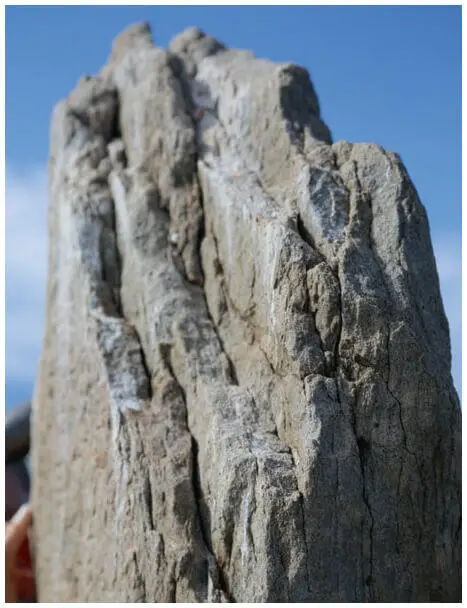
Figure 2:Detail of the delamination in the upper third of the main stele, 2018. © Amarsanaa.
Читать дальшеИнтервал:
Закладка:
Похожие книги на «Monument Future»
Представляем Вашему вниманию похожие книги на «Monument Future» списком для выбора. Мы отобрали схожую по названию и смыслу литературу в надежде предоставить читателям больше вариантов отыскать новые, интересные, ещё непрочитанные произведения.





Обсуждение, отзывы о книге «Monument Future» и просто собственные мнения читателей. Оставьте ваши комментарии, напишите, что Вы думаете о произведении, его смысле или главных героях. Укажите что конкретно понравилось, а что нет, и почему Вы так считаете.