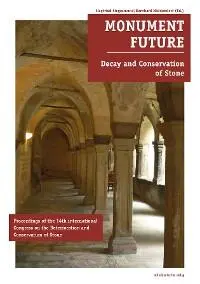
Siegfried Siegesmund - Monument Future
Здесь есть возможность читать онлайн «Siegfried Siegesmund - Monument Future» — ознакомительный отрывок электронной книги совершенно бесплатно, а после прочтения отрывка купить полную версию. В некоторых случаях можно слушать аудио, скачать через торрент в формате fb2 и присутствует краткое содержание. Жанр: unrecognised, на немецком языке. Описание произведения, (предисловие) а так же отзывы посетителей доступны на портале библиотеки ЛибКат.
- Название:Monument Future
- Автор:
- Жанр:
- Год:неизвестен
- ISBN:нет данных
- Рейтинг книги:4 / 5. Голосов: 1
-
Избранное:Добавить в избранное
- Отзывы:
-
Ваша оценка:
Monument Future: краткое содержание, описание и аннотация
Предлагаем к чтению аннотацию, описание, краткое содержание или предисловие (зависит от того, что написал сам автор книги «Monument Future»). Если вы не нашли необходимую информацию о книге — напишите в комментариях, мы постараемся отыскать её.
Alle vier Jahre treffen sich auf einer internationalen Tagung Experten, die sich mit den entsprechenden Sachfragen beschäftigen. Der „14th International Congress on the Deterioration and Conservation of Stone“ findet im September 2020 in Göttingen statt. Er ist die wichtigste Veranstaltung zur Verbreitung des Wissens von Praktikern und Forschern, die im Bereich der Steinkonservierung zur Erhaltung des baulichen Kulturerbes arbeiten: Geowissenschaftler, Architekten, Bauspezialisten, Ingenieure, Restauratoren, Denkmalpfleger und Bauherren.
Der Tagungsband mit über 150 wissenschaftlichen Beiträgen repräsentiert und erfasst den neuesten Stand der Technik auf diesem Gebiet.
Themen sind:
– Charakterisierung von Schadensphänomenen von Steinen und verwandten Baumaterialien (Stuck, Putz, Mörtel usw.)
– Methoden zur Untersuchung des Steinverfalls in situ und zerstörungsfreie Prüfung
– Langzeitüberwachung von Steindenkmälern und Gebäuden
– Simulation und Modellierung des Zerfalls
– Technologien und Entwicklung verbesserter Bearbeitung und Verwendung von Stein in Neubauten
– Bewertung der Langzeitwirkung von Bearbeitungstechniken
– Auswirkungen des Klimawandels auf die Steinverwitterung des Kulturerbes
– Berichte zur Steinkonservierung: Fallstudien und Projekte
– Digitalisierung und Dokumentation von Steinkonservierung
–
The 14th International Congress on the Deterioration and Conservation of Stone, entitled MONUMENT FUTURE: DECAY AND CONSERVATION OF STONE is a quadrennial event that brings together a world-wide community of geoscientists, architects, building specialists, engineers, conservators, restorators, monument curators and building owners who are concerned about the conservation of cultural stone structures and objects. Since antiquity, the weathering and deterioration of historical buildings, masonry, monuments, sculptures etc. using natural stones has been a very well-known problem.
This conference is the main gathering for the dissemination of knowledge in the field of stone deterioration issues. It represents and captures the state-of-the-art in the field of stone conservation and cultural heritage conservation with regards to the following topics:
– Characterisation of damage phenomena of stone and related building materials (plaster, rendering, mortar etc.)
– Methods for the investigation of stone decay; in-situ and non-destructive testing
– Long-term monitoring of stone monuments and buildings
– Simulation and modelling of decay
– Technology and development of improved treatments and use of stone in new buildings
– Assessment of long-term effects of treatments
– Impact of climate change on stone decay of Cultural Heritage
– Reports about stone conservation: case studies and projects
– Digitalization and documentation in stone conservation
Monument Future — читать онлайн ознакомительный отрывок
Ниже представлен текст книги, разбитый по страницам. Система сохранения места последней прочитанной страницы, позволяет с удобством читать онлайн бесплатно книгу «Monument Future», без необходимости каждый раз заново искать на чём Вы остановились. Поставьте закладку, и сможете в любой момент перейти на страницу, на которой закончили чтение.
Интервал:
Закладка:

Figure 2:A) Spectral data showing the initial state of the Savonnières limestone (blank) and the progress of the colour change after adding Arthrobacter agilis during the different cycles (Cycle 1–3). B) Savonnières stone after three cycles showing the discolouration compared to the initial state at the top section.
Conclusion
Lede stone at Ghent and Berlare were both deteriorated and contained gypsum crusts. The crusts were more elaborate in Ghent with overall a higher content of soluble salts. 16S rRNA gene amplicon sequencing revealed potential stone deteriorating nitrogen and sulphur prokaryotes, especially on the City Hall. This suggests a positive correlation with air pollution. However, they were only present with a low concentration in some samples and absent in the isolates. Currently, a strong effect of prokaryotes on crust formation is not expected. Furthermore with decreasing sulphur pollutions, the gypsum is mainly a result of historical accumulation. on Lede stone, prokaryotes can have an impact on the appearance of the monuments as Arthrobacter agilis successfully discoloured Savonnières limestone.
Acknowledgements
This work was funded by Research Foundation Flanders (Research grant number 11D4518N). We would like to thank Sarah Williamson and the lab technicians of CMET for their help with the experiments.
References
Bai, Y., Thompson, G. E. and Martinez-Ramirez, S. (2006) ‘Effects of NO2 on oxidation mechanisms of atmospheric pollutant SO 2 over Baumberger sandstone’, Building and Environment , 41(4), pp. 486–491. doi: 10.1016/j.buildenv.2005.02.007.
Bionda, D. (2005) RUNSALT – A graphical user interface to the ECOS thermodynamic model for the prediction of the behaviour of salt mixtures under changing climate conditions. Available at: h ttp://scie n c e .sdf-eu.o r g/ru n salt.
Camuffo, D., Del Monte, M. and Sabbioni, C. (1983) ‘Origin and growth mechanisms of the sulfated crusts on urban limestone’, Water, Air, and Soil Pollution . Kluwer Academic Publishers, 19(4), pp. 351–359. doi: 10.1007/BF00159596.
Castanier, S., Le Métayer-Levrel, G. and Perthuisot, J.-P. (1999) ‘Ca-carbonates precipitation and limestone genesis — the microbiogeologist point of view’, Sedimentary Geology , 126(1–4), pp. 9–23. doi: 10.1016/S0 037-0738(99)00028-7.
Dewanckele, J. et al. (2014) ‘Neutron radiography and X-ray computed tomography for quantifying weathering and water uptake processes inside porous limestone used as building material’, 100 Materials Characterization . Elsevier Inc., 88, pp. 86–99. doi: 10.1016/j.matchar.2013.12.007.
Doehne, E. and Price, C. A. (2010) Stone Conservation, An Overview of Current Research . 2nd ed. Re. Los Angeles, CA: Getty Conservation Institute.
Greene, A. C., Patel, B. K. C. and Yacob, S. (2009) ‘Geoalkalibacter subterraneus sp. nov., an anaerobic Fe(III)- and Mn(IV)-reducing bacterium from a petroleum reservoir, and emended descriptions of the family Desulfuromonadaceae and the genus Geoalkalibacter’, INTERNATIONAL JOURNAL OF SYSTEMATIC AND EVOLUTIONARY MICROBIOLOGY , 59(4), pp. 781–785. doi: 10.1099/ijs.0.001537-0.
Hunter, C. N. et al. (eds) (2009) The Purple Phototrophic Bacteria , Photosynthetica . Dordrecht: Springer Netherlands (Advances in Photosynthesis and Respiration). doi: 10.1007/978-1-4020-8815-5.
De Kock, T. et al. (2015) ‘Lede Stone: A potential “Global Heritage Stone Resource” from Belgium’, Episodes , 38(2), pp. 91–96. doi: 10.18814/epiiugs/2015/v38i2/004.
Krumbein, W. and Gorbushina, A. (2009) ‘Some Aspects of Biological Weathering and Air Pollution Some Aspects of Biological Weathering and Air Pollution’, in The Effects of Air Pollution on Cultural Heritage . Boston, MA: Springer US, pp. 127–145. doi: 10.1007/978-0-387-84893-8_5.
Li, Q. et al. (2016) ‘Distribution and diversity of bacteria and fungi colonization in stone monuments analyzed by high-throughput sequencing’, PLoS ONE , 11(9), pp. 1–17. doi: 10.1371/journal.pone.0163287.
Mansch, R. and Bock, E. (1996) ‘Simulation of Microbial Attack on Natural and Artificial Stone’, in Microbially Influenced Corrosion of Materials . Berlin, Heidelberg: Springer Berlin Heidelberg, pp. 167–186. doi: 10.1007/978-3-642-80017-7_13.
Mansch, R. and Bock, E. (1998) ‘Biodeterioration of natural stone with special reference to nitrifying bacteria’, Biodegradation , 9(1), pp. 47–64. doi: 10.1023/A:1008381525192.
De Muynck, W. et al. (2009) ‘Evaluation of strategies to prevent algal fouling on white architectural and cellular concrete’, International Biodeterioration & Biodegradation , 63(6), pp. 679–689. doi: 10.1016/j.ibiod.2009.04.007.
De Paepe, K. et al. (2017) ‘Inter-individual differences determine the outcome of wheat bran colonization by the human gut microbiome’, Environmental Microbiology , 19(8), pp. 3251–3267. doi: 10.1111/1462-2920.13819.
Price, C. A. (2000) An expert chemical model for determining the environmental conditions needed to prevent salt damage in porous materials. London: European Commission Research Report No 11 (Protection and Conservation of European Cultural Heritage). Archetype Publications.
Rosenberg, E. et al. (2013) The Prokaryotes , The Prokaryotes: Prokaryotic Physiology and Biochemistry . Edited by E. Rosenberg et al. Berlin, Heidelberg: Springer Berlin Heidelberg. doi: 10.1007/978-3-642-30141-4.
Schröer L., De Kock T., Cnudde V., Boon N. 2020. Differential colonization of microbial communities inhabiting Lede stone in the urban and rural environment. Science of the Total Environment 733: 139339.
Villa, F. et al. (2015) ‘RNA-based molecular survey of biodiversity of limestone tombstone microbiota in response to atmospheric sulphur pollution’, Letters in Applied Microbiology . John Wiley & Sons, Ltd (10.1111), 60(1), pp. 92–102. doi: 10.1111/lam.12345.
Vlaamse Milieumaatschappij (2019) Jaarrapport Lucht Emissies en concentraties van luchtverontreinigende stoffen .
De Vrieze, J. et al. (2018) ‘The active microbial community more accurately reflects the anaerobic digestion process: 16S rRNA (gene) sequencing as a predictive tool’, Microbiome . NLM (Medline), 6(1), p. 63. doi: 10.1186/s40168-018-0449-9.
Williams, T. J. et al. (2012) ‘Magnetospira thiophila gen. nov., sp. nov., a marine magnetotactic bacterium that represents a novel lineage within the Rhodospirillaceae (Alphaproteobacteria)’, INTERNATIONAL JOURNAL OF SYSTEMATIC AND EVOLUTIONARY MICROBIOLOGY , 62(Pt 10), pp. 2443–2450. doi: 10.1099/ijs.0.037697-0.
101
STONE CULTURAL HERITAGE IN MONGOLIA – MODEL-LIKE STUDY AND CONDITION ASSESSMENT OF THE SITE OF IKH KHÖSHÖÖT
Martina Haselberger 1 , Marija Milchin 1 * , Katharina Fuchs 1, Galbadrakh Enkhbat 2 , Tserendorj Tsolmon 2, Johannes Weber 3 , Gabriela Krist 1
IN: SIEGESMUND, S. & MIDDENDORF, B. (EDS.): MONUMENT FUTURE: DECAY AND CONSERVATION OF STONE.
– PROCEEDINGS OF THE 14TH INTERNATIONAL CONGRESS ON THE DETERIORATION AND CONSERVATION OF STONE –
VOLUME I AND VOLUME II. MITTELDEUTSCHER VERLAG 2020.
1Institute of Conservation, University of Applied Arts Vienna, Austria
Читать дальшеИнтервал:
Закладка:
Похожие книги на «Monument Future»
Представляем Вашему вниманию похожие книги на «Monument Future» списком для выбора. Мы отобрали схожую по названию и смыслу литературу в надежде предоставить читателям больше вариантов отыскать новые, интересные, ещё непрочитанные произведения.







Обсуждение, отзывы о книге «Monument Future» и просто собственные мнения читателей. Оставьте ваши комментарии, напишите, что Вы думаете о произведении, его смысле или главных героях. Укажите что конкретно понравилось, а что нет, и почему Вы так считаете.