Siegfried Siegesmund - Monument Future
Здесь есть возможность читать онлайн «Siegfried Siegesmund - Monument Future» — ознакомительный отрывок электронной книги совершенно бесплатно, а после прочтения отрывка купить полную версию. В некоторых случаях можно слушать аудио, скачать через торрент в формате fb2 и присутствует краткое содержание. Жанр: unrecognised, на немецком языке. Описание произведения, (предисловие) а так же отзывы посетителей доступны на портале библиотеки ЛибКат.
- Название:Monument Future
- Автор:
- Жанр:
- Год:неизвестен
- ISBN:нет данных
- Рейтинг книги:4 / 5. Голосов: 1
-
Избранное:Добавить в избранное
- Отзывы:
-
Ваша оценка:
Monument Future: краткое содержание, описание и аннотация
Предлагаем к чтению аннотацию, описание, краткое содержание или предисловие (зависит от того, что написал сам автор книги «Monument Future»). Если вы не нашли необходимую информацию о книге — напишите в комментариях, мы постараемся отыскать её.
Alle vier Jahre treffen sich auf einer internationalen Tagung Experten, die sich mit den entsprechenden Sachfragen beschäftigen. Der „14th International Congress on the Deterioration and Conservation of Stone“ findet im September 2020 in Göttingen statt. Er ist die wichtigste Veranstaltung zur Verbreitung des Wissens von Praktikern und Forschern, die im Bereich der Steinkonservierung zur Erhaltung des baulichen Kulturerbes arbeiten: Geowissenschaftler, Architekten, Bauspezialisten, Ingenieure, Restauratoren, Denkmalpfleger und Bauherren.
Der Tagungsband mit über 150 wissenschaftlichen Beiträgen repräsentiert und erfasst den neuesten Stand der Technik auf diesem Gebiet.
Themen sind:
– Charakterisierung von Schadensphänomenen von Steinen und verwandten Baumaterialien (Stuck, Putz, Mörtel usw.)
– Methoden zur Untersuchung des Steinverfalls in situ und zerstörungsfreie Prüfung
– Langzeitüberwachung von Steindenkmälern und Gebäuden
– Simulation und Modellierung des Zerfalls
– Technologien und Entwicklung verbesserter Bearbeitung und Verwendung von Stein in Neubauten
– Bewertung der Langzeitwirkung von Bearbeitungstechniken
– Auswirkungen des Klimawandels auf die Steinverwitterung des Kulturerbes
– Berichte zur Steinkonservierung: Fallstudien und Projekte
– Digitalisierung und Dokumentation von Steinkonservierung
–
The 14th International Congress on the Deterioration and Conservation of Stone, entitled MONUMENT FUTURE: DECAY AND CONSERVATION OF STONE is a quadrennial event that brings together a world-wide community of geoscientists, architects, building specialists, engineers, conservators, restorators, monument curators and building owners who are concerned about the conservation of cultural stone structures and objects. Since antiquity, the weathering and deterioration of historical buildings, masonry, monuments, sculptures etc. using natural stones has been a very well-known problem.
This conference is the main gathering for the dissemination of knowledge in the field of stone deterioration issues. It represents and captures the state-of-the-art in the field of stone conservation and cultural heritage conservation with regards to the following topics:
– Characterisation of damage phenomena of stone and related building materials (plaster, rendering, mortar etc.)
– Methods for the investigation of stone decay; in-situ and non-destructive testing
– Long-term monitoring of stone monuments and buildings
– Simulation and modelling of decay
– Technology and development of improved treatments and use of stone in new buildings
– Assessment of long-term effects of treatments
– Impact of climate change on stone decay of Cultural Heritage
– Reports about stone conservation: case studies and projects
– Digitalization and documentation in stone conservation
Monument Future — читать онлайн ознакомительный отрывок
Ниже представлен текст книги, разбитый по страницам. Система сохранения места последней прочитанной страницы, позволяет с удобством читать онлайн бесплатно книгу «Monument Future», без необходимости каждый раз заново искать на чём Вы остановились. Поставьте закладку, и сможете в любой момент перейти на страницу, на которой закончили чтение.
Интервал:
Закладка:
95
EXPLORING MICROBIAL COMMUNITIES INHABITING GYPSUM CRUSTS OF WEATHERED NATURAL BUILDING STONES
Laurenz Schröer 1, 2, Tim De Kock 1, 3, Nico Boon 2 , Veerle Cnudde 1, 4
IN: SIEGESMUND, S. & MIDDENDORF, B. (EDS.): MONUMENT FUTURE: DECAY AND CONSERVATION OF STONE
– PROCEEDINGS OF THE 14TH INTERNATIONAL CONGRESS ON THE DETERIORATION AND CONSERVATION OF STONE –
VOLUME I AND VOLUME II. MITTELDEUTSCHER VERLAG 2020.
1Ghent University, PProGRess-UGCT, Department of Geology, Ghent, Belgium
2Ghent University, Center for Microbial Ecology and Technology (CMET), Ghent, Belgium
3Antwerp Cultural Heritage Sciences (ARCHES), University of Antwerp, Antwerp, Belgium
4Environmental hydrogeology, Utrecht University, Department of Earth Sciences, Utrecht, The Netherlands
Abstract
Microbes thrive in almost every possible environment, including natural building stones. Microbial communities affect these materials which can lead to biodeterioration. Among others, air pollution, especially SO 2and NO x, is an important actor for stone degradation. This leads to crust formation and in limestone typically to gypsum crusts. There are questions if and how sulphur-oxidizing prokaryotes can play a role in crust formation, oxidizing sulphur dioxide to sulphuric acid. This study explores the microbial community inside and underneath gypsum crusts to find out who is there and how they relate to the weathering and gypsum crust formation.
We studied Lede stone, a sandy limestone or calcareous sandstone, used in many historical buildings in north western Belgium. This stone is prone to weathering and gypsum crust formation. Two historic monuments have been sampled both in the urban environment (City hall, Ghent, Belgium) and in the countryside (Castle of Berlare, Belgium). These monuments consisted of severely weathered Lede stone: the City Hall in Ghent contained very thick botryoidal gypsum crusts while the crusts in Berlare were more superficial. Stone material was collected with a flame sterilized chisel and drill chuck and was used to isolate bacteria. To desribe the prokaryotic community: DNA was extracted, 16S rRNA genes were amplified and sequenced by Illumina Mi-Seq Next Generation Sequencing (NGS). The isolation campaign gave more information on the genus and species level of the bacterial community and makes it possible to test their abilities. The isolates from the two localities differ significantly and include diverse pigmented bacteria (orange, red, pink, yellow). The pigmented bacteria might contribute to the overall rock discoloration. The impact of the prokaryotic colonization on potential crust formation will be discussed.
Introduction
Our historic built heritage consists mainly out of natural building stones. As these stones interact with the environment, their properties slowly alter and the stones degrade. On limestones, gypsum crusts are among the most abundant deterioration features. These are sulphate encrustations that incorporate airborne dust, giving them a black appearance (Camuffo, Del Monte and Sabbioni, 1983). There is a strong correlation with pollution, especially with SO 2and NO x. It has been regarded that atmospheric SO 2oxidizes and forms H 2SO 4, 96which will transform CaCO 3to gypsum. NO xacts as a catalyst (Bai, Thompson and Martinez-Ramirez, 2006).
Besides air pollution, biodeterioration by lichens, algae, fungi, archaea and bacteria can alter building stones significantly. Several groups of prokaryotes produce acids, chelating agents and pigments leading to dissolution and discolouration. (Doehne and Price, 2010). Some autotrophic prokaryotes can oxidize sulphur or nitrogen compounds and produce respectively H 2SO 4or HNO 3. By other means they can turn air pollutants such as NO xand SO 2into nitrates and sulphates and can play a role in gypsum crust formation (Doehne and Price, 2010). Those prokaryotes have been isolated and sequenced from buildings and a correlation between air pollution and their occurrence has been indicated (Mansch and Bock, 1998; Villa et al. , 2015; Li et al. , 2016) Laboratory tests by Mansch and Bock (1996) show an increase of gypsum formation in the presence of nitrifying bacteria. The role of nitrogen and sulphur oxidizers in gypsum crust formation is still unclear and for this reason we sampled specifically gypsum crusts of Lede stone at the city and the countryside (De Kock et al. , 2015), to characterize the prokaryotic community and to test if they can alter natural building stones.
This manuscript will focus on sulphur and nitrogen oxidizing prokaryotes and the discolouration potential of one of the isolates. A more in-depth description of the whole microbial community can be found (Schröer et al., 2020).
Material and Methods
The samples were retrieved at the beginning of April 2019 from two monuments in north western Belgium: six samples (G1–G6) from the City Hall of Ghent and seven (B1–B7) from the Castle of Berlare, representing respectively an urban and rural environment. Data from the Flemish environmental agency (VMM) indicates both a higher concentration of NO xand SO 2in the city centre of Ghent, compared to the area of Berlare. However, overall SO 2concentrations declined around 90 % since the eighties resulting today in a minor difference between city and countryside. NO 2emission decreased significantly as well, but here a bigger difference remains between urban (+− 30 μg/m 3) and rural environment (+− 15 μg/m 3) (Vlaamse Milieumaatschappij, 2019). Both monuments contain deteriorated Lede stone with gypsum crusts. Lede stone is a sandy limestone from north western Belgium out of the Lutetian (Eocene) (De Kock et al. , 2015). The material for amplicon sequencing has been collected using a small flame sterilized drill, while around the drill hole, crust and underlying rock has been collected with a flame sterilised chisel to perform the isolations and soluble salt measurements.
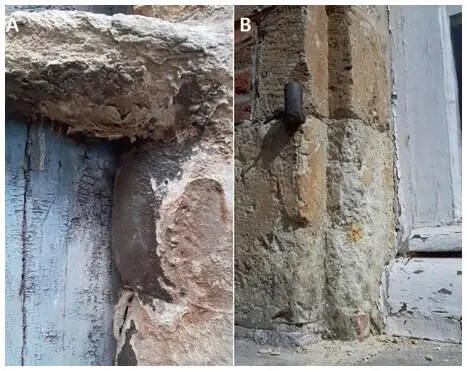
Figure 1:A) Gypsum crust in Ghent and B) Berlare.
DNA was extracted out of the drill powder using the DNeasy PowerSoil Kit (Qiagen, Venlo, Netherlands), following the manufactures instructions. DNA extract was sent out to LGC genomics GmbH (Berlin, Germany) for 16S rRNA gene sequencing on an Illumina MiSeq platform and library preparation. For the bacteria it followed the same procedure as De Paepe et al. (2017) with 35 PCR cycles. Additionally, the archaea were determined, on three samples of each location, using a nested approach (De Vrieze et al. , 2018).
Furthermore, one powdered sample of each location was used as inoculum for isolations: R2A agar for heterotrophic bacteria and thiosulphate plates for sulphur oxidizers containing (per Litre) 980 mL fresh water basal mineral medium, 9.7 g Na 2SO 4, 6 g Na 2S 2O 3,10 g agar, 0.02 g bromothymol blue, 10 mL 971 M MOPS buffer, 10 mL 1 M NaHCO 3, 1 mL SL-10 trace element solution and 1 mL 7-vitamin solution The plates were incubated between two and six weeks at room temperature. For anaerobic isolations 2 g/L NaNO 3was added. The isolates have been characterized by Sanger sequencing (LGC Genomics GMbH, Berlin, Germany) using 27 F and 1492R LGC primers. The resulting sequences were blasted with NCBI’s BLAST and with RDP Seqmatch. The gypsum crusts were characterized by their soluble ions. These have been extracted from powdered crust and underlying rock with Milli-Q water with a 1 : 5 ratio. The cations Na +, K +, Ca 2+, Mg 2+and the anions Cl –, NO 3 –, NO 2 –, SO 4 2–, PO 4 3–have been quantified on a 930 Compact Ion Chromatograph Flex (Methrohm, Switzerland) with a conductivity detector. From the measured concentrations, the amount of soluble ions was calculated. RUNSALT was used to model the phases of the salt mixture in function of relative humidity (Price, 2000; Bionda, 2005).
Читать дальшеИнтервал:
Закладка:
Похожие книги на «Monument Future»
Представляем Вашему вниманию похожие книги на «Monument Future» списком для выбора. Мы отобрали схожую по названию и смыслу литературу в надежде предоставить читателям больше вариантов отыскать новые, интересные, ещё непрочитанные произведения.









Обсуждение, отзывы о книге «Monument Future» и просто собственные мнения читателей. Оставьте ваши комментарии, напишите, что Вы думаете о произведении, его смысле или главных героях. Укажите что конкретно понравилось, а что нет, и почему Вы так считаете.