Siegfried Siegesmund - Monument Future
Здесь есть возможность читать онлайн «Siegfried Siegesmund - Monument Future» — ознакомительный отрывок электронной книги совершенно бесплатно, а после прочтения отрывка купить полную версию. В некоторых случаях можно слушать аудио, скачать через торрент в формате fb2 и присутствует краткое содержание. Жанр: unrecognised, на немецком языке. Описание произведения, (предисловие) а так же отзывы посетителей доступны на портале библиотеки ЛибКат.
- Название:Monument Future
- Автор:
- Жанр:
- Год:неизвестен
- ISBN:нет данных
- Рейтинг книги:4 / 5. Голосов: 1
-
Избранное:Добавить в избранное
- Отзывы:
-
Ваша оценка:
Monument Future: краткое содержание, описание и аннотация
Предлагаем к чтению аннотацию, описание, краткое содержание или предисловие (зависит от того, что написал сам автор книги «Monument Future»). Если вы не нашли необходимую информацию о книге — напишите в комментариях, мы постараемся отыскать её.
Alle vier Jahre treffen sich auf einer internationalen Tagung Experten, die sich mit den entsprechenden Sachfragen beschäftigen. Der „14th International Congress on the Deterioration and Conservation of Stone“ findet im September 2020 in Göttingen statt. Er ist die wichtigste Veranstaltung zur Verbreitung des Wissens von Praktikern und Forschern, die im Bereich der Steinkonservierung zur Erhaltung des baulichen Kulturerbes arbeiten: Geowissenschaftler, Architekten, Bauspezialisten, Ingenieure, Restauratoren, Denkmalpfleger und Bauherren.
Der Tagungsband mit über 150 wissenschaftlichen Beiträgen repräsentiert und erfasst den neuesten Stand der Technik auf diesem Gebiet.
Themen sind:
– Charakterisierung von Schadensphänomenen von Steinen und verwandten Baumaterialien (Stuck, Putz, Mörtel usw.)
– Methoden zur Untersuchung des Steinverfalls in situ und zerstörungsfreie Prüfung
– Langzeitüberwachung von Steindenkmälern und Gebäuden
– Simulation und Modellierung des Zerfalls
– Technologien und Entwicklung verbesserter Bearbeitung und Verwendung von Stein in Neubauten
– Bewertung der Langzeitwirkung von Bearbeitungstechniken
– Auswirkungen des Klimawandels auf die Steinverwitterung des Kulturerbes
– Berichte zur Steinkonservierung: Fallstudien und Projekte
– Digitalisierung und Dokumentation von Steinkonservierung
–
The 14th International Congress on the Deterioration and Conservation of Stone, entitled MONUMENT FUTURE: DECAY AND CONSERVATION OF STONE is a quadrennial event that brings together a world-wide community of geoscientists, architects, building specialists, engineers, conservators, restorators, monument curators and building owners who are concerned about the conservation of cultural stone structures and objects. Since antiquity, the weathering and deterioration of historical buildings, masonry, monuments, sculptures etc. using natural stones has been a very well-known problem.
This conference is the main gathering for the dissemination of knowledge in the field of stone deterioration issues. It represents and captures the state-of-the-art in the field of stone conservation and cultural heritage conservation with regards to the following topics:
– Characterisation of damage phenomena of stone and related building materials (plaster, rendering, mortar etc.)
– Methods for the investigation of stone decay; in-situ and non-destructive testing
– Long-term monitoring of stone monuments and buildings
– Simulation and modelling of decay
– Technology and development of improved treatments and use of stone in new buildings
– Assessment of long-term effects of treatments
– Impact of climate change on stone decay of Cultural Heritage
– Reports about stone conservation: case studies and projects
– Digitalization and documentation in stone conservation
Monument Future — читать онлайн ознакомительный отрывок
Ниже представлен текст книги, разбитый по страницам. Система сохранения места последней прочитанной страницы, позволяет с удобством читать онлайн бесплатно книгу «Monument Future», без необходимости каждый раз заново искать на чём Вы остановились. Поставьте закладку, и сможете в любой момент перейти на страницу, на которой закончили чтение.
Интервал:
Закладка:
86 
Figure 6:Three-point bending tests of thin sandstone plates.
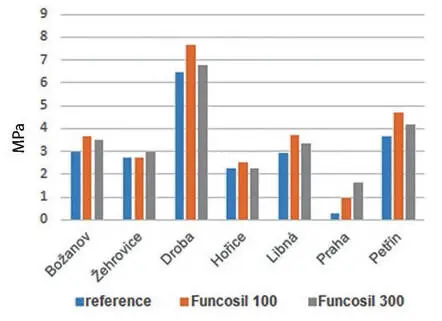
Figure 7:Changes in the bending strength of the unweathered sandstone after consolidation.
Similarly, the bending strength tests on thin plates (Figure 6), cut from the unweathered stone samples, exhibited the highest impact of consolidation on the high porosity Praha sandstone, Figure 7.
In most cases, the consolidation by Funcosil 100 caused a higher increase in strength than by Funcosil 300.
Figure 5 above clearly shows significant differences in the material characteristics of the weathered and deteriorated sandstone in the depth profiles. Due to crust formation on some stones, the surface and near-surface layers may have elevated mechanical properties – strength and the modulus of elasticity usually together with a decreased mean pore size. On the other hand, disintegrated sandstone types exhibit lower mechanical properties and higher mean pore size characteristics. As an example of both types, let us present Figure 8 showing a variation of the bending strength in the depth profile and Figure 9 comparing mean pore size variations.
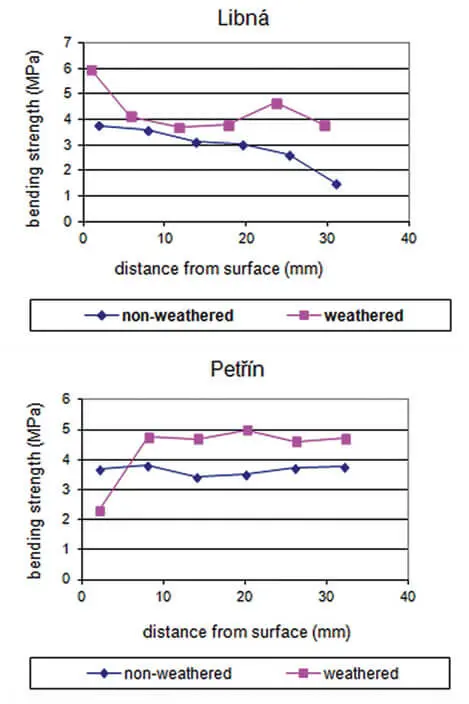
Figure 8:Examples of the bending strength variations according to the dept profile of the weathered and “virgin” sandstone samples.
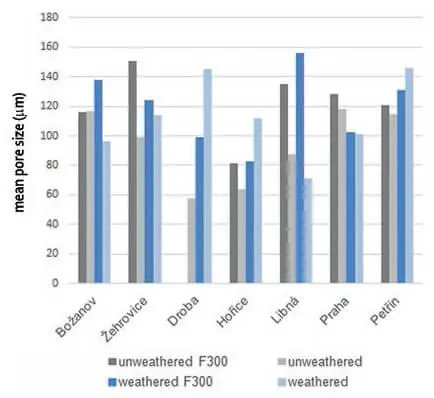
Figure 9:Comparison of mean pore size before and after consolidation.
87 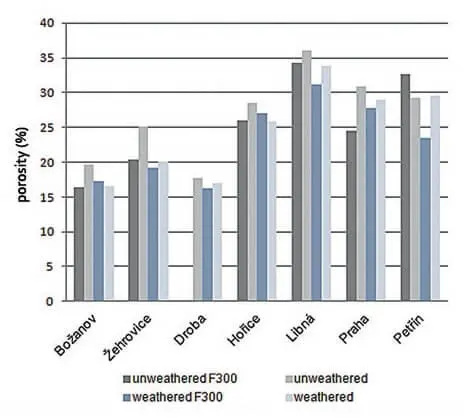
Figure 10:Consolidation impact on the stone porosity.
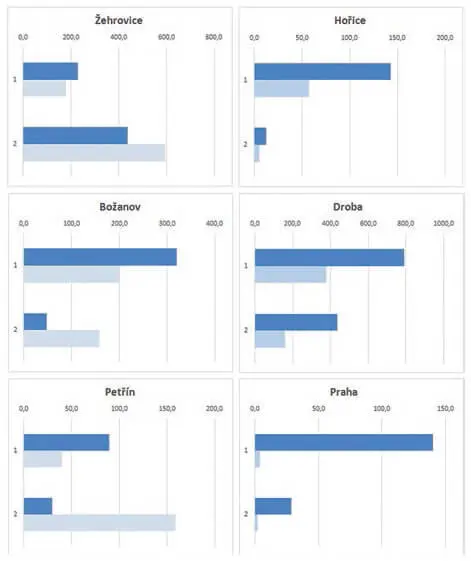
Figure 11:Hydric dilatation after Funcosil 300 treatment on the first two plates under the treated surface – αH in μm/m.
It is seen in Figure 8 that the bending strength of the inner layers of the weathered stone is higher than that of the virgin material. Here must be taken into account that the weathered layers might have some consolidation history, which is not exactly known but could increase the strength of the original material in the near-surface layers.
The weathering with subsurface deposits, as well as the consolidation, decreases the volume of pores especially by filling the small pores which reflect in an increase of the mean pore size value. The value of porosity changes can be studied on Figure 10.
From the other test results, the hydric dilation changes are interesting. Figure 11 shows a series of results of hydric dilation measurements on the surface and the first subsurface layers of the weathered stones. At the same time, the effect of sandblasting cleaning has been investigated.
In Figure 11 the dark blue denotes the weathered uncleaned material, the light blue the material which was sandblasted.
It is apparent that the cleaning of the stone surface significantly reduced hydric dilatation up to 5 mm depth. Probably some effect of packing during blasting may be the reason.
In depths from 5–10 mm (second plate), the hydric dilatation is more affected by a consolidation agent.
Conclusion
The tests were required by restorers before planning a rather massive conservation campaign on the Charles bridge in Prague – one of the most important stones Gothic structure. The results achieved helped to make an appropriate choice of consolidation agent, to decide about necessity and type of surface cleaning, to be prepared for a selection of an appropriate stone in cases of replacement needs and to assess intervention impacts. It enhanced the overall design of restoration interventions.
Acknowledgements
The paper is based on the results of research supported by the institutional project RVO 68378297. The authors acknowledge experimental support of E. Čechová, A. Zeman, J. Valach and professional advice of J. Novotný.
88 References
Drdácký, M. F., Slížková, Z. Performance of glauconitic sandstone treated with ethylsilicate consolidation agents, In Proc. of the 11th Int. Congr. on Stone, Vol. 2. Toruń; 2008. pp.1205–1212.
Sasse, H. R., Snethlage, R. Evaluation of stone consolidation treatments. Science and Technology for Cultural Heritage. 1996;5(1):85–92.
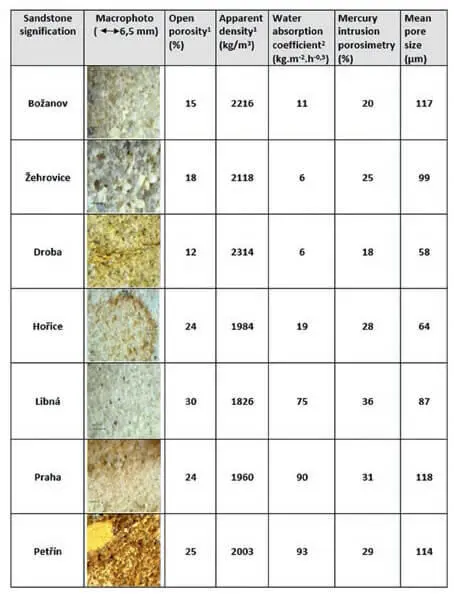
Table 1:Annex. Sorption characteristics of the tested sandstones.
89
THERMAL BEHAVIOR OF BUILDING SANDSTONE: LABORATORY HEATING EXPERIMENTS VS. REAL FIRE EXPOSURE
Nadine Freudenberg 1, Thomas Frühwirt 1 , Klaus-Jürgen Kohl 2, Monika Kutz 2 , Heiner Siedel 3, Jörn Wichert 3
IN: SIEGESMUND, S. & MIDDENDORF, B. (EDS.): MONUMENT FUTURE: DECAY AND CONSERVATION OF STONE.
– PROCEEDINGS OF THE 14TH INTERNATIONAL CONGRESS ON THE DETERIORATION AND CONSERVATION OF STONE –
VOLUME I AND VOLUME II. MITTELDEUTSCHER VERLAG 2020.
1Technische Universität Bergakademie Freiberg, Institute of Geotechnics, Gustav-Zeuner-Str. 1, 09599 Freiberg, Germany
2Institut für Brandund Katastrophenschutz Heyrothsberge, Research Division, Biederitzer Str. 5, 39175 Biederitz, Germany
3Technische Universität Dresden, Institute of Geotechnical Engineering, 01062 Dresden, Germany, Heiner.Siedel@tu-dresden.de
Abstract
Heat-induced short-term decay of dimension stone on buildings and monuments caused by fire is a well-known phenomenon. Most of the scientific studies about thermal behavior and thermal changes of building stones are carried out in laboratory ovens by stepwise heating of stone samples to different stages of temperature. However, real conditions of fire attack on stone elements of buildings might differ considerably from the relatively slow, even heating of small samples in ovens. Therefore, more realistic fire scenarios were designed to test the behavior of sandstone specimens such as cylinders and balusters (height 58 cm and max. diameter 19 cm). The samples comprise the Cotta and Posta type of the Cretaceous Elbe sandstone. They were exposed to a real scale fire test, based on the standard ISO 9705 (room corner test). The specimens were mounted in a fire container at a height of 170 cm above the fire source, a wood crib in accordance to DIN EN 3–7. The standard defines a known theoretical heat release rate, producing a maximum air temperature of approx. 900 °C for about 15 minutes. The temperature in the container as well as on the surface and within the stone specimens was monitored by thermocouples during the tests. The measured surface temperatures vary between 350 and 600 °C, whereas the temperatures at some 4.5–9.5 cm below surface vary only between 200 and 350 °C, depending on the shape of the samples. After the fire tests, different crack patterns were observed. In contrast, smaller specimens heated in a laboratory oven did not reveal any macroscopic cracks, although they were exposed to the same or even markedly higher temperatures (1,000 °C in the sample core). However, both treatments are needed for a better understandig of fire damages on stone buildings since the material behavior of sandstone on grain size scale (fabric and mineralogy) triggers macroscopic crack patterns such as fragmentation and scaling.
Читать дальшеИнтервал:
Закладка:
Похожие книги на «Monument Future»
Представляем Вашему вниманию похожие книги на «Monument Future» списком для выбора. Мы отобрали схожую по названию и смыслу литературу в надежде предоставить читателям больше вариантов отыскать новые, интересные, ещё непрочитанные произведения.







Обсуждение, отзывы о книге «Monument Future» и просто собственные мнения читателей. Оставьте ваши комментарии, напишите, что Вы думаете о произведении, его смысле или главных героях. Укажите что конкретно понравилось, а что нет, и почему Вы так считаете.